CCSD code A2720: Proximal gastric vagotomy billing guide
What is CCSD code A2720? CCSD code A2720 is the procedure billing code assigned ...

Last Updated: Oct 8, 2026
49418 is the CPT code for insertion of tunneled intraperitoneal catheter (eg, dialysis, intraperitoneal chemotherapy instillation, management of ascites), percutaneous. It is a complete procedure, including imaging guidance, catheter placement, contrast injection when performed, and radiological supervision and interpretation.
Billing imaging guidance or radiological supervision separately alongside 49418 counts as unbundling, because the code already includes both. Confusing it with 49419 (the port-bearing code) is a common coding error.
Let Pabau's smart automation suggest the right codes, reduce claim denials, and keep your practice compliant—effortlessly.
Automate repetitive tasks and focus on what matters most—your patients.
Reduce coding errors and ensure compliance with the latest regulations.
Clean claims, fewer denials, and faster reimbursements.
Powerful insights and reporting to help your practice thrive.
HIPAA compliant SOC 2 certified GDPR-compliant Trusted by 4,000+ clinics worldwide

CPT 49418 covers percutaneous tunneled catheter insertion without a subcutaneous port, and port presence is what separates it from 49419.
The code bundles imaging guidance as a complete procedure, so billing RS&I separately alongside 49418 is an unbundling risk flagged by CCI edits.
Open placement for dialysis is 49421 and laparoscopic placement is 49324, so the operative approach decides the code before the port does.
Dialysis, intraperitoneal chemotherapy instillation, and ascites management are the descriptor’s three examples, and each needs a matching ICD-10 diagnosis.
Pabau, the practice management platform we build, runs validation checks before each claim is sent, so missing 49418 details surface before the payer sees them.
CPT code 49418 is the code for percutaneous insertion of a tunneled intraperitoneal catheter, billed as one complete procedure. The official descriptor opens with “Insertion of tunneled intraperitoneal catheter (eg, dialysis, intraperitoneal chemotherapy instillation, management of ascites).” It then reads “complete procedure, including imaging guidance, catheter placement, contrast injection when performed, and radiological supervision and interpretation, percutaneous.”
The phrase “complete procedure” is the most operationally significant part of the descriptor. It means the American Medical Association has bundled every component of the placement into the single code. The word “percutaneous” matters just as much, because open and laparoscopic placements have codes of their own.
In practice, “complete procedure” means four components are already captured by 49418:
Billing any of these components separately with a standalone RS&I or imaging guidance code alongside 49418 is unbundling. The Correct Coding Initiative (CCI) edit table governs this. Payers routinely deny or recoup claims where RS&I codes appear with 49418 without a valid modifier justification.
Dialysis, intraperitoneal chemotherapy instillation, and management of ascites are the three examples in the descriptor’s parenthetical. These are examples, not an exhaustive list, but they represent the three payer-recognized clinical contexts where 49418 is routinely covered.
The ICD-10 code must match the documented clinical indication precisely. A Z49.02 on an ascites catheter claim, or an R18.0 on a dialysis access claim, triggers a medical necessity denial. In both cases the diagnosis does not support the clinical rationale in the operative note.
Choosing between these two codes is a common code-selection error in the peritoneal catheter family. CPT 49418 is used when a tunneled catheter is placed without a subcutaneous port or reservoir. CPT 49419 is used when the tunneled catheter includes an implanted subcutaneous port. The single distinguishing criterion is port presence.
Selecting 49419 when no port was implanted constitutes upcoding, a compliance risk with significant audit exposure. The operative note must document the catheter type explicitly. If the note says “Tenckhoff catheter” or “tunneled drain,” 49418 is correct. If it says “Port-a-Cath,” “subcutaneous port,” or “implanted reservoir,” 49419 applies.
The 49418 family spans several related procedure codes. Knowing when each applies prevents both undercoding and duplicate billing when multiple procedures occur on the same encounter. Two questions settle the choice, as the decision path below shows. The surgical approach comes first, then the port.
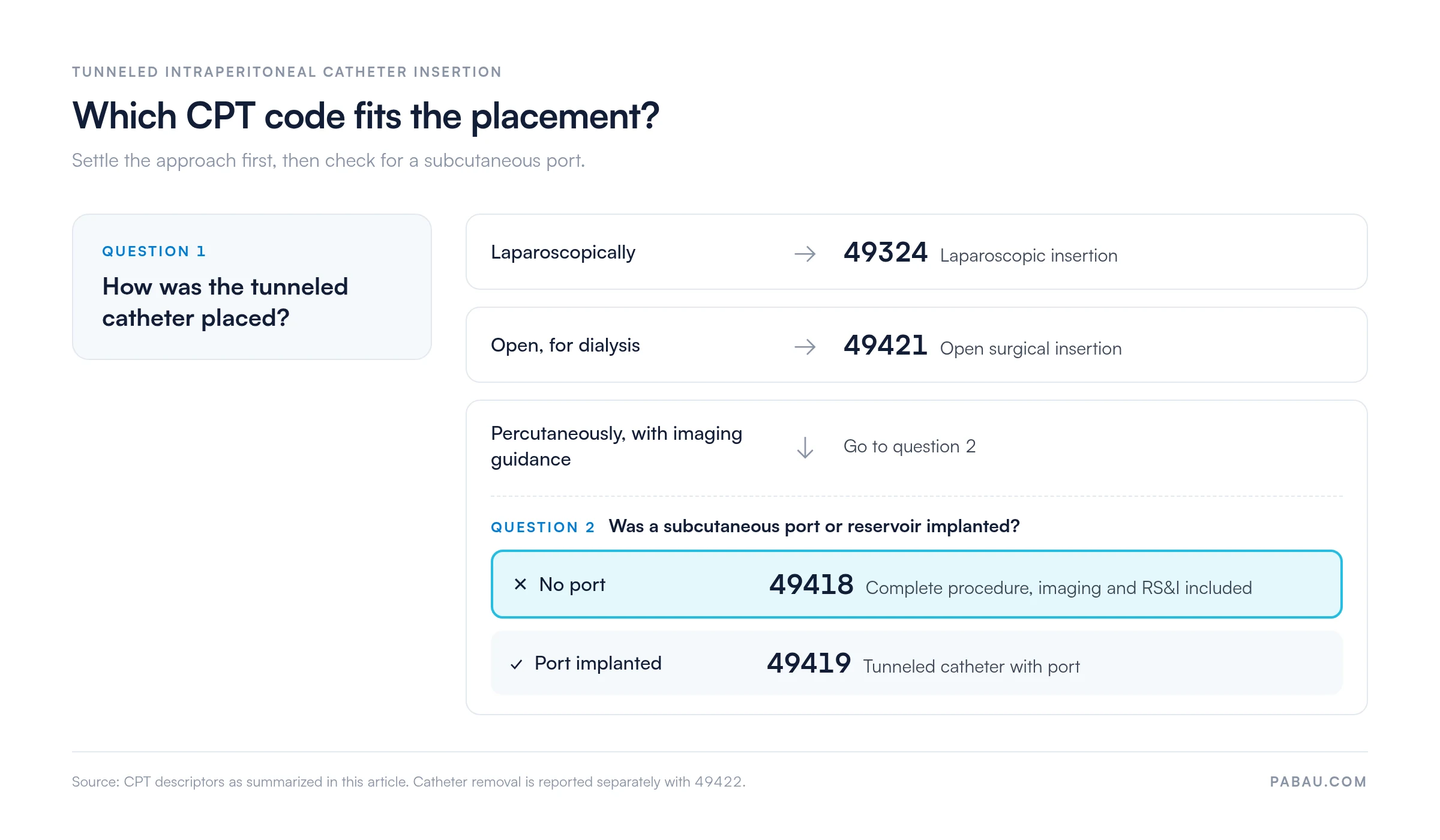
49418 and 49324 should never appear on the same claim for the same catheter. They describe the same placement by different approaches. If the operative note documents laparoscopic visualization with tunneling, 49324 is the correct code, not 49418.
Because CPT code 49418 already bundles imaging guidance, modifier use requires care. These are the most common modifiers and when each applies.
Modifiers 26 and TC belong on a radiologist’s separately billed interpretation, never on the proceduralist’s 49418 claim. Applying 26 or TC to 49418 itself is a billing error.
Medicare pays for CPT code 49418 based on the CMS Physician Fee Schedule, which is updated annually on January 1. Reimbursement is calculated using three relative value unit (RVU) components. These are work RVUs, practice expense RVUs, and malpractice RVUs. These are multiplied by the conversion factor and the geographic practice cost index (GPCI) for the provider’s locality.
Because rates change each year and vary by geographic locality, always verify current figures using the CMS MPFS lookup tool before submitting claims. The FastRVU lookup tool provides current work, practice expense, and malpractice RVU values for 49418 organized by facility and non-facility settings.
Place of service also changes the payment, although it is not a modifier. Medicare pays differently in facility settings, such as a hospital or ambulatory surgery center (ASC), than in a non-facility office. The place-of-service code determines which RVU rate applies.
For revenue cycle management teams, tracking these annual changes in the practice management system prevents underbilling when conversion factor updates take effect.
Private payer reimbursement typically follows Medicare rates with a multiplier, though some payers negotiate rates independently. Prior authorization requirements vary by payer and MAC jurisdiction. For peritoneal dialysis initiation, many commercial insurers and Medicare Advantage plans require prior authorization.
For oncology IP chemotherapy catheters, authorization requirements depend on the specific plan and diagnosis. Check payer-specific policies before scheduling the procedure, and document the authorization number in the claim record.
Local Coverage Determinations (LCDs) issued by Medicare Administrative Contractors may impose additional documentation or medical necessity requirements for peritoneal catheter placement in specific MAC jurisdictions. Search the CMS LCD database for your MAC’s current policy before billing.
Six denial reasons come up repeatedly on CPT 49418 claims. Each has a specific prevention step that belongs in the pre-submission workflow. Effective denial management in healthcare starts with catching these before the claim leaves the practice.
Logging each denial in claims management software shows whether the same coding error repeats across providers or locations.
Practices that submit through the Claim.MD clearinghouse can run real-time eligibility checks and validate claim data against payer edits. That catches many of these errors before the claim is submitted. If a 49418 claim is still denied, the guide to denial codes in medical billing explains the CARC patterns and how to appeal them.
Understanding medical billing compliance requirements also helps practices build internal audit checkpoints before patterns become recoupment risks.
The operative note is the evidentiary foundation for every 49418 claim. Coders reviewing the note before submission should confirm all of the following are present. Practices that standardize this review as part of submitting a clean claim reduce the back-and-forth of additional documentation requests from payers.
If your billing software tracks documentation requirements, link this checklist to the billing workflow. A claim then cannot go out before the note is finalized. A superbill that includes 49418-specific documentation fields makes this review systematic rather than ad hoc.
Before billing CPT 49418, run three checks. Confirm that “tunneled” and “percutaneous” both appear in the operative note. Verify that no port was placed, since a port makes it 49419. Then match the ICD-10 code to the documented clinical indication.
In many surgical and interventional radiology practices, the coder reads the operative note in one system and builds the claim in another. Each handoff is a chance to lose the tunneled detail, the port status, or the matching diagnosis.
Pabau keeps the treatment note, the invoice, and the claim on the same patient record. When the invoice is ready, Pabau pulls the patient, treatment, and insurer details into the claim. It then sends the claim through Claim.MD, the clearinghouse Pabau connects to in the US.
Validation checks run every time a claim is sent, so missing details surface before a payer rejects it. Eligibility checks, claim status tracking, and ERA remittance posting sit in the same dashboard. Your billing team spends less time reworking 49418 denials and more time on the next case.

Pabau links procedure documentation to the invoice and submits the claim through Claim.MD. Validation checks catch missing details before a 49418 claim reaches the payer.

A 49418 claim stands or falls on three facts in the operative note. The placement was percutaneous and tunneled, no port was implanted, and the diagnosis matches the indication. Settle those before the claim is built, and the code choice follows on its own.
The trade-off is a few minutes of note review on every claim. That is far cheaper than an appeal, or a recoupment months after the payment landed.
Want those checks built into the billing workflow rather than left to memory? Book a demo to see how Pabau ties 49418 documentation to a clean claim.

Need help managing claim denials systematically? Denial management in healthcare covers how to build an appeal workflow and track CARC codes across payers.
Want a clearinghouse built into your billing workflow? Medical claims clearinghouse explains how clearinghouse submission works and what to look for in a clearinghouse integration.
Looking for compliance guidance on procedure billing? Medical billing compliance outlines the documentation and audit standards that apply to surgical procedure codes.
CPT code 49418 is a complete procedure code for percutaneous tunneled intraperitoneal catheter insertion. Its descriptor lists peritoneal dialysis, intraperitoneal chemotherapy instillation, and ascites management as examples. It bundles catheter placement, imaging guidance, contrast injection when performed, and radiological supervision and interpretation into a single billable unit.
49418 is correct when no subcutaneous port is implanted. 49419 applies only when the tunneled catheter includes an implanted subcutaneous port or reservoir. The presence or absence of a port is the single distinguishing criterion between the two codes.
Yes. Imaging guidance is bundled into CPT 49418 as part of the “complete procedure” descriptor. Billing a separate imaging guidance or radiological supervision code alongside 49418 is unbundling and will be denied or recouped under CCI edits. If imaging was not performed, append modifier 52 to indicate reduced services.
Modifier 52 applies when imaging guidance was not performed (reduced services). Modifier 59 applies when a separately identifiable, distinct procedure is performed on the same date. Modifiers 26 and TC apply to the RS&I component only when a radiologist bills interpretation separately from the proceduralist billing 49418, not to 49418 itself.
Medicare reimbursement for CPT 49418 is calculated from work, practice expense, and malpractice RVUs. Those are multiplied by the annual conversion factor and the GPCI for the provider’s locality. Rates change annually. Verify current facility and non-facility rates using the CMS Physician Fee Schedule lookup tool or the FastRVU lookup tool.
For malignant ascites, use R18.0. For other ascites (non-malignant causes), use R18.8. For alcoholic cirrhosis with ascites, use K70.31. The selected ICD-10 code must match the clinical documentation in the operative note. A mismatch is a medical necessity denial risk.
No. CPT 49324 describes a laparoscopic tunneled intraperitoneal catheter insertion. If the procedure was performed laparoscopically, report 49324. If it was performed percutaneously with tunneling, report 49418. If it was open, report 49421. They describe the same procedure by different surgical approaches and cannot be billed together for the same catheter placement.