

CCSD code G5100: Bypass of duodenum billing guide
CCSD code G5100 bills a bypass that leaves the duodenum in place CCSD code G5100...

Last Updated: Oct 16, 2026
49322 is the CPT code for laparoscopy, surgical; with aspiration of cavity or cyst (eg, ovarian cyst) (single or multiple). It is a standalone surgical code, reported once per session however many cysts or fluid collections the surgeon drains.
The code sits in the 49320-49329 laparoscopy range and carries a 10-day global period under the Medicare Physician Fee Schedule. Diagnostic laparoscopy, CPT 49320, is bundled into it and is never billed in the same session.
Let Pabau's smart automation suggest the right codes, reduce claim denials, and keep your practice compliant—effortlessly.
Automate repetitive tasks and focus on what matters most—your patients.
Reduce coding errors and ensure compliance with the latest regulations.
Clean claims, fewer denials, and faster reimbursements.
Powerful insights and reporting to help your practice thrive.
HIPAA compliant SOC 2 certified GDPR-compliant Trusted by 4,000+ clinics worldwide

CPT code 49322 covers laparoscopic aspiration of any abdominal or pelvic cavity or cyst, and it is billed once per session however many are drained.
CPT 49320, diagnostic laparoscopy, is bundled into 49322 by NCCI edits and cannot be billed in the same operative session.
Modifier -59 is required when billing 49322 with CPT 58661, removal of adnexal structures (oophorectomy and/or salpingectomy). The operative report must support a distinct aspiration service.
49322 carries a 10-day global period, so related post-operative visits in those 10 days are included in the surgical payment.
Claims software such as Pabau flags NCCI edit pairs and missing modifiers before submission, which cuts denials on gynecologic laparoscopy claims.
CPT code 49322 is the surgical laparoscopy code for aspirating a cavity or cyst, such as an ovarian cyst. Its official descriptor, maintained by the American Medical Association, reads: Laparoscopy, surgical; with aspiration of cavity or cyst (eg, ovarian cyst) (single or multiple). It sits in the CPT surgery section, in the laparoscopy and peritoneoscopy range 49320 to 49329.
The “(eg, ovarian cyst)” parenthetical gives one example. The code also covers aspiration of any abdominal or pelvic cavity, cyst, or fluid collection approached laparoscopically. The “(single or multiple)” wording sets the unit rule. The code is billed once per operative session, however many cysts or fluid collections were aspirated.
CPT 49320 is diagnostic laparoscopy only. CPT 49322 is surgical laparoscopy with aspiration. When a surgeon enters the abdomen and aspirates a cyst in the same session, only 49322 is billable. The National Correct Coding Initiative treats 49320 as a component of the more extensive surgical code, so submitting both triggers an automatic denial on 49320.
CPT code 49322 is appropriate when the surgeon performs laparoscopic aspiration as the primary therapeutic intent of the procedure. Gynecologic and general surgery practices see this code regularly. The most common clinical scenarios include:
What 49322 does not cover: Laparoscopic cystectomy or excision (where the cyst wall is removed) maps to a different code. Drainage of an intra-abdominal abscess uses a separate code family. If the operative report documents removal of ovarian tissue rather than aspiration alone, 49322 is not the correct code.
CPT 58661 covers laparoscopic removal of adnexal structures (oophorectomy and/or salpingectomy). It can be billed with 49322 when a distinct aspiration happens separately from the adnexal removal. By default, NCCI edits treat 49322 as a column 2 component of 58661, because aspiration is often inherent to the removal. Modifier -59 overrides this edit when the aspiration is a separate service.
The operative report must place the aspiration at a separate anatomical site, on a different cyst, or before the decision to remove the adnexa. Without that documentation, modifier -59 carries audit risk. Similarly, CPT 58662 (laparoscopic fulguration or excision of lesions) carries a related bundling relationship with 49322 requiring the same distinct-procedure justification.
Bill 58661 as the primary code and 49322-59 as the secondary when submitting both. Some payers require the higher-RVU code in the primary position, so confirm your payer’s rules before claim submission.
Correct modifier use on CPT code 49322 claims prevents the most common denials. Accurate superbill preparation should flag modifier requirements before the claim leaves the practice. The modifiers applicable to this code are:
CMS has issued guidance cautioning against routine modifier -59 use as a denial bypass. Apply it only when the operative report genuinely supports a distinct service. Claims flagged for modifier -59 overuse can trigger a compliance review of the full procedure history.
Payers cross-reference the diagnosis code against the procedure to confirm medical necessity. For CPT code 49322, the ICD-10-CM codes below are the most commonly accepted on claims. Specificity matters. Selecting an unspecified code when the operative report documents laterality is a common audit finding.
Always verify diagnosis code pairing against the applicable Medicare Administrative Contractor (MAC) Local Coverage Determination (LCD) for your region. Some MACs restrict 49322 to specific ICD-10 codes under their gynecologic laparoscopy LCD. Look each diagnosis up in our ICD-10-CM codes library to confirm its full descriptor before you finalize the claim.
The operative report is the single most important document for defending CPT code 49322 claims. Building a habit of medical billing compliance around documentation starts at the time of service. A report that will support 49322 on audit must include:
Submitting a clean claim for this code depends on the operative report being finalized before submission. Billing from incomplete notes is the root cause of most 49322 audits.
Medicare reimbursement for CPT code 49322 is determined by the Medicare Physician Fee Schedule (MPFS), maintained by the Centers for Medicare and Medicaid Services. Use the CMS Physician Fee Schedule lookup tool to pull current-year rates for your geographic practice area, as rates vary by locality and change annually.
Under the 2026 MPFS, CPT 49322 carries the same RVUs in facility and non-facility settings:
The 10-day global period covers the day of the procedure plus 10 post-operative days. Related post-operative services in that window are included in the surgical payment and are not billed separately without a modifier. Commercial payer rates vary and may sit above or below Medicare. Prior authorization is increasingly common for elective gynecologic laparoscopy, so confirm it before scheduling.
The National Correct Coding Initiative (NCCI) governs which code pairs can be billed together and which are automatically bundled. For CPT code 49322, the most consequential edit pairs involve 49320 and 58661. Pre-claim scrubbing in claims management software flags these edit pairs before submission. The key NCCI relationships are:
NCCI edit tables update quarterly. Always verify the current modifier indicator in the CMS NCCI procedure-to-procedure edits before submitting complex multi-procedure claims. A modifier indicator of 0 means no modifier can override the bundle under any circumstances.
Put together, these edits reduce to three billing paths, and the operative report decides which one applies.
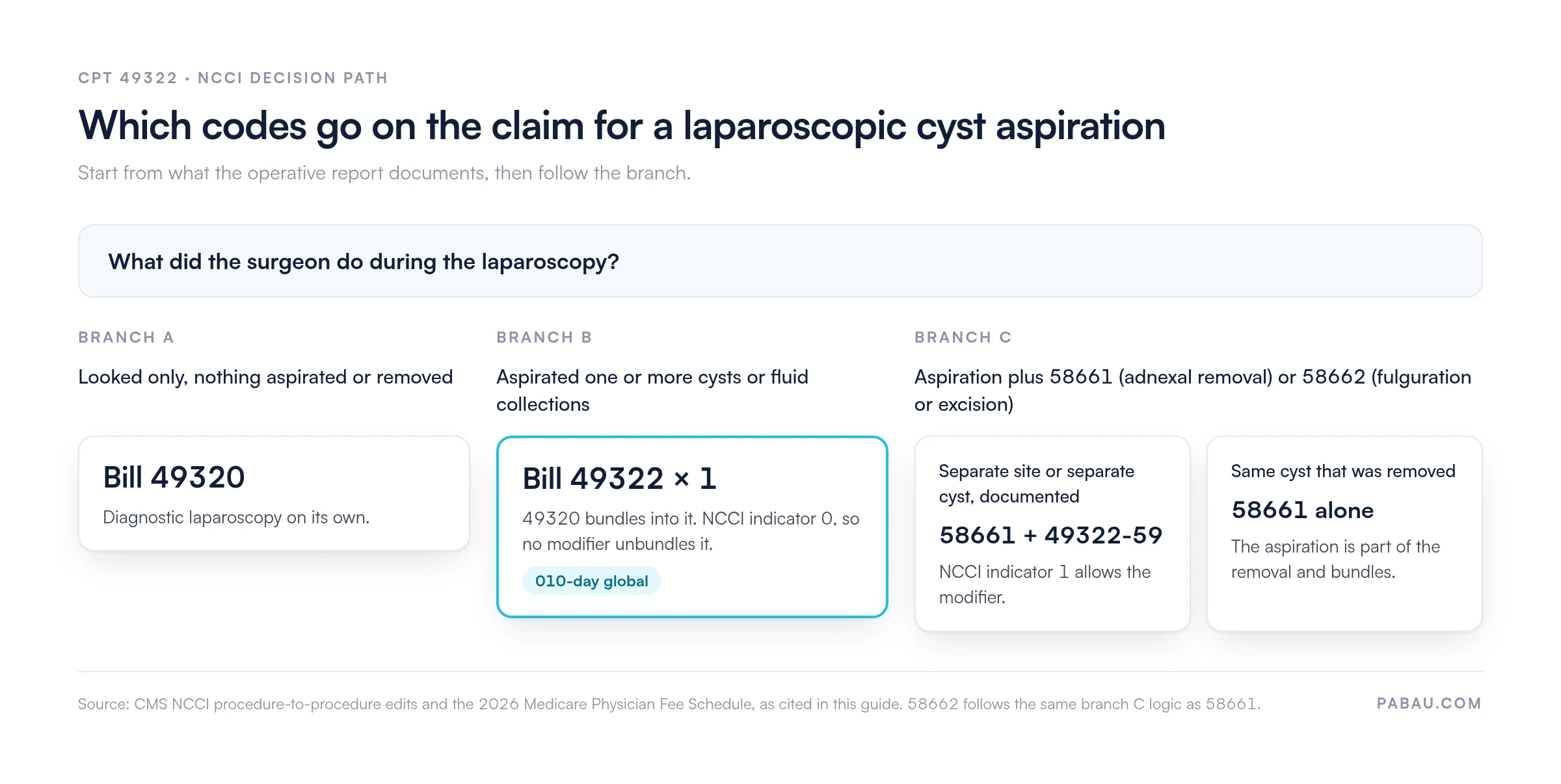
Most CPT code 49322 denials fall into a short list of avoidable root causes. A structured denial management workflow should address each of these before claims leave the practice:
When appealing a 49322 denial for missing modifier -59, include a cover letter that quotes the operative report paragraph showing the distinct aspiration site. Payers respond faster to targeted appeals that quote the clinical record directly rather than general arguments about medical necessity.
Without a scrubbing step, a coder checks each 49322 claim against the NCCI tables by hand, often only after a denial comes back. Fixing it then means reworking the claim, attaching the operative report, and waiting another payment cycle.
Pabau, the practice management platform we build, runs that check before the claim leaves the practice. Its claims tools flag the 49320 bundle and a missing -59 on a 58661 or 58662 pairing while the claim is still a draft. US practices then submit through the Claim.MD clearinghouse integration and track each claim to payment.
The result is fewer resubmissions on gynecologic laparoscopy claims, and faster payment for surgery your team has already performed.

Pabau’s billing workflow flags modifier requirements and NCCI bundles before your claims reach the payer. See how practices reduce 49322-related denials with pre-claim scrubbing built into the scheduling-to-payment workflow.

Billing CPT code 49322 cleanly comes down to one habit. Read the operative report before you choose the codes. If it shows aspiration alone, bill 49322 once and leave 49320 off the claim. If it shows adnexal removal or fulguration as well, add -59 only where the report places the aspiration at a separate site or cyst.
Coders who build that check into charge entry trade a few minutes per case for fewer appeals and a cleaner audit trail. The trade-off is strict discipline with -59, which payers watch closely. Book a demo to see how Pabau catches NCCI conflicts on gynecologic laparoscopy claims before they reach the payer.

Taking a biopsy during the same laparoscopy? CPT code 49321 walks through billing a laparoscopic biopsy from the same 49320-49329 code family.
Fulgurating or excising lesions in the same session? CPT code 58662 covers the laparoscopic fulguration code that bundles with 49322.
Want a step-by-step guide to reducing claim rejections? Submitting a clean claim walks through the pre-submission checks that prevent the most common CPT billing errors.
Looking to build a systematic response to denied surgical claims? Denial management in healthcare covers how to triage, appeal, and prevent recurring rejections across all procedure types.
CPT code 49322 is a standalone surgical laparoscopy code for aspiration of a cavity or cyst, such as an ovarian cyst. It covers single or multiple aspirations in one operative session. It sits in the CPT surgery section, code range 49320-49329, and carries a 10-day global surgery period.
CPT 49320 is diagnostic laparoscopy (visualization only). CPT 49322 is surgical laparoscopy with therapeutic aspiration. NCCI edits bundle 49320 as a component of 49322, so both cannot be billed in the same operative session. Bill only 49322 when aspiration is performed.
Modifier -59 is required when CPT 49322 is billed alongside CPT 58661 or 58662 to show a distinct aspiration service. 58661 is removal of adnexal structures (oophorectomy and/or salpingectomy), and 58662 is fulguration or excision of lesions. The operative report must describe the aspiration at a separate site or as a separately planned procedure. Without this documentation, the modifier carries audit risk.
Medicare reimbursement for CPT 49322 varies by geographic locality and changes annually under the Medicare Physician Fee Schedule. The 2026 MPFS assigns it the same 10.64 total RVUs in facility and non-facility settings. Use the CMS MPFS lookup tool at cms.gov to pull the current-year rate for your specific locality before billing.
Yes, they can be billed together when the aspiration is a distinct service from the removal of adnexal structures (oophorectomy and/or salpingectomy). Append modifier -59 to CPT 49322, list 58661 as the primary code, and ensure the operative report explicitly documents the separate aspiration procedure. Without modifier -59, NCCI edits will bundle 49322 and deny it.
CPT 49322 is a standalone code. It has no “+” prefix and can be independently reported. It does not need a primary surgical CPT code to accompany it. In practice, it is often billed alongside other gynecologic laparoscopy codes in multi-procedure encounters.
CPT 49322 carries a 010-day (10-day) global surgery period under the Medicare Physician Fee Schedule. It covers the day of the procedure plus 10 post-operative days. Related post-operative services in that window are bundled into the surgical payment. Bill them separately only when a modifier documents that the service is unrelated to the surgery.



