CPT Code 62284: Injection procedure for myelography
CPT Code 62284: official descriptor and procedure overview The American Medical ...

Last Updated: Oct 19, 2026
49324 is the CPT code for laparoscopy, surgical, with insertion of tunneled intraperitoneal catheter. Surgeons use it most often to place a peritoneal dialysis catheter, and also for ascites management or intraperitoneal chemotherapy access.
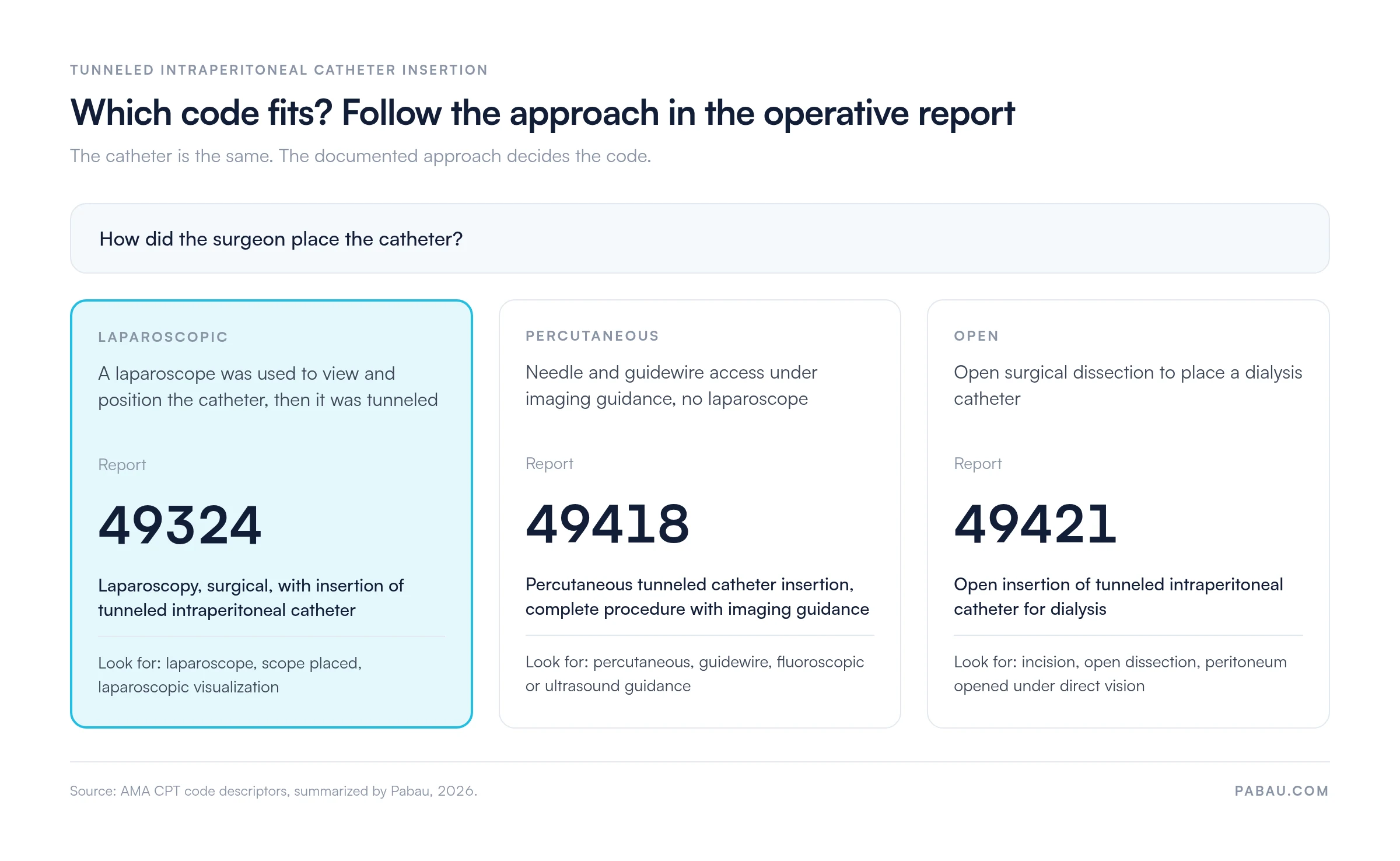
Code selection turns on the approach documented in the operative report. Laparoscopic placement is 49324, percutaneous placement with imaging guidance is 49418, and open placement of a dialysis catheter is 49421. A code that does not match the documented approach can trigger a denial or audit.
Let Pabau's smart automation suggest the right codes, reduce claim denials, and keep your practice compliant—effortlessly.
Automate repetitive tasks and focus on what matters most—your patients.
Reduce coding errors and ensure compliance with the latest regulations.
Clean claims, fewer denials, and faster reimbursements.
Powerful insights and reporting to help your practice thrive.
HIPAA compliant SOC 2 certified GDPR-compliant Trusted by 4,000+ clinics worldwide

CPT code 49324 covers laparoscopic insertion of a tunneled intraperitoneal catheter, most often for peritoneal dialysis and also for ascites or chemotherapy access.
The documented approach decides the code, with 49324 for laparoscopic, 49418 for percutaneous with imaging guidance and 49421 for open dialysis catheter placement.
A clean 49324 claim needs an operative report confirming the approach, tunneling, catheter type and indication, typically ESRD (N18.6) when billed for dialysis.
The 2026 Medicare fee schedule lists 49324 at 10.96 total RVUs with a 10-day global period.
Pabau, the practice management platform we build, connects to the Claim.MD clearinghouse for electronic claim submission, eligibility checks and claim status tracking.
CPT code 49324 describes “laparoscopy, surgical, with insertion of tunneled intraperitoneal catheter,” as defined by the American Medical Association’s CPT code set. A surgeon uses a laparoscope to place the catheter through the abdominal wall into the peritoneal cavity. The catheter is then tunneled under the skin to an exit site.
Most 49324 cases place a peritoneal dialysis catheter. The descriptor is not limited to dialysis, though. The code also covers catheters placed for ascites management or intraperitoneal chemotherapy access.
The tunneling step is a defining requirement. A catheter positioned laparoscopically but not subcutaneously tunneled does not satisfy 49324. Both elements (laparoscopic approach and subcutaneous tunneling) must appear in the operative note for the code to apply.
Several services are bundled within 49324 and cannot be billed separately on the same claim. Billing a bundled component as a separate line item triggers an NCCI unbundling edit.
Adding fluoroscopy as a routine line item gets the claim denied by automated NCCI edits unless it was a separate, documented service. Confirm the operative report describes each service distinctly before billing separately.
The three tunneled intraperitoneal catheter insertion codes differ by surgical approach. CPT 49324 is laparoscopic, 49418 is percutaneous with imaging guidance, and 49421 is open placement of a dialysis catheter. A mismatch between the code and the documented approach can trigger a denial or audit. The diagram below the table shows what to look for in the operative report.
Common mis-selection scenario: A surgeon converts a planned open procedure to laparoscopic mid-case. If the operative report reflects both approaches, the approach that was used for the definitive catheter placement governs code selection. Document the reason for conversion and the technique used at the time of final catheter positioning.
CPT 49324 sits within a small family of tunneled intraperitoneal catheter codes. A patient on peritoneal dialysis may meet several of them over the life of one catheter.
CPT 49329 (unlisted laparoscopy) is a last resort. Payers require a special report explaining why no listed code applies, and reimbursement is individually determined. Never default to 49329 when 49324 accurately describes the procedure performed.
Check the operative report before choosing between 49324, 49418 and 49421. If it documents a laparoscope or laparoscopic visualization, 49324 applies. If the catheter went in percutaneously over a guidewire under imaging guidance, use 49418. Open dissection to place a dialysis catheter is 49421. The approach determines the code, not the catheter type or brand.
Modifier selection for CPT 49324 follows standard laparoscopic surgery rules. Apply modifiers only when the clinical situation clearly warrants them. Unsupported modifier use is a common audit trigger.
Modifier -59 carries the highest audit risk. Use it only when you can document that the bundled service was genuinely distinct in session, location, or indication. Many payers now prefer the more specific X-modifiers (XE, XS, XP, XU) over -59 alone.
Medical necessity for CPT 49324 hinges on the linked diagnosis. When the catheter is for peritoneal dialysis, the codes below are the ones payers most consistently accept. Ascites or chemotherapy access cases link the condition being treated instead. Always verify against the relevant MAC local coverage determination (LCD) before submitting.
The operative report is the single most important document supporting a 49324 claim. Payers and MACs review it routinely for this procedure. A vague or incomplete report is the fastest route to a denial or audit. Submitting a clean claim for 49324 requires the operative report to include all six elements below.
Prior authorization requirements for CPT 49324 vary by payer. Medicare does not universally require prior auth for this procedure, but commercial payers and Medicare Advantage plans frequently do. Confirm requirements through the patient’s specific plan before scheduling the procedure. A solid medical billing workflow tracks authorization status from referral through claim submission.
The Medicare ESRD prospective payment system (PPS) bundles many dialysis-related services into one payment to the dialysis facility. When 49324 places a dialysis catheter, a surgeon typically performs it and bills it separately under Part B, outside the ESRD bundle.
Before submitting the Part B claim, confirm with the MAC whether any part of the encounter falls under the ESRD bundle.
Medicare reimbursement for CPT 49324 is set through the CMS Physician Fee Schedule (MPFS), which updates each January. The 2026 national values below come before geographic adjustment, so the payment in your MAC locality will differ.
To estimate your own rate, apply your locality’s GPCI values to each RVU component before multiplying by the conversion factor. RVUs and the conversion factor change every year, so pull the current PPRRVU file from CMS each January.
The 2026 MPFS assigns CPT 49324 a global period of 010, which means a 10-day global period. The day of the procedure and routine follow-up within those 10 days are included in the surgical payment. Check the indicator again each January before billing follow-up care.
Most CPT 49324 denials fall into five categories. Knowing the pattern in advance lets practices build pre-submission checks that catch errors before the claim leaves the system. Structured denial management workflows cut rework on high-value surgical claims. When a remittance does come back denied, the medical billing denial codes reference explains each reason code.
A clean 49324 claim depends on three pieces lining up. The operative report has to name the approach, the diagnosis has to support the indication, and the claim has to reach the payer intact. When one slips, a billing team can lose hours on rework.
Pabau’s claims management software connects to the Claim.MD clearinghouse, which reaches thousands of US payers. Your team can check eligibility in real time before the procedure date, submit the claim electronically and track its status. Electronic remittance advice (ERA) comes back into the same system, so each payment is easier to match to its claim.
Your coders still choose the codes. Pabau can then generate a superbill that carries the CPT and ICD-10 codes they entered. Pabau’s digital forms can also collect the six documentation elements before the claim is built. That covers the approach, the tunneling description, the indication and any auth number.

Pabau connects to Claim.MD for electronic claim submission, real-time eligibility checks and claim status tracking, so practices billing CPT 49324 catch errors before payers do.

CPT code 49324 rewards practices that code from the operative report rather than from the surgical schedule. Confirm the laparoscope, the tunnel and the indication before the claim is built. The choice against 49418 and 49421 then settles itself.
The trade-off is a few minutes of chart review on every case. That costs less than reworking a denied surgical claim weeks after the 10-day global period has closed.
Book a demo to see how Pabau keeps eligibility checks, claims and remittances in one place for your surgical billing team.

Need a clearinghouse that handles surgical claim submission? Understanding medical claims clearinghouses explains how electronic claim routing works and what to look for in a clearinghouse partner.
Dealing with repeated claim denials across surgical codes? Denial codes in medical billing provides a reference guide to the most common CARC codes and how to respond to each one.
Want to understand how ERA files affect reconciliation? Electronic remittance advice (ERA) processing covers how 835 files work and how to map payment data back to original claims.
CPT code 49324 covers laparoscopy, surgical, with insertion of a tunneled intraperitoneal catheter. A surgeon uses a laparoscope to place the catheter in the peritoneal cavity and tunnels it under the skin to an exit site. It is used most often for peritoneal dialysis, and also for ascites or chemotherapy access.
CPT 49324 is laparoscopic insertion of a tunneled intraperitoneal catheter. CPT 49418 is percutaneous insertion with imaging guidance, reported as a complete procedure. If the operative report documents a laparoscope, 49324 applies. If the catheter was placed over a guidewire under imaging with no laparoscope, 49418 is correct. Open placement of a dialysis catheter is 49421.
The operative report must name the laparoscopic approach, describe the subcutaneous tunneling step and identify the catheter type and length. It must also document peritoneal placement and the clinical indication, which is ESRD when the catheter is for dialysis. Where prior authorization is required, the authorization number must appear on the claim or attached documentation.
For dialysis access, the most commonly accepted primary diagnosis is N18.6 (end-stage renal disease). Secondary codes include Z99.2 (dependence on renal dialysis) and N18.5 (chronic kidney disease, stage 5) when ESRD classification is pending. Always verify ICD-10 pairings against your MAC’s local coverage determination, as accepted codes can vary by region.