ICD-10 Code S42.444P: Medial epicondyle fracture, right humerus
ICD-10 Code S42.444P: full descriptor and code validity ICD-10 Code S42.444P car...

Last Updated: Oct 13, 2026
Billable Code Specific Code
K81.2 is the billable ICD-10-CM code for acute cholecystitis with chronic cholecystitis.
The condition, also called acute on chronic cholecystitis, is an acute exacerbation superimposed on pre-existing chronic gallbladder inflammation. Coders often default to K81.9 when the note already documents both phases. Correct assignment turns on that documentation and on the Excludes1 note that separates K81.2 from the K80 gallstone codes. The same record decides the MS-DRG, which sets inpatient payment.
Let Pabau's smart automation suggest the right codes, reduce claim denials, and keep your practice compliant—effortlessly.
Automate repetitive tasks and focus on what matters most—your patients.
Reduce coding errors and ensure compliance with the latest regulations.
Clean claims, fewer denials, and faster reimbursements.
Powerful insights and reporting to help your practice thrive.
HIPAA compliant SOC 2 certified GDPR-compliant Trusted by 4,000+ clinics worldwide

K81.2 is a billable FY2026 ICD-10-CM code for acute cholecystitis with chronic cholecystitis, distinct from K81.0 (acute-only) and K81.9 (unspecified).
Physician documentation must explicitly reference both the acute and chronic phases to support K81.2 rather than defaulting to an unspecified code.
Category K81 carries an Excludes1 note for cholecystitis with cholelithiasis (K80.-), so K81.2 and a K80 gallstone code are never reported together.
Practice management software like Pabau keeps the note, the diagnosis and the claim on one record, so coders can verify a K81.2 fast.
ICD-10 code K81.2 captures the dual-phase presentation of cholecystitis. The table below summarizes every field a coder or billing team needs at submission.
Acute cholecystitis with chronic cholecystitis is a gallbladder condition in which an acute inflammatory episode occurs against a background of ongoing, long-standing chronic gallbladder disease. The gallbladder wall shows both the fibrous thickening characteristic of chronic inflammation and the edema, hyperemia, and neutrophilic infiltration of an acute attack. Clinically, patients present with the hallmarks of acute cholecystitis: sudden right upper quadrant pain, fever, and a positive Murphy’s sign. Their history and imaging, meanwhile, reveal prior chronic disease.
A separate code exists for this presentation because reimbursement, clinical severity scoring, and MS-DRG assignment all differ from straightforward acute or chronic cholecystitis alone. Coding only K81.0 (acute cholecystitis) misses the chronic component that may affect surgical approach and inpatient complexity. Coding K81.1 (chronic cholecystitis) misses the acute exacerbation that drives the admission. K81.2 captures both, which is why physician documentation must clearly state both phases.
Understanding where K81.2 sits within the ICD-10-CM classification published by CMS helps coders navigate related codes and excludes notes. A code inherits every instruction attached to the levels above it. The notes at category K81 therefore apply to K81.2 in full.
The K81 category contains four billable subcodes. Selecting the wrong one is the single most common audit finding in gallbladder billing. The table below maps each subcode to its clinical scenario and the documentation the physician note must provide to support it.
Key rule: K81.9 is appropriate only when the physician note genuinely cannot be clarified. If the note says “cholecystitis” without further detail, check the chart for a documented history of chronic cholecystitis. Where that history exists and the current presentation is acute, query the physician before defaulting to K81.9. The chart below runs the same decision in order, starting with the gallstone question the next section covers.
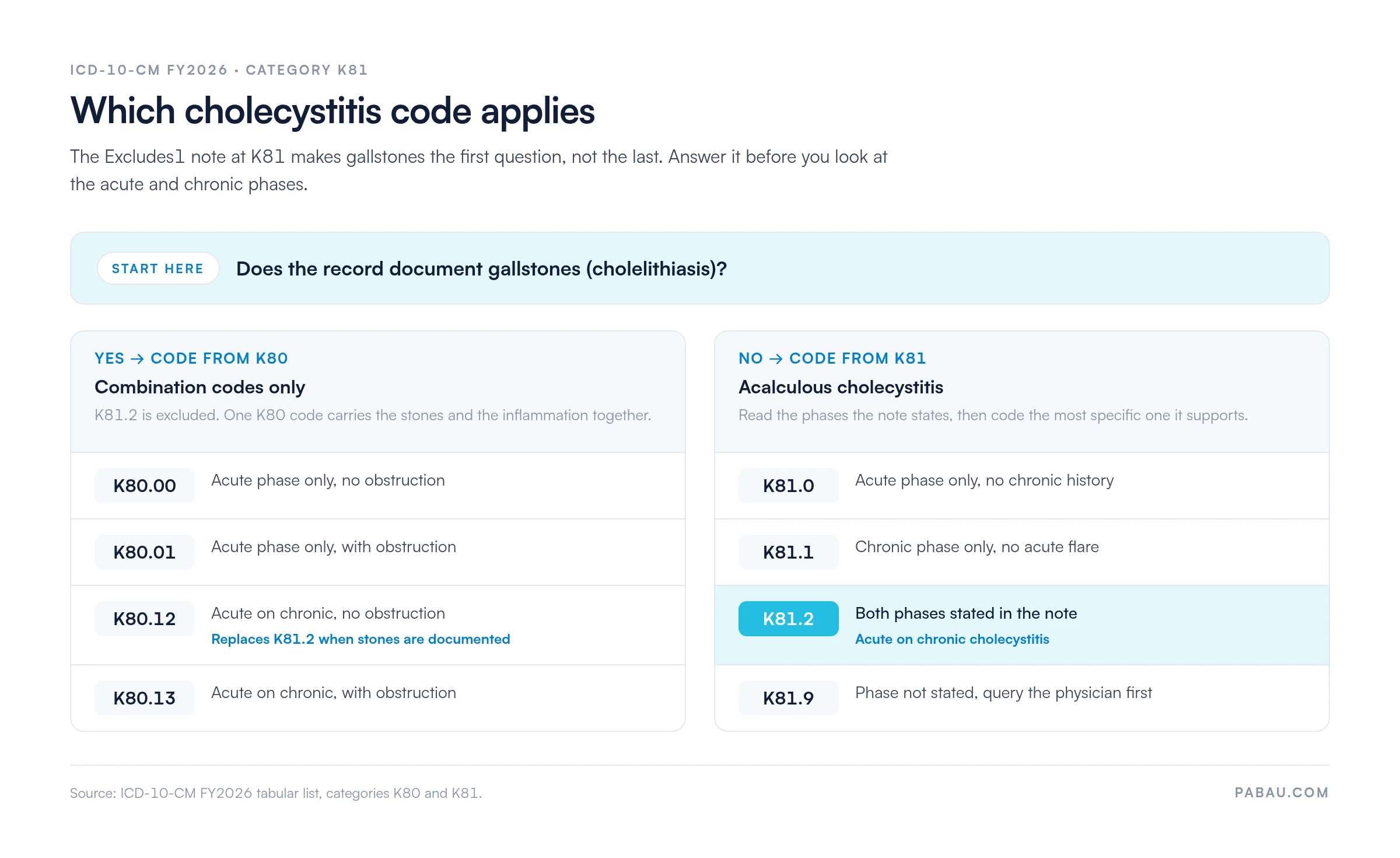
The K81 category and its subcodes carry include and exclude notations that govern which codes can be assigned together. Misreading an Excludes1 as an Excludes2 is one of the fastest routes to a claim denial. The remittance rarely names the note that was broken, so read the denial codes you get back against the pair you reported.
The single Excludes1 note is what decides this code. A patient admitted with acute on chronic cholecystitis and documented gallstones is not coded K81.2 plus a K80 subcode. That patient gets the K80 combination code on its own: K80.12 without obstruction, or K80.13 with obstruction. K81.2 belongs to the acalculous presentation, where the record documents acute on chronic cholecystitis and no stones.
Physician documentation drives code selection for K81.2. Coders cannot infer the dual-phase diagnosis from imaging alone. The note or discharge summary has to capture both components in its own words. That wording is what makes the encounter K81.2 rather than K81.0 or K81.1.
Query the physician when the note says only ‘cholecystitis’ but prior records show a history of chronic cholecystitis and the current admission is acute. A one-line addendum confirming ‘acute on chronic cholecystitis’ converts a K81.9 to a K81.2 and may shift the DRG.
The ICD-10-CM Official Guidelines for Coding and Reporting govern code selection and sequencing for cholecystitis diagnoses. Checking a K81 assignment against them before the claim goes out is the point of cleaner claims management.
When K81.2 is the reason for the inpatient admission, it is sequenced as the principal diagnosis. If the patient is admitted for another reason and acute on chronic cholecystitis is identified as a complicating condition, K81.2 becomes a secondary diagnosis. Never sequence K81.2 as secondary when it is the primary reason for the admission.
Because the K81 Excludes1 note makes K81.2 and K80 mutually exclusive, the question is which single code to report, not how to pair two. When stones are documented, ICD-10-CM already supplies a combination code that captures the calculus and the inflammation together. The table maps the K80 subcodes that take the place of K81.2 in those scenarios.
Coding note: K80.12 and K80.13 are combination codes. Each one already describes the calculus and the acute on chronic inflammation in a single code, so K81.2 adds no further detail. Reporting it beside either code creates an Excludes1 conflict that payer edits and clearinghouse scrubbers are built to reject. The K80.1 subcategory carries the same use-additional-code instruction as K81, so add K82.A1 or K82.A2 when gangrene or perforation is documented.
Several repeating error patterns appear in cholecystitis claims reviews. Recognizing them before submission is faster than appealing a denial after the fact.
K81.2 is a diagnosis code. The procedure codes reported alongside it depend on what the surgeon did. The CPT codes below are the ones most commonly paired with a K81.2 diagnosis, and 47562 carries documentation rules of its own.
CPT code selection always depends on what the operative report documents. The same K81.2 principal diagnosis can be paired with 47562, 47563, or 47564 depending on intraoperative findings. AMA’s CPT descriptions are proprietary; the descriptions above are paraphrased for reference only.
Inpatient admissions carrying K81.2 as the principal diagnosis group to an MS-DRG, and that grouping sets the payment. Two variables decide which one applies. The first is whether a cholecystectomy is performed. The second is whether a major complication or comorbidity (MCC) or a complication/comorbidity (CC) is documented.
Relative weights and exact payment amounts are updated annually. Always verify against the current CMS MS-DRG Definitions Manual rather than publishing figures from prior fiscal years, as weights change with each October 1 update.
A K81 excludes conflict usually surfaces weeks after submission, as a denial someone has to research, rework, and resubmit. By then the coder has worked through another few hundred encounters. The operative note that would settle the question sits in a chart nobody has open.
Pabau, our practice management software, keeps the clinical note, the diagnosis, and the claim on one patient record. A coder checking a K81.2 against the documentation is one click from the imaging findings and the surgeon’s wording.
Claims then route out through our Claim.MD integration, where clearinghouse edits run against diagnosis and procedure pairings before the claim reaches the payer. Denials that do come back land in the same place, with the original note attached, so the rework starts with evidence.

Pabau routes claims through Claim.MD, where diagnosis and procedure pairings are validated before the payer sees them. That means fewer denials and faster reimbursement for your practice.

ICD-10 code K81.2 is a billable, specific FY2026 code that requires explicit documentation of both acute and chronic phases to use correctly. Two errors account for most of the rework on these claims. The first is defaulting to K81.9 when the note supports K81.2. The second is reporting K81.2 when stones are documented, where the Excludes1 note requires a K80 combination code instead.
Practices handling biliary claims can cut denials by building K81.2 documentation checks into their encounter note templates. Validating the diagnosis and procedure pair before submission catches most of the rest. To see how Pabau supports ICD-10 claim submission for gastroenterology and surgical practices, book a demo.

Need to understand how denials are structured in remittance data? Denial codes in medical billing explains CARC and RARC codes that appear when excludes-note violations cause K81.2 claims to reject.
Want to understand how ICD-10 codes move through a clearinghouse? Pabau’s Claim.MD clearinghouse guide covers how 837P electronic claims carrying K81.2 are validated, scrubbed, and transmitted to payers.
Looking for guidance on revenue cycle management for your practice? What is revenue cycle management covers the end-to-end billing process from diagnosis coding through payment posting.
ICD-10 code K81.2 is the billable diagnosis code for acute cholecystitis with chronic cholecystitis. It applies when a patient has an acute exacerbation of gallbladder inflammation superimposed on a documented history of chronic cholecystitis. It is valid for HIPAA-covered claim submission in FY2026.
Yes. K81.2 is a billable and specific ICD-10-CM code, valid for the FY2026 edition effective October 1, 2025. It can be used as a standalone diagnosis code on HIPAA-covered claims for outpatient and inpatient encounters.
K81.0 is acute cholecystitis only, and K81.1 is chronic cholecystitis without an acute component. K81.2 is acute cholecystitis superimposed on chronic cholecystitis, with both phases documented. K81.9 is unspecified cholecystitis, used only when documentation cannot support a more specific code.
No. Category K81 carries an Excludes1 note for cholecystitis with cholelithiasis (K80.-), which makes the two mutually exclusive. When gallstones are documented alongside acute on chronic cholecystitis, report the combination code instead: K80.12 without obstruction, or K80.13 with obstruction.
The physician note must explicitly reference both the acute and chronic phases. Use language such as “acute on chronic cholecystitis” or “acute exacerbation of chronic cholecystitis.” That statement needs support from current acute symptoms, imaging findings, and a documented prior history of chronic cholecystitis.
When K81.2 is the principal diagnosis and a laparoscopic cholecystectomy is performed, the case usually groups to one of three MS-DRGs. These are DRG 417 (with MCC), DRG 418 (with CC), and DRG 419 (without CC/MCC). Exact relative weights change annually; verify against the current CMS MS-DRG Definitions Manual.