

CCSD code G5100: Bypass of duodenum billing guide
CCSD code G5100 bills a bypass that leaves the duodenum in place CCSD code G5100...

Last Updated: Oct 16, 2026
47120 is the CPT code for hepatectomy, resection of liver; partial lobectomy. It covers surgical removal of one or more liver segments while the rest of the lobe stays in place.
Surgeons use it most often for hepatocellular carcinoma, colorectal metastases, benign tumors, and liver trauma. It sits in the 47100-47130 liver excision group, alongside trisegmentectomy (47122) and total left or right lobectomy (47125, 47130). The operative report decides between them by naming the segments removed.
Let Pabau's smart automation suggest the right codes, reduce claim denials, and keep your practice compliant—effortlessly.
Automate repetitive tasks and focus on what matters most—your patients.
Reduce coding errors and ensure compliance with the latest regulations.
Clean claims, fewer denials, and faster reimbursements.
Powerful insights and reporting to help your practice thrive.
HIPAA compliant SOC 2 certified GDPR-compliant Trusted by 4,000+ clinics worldwide

CPT code 47120 describes hepatectomy, resection of liver, partial lobectomy, which is distinct from total left (47125) or right (47130) lobectomy.
The 90-day global surgical package bundles routine post-op E&M visits. Unrelated diagnoses and unrelated procedures need modifier -24 or -79 to bill separately.
The most common denial trigger is miscoding to a total lobectomy code when the operative report documents only partial segment removal.
Pabau’s claims management software checks each claim for missing details before it goes out, then submits it through the Claim.MD clearinghouse.
CPT code 47120 is classified under the Surgery section of the AMA CPT code set, within the Digestive System subsection (codes 40490-49999). Its official descriptor is Hepatectomy, resection of liver; partial lobectomy.
Under the AMA’s CPT code set, the code applies to partial resection of liver tissue. That means removing one or more liver segments without a complete anatomical lobectomy.
Clinical indications for 47120 include primary hepatocellular carcinoma and metastatic liver disease, particularly colorectal metastases. Benign tumors such as hepatic adenoma and trauma requiring surgical debridement also qualify.
The procedure is performed in an inpatient hospital setting, so a non-facility place of service is not appropriate for this code.
A 47120 encounter starts with an upper abdominal incision, typically a right subcostal or midline approach. The surgeon identifies the segments to resect using intraoperative imaging or palpation, then divides the liver tissue along anatomical planes.
Bleeding is controlled with argon beam coagulation, suture ligation, or topical agents. The resected specimen goes for intraoperative or permanent pathology.
Coders need the operative report to name the segments removed, ideally by Couinaud number. It also has to confirm the resection was partial rather than total, and state how bleeding was controlled. Without these, the claim is exposed to a medical necessity or specificity denial.
The four codes most frequently confused with 47120 differ by anatomical extent and type of resection. Selecting the wrong code is the single most common billing error in hepatic surgery. You can look up neighboring surgical codes in our procedure codes library.
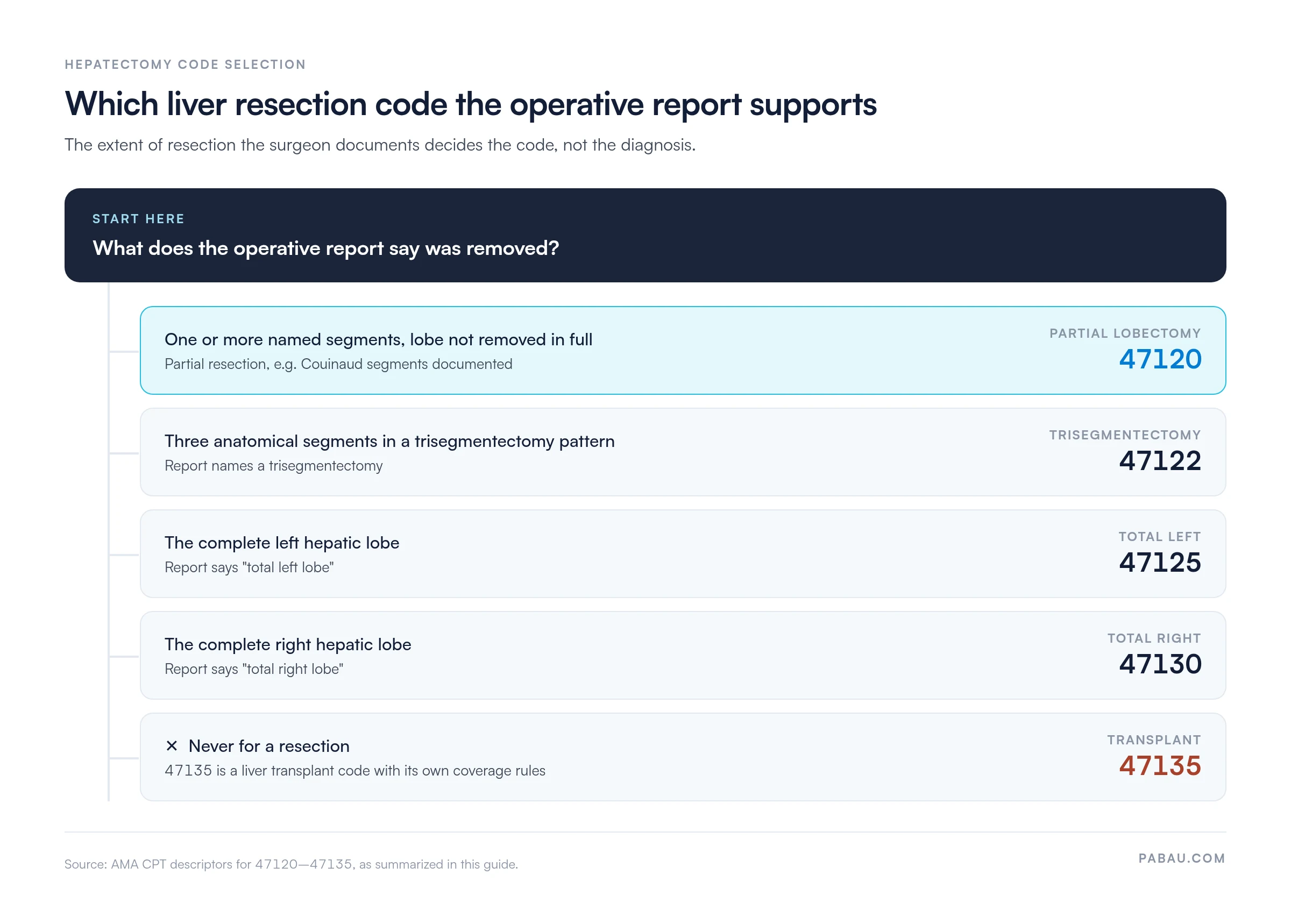
The decision rule: if the operative report says “partial resection” of specific segments, use 47120. If it says “total left lobe” or “total right lobe,” use 47125 or 47130 respectively.
If three full segments are removed in a trisegmentectomy pattern, 47122 applies. 47135 is a transplant code and is never appropriate for resection. The diagram below maps each outcome to its code.
Every 47120 claim requires an ICD-10-CM code that establishes medical necessity. Payers require specificity down to the morphology and site of the lesion.
That includes Medicare Administrative Contractors (MACs) applying Local Coverage Determinations (LCDs) for hepatic surgery. A non-specific code such as K76.9 (unspecified liver disease), used without a more definitive diagnosis, is a leading cause of medical necessity denials.
When the liver resection is for metastatic disease, sequence the code for the secondary malignancy (C78.7) and add the code for the primary site.
Reserve K76.89 for cases where the pathology can’t support a more specific code. ICD-10-CM codes update every October 1, so verify each pairing against the current fiscal year’s code set before submitting.
Modifier selection for CPT code 47120 depends on the surgical team and the complexity of the encounter. It also depends on whether services fall within the global period of a prior procedure.
Modifier -22 caution: this modifier requires objective evidence of substantially increased work, not routine complexity. Automatic application without supporting documentation typically results in denial or audit. Apply it only when the operative note explicitly quantifies the additional time and difficulty.
CPT code 47120 carries a high RVU assignment reflecting the complexity of major hepatic surgery. Reimbursement rates vary by geographic locality, facility vs. non-facility setting, and the applicable conversion factor for the payment year.
Use the CMS Physician Fee Schedule search tool or the FastRVU RVU lookup to pull locality-adjusted figures for a specific MAC jurisdiction.
CPT code 47120 carries a 90-day global surgical period under the Medicare Physician Fee Schedule. The base payment bundles all related post-operative evaluation and management (E&M) visits in the 90 days after surgery. It also covers minor procedures for routine complications and suture removal.
Some services stay separately billable during the 90-day global period. These include visits for unrelated conditions, staged procedures planned at the original surgery, and complications that need a return to the operating room.
Check the date of service on every post-op claim against the 47120 surgery date. A post-op E&M submitted within 90 days without a modifier flags immediately in clearinghouse edits. Build a date-range check into your billing workflow for all 90-day global codes.
Traditional Medicare (Part A/B) generally does not require prior authorization for CPT code 47120. Hepatic resection for documented malignancy or trauma meets medical necessity under published coverage criteria.
However, Medicare Advantage plans and commercial payers frequently do require pre-authorization, and requirements vary significantly by plan and state.
A typical prior authorization package for 47120 includes the elements below. Requirements differ by payer, so check them against your prior authorization process before the surgery date.
When prior authorization is denied, the appeals process typically requires a peer-to-peer review between the operating surgeon and the payer’s medical director. Document the peer-to-peer call immediately, including the payer representative’s name, credentials, and the clinical rationale discussed.
Hepatic surgery claims are high-dollar encounters, which means payers apply additional scrutiny at adjudication. Building a clean claim submission process for 47120 starts with understanding the six most frequent denial triggers.
Effective denial management workflows for hepatic surgery include a pre-submission checklist. It confirms code selection, ICD-10 specificity, prior authorization status, and place of service before the claim leaves the practice.
The operative report is the single most scrutinized document in a 47120 audit. Coders should verify each element below before submitting a claim. If one is missing, request a surgeon addendum before the claim goes out.
The pathology report matters just as much for complete medical billing documentation. It confirms the diagnosis code and supplies the specificity, such as hepatocellular vs. metastatic, that drives ICD-10 accuracy.
Several codes may be reported in addition to CPT code 47120 when the documented services support them. Each requires independent documentation separate from the 47120 operative note elements.
Verify all companion codes against current National Correct Coding Initiative (NCCI) edits before submitting. NCCI edits update quarterly, and a code that was separately payable in a prior quarter may be bundled in the current one. The AAPC’s CPT code lookup includes bundling edit notes alongside code descriptors.
When intraoperative ultrasound (76998) is performed alongside 47120, confirm the imaging is documented with its own real-time image record separate from the operative note. Some MACs require a separate radiology report for 76998 to pass scrutiny. Check your MAC’s LCD for hepatic surgery before submitting both codes.
Many surgical billing teams still check authorization numbers, modifiers, and dates of service by hand before a high-value claim goes out. A missed field comes back as a rejection weeks later, when the surgeon has moved on to other cases.
Pabau runs validation checks every time you go to send a claim. If a required detail like an authorization code is missing, the Send button stays disabled until the claim is complete. Its medical claims management tools then submit the claim through the Claim.MD clearinghouse to thousands of US payers.
Real-time eligibility checks run before the surgery date, and electronic remittance advice (ERA) comes back into the same billing workflow. Your team sees which 47120 claims were paid, denied, or still pending without logging in to a payer portal.
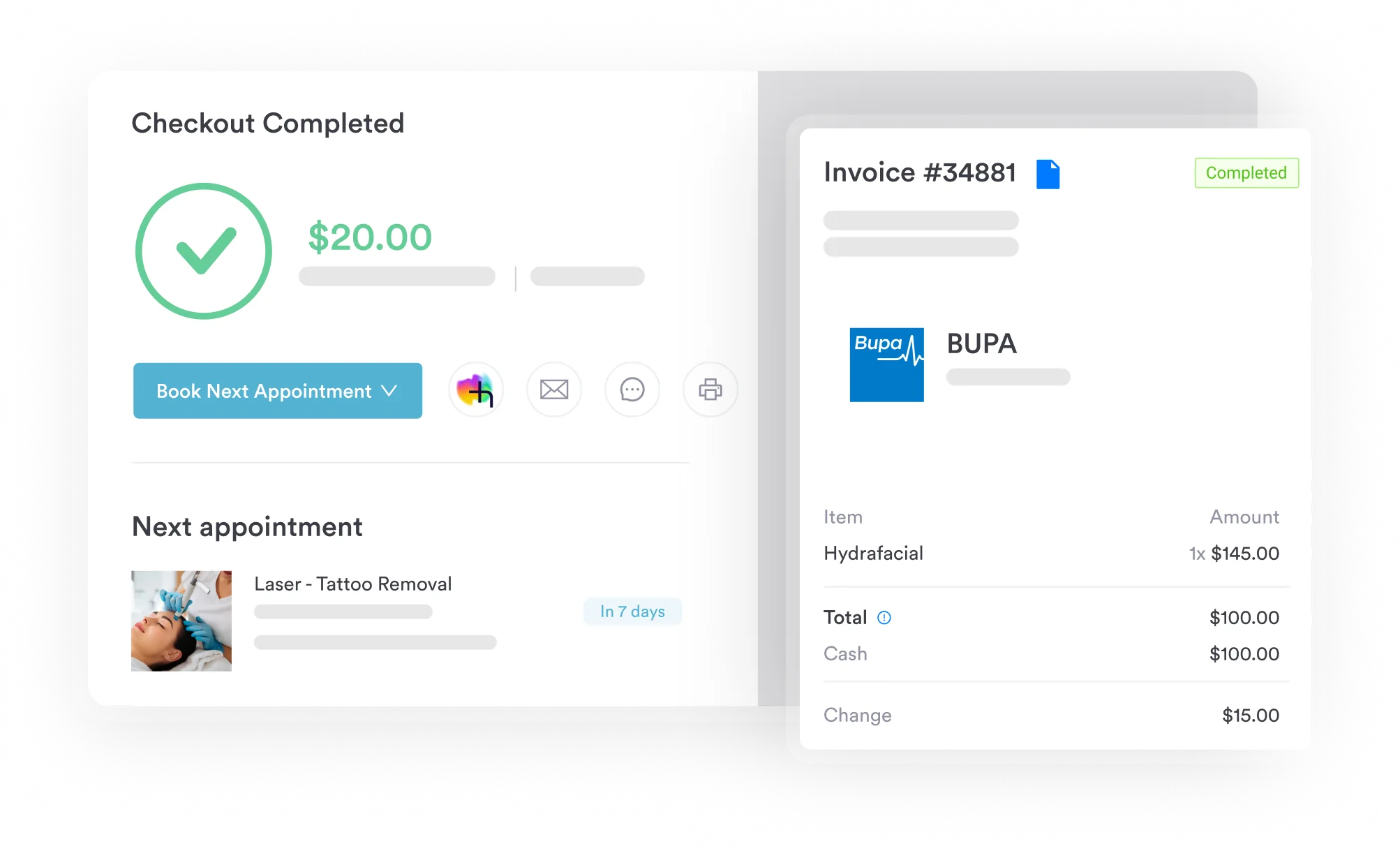

Pabau checks every claim for missing details before it goes out, then submits it through Claim.MD and tracks it to payment. Your billing team spends less time on rework and more time on collections.

On a 47120 claim, the operative report decides the code. Read it for the segments removed and the word “partial” before you look at the diagnosis, and query the surgeon if either is missing.
Then secure the two items that sink high-dollar liver claims after surgery. Get the prior authorization on file for Medicare Advantage and commercial plans, and pair the most specific ICD-10-CM code the pathology allows.
Treat modifier -22 as the trade-off worth weighing. It can lift payment on a difficult resection, but only when the operative note quantifies the extra time and work.
Book a demo to see how Pabau stops a hepatic surgery claim from going out without its authorization details.

Need a guide to clearinghouse billing workflows? Medical claims clearinghouse overview explains how electronic claim routing and ERA processing work for surgical specialties.
Handling a high volume of 837 claim submissions? 837 electronic claim file guide covers the transaction set structure, required segments, and common submission errors.
Managing payer denials across multiple procedure codes? Denial codes in medical billing maps common CARC reason codes to corrective actions for surgical billing teams.
Billing the biopsy that came before the resection? CPT code 47000 covers percutaneous needle liver biopsy, with its own documentation and modifier rules.
Need a standard form for payer pre-approval? Medical prior authorization form gives your team one template for imaging, pathology, and surgeon attestation.
CPT code 47120 covers hepatectomy, resection of liver, partial lobectomy. That is the surgical removal of one or more hepatic segments while the remaining liver is preserved. It applies to partial resections for primary malignancy (such as hepatocellular carcinoma), metastatic liver disease, benign tumors, and trauma requiring hepatic debridement.
CPT 47120 describes a partial lobectomy, where one or more segments are removed and the rest of the lobe stays in place. CPT 47125 describes total left lobectomy, the complete removal of the left hepatic lobe. The operative report’s description of the extent of resection decides between them. Miscoding between these two is the most common hepatic billing error.
CPT code 47120 carries a 90-day global surgical period under Medicare’s Physician Fee Schedule. Routine post-operative visits, suture removal, and uncomplicated wound care in that window are bundled into the base payment. Billing one separately needs a modifier. Use -24 for unrelated diagnoses, -78 for a return to the OR for complications, and -79 for unrelated procedures.
The most commonly used modifiers are -22, -51, -62, -80, -24, and -79. Modifier -22 marks substantially increased procedural work and needs objective documentation in the operative note. Modifier -51 covers multiple procedures on the same day, and -62 covers co-surgeons, each paid at 62.5%. Modifier -80 is for an assistant surgeon, while -24 and -79 cover an unrelated E&M or procedure during the global period.
Traditional Medicare (Part A/B) generally does not require prior authorization for CPT 47120, but Medicare Advantage plans and most commercial payers do. Required documentation typically includes imaging reports, pathology, tumor board review documentation, and the surgeon’s attestation of medical necessity. Requirements vary by payer and plan, so verify before surgery.
The most common ICD-10-CM codes paired with CPT 47120 are C22.0 (hepatocellular carcinoma), C78.7 (secondary malignant neoplasm of liver), and C22.1 (intrahepatic bile duct carcinoma). For metastatic disease, code the primary site as well as C78.7. D13.4 (benign neoplasm of liver) and K76.89 (other specified liver diseases) also appear. Use the most specific code the confirmed pathology supports.
The top denial trigger is miscoding to a total lobectomy code (47125 or 47130) when the operative report describes a partial resection. Others include a non-specific ICD-10 pairing that fails LCD medical necessity criteria, and missing prior authorization from a Medicare Advantage or commercial plan. An operative report without segment identification or extent of resection also draws denials. Wrong place of service (non-facility instead of inpatient hospital 21) is a common and easily preventable denial.
Medicare reimbursement for CPT 47120 varies by geographic locality and the applicable conversion factor for the payment year. The work RVU is approximately 38.03. The practice expense RVU is calculated at the facility rate, because the procedure is performed in an inpatient hospital. Commercial payers typically reimburse at 110-150% of the Medicare allowable, depending on the provider’s contract. Use the CMS Physician Fee Schedule lookup tool for locality-adjusted current figures.



