



CCSD code G5100: Bypass of duodenum billing guide
CCSD code G5100 bills a bypass that leaves the duodenum in place CCSD code G5100...

Last Updated: Oct 16, 2026
CPT Code 45990 is the billing code for a diagnostic anorectal examination performed under general, spinal, or epidural anesthesia. It applies when a standard office examination cannot complete the evaluation. The code sits in the “Other Procedures on the Colon and Rectum” section of the American Medical Association’s CPT code set.
45990 covers diagnostic exams only. The anesthesia provider bills 00902 separately for the anesthesia itself. The moment the surgeon treats rather than examines, a different code carries the claim.

CPT Code 45990 covers a diagnostic anorectal exam under anesthesia and never a therapeutic procedure.
The companion anesthesia code is 00902, billed by the anesthesia provider under their own NPI.
Most 45990 denials trace back to the operative note rather than to the code selection.
2026 Medicare reimbursement varies by facility setting and by locality, so verify rates in the CMS Physician Fee Schedule.
Practice management software like Pabau lets surgical practices attach CPT codes to the procedure note before the claim goes out.
CPT Code 45990 describes an anorectal examination, surgical, requiring anesthesia (general, spinal, or epidural), diagnostic. The American Medical Association owns and maintains the code. It is classified under the Surgery section, Digestive System subsection, specifically “Other Procedures on the Colon and Rectum.”
The word “diagnostic” in the descriptor is the part that decides the claim. This code applies only when the anesthetized examination evaluates pathology rather than treats it. Once a therapeutic intervention happens under the same anesthesia, a different procedure code captures that service.
CPT Code 45990 applies when a standard office anorectal examination cannot complete the diagnostic evaluation. The attending surgeon decides that anesthesia is medically necessary to examine the anorectal region thoroughly.
Payers require documentation that supports why anesthesia was necessary. The indications below are the ones most commonly accepted, consistent with specialty coding guidance from the American Society of Colon and Rectal Surgeons.
This code does not apply when a therapeutic procedure happens at the same time. If a fistulotomy, sphincterotomy, or abscess drainage is performed under the same anesthetic, that therapeutic code replaces or supplements 45990. Check current NCCI bundling edits before billing both on one date.
Payers require a linked ICD-10-CM diagnosis code that establishes medical necessity for an anorectal exam under anesthesia. The diagnosis must reflect the condition prompting the examination, not the procedure itself. The codes below are the ones Medicare and commercial payers most commonly accept for 45990.
Verify every ICD-10-CM code against the CDC/NCHS ICD-10-CM web tool for the current fiscal year before billing. Payer local coverage determinations may restrict which codes they accept. Our ICD-10-CM code library covers the diagnosis codes that support medical necessity across specialties.
When a practice bills CPT Code 45990, the anesthesia provider reports the anesthesia service separately under CPT 00902. Its descriptor reads “anesthesia for anorectal procedure.” That is the pairing the ASA and CMS anesthesia crosswalks carry.
Two gastrointestinal endoscopy anesthesia codes, 00812 and 00813, are sometimes quoted for 45990 in error. Neither one describes an anorectal examination, and either will get the anesthesia claim rejected.
The anesthesia code is billed separately from CPT 45990. The surgical team bills 45990, and the anesthesiologist or CRNA bills 00902 under their own National Provider Identifier. Both claims can be submitted electronically through Pabau’s Claim.MD integration, which sends CMS-1500 claims to thousands of US payers.
Medicare reimbursement for CPT Code 45990 is calculated using the Resource-Based Relative Value Scale. Work, practice expense, and malpractice RVUs are each multiplied by a geographic practice cost index. That total is then multiplied by the annual conversion factor to produce the dollar payment.
Use the CMS Physician Fee Schedule Look-Up Tool to retrieve locality-adjusted 2026 rates for your practice ZIP code. National figures are indicative only, because geographic adjustment moves the final number in both directions.
Because CPT Code 45990 requires anesthesia, it is always performed in a facility setting. That means a hospital inpatient unit, a hospital outpatient department, or an ambulatory surgery center.
The practice expense RVU is lower in a facility, because the facility absorbs the overhead. Non-facility rates generally do not apply to this code.
Always confirm the place-of-service code on the claim matches the setting where the procedure took place. Mismatched POS codes are a leading cause of reimbursement delays for facility-based anorectal procedures.
Run a quarterly audit of your 45990 claims against the CMS Physician Fee Schedule for your locality. Rates adjust every year, and practices that set fee schedules from prior-year values routinely underbill or miscalculate patient cost-share. Build the CMS lookup into your annual coding compliance calendar.
Modifiers refine the circumstances of the procedure for payers. The modifiers below are the ones most commonly applicable to CPT Code 45990. Append only what accurately reflects the encounter, because incorrect modifier use triggers audits and denials.
Insufficient documentation is the single most common reason CPT Code 45990 claims are denied on audit. The operative note must establish medical necessity and capture every element payers use to adjudicate the claim.
The following elements must appear in the procedure note or anesthesia record:
A standardized procedure note template that prompts for each element above keeps the operative note complete while the surgeon is still writing it. Chasing an addendum after a rejection costs far more time.
CPT Code 45990 sits within a broader family of anorectal and colorectal procedure codes. Knowing the adjacent codes prevents unbundling errors and helps coders pick correctly when a therapeutic procedure is also performed. Cross-reference the codes below against current NCCI edits before billing more than one on the same date.
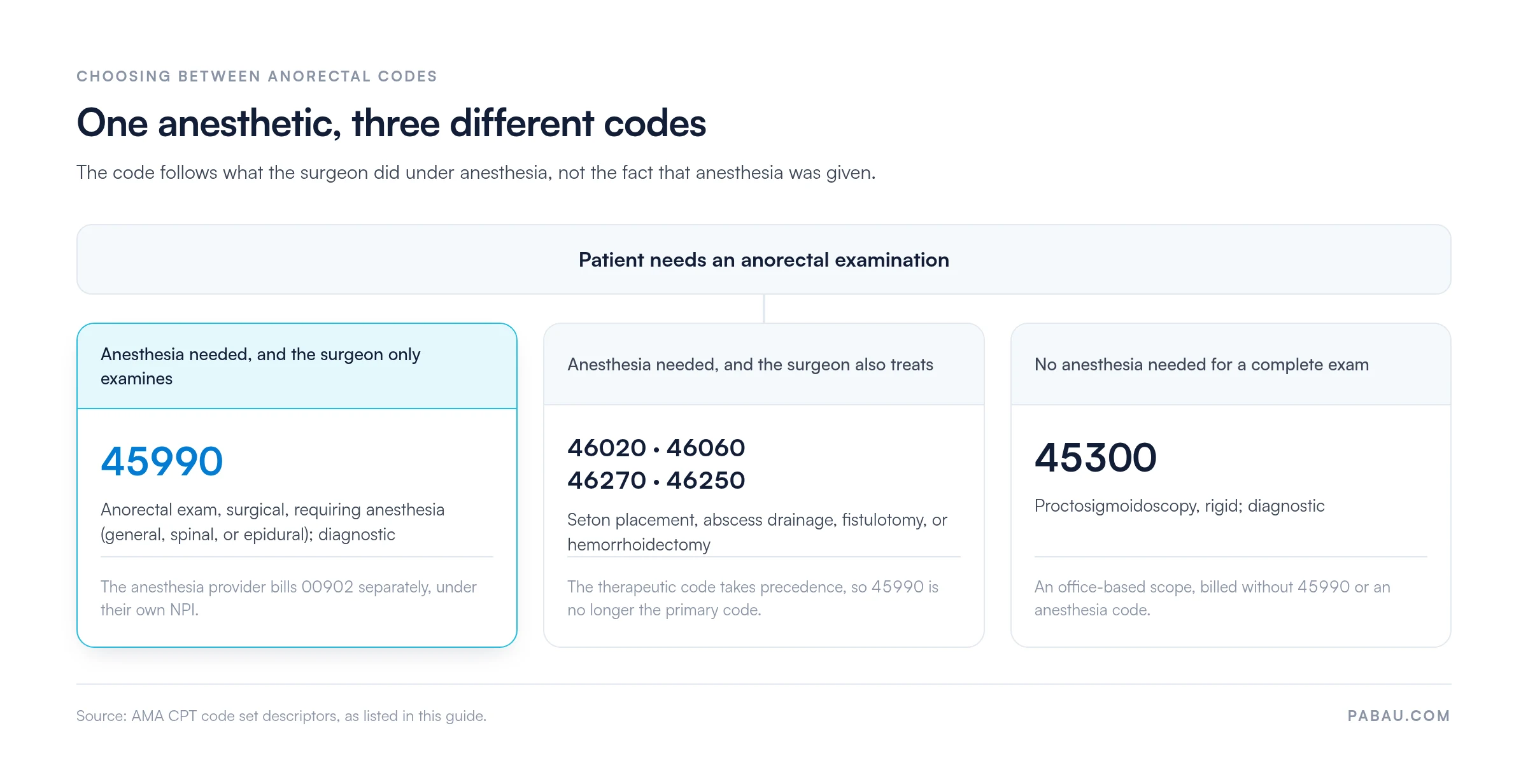
The decision that matters is what the surgeon did once the patient was asleep. The diagram below maps that single choice onto the three codes it can lead to.
The anorectal manometry codes changed for 2026 dates of service. 91122 was deleted on January 1, 2026, and 91125 replaced it.
Denials for CPT Code 45990 cluster around five recurring errors. Each one is preventable with the right documentation habits and claim review process. Strong claim denial management catches these before submission rather than after the fact.
Practices billing CPT Code 45990 carry documentation pressure at every stage. The operative note has to capture specific clinical elements, and the claim has to pair the right ICD-10 code. The submission then has to clear NCCI edits before it reaches the payer.
Pabau’s claims software for surgeons connects those steps in one workflow.
Colorectal and surgical practices using Pabau can build procedure note templates that prompt for anesthesia type, diagnostic rationale, and examination findings. The prompts appear while the surgeon is writing the note. CPT and ICD-10 codes attach to that note before the claim is submitted.
The platform then routes the claim electronically through its Claim.MD integration, which sends CMS-1500 claims to thousands of US payers. Validation runs before the claim leaves the practice, so errors surface while they are still cheap to fix.
Use Pabau’s procedure note templates to pre-load the four fields CPT 45990 needs: anesthesia type, clinical rationale, diagnostic intent, and findings. Standardizing those prompts across the surgical team means fewer operative notes come back incomplete, and the billing team stops chasing addenda before submission.

Pabau helps colorectal and surgical practices attach CPT codes to procedure notes at the point of care. Claims go out electronically, and denials are tracked in the same place. See how it works for your practice.

CPT Code 45990 rests on a simple judgment. If the surgeon only examined, 45990 is the claim. If the surgeon also treated, the therapeutic code carries the claim instead.
Almost every 45990 denial comes down to what the operative note says, not to which code was picked. Build the required elements into your procedure note template, verify the ICD-10 pairing before submission, and check NCCI edits on same-day claims.
Do that consistently and 45990 denials stop being a monthly surprise. Book a demo to see how Pabau keeps the operative note, the codes, and the claim in one place.

Need a framework for managing surgical billing compliance? Medical billing compliance covers the audit controls and documentation standards surgical practices need to stay compliant with CMS requirements.
Want to reduce denied claims across your colorectal practice? Submitting a clean claim explains the validation steps that prevent rejections before a claim reaches the payer.
Looking to understand how clearinghouse submissions work? Medical claims clearinghouse explains the role of a clearinghouse in the 837P claim lifecycle and how electronic submission reduces manual errors.
CPT Code 45990 is a diagnostic billing code for an anorectal examination performed under general, spinal, or epidural anesthesia. It is used when a complete anorectal evaluation cannot be accomplished in a standard office setting. The code sits in the Other Procedures on the Colon and Rectum section of the AMA CPT code set. It applies to diagnostic exams only.
The operative note must state the anesthesia type, the clinical rationale for why an office exam was insufficient, and confirmation of diagnostic intent. It also needs detailed examination findings and a signed surgeon attestation with date and time. The documented findings must support the ICD-10-CM diagnosis code billed on the claim.
The 2026 Medicare rate for CPT 45990 varies by geographic locality. It is calculated from work, practice expense, and malpractice RVUs, multiplied by GPCI factors and the annual conversion factor. Verify the exact rate for your practice location with the CMS Physician Fee Schedule Look-Up Tool, since third-party figures may not reflect locality adjustments.
Commonly accepted codes include K60.3 (anal fistula), K61.0 (anal abscess), K61.1 (rectal abscess), and K62.3 (rectal prolapse). Also accepted are K62.89, K59.4 (anal spasm), K64.8 (other hemorrhoids), and K62.5 (hemorrhage of anus and rectum). Verify each against current payer LCDs and the CDC/NCHS ICD-10-CM tool for the applicable fiscal year.



