CPT code 33234: Pacemaker lead removal billing guide
CPT code 33234: Official descriptor and code placement CPT code 33234 is the cod...

Last Updated: Nov 26, 2026
43840 is the CPT code for gastrorrhaphy, the suture repair of a perforated duodenal or gastric ulcer, wound, or injury. Surgeons report it after closing a hole in the stomach or duodenum through an open incision, without removing any tissue.
Most claims follow a perforated peptic ulcer, a stab or blunt abdominal injury, or a perforation caused during another procedure. The code carries a 90-day Medicare global period, so the day before surgery, the operation and three months of routine follow-up share one payment. Pairing it with an acute perforation or stomach-injury diagnosis keeps the claim defensible.
Let Pabau's smart automation suggest the right codes, reduce claim denials, and keep your practice compliant—effortlessly.
Automate repetitive tasks and focus on what matters most—your patients.
Reduce coding errors and ensure compliance with the latest regulations.
Clean claims, fewer denials, and faster reimbursements.
Powerful insights and reporting to help your practice thrive.
HIPAA compliant SOC 2 certified GDPR-compliant Trusted by 4,000+ clinics worldwide

CPT code 43840 covers open suture repair of a perforated gastric or duodenal ulcer, wound, or injury, with no resection.
A laparoscopic repair isn’t reported with 43840, and a same-day exploratory laparotomy is bundled into the open repair.
The 90-day global period runs from the day before surgery through post-op day 90, so routine follow-up care is bundled.
Use modifier 57 on the visit that led to surgery, 58 for a staged procedure and 79 for an unrelated one.
Pabau pre-fills the claim from the patient record, offers ICD-10 and CPT lookup and submits US claims through Claim.MD.
CPT code 43840 is the code for gastrorrhaphy, the open suture repair of a perforated duodenal or gastric ulcer, wound, or injury.
The AMA’s CPT code set describes it as gastrorrhaphy, suture of perforated duodenal or gastric ulcer, wound, or injury. The surgeon opens the abdomen by laparotomy, finds the perforation and closes it with sutures. No resection or other gastric procedure is part of it.
Three scenarios account for most 43840 claims:
What links them is the open approach and a repair done by suture alone. The table sums up the basics.
The code pays for the suture repair, the laparotomy needed to reach the stomach, and routine irrigation and closure. A resection, partial gastrectomy or fundoplication done at the same session falls outside it. Those take their own codes, and the note has to support each one.
Included in 43840:
Not included (code separately when performed):
The codes most often confused with 43840 sit in the same stomach subsection. The deciding question is always the type of work. 43840 is suture repair only, while its neighbors involve resection, bypass or a different structure.
“Gastric repair” in an operative note isn’t enough to pick a code. Confirm that no resection took place and check the pathology before you assign 43840. If the note describes a duodenal switch, the 43845 guide covers that code instead.
A 43840 claim survives medical review when the operative report supports both the open approach and the suture-only repair. When the note is vague, payers tend to read it as laparoscopic, which can mean a denial or a lower payment.
What the operative note needs:
A surgical superbill that maps each of these elements to the code lowers audit risk. When the superbill and the note line up, a reviewer can follow the trail without sending a query.
Here is the path a typical claim takes, and where each step can go wrong.
A worked example. A surgeon sees a patient in the emergency department with free air under the diaphragm. She decides to operate and closes a perforated anterior duodenal ulcer through a midline laparotomy that night.
The claim carries the emergency visit with modifier 57, then 43840 paired with K26.1. There is no separate line for the exploration. A wound check on day 10 is bundled. If the patient returns on day 20 with an unrelated problem, that visit takes modifier 24.
Payers check that the diagnosis supports the procedure. A 43840 claim sent with a chronic, stable gastritis code will likely be denied for lack of medical necessity. The ICD-10-CM codes below are the most clinically fitting pairings.
Codes and descriptors change every fiscal year, so check them against the current release from the Centers for Medicare and Medicaid Services.
Use the most specific code the note supports. K25.1 beats an unspecified gastric ulcer code when the operative note confirms acute perforation, and that specificity cuts medical necessity denials.
Modifiers change how a payer reads and prices a 43840 claim. A wrong modifier, or a missing one, is one of the fastest routes to a denial or an audit flag.
Modifier 22 needs a letter of medical necessity with the claim. Without one, most payers pay the standard rate and deny the increase on appeal.
Use modifier 59 only when the NCCI edit is genuinely triggered and the record supports a distinct service. It isn’t a blanket bypass of bundling rules.
Before appending modifier 22 to a CPT 43840 claim, calculate the actual operative time and compare it to CMS benchmark times for gastrorrhaphy. A procedure running 50% or longer than the benchmark, with documented rationale in the operative note, gives a strong basis for the increased complexity argument. Without that comparison, payer reviewers rarely approve modifier 22 uplifts.
Medicare pays 43840 through the relative value unit (RVU) framework of the Medicare Physician Fee Schedule. Work, practice expense and malpractice RVUs are each adjusted by a geographic factor (GPCI), added together and multiplied by the conversion factor.
The conversion factor changes each January, and geographic adjustments vary by locality. Check current figures in the CMS lookup or the FastRVU lookup tool.
Commercial payers negotiate their own fee schedules, separate from Medicare. Their rates are set per contract and often differ from the MPFS, so benchmark each one against the CMS rate.
Medicare counts 92 days in the package. The CMS global surgery booklet includes the day before surgery, the day of surgery and the 90 days after it. A routine wound check or post-op visit in that window is denied if you bill it without a modifier.
The timeline below shows what the payment bundles, and which modifier lets you bill a service outside it.
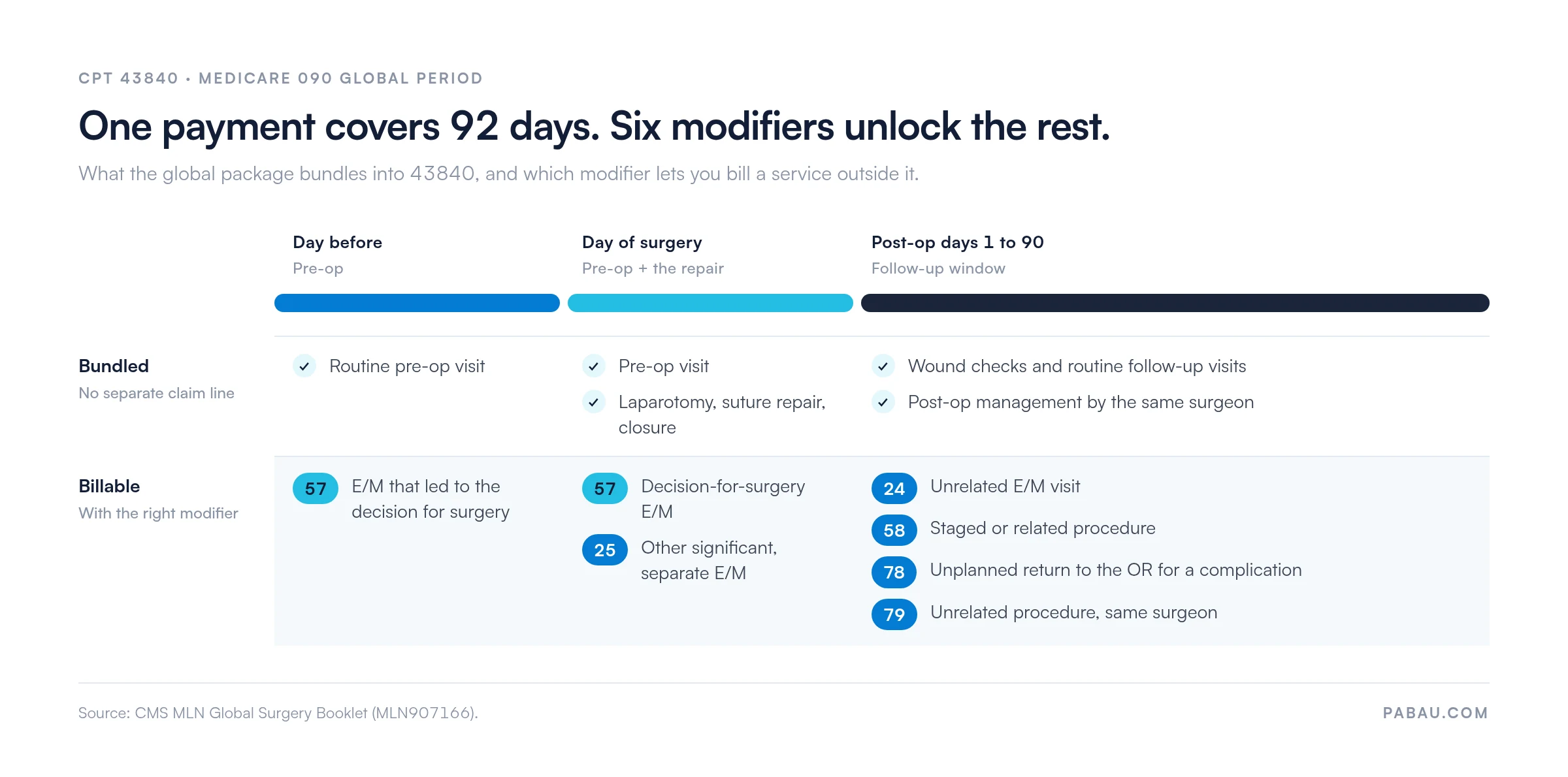
Billable outside the global period, with the right modifier:
Most commercial policies exempt emergency gastric repair from prior authorization. A perforated ulcer or traumatic stomach injury leaves no time for pre-approval. The exemption is payer- and plan-specific, though, so check the patient’s benefits rather than assuming it applies.
After an emergency case, the payer usually expects notification within its contractual window, typically 24 to 72 hours after admission. That notice is part of submitting a clean claim.
When prior authorization may still be required:
What to send with a prior authorization request:
Most 43840 denials trace back to four causes. The diagnosis doesn’t support the procedure, the note doesn’t confirm the open approach, an NCCI edit bundles a same-day code, or a modifier is missing.
Read the exact reason code on the remittance before you draft an appeal. The guide to denial codes in medical billing explains each one.
The National Correct Coding Initiative (NCCI) publishes edits that stop certain codes being billed together without a modifier. CMS updates them every quarter, so check the companion-code list in the current NCCI tables rather than last year’s references.
Three groups of codes commonly clash with 43840. Exploratory laparotomy, CPT 49000, is the classic one, because the exploration is already part of the open repair. Some abdominal drain codes and wound closure codes are treated as part of the repair too.
When a companion service was genuinely distinct, modifier 59 or one of the X modifiers (XE, XS, XP, XU) unbundles it. That means a different site, a separately documented indication or a clearly separate session. Using modifier 59 routinely without that support is improper unbundling, and it carries OIG audit risk.
A good denial management workflow catches NCCI conflicts before the claim reaches the payer. Scrubbing against the current quarterly tables removes the most preventable bundling denials. A medical claims clearinghouse then adds a format check on the way out, which cuts rework for busy surgical billing teams.
Run NCCI edit checks against the current quarterly CMS tables, not last year’s data. NCCI edits change four times per year, and a code pair that required modifier 59 in Q1 may be restructured by Q3. Subscribing to CMS NCCI table updates is free and prevents avoidable denials that only appear after the fact.
Many surgical billing teams still key an operative claim by hand. They copy codes out of the note, check the ICD-10 code in a separate tool and chase missing policy details after a rejection.
Pabau, a practice management platform, includes time-saving claims management that pre-fills the claim from the patient record. The CPT code on the service lands on the charge line, and ICD-10 slots are seeded from the recorded problem list. Built-in ICD-10-CM and CPT lookup libraries let your coder confirm K26.1 or S36.33XA without leaving the claim.
Before the Send button unlocks, Pabau checks that required claim fields, such as membership numbers and authorization codes, are filled in.
US claims then go through Claim.MD, with eligibility checks before the visit and ERA remittances posted back against each claim. Your team spends its time on the coding decisions in this guide rather than on re-entering data.

Pabau pre-fills claims from the patient record, offers ICD-10 and CPT code lookup and checks required fields. US claims go through Claim.MD with eligibility checks and ERA posting.

Treat 43840 as a documentation code first. Once the note proves an open, suture-only repair, the code itself is rarely the problem. The diagnosis just has to show an acute perforation or a stomach injury.
Revenue slips away around it instead. A decision-for-surgery visit goes out with 25 instead of 57, a 49000 line gets bundled, or a day-20 visit is sent without modifier 24. Build those three checks into your routine, and most denials on this code never happen.
If your team still retypes each claim from the operative note, that is the next place to save time. Book a demo to see how Pabau handles pre-fill, code lookup and Claim.MD submission in your practice’s claims workflow.

Need to understand how clearinghouse validation works? Medical claims clearinghouse guide explains how clearinghouses scrub surgical claims before payer submission.
Tracking denials across your general surgery caseload? Denial management in healthcare covers root cause analysis and appeals workflow for high-volume practices.
Building a clean claim process for abdominal surgery billing? Revenue cycle management overview outlines the end-to-end billing workflow from encounter to payment posting.
Coding the exploration on its own? CPT code 49000 billing guide covers exploratory laparotomy when no repair follows.
Coding a bleeding gastric ulcer without perforation? ICD-10 code K25.0 explains the acute hemorrhage code and when it applies.
No. 43840 describes the open repair. A laparoscopic closure, including a laparoscopic Graham patch, is usually reported with 43659, the unlisted laparoscopy code for the stomach. Send the operative note with the claim, because unlisted codes are priced by report.
Yes, for Medicare. 43840 appears on the hospital inpatient-only list, so it’s billed for an inpatient stay rather than an outpatient or ambulatory surgery center setting. Commercial payers set their own site-of-service rules.
It’s 90 days. Medicare bundles the day before surgery, the day of surgery and 90 post-op days into one payment. Separate E/M visits in that window need modifier 24, 25 or 57, plus documentation of a distinct reason.
The usual pairings are K25.1 or K26.1 for an acute perforated ulcer, and K25.2 or K26.2 when hemorrhage comes with the perforation. For trauma, use S36.33XA, S36.30XA or S36.39XA. Pick the most specific code the note supports.
Usually not. The exploratory laparotomy is part of the open 43840 repair, so a separate 49000 line counts as unbundling. Check the current NCCI table before you add any same-day abdominal code.