



CCSD code G5100: Bypass of duodenum billing guide
CCSD code G5100 bills a bypass that leaves the duodenum in place CCSD code G5100...

Last Updated: Oct 16, 2026

CPT code 41899 is the unlisted procedure code for dentoalveolar structures, meaning teeth and the alveolar bone and soft tissue around them.
It is the last code in the 41800 family, so rule out every listed code in that range before you use it.
Since 2023, the facility fee for dental cases done under monitored anesthesia belongs on HCPCS code G0330, not on 41899.
Medicare contractors price 41899 by report, so the special report and a named comparison code decide what the claim pays.
Modifiers 22 and 52 do not belong on an unlisted code, and the claim goes out as one line with one unit.
CPT code 41899 covers unlisted procedures on the dentoalveolar structures, which means the teeth plus the bone and soft tissue that hold them.
The code sits at the end of the 41800 series and exists for surgical work that no listed code describes. It also carries no relative value units, so a Medicare contractor sets the price by hand after reading your documentation.
That makes 41899 a documentation problem before it is a coding problem. A thin operative note turns a payable procedure into an appeal, and the whole billing cycle stalls with it. Write the special report properly and the same claim gets priced on the first pass.
CPT code 41899 is the unlisted procedure code for dentoalveolar structures. Dentoalveolar covers the teeth, the alveolar bone that anchors them, and the gingiva and mucosa attached to that bone. When a surgeon operates in that area and no listed code fits, 41899 is the reporting option of last resort.
It is a Category I code with no assigned relative value units. The American Medical Association reserves codes like this for services that no other code describes accurately.
Medicare gives it status C in the 2026 physician fee schedule, which means the contractor prices it after reviewing documentation.
One warning before the detail. Coders often confuse 41899 with 41599, the unlisted code for the tongue and floor of the mouth. Different anatomy, different code. If the surgery involved the tongue, 41899 is the wrong choice.
Check every listed code in the 41800 to 41899 range before you reach for the unlisted one.
CPT is blunt about the standard. A listed code is only correct when it describes the service performed and every component of it was done. A near miss is a coding error, not a shortcut.
Payment status matters as much as the descriptor, and the family splits in an awkward way. Only six of these codes hold status A, so Medicare pays them from the national fee schedule. Ten carry restricted coverage, and 41899 itself is contractor priced.
Six of those restricted codes do publish work RVUs, which is easy to misread as active pricing. The contractor still decides whether it covers the service at all. That makes the published figure a starting point rather than a payment.
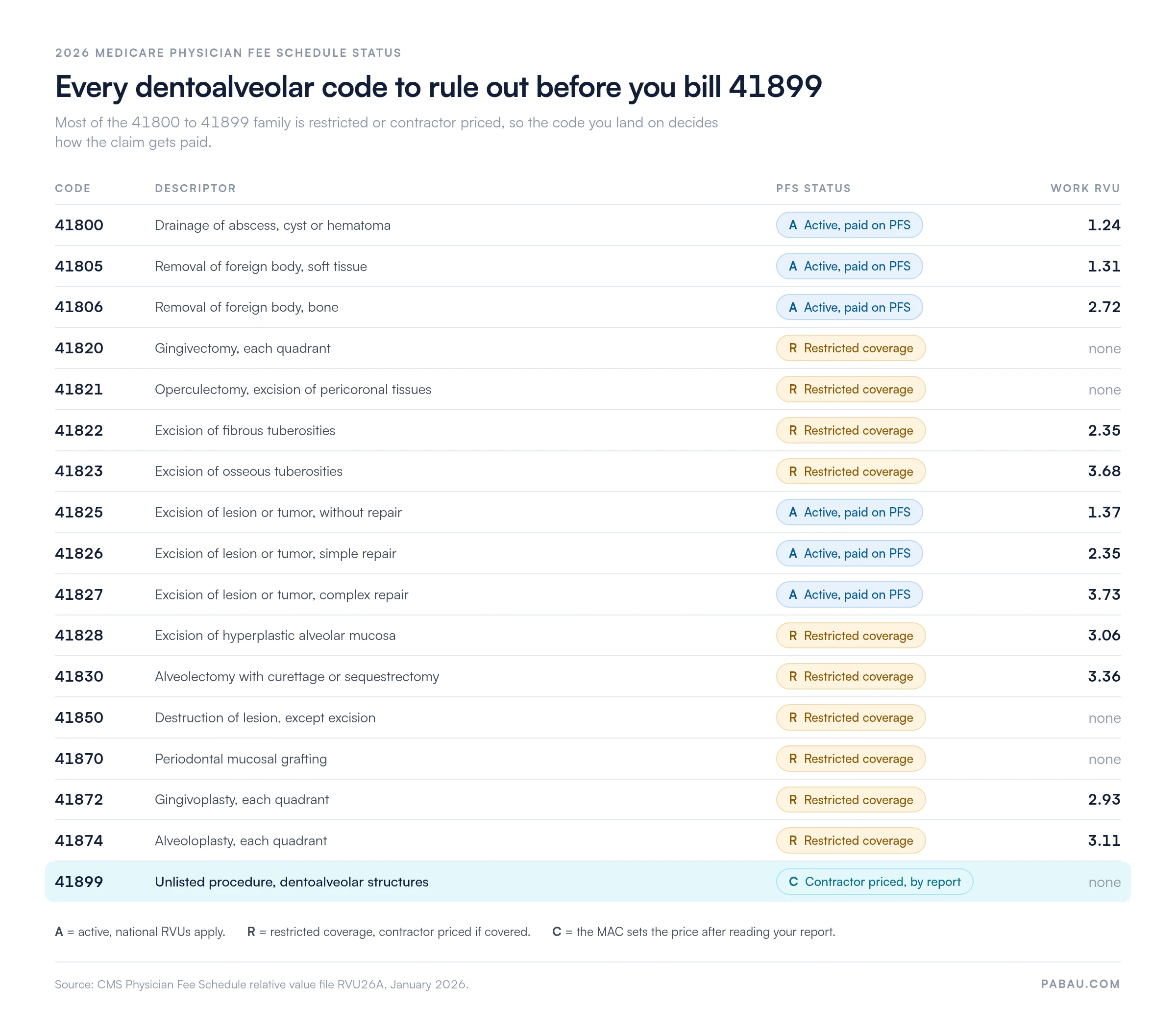
Hospitals and surgery centers once billed 41899 as the facility fee for dental cases done in an operating room. That billing habit is now out of date.
CMS created HCPCS code G0330 for facility services on dental rehabilitation cases that need monitored anesthesia and an operating room.
G0330 took effect on January 1, 2023 under the outpatient prospective payment system. CMS put it in APC 5871 for that first year, then moved it to APC 5164 from January 1, 2024. It stays in APC 5164 under the 2026 OPPS rule.
That same January 2024 date made G0330 a covered ambulatory surgical center service. The ADA, AAPD and AAOMS toolkit pushed payers to adopt it, because 41899 had never been valued for facility costs.
State programs followed. Texas Medicaid stopped taking 41899 for facility services on dental procedures under anesthesia.
The change applies to dates of service from September 1, 2024, and points providers to G0330. Other states have made the same switch on their covered procedure lists.
The professional claim is a separate matter. The surgeon still reports the work performed, and 41899 remains available there when no listed code fits.
If 41899 is still sitting on your chargemaster as an operating room line, treat that as a revenue leak. The same goes for any state covered procedure list your facility bills against. Ask each payer in writing whether G0330 has replaced it, and update the line before the next case rather than after the next denial.
An unlisted claim takes a different route through billing than a listed one, and knowing the route tells you where it can stall. Here is the path, stage by stage.
This route rarely involves a bundling edit. The NCCI policy manual states that the program generally does not publish edits for unlisted codes, since they cover such a wide range of services. Manual review, not an automated edit, is what holds these claims up.
Unlisted codes in other body systems follow this same route. CPT code 53899 covers unlisted urinary procedures, and those claims need the same narrative, special report and contractor review.
The special report sets the price, so treat it as the claim’s main event rather than an attachment. CPT asks for one on any service that is unusual, variable, rarely provided, or new. It wants the nature, extent and need for the procedure, plus the time, effort and equipment involved.
Reviewers consistently look for six elements:
Name a comparison code even when the payer does not ask for one. Leave that choice to the reviewer and they will pick their own benchmark, which is seldom the generous option.
Modifier 22 and modifier 52 describe work that ran above or below a code’s usual effort. An unlisted code has no usual effort to measure against, so neither modifier tells the reviewer anything. The special report already carries the complexity, and adding either modifier only flags the coder.
Units follow the same logic. One procedure, one line, one unit. The narrative already describes the whole service, so a second unit gives the reviewer nothing extra to price and invites a denial.
Medicare excludes most dental care by statute, under section 1862(a)(12) of the Social Security Act. That exclusion is why so much of the dentoalveolar range sits at restricted coverage on the fee schedule. It is not a blanket ban, though.
Since the 2023 physician fee schedule, CMS pays for dental services that are inextricably linked to a covered medical service. The list has grown each year.
It now reaches dental exams and treatment given before or alongside:
Diagnosis coding has to carry that story. A claim that reads as routine dental care gets denied, whatever the CPT code on it says.
Medicaid runs state by state. Hospital and ASC dental cases under general anesthesia are covered more often than office dental work, because the setting makes them medical. Check your state’s covered procedure list, and check whether it still names 41899 or has moved to G0330.
Commercial coverage splits along the same line. Dental plans take CDT codes on a dental claim. Medical plans take CPT codes on a CMS-1500 or an 837P. Sending the wrong code set to the wrong plan produces a fast denial and a slow appeal.
Denials on 41899 cluster around a short list of causes, and most are avoidable at the billing desk. Reviewing the denial codes on each remittance tells you which one you are hitting.
Run this on every 41899 claim. It takes about a minute, and it catches the causes above.
That minute is what turns an unlisted line into a clean claim instead of an appeal three months later.
Unlisted claims usually fail on process rather than clinical judgment. The operative note exists somewhere, the authorization exists somewhere, and the claim still goes out with neither attached. Practice management software like Pabau is where those pieces can sit together on one patient record.
Pabau’s software for billing teams keeps the note, the authorization and the claim on one record. Staff can see what is attached before a claim leaves the building, rather than finding out when a payer asks.
Through Pabau’s Claim.MD integration, US practices submit claims electronically and receive remittance data back in the system. For a code priced by hand, that visibility saves weeks. You learn whether a 41899 claim was accepted, pended for review, or denied, without waiting on a paper explanation of benefits.

Pabau keeps operative notes, authorizations and claim status on one record, so a 41899 claim leaves the practice complete the first time.

CPT code 41899 has a narrow job. It reports surgical work on teeth and alveolar bone that no listed code describes. Facility time now belongs on G0330, tongue surgery belongs to 41599, and a near miss belongs to the listed code it nearly matched.
Write the report properly and the claim gets priced. Write it thinly and it sits in a review queue while the reviewer guesses. The difference is a documentation habit, not a coding trick.
If unlisted claims are eating your billing team’s week, the fix is usually workflow rather than coding skill. See how Pabau keeps documentation, authorizations and claim status in one place, and book a demo with our team.

Need a framework for tracking and reducing claim denials? Denial management in healthcare covers how to spot, appeal and prevent the patterns that cost you the most.
Want to see how an attachment reaches the payer? Medical claims clearinghouse explains the route an electronic claim takes, and where documentation gets dropped.
Building a billing workflow from scratch? How medical billing works is the reference to hand new coders before they meet their first unlisted code.
No. 41599 is the unlisted code for the tongue and floor of the mouth. 41899 is the unlisted code for dentoalveolar structures, meaning teeth and the bone around them. The two get mixed up often, and payers deny on the mismatch.
File a redetermination and attach the same special report, plus the fee schedule amount for your comparison code. Show the reviewer what the service should have been priced against. Medicare gives you 120 days from the remittance notice.
Yes, when the dentist or oral surgeon is enrolled with the medical payer. CPT codes go to medical plans on a CMS-1500 or 837P. Dental plans take CDT codes on a dental claim instead.
That depends on the payer, and many require it for unlisted surgical codes. Ask before the case and keep the reference number. Approval is rarely granted after the procedure is done.
Longer than a listed code, because a person prices it. The claim leaves automated adjudication and waits for manual review. Follow up at 30 days rather than reading silence as progress.
Report one unit on one line. The special report describes the whole service performed, so a second unit gives the reviewer nothing extra to price. Additional units are usually denied.



