CCSD code G5100: Bypass of duodenum billing guide
CCSD code G5100 bills a bypass that leaves the duodenum in place CCSD code G5100...

Last Updated: Oct 16, 2026
CPT Code 38900 is the add-on code for intraoperative identification, or mapping, of sentinel lymph node(s) with an injection of non-radioactive dye. It is never submitted on its own. It rides on a primary procedure taken from CPT’s base-code list for 38900, billed on the same claim and the same date of service.
Surgeons report it in breast cancer, melanoma, and gynecologic oncology cases. Medicare’s 2026 national payment is roughly $123 in a facility setting and $145 in a non-facility setting. Which code you pair it with decides whether it pays at all, and that is where most denials begin.

CPT Code 38900 covers intraoperative sentinel lymph node mapping with a non-radioactive agent, and it is never billed on its own.
The parent code is usually the lymph node procedure itself, such as 38525, rather than the tumor resection performed alongside it.
Medicare pays about $123 in a facility setting and $145 in a non-facility setting in 2026, based on a total RVU of 3.68 and 4.34.
CMS Billing and Coding Article A52437 frames coverage, and the operative report has to state the mapping technique and its outcome.
Practice management software like Pabau keeps the operative note, the invoice, and the claim on one client record. Add-on lines can then be checked before submission.
CPT Code 38900 is the designated code for intraoperative identification (e.g., mapping) of sentinel lymph node(s) including injection of non-radioactive dye, when performed. The AAPC’s CPT code lookup lists it under the Hemic and Lymphatic System subsection of the Surgery chapter.
The surgeon injects a non-radioactive agent into or near the tumor site. That is usually isosulfan blue or methylene blue dye, and increasingly indocyanine green, which fluoresces under near-infrared light. Uptake is then traced to the node or nodes that drain the tumor first, and their pathology guides how far the dissection goes.
The phrase “when performed” in the descriptor matters. It signals that the injection belongs to the primary procedure. Separate payment follows only when the mapping is carried out and written into the operative report.
CPT 38900 carries the plus (+) symbol, which makes it an add-on code under the AMA’s CPT code set conventions. Add-on codes are never the only procedure on a claim. They are always reported with a primary, or parent, procedure code.
Three practical consequences follow from that designation:
The first denial reason on sentinel node claims is the simplest one. The add-on arrives without a parent procedure on the same claim, and the payer has nothing to attach it to.
CPT names the procedures 38900 may accompany, and the list is narrower than surgeons expect. In most cases the parent code is the lymph node procedure performed in the same session, not the resection of the tumor. These are the pairings that come up most often in breast, melanoma, and gynecologic oncology surgery.
An open biopsy of a superficial node, reported under 38500, is one of those parent codes.
Two codes surgical billers reach for are missing from that list. A partial mastectomy without node work (19301) is not a parent code for 38900, and neither are the melanoma excision codes 11600 to 11606. When the surgeon excises the lesion and maps the node, 38900 attaches to the node procedure instead.
Check the pairing against National Correct Coding Initiative (NCCI) edits before submission, and against the parent-code list printed with 38900 in the current CPT codebook. NCCI edits govern which procedures can be billed together without a bundling denial.
The mapping technique decides which code applies. CPT Code 38900 covers non-radioactive agents only. When a radioactive tracer such as technetium-99m is used, the injection and the imaging are coded separately.
On a dual-technique case, 38900 covers the surgeon’s dye injection. The tracer injection and the imaging are coded by the team that performed them. Never fold both pathways into 38900.
Because 38900 is an add-on code, its modifier rules run the opposite way to a standard surgical code. The table below lists what may apply under AMA CPT guidelines and NCCI policy.
Modifier -51 is the most common modifier error on these claims. Payers reject it because the add-on designation already tells them no multiple-procedure discount applies.
Medicare pays 38900 from the Medicare Physician Fee Schedule (MPFS). The CMS Physician Fee Schedule lookup tool publishes the national amounts, and geographic practice cost index (GPCI) adjustments produce the rate for each locality.
Both payment figures are the total RVU multiplied by the 2026 conversion factor. Work and malpractice RVUs are identical in each setting, so the whole difference between $123 and $145 is practice expense. Rates move with the annual fee schedule update and with locality, so confirm the current amount before you quote it to a surgeon.
CMS sets out its billing framework for sentinel lymph node biopsy in Billing and Coding Article A52437. Coverage applies when the procedure is medically necessary and the diagnosis meets the criteria listed in the article. The operative report is the documentation that carries the claim.
Required operative report elements for CPT Code 38900 coverage include:
Payers ask for the operative note more often on oncology add-on claims than on routine surgery. Filing that note against the same encounter as the invoice shortens the round trip when a request arrives.
Mapping fails when the injection does not identify a sentinel node during the operation. What you code next depends on what was performed and what the note says.
Payer policies on failed mapping vary. Some carriers want a narrative note or a letter of medical necessity attached. Confirm what the carrier expects before you submit.
Document the agent and the outcome in the operative note before the patient leaves the OR. A vague line such as sentinel node biopsy performed names no agent. That omission is the leading reason payers request records or deny CPT Code 38900 outright.
The descriptor is short, but the add-on status creates a predictable set of claim errors. These are the ones that recur:
Those six errors collapse into four questions a biller can answer from the operative note and the claim line in under a minute.
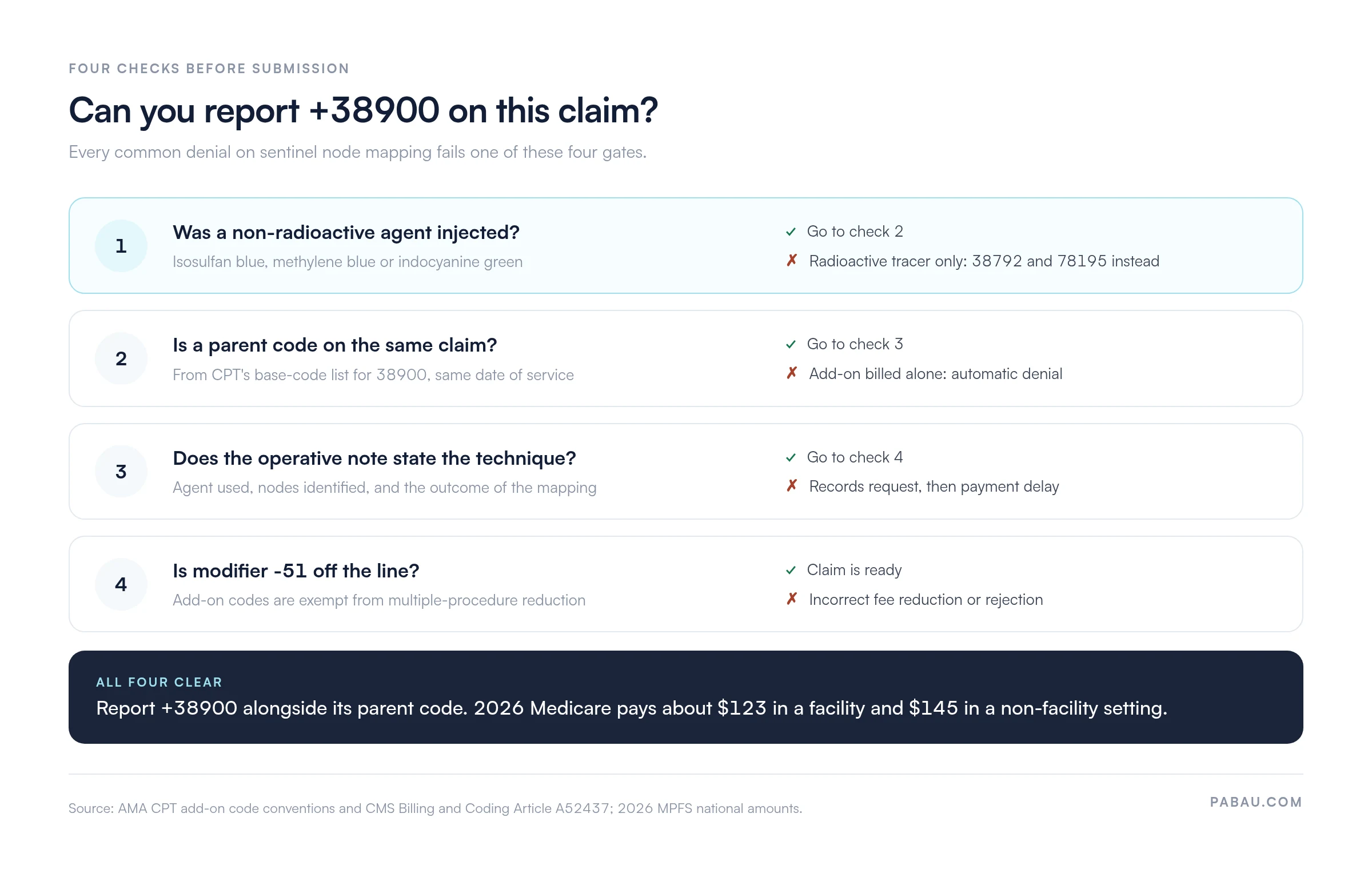
Running those checks before transmission is what clean claim submission looks like on an add-on code. Confirm the parent code is present, -51 is absent, and the operative note names the agent.
Coverage for 38900 under Medicare and most commercial payers depends on the diagnosis submitted with it. These ICD-10-CM codes cover the indications that come up most often in sentinel node mapping.
Use the most specific code the confirmed pathology and laterality allow. Unspecified codes raise audit risk on high-value oncology claims. The ICD-10-CM code index is the quickest way to find the specific code before the claim goes out.
Add-on claims usually fail for administrative reasons rather than clinical ones. The operative note sits in one system and the charge sheet in another, so the person building the claim cannot see both at once.
Practice management software like Pabau keeps the appointment, the treatment note, the invoice, and the claim on one client record. A biller opens the encounter and sees the primary procedure and the mapping recorded side by side. A 38900 line with no parent code shows up before submission instead of after a denial.
Claims leave through the Claim.MD clearinghouse, which connects Pabau to US payers and returns electronic remittance advice to the same record. Pabau’s claims management software keeps submission, payment posting, and denial follow-up on the encounter they belong to. Your team stops reconciling remittances against a spreadsheet.

Pabau holds the operative note, the invoice, and the claim on one client record. Your billing team can check an add-on line against its parent code before it is submitted.

Three habits cover almost every denial on this code. Take the parent code from CPT’s list rather than from the tumor resection. Keep modifier -51 off the line, and make the operative note name the agent and the outcome.
The documentation habit is the one worth building first. Coverage and modifier rules can be checked from a desk at any point. The technique statement has to come from the surgeon while the case is still fresh.
Book a demo to see how Pabau keeps operative notes, invoices, and claims on a single record for surgical billing teams.

Need a broader guide to submitting clean claims? Clean claim best practices covers the pre-submission checklist that reduces rejections across all CPT code types.
Unsure how denials are tracked and resolved? Denial codes in medical billing explains the most common denial reason codes and how to appeal them effectively.
Looking for guidance on revenue cycle management? Electronic remittance advice explains how ERA files speed up payment posting and reconciliation after claims are adjudicated.
CPT Code 38900 is the add-on code for intraoperative identification, or mapping, of sentinel lymph node(s) using a non-radioactive dye injection. It is reported alongside a primary surgical procedure in breast cancer, melanoma, and gynecologic oncology cases. It is never submitted as a standalone claim, and it needs an approved primary procedure code on the same date of service.
Yes. CPT Code 38900 carries the plus (+) symbol in the AMA CPT codebook, designating it as an add-on code. It must be reported in addition to the primary surgical procedure and is exempt from multiple-procedure reduction modifier -51.
Modifier -51 must never be appended to 38900. Modifier -59 may apply when a payer edit incorrectly bundles the add-on code. Laterality modifiers -LT or -RT may be required by some payers for bilateral mapping. Always verify modifier requirements with the specific payer before submission.
Not with 19301. The parent-code list CPT publishes for 38900 includes 19302 and 19307, but not 19301. When a lumpectomy is reported as 19301, 38900 attaches instead to the lymph node procedure from the same session, such as 38525.
The ICD-10-CM codes most often paired with CPT Code 38900 include breast cancer codes C50.911 and C50.912, plus malignant melanoma C43.9. Gynecologic malignancies such as endometrial cancer (C54.1) and ovarian cancer (C56.1) also apply. Coverage is diagnosis-dependent under CMS Billing and Coding Article A52437, so use the most specific code the pathology supports.