



CCSD code G5100: Bypass of duodenum billing guide
CCSD code G5100 bills a bypass that leaves the duodenum in place CCSD code G5100...

Last Updated: Oct 16, 2026
CPT Code 36598 is the procedure code for contrast injection(s) used to radiologically evaluate an existing central venous access device (CVAD). Fluoroscopy, image documentation and the report are all included. It’s a diagnostic study on a device that’s already in place, so it never covers inserting or repairing one.
However, coders often confuse it with insertion codes such as 36561 because both involve CVADs. As a result, payers often deny 36598 claims at first pass. In the CY2026 Medicare file, 36598 carries 0.91 total RVUs in a facility and 3.47 in a non-facility setting.

CPT Code 36598 covers contrast injection studies of an existing central venous access device, not catheter insertion or repair.
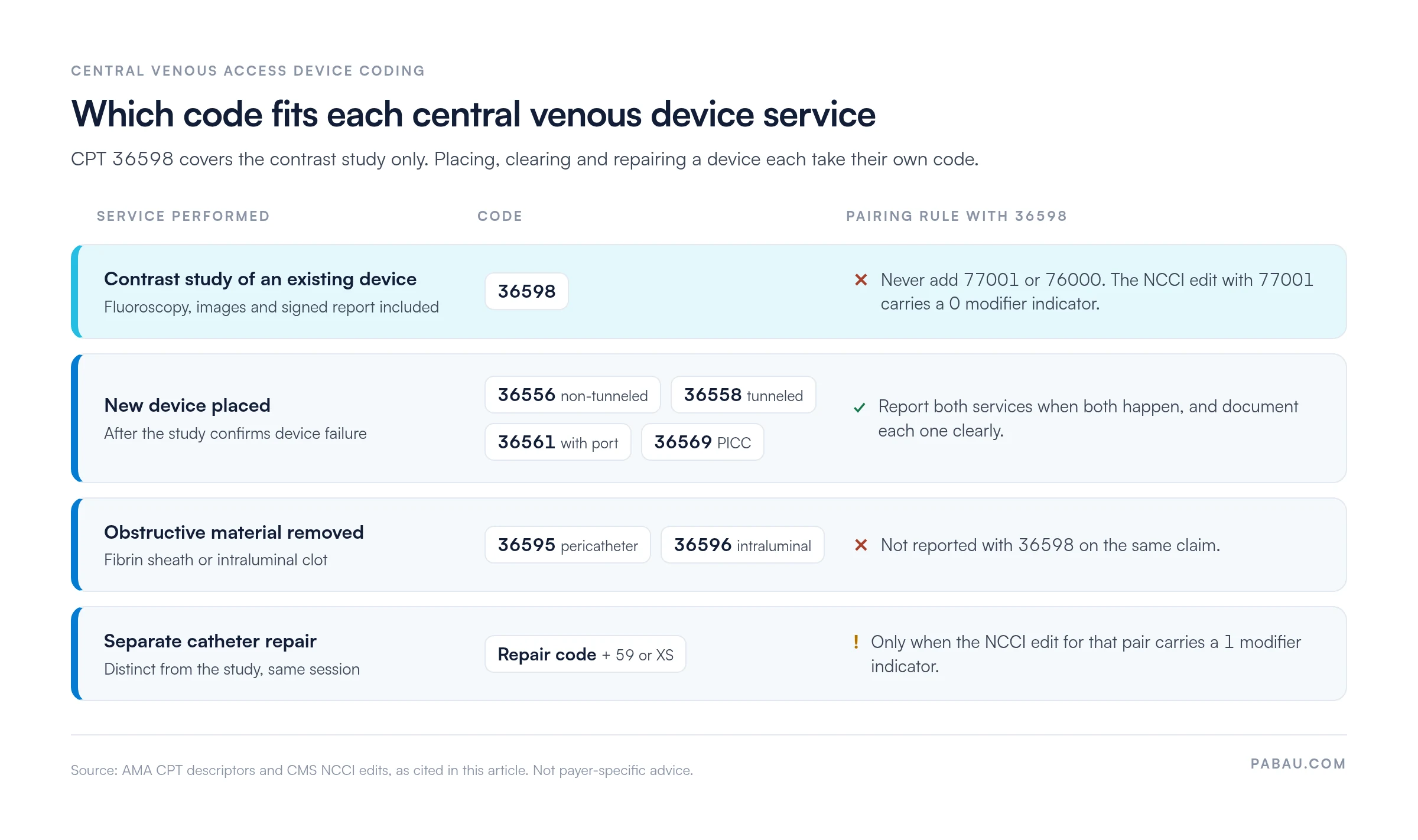
Fluoroscopy is built into the descriptor, so 77001 and 76000 can’t be billed with it, and neither can 36595 or 36596.
In the CY2026 Medicare file, 36598 carries 0.91 total RVUs in a facility and 3.47 in a non-facility setting.
Documentation must name the device type, clinical indication, contrast agent, fluoroscopic findings and interpreting physician.
Pabau’s claims management software, with Claim.MD, returns denial reason codes your team can match to the procedure note.
The official AMA CPT descriptor reads: Contrast injection(s) for radiologic evaluation of existing central venous access device, including fluoroscopy, image documentation and report. Three words in that descriptor do the heaviest coding work: “existing,” “evaluation,” and “including fluoroscopy.”
Within CPT, the code sits in the Cardiovascular System section of the Surgery chapter (Vascular Injection Procedures, 36000-36598). It applies across all three major CVAD types: tunneled catheters (such as Hickman or Broviac lines), implanted ports, and peripherally inserted central catheters (PICC lines). In every case, the team injects contrast through the existing lumen, then acquires and reads fluoroscopic images.
A central venous catheter obstruction study using CPT Code 36598 follows a defined sequence. Knowing the steps helps coders confirm that the procedure note documents each element before they submit a claim.
Clinicians usually order the study when a patient’s catheter malfunctions: slow infusion, no blood return on aspiration, or pain on injection. Oncology units, infusion centers, and dialysis-adjacent facilities perform it often, since tunneled catheters and ports stay in place for months or years.
Bundling errors are a frequent cause of 36598 claim rejections. For that reason, the table below separates what the code packages in from what practitioners sometimes try to bill separately.
The key compliance risk is appending 77001 to 36598. The NCCI assigns a 0 modifier indicator to that pair, meaning no modifier can override the edit. Submitting both codes triggers an automatic denial, or a recoupment on audit.
Three more codes stay off a 36598 claim. Don’t report CPT 36595 and 36596, which remove pericatheter and intraluminal obstructive material, with 36598. Likewise, skip 76000 for fluoroscopy.
For CPT Code 36598, the procedure note must capture each of the following before a clean claim can go out. Payers look for every element when they review the record.
Even so, payers can recoup a claim that paid without these elements in the record once an auditor asks for the note.
Flag 36598 claims for pre-submission documentation review if your facility performs this study on chemotherapy patients. Payers reviewing oncology vascular access claims may request the procedure note before they pay.
The biggest coding decision for CPT Code 36598 is telling it apart from nearby insertion and repair codes. The table below covers the codes coders compare most often.
Confusing 36598 with 36561 is the costliest error. A coder who bills 36561 when the provider only performed a contrast evaluation is upcoding a diagnostic service to a surgical one. In contrast, billing 36598 when the physician placed a new tunneled port undercodes a more complex procedure. Both errors carry compliance risk.
Therefore, the procedure note must state clearly whether the physician placed a new device or evaluated an existing one. The chart below maps each device service to its code, and to the rule for pairing it with 36598.
Medicare pays CPT Code 36598 under the Physician Fee Schedule (PFS), at a facility rate and a higher non-facility rate. The RVUs below come from the CMS Physician Fee Schedule relative value file for CY2026. The CMS Physician Fee Schedule lookup tool publishes the rate for each locality.
CY2026 has two conversion factors: $33.4009 for most clinicians and $33.5675 for qualifying APM participants. At $33.4009, the national amounts are about $30.39 in a facility and $115.90 outside one. At $33.5675, they rise to $30.55 and $116.48.
The non-facility rate is far higher because its practice expense covers the equipment and clinical staff used outside a hospital. Also, your local rate applies your locality’s Geographic Practice Cost Index (GPCI) to each RVU component.
CMS lists 36598 with payment status T and a 000 global period. Status T means Medicare pays it only when the same provider bills no other PFS service that day. If the provider bills another payable service, Medicare bundles 36598 into it.
Meanwhile, the Outpatient Prospective Payment System (OPPS) pays hospital outpatient departments. Confirm the current APC assignment in the CMS Addendum B file rather than applying the PFS rate to facility billing.
Prior authorization requirements for CPT Code 36598 vary by payer and plan. No single rule applies across Medicare, Medicaid, and commercial carriers, so verify requirements per payer and per plan before scheduling. Strong medical billing compliance builds that check into the intake workflow.
When a payer requires prior authorization, attach the procedure note documenting prior conservative management (flush attempts, alteplase instillation) alongside the clinical order. Payers who deny for medical necessity often cite missing evidence that the team tried simpler interventions first.
Good denial management workflows prevent revenue loss on a procedure that’s straightforward to document correctly. These are the denial patterns that recur on 36598 claims.
Reviewing common denial codes as a team each quarter helps billing staff spot these patterns early. Then they can adjust workflows before the next claims go out.
The National Correct Coding Initiative (NCCI) publishes quarterly edit tables that govern which codes you can’t bill together without a modifier. For CPT Code 36598, the most consequential edit is the 77001 pair. That edit carries a 0 modifier indicator, so no clinical scenario justifies billing both for the same session.
For other bundling cases, submitting a clean claim means confirming each code pair in the current quarterly NCCI release before the claim goes out.
The AAPC CPT code lookup includes bundling notation that flags common edit pairs. Cross-checking it against the official CMS NCCI edit tables adds a second check before you submit claims.
Pull the NCCI edit table for 36598 every quarter, when CMS releases the updated NCCI file. Bundling rules for vascular access codes have changed in recent years. As a result, an outdated table can let through claims that trigger edits your denial workflow doesn’t cover.
Practices that perform CVAD studies often write the procedure note in one system and build the claim in another. However, when a 36598 denial comes back, someone has to find the note, work out which element was missing, and decide whether to appeal.
Pabau, the practice management platform we build, keeps the procedure note in the patient record. Pabau’s claims management software, with Claim.MD, submits claims and returns remittance advice and denial reason codes. Your team can then match them to the procedure note.
Because electronic remittance advice lands in the same platform as the patient record, your team can check a denial for missing images against the note quickly. Then they can correct and resubmit while the appeal window is still open.
For infusion centers and oncology practices that bill 36598 often, the denial codes show which documentation element keeps failing. That shows you which line of the note template to fix before the next batch of claims.

Pabau’s claims management software, with Claim.MD, submits your 36598 claims and returns denial reason codes your team can match to the procedure note.

The decision that protects a 36598 claim is made in the procedure note, before coding starts. If the note shows contrast through an existing device, saved images and a signed report, 36598 stands on its own. Leave 77001, 76000, 36595 and 36596 off the claim.
Build those elements into your note template, and check prior authorization at scheduling. In short, the trade-off is a few minutes of documentation per study against reworking a denied claim later.
Book a demo to see how Pabau returns denial reason codes your team can match to each 36598 procedure note.

Need a framework for managing claim rejections? Denial management in healthcare walks through a structured approach to reducing first-pass rejection rates across your billing team.
Want to understand how clearinghouses process your vascular access claims? How Claim.MD works as a clearinghouse explains the electronic submission pathway from charge capture to payer acknowledgment.
Looking for a complete guide to the billing submission process? Medical superbill documentation covers the components every superbill needs to support accurate charge capture for procedure codes like 36598.
Placing a new tunneled catheter after the study? CPT Code 36558 covers insertion of a tunneled central venous catheter without a port.
Coding a non-tunneled line instead? CPT Code 36556 explains the non-tunneled central venous catheter insertion code and its documentation.
CPT Code 36598 covers contrast injection(s) for radiologic evaluation of an existing central venous access device, including fluoroscopy, image documentation, and the interpreting physician’s report. It applies to tunneled catheters, implanted ports, and PICC lines already in place and evaluated for obstruction, malposition, or malfunction. It doesn’t cover new catheter placement or catheter repair.
In the CY2026 Medicare file, CPT Code 36598 carries 0.91 total RVUs in a facility and 3.47 in a non-facility setting. Nationally, that’s about $30 and $116 before your locality adjustment. The facility rate is lower because the hospital or facility bears the practice expense, not the billing physician. Verify your local allowable in the CMS Physician Fee Schedule lookup tool, because rates change every year.
The procedure note must document the device type and location, the clinical indication, and the contrast agent’s name, concentration and volume. It must also confirm that fluoroscopic images were obtained and saved, and give the findings and the interpreting physician’s identity. A missing signed report and a vague clinical indication are the two gaps payers flag most in audits.
Prior authorization requirements vary by payer and plan type. Traditional Medicare generally doesn’t require prior auth for 36598, though MAC LCDs may impose coverage conditions. Medicare Advantage plans, commercial carriers, and many Medicaid programs often require it. Verify per payer and per plan at scheduling, not after the procedure.



