CPT code 63081: Vertebral corpectomy, cervical spine
CPT code 63081: official descriptor and procedure overview CPT code 63081 descri...

Last Updated: Oct 6, 2026
36593 is the CPT code for declotting by thrombolytic agent of an implanted vascular access device or catheter. It covers instilling a drug such as alteplase into an occluded port, PICC or tunneled catheter, letting it dwell, then aspirating it and confirming patency.
The drug is billed separately, as J2997 for alteplase. Mechanical removal of obstructive material through the device lumen is 36596, not 36593, and a routine flush is never reported with this code.
Let Pabau's smart automation suggest the right codes, reduce claim denials, and keep your practice compliant—effortlessly.
Automate repetitive tasks and focus on what matters most—your patients.
Reduce coding errors and ensure compliance with the latest regulations.
Clean claims, fewer denials, and faster reimbursements.
Powerful insights and reporting to help your practice thrive.
HIPAA compliant SOC 2 certified GDPR-compliant Trusted by 4,000+ clinics worldwide

CPT code 36593 covers declotting an implanted catheter with a thrombolytic agent, never mechanical clearance or a routine flush.
It can be reported with 96413 on the same date when the note documents a distinct occlusion and a named thrombolytic agent.
When an NCCI edit applies, use modifier 59 or the X-modifier your payer’s NCCI guidance names, such as XU.
The note must capture the occlusion finding, the agent and dose, the dwell time, and confirmed patency afterward.
Pabau, the practice software we build, sends 36593 claims to thousands of US payers through its Claim.MD integration.
CPT code 36593 is defined by the American Medical Association (AMA) as: “Declotting by thrombolytic agent of implanted vascular access device or catheter.” The code covers instilling a thrombolytic drug into an occluded central venous access device (CVAD). The agent dwells to dissolve the clot, then it is aspirated and the catheter is confirmed patent.
Device types covered include implanted subcutaneous ports (port-a-cath), tunneled central venous catheters, and peripherally inserted central catheters (PICCs). The code is not limited to one catheter type, but the clinical record must confirm which device was treated.
The thrombolytic agent requirement is what separates 36593 from 36596, which covers mechanical removal of obstructive material through the device lumen. Alteplase (Cathflo Activase) is by far the most commonly used agent. Urokinase has historical use but limited current availability.
The drug must be documented by name, concentration, volume instilled, and dwell time. A saline flush recorded as a declotting procedure does not support 36593, and payers deny it.
The complete procedure sequence that supports CPT 36593 billing follows a standard protocol. Documentation should reflect each step to establish medical necessity and coding accuracy.
Missing any of these elements is the most direct path to a CPT 36593 denial, especially the drug name, dwell time, and patency confirmation.
Understanding the bundling boundaries of CPT 36593 prevents both under-billing and inappropriate separate reporting. The National Correct Coding Initiative (NCCI) governs which services are inherent to the procedure and which may be reported separately.
CPT 36596 covers mechanical removal of intraluminal (intracatheter) obstructive material from a central venous device through the device lumen. Removing pericatheter material, such as a fibrin sheath, through separate venous access is 36595. The method decides the code, so the choice comes down to what the note says cleared the occlusion, as the diagram below maps out.
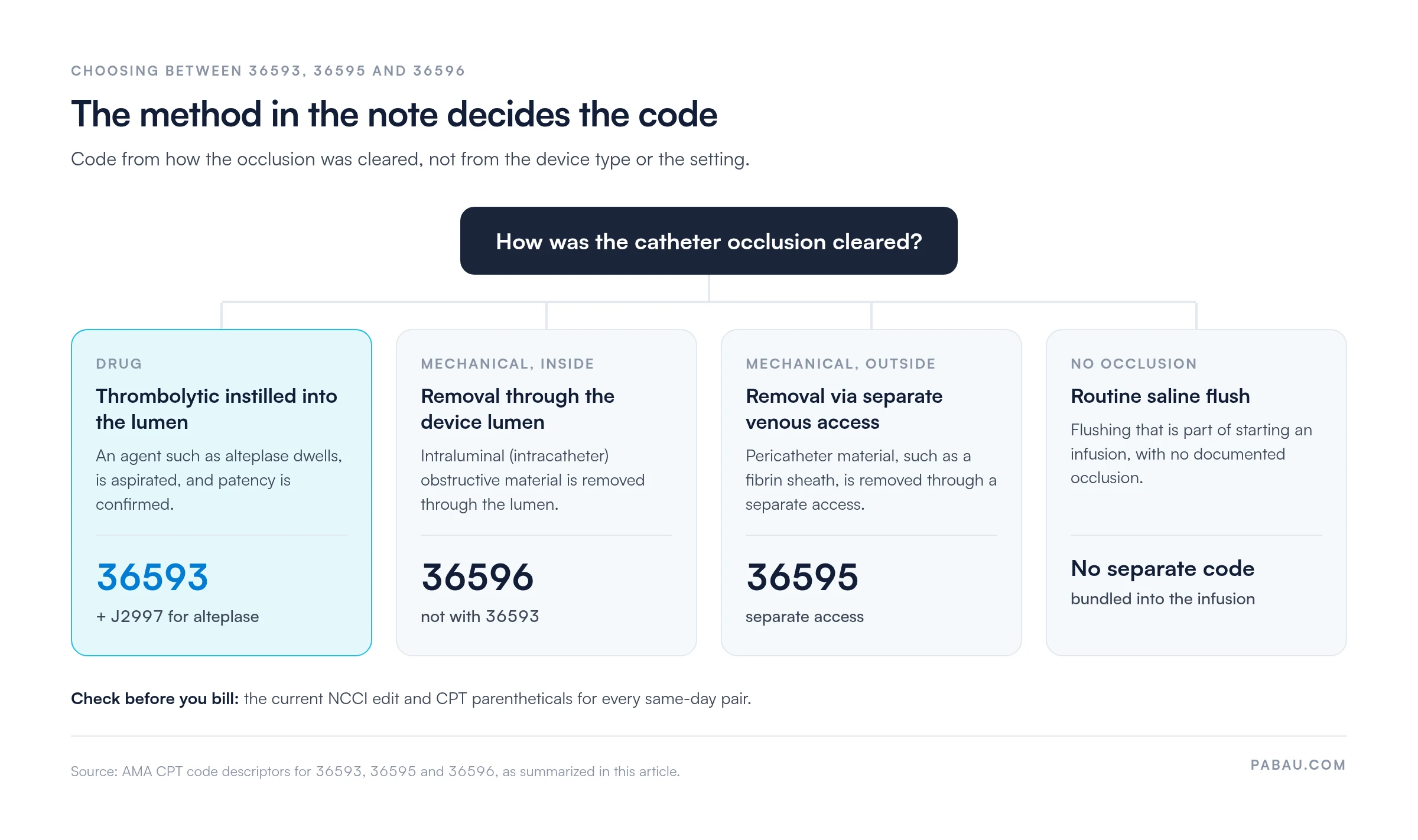
Do not report both 36593 and 36596 for the same catheter on the same date. If a thrombolytic was instilled and it worked, use 36593. CPT instructs not to report 36596 with 36593. When a mechanical attempt follows a failed thrombolytic, check CPT Assistant and the NCCI policy manual before choosing the code.
Yes, CPT 36593 may be separately reported on the same date as CPT 96413 (chemotherapy infusion, initial), but only when specific conditions are met. The answer hinges on documentation.
The clinical logic is simple. The catheter was occluded, a thrombolytic agent cleared it, and the chemotherapy infusion went ahead only once patency was restored. That sequence represents two distinct services. Routine flushing at the start of an infusion is different, and it is bundled into the infusion code.
Separate reporting rests on the current NCCI procedure-to-procedure edits and the CPT guidelines for the infusion codes. Check both before you submit, because the edit tables change every quarter.
Coders in infusion and oncology settings meet several 365xx codes on the same day as 36593. The table below summarizes the ones most often confused, as a quick check against duplicate reporting. Port blood draws have their own rules, and the 36591 reference covers when that code stands alone.
Modifier selection for CPT 36593 turns on two questions. Does an NCCI edit pair it with another code billed that day, and were the services genuinely distinct? According to the AAPC CPT code reference, modifier use on vascular access codes requires careful documentation support.
Warning on modifier 59 misuse: appending modifier 59 to every 36593 claim submitted alongside an infusion code is a common compliance error. The modifier is appropriate only when an NCCI edit exists AND the clinical circumstances genuinely support separate billing. Routine use without documentation support is a false-claims risk.
Check the current NCCI Procedure-to-Procedure edits table on the CMS website before submitting a CPT 36593 claim alongside any 96xxx infusion code. NCCI edits update quarterly, so an edit relationship that did not exist in Q1 may be active in Q3. Always verify, never assume.
Medicare payment rates for CPT 36593 are determined by the Resource-Based Relative Value Scale (RBRVS) and vary by geographic locality and place of service. The CMS Physician Fee Schedule lookup provides the current national rates; practices should use their specific locality multiplier for accurate budgeting.
Commercial payer rates for CPT 36593 vary significantly from Medicare. Some payers reimburse at Medicare rates or a percentage of them, and others have negotiated fee schedules with no published reference. Always verify contracted rates through your payer portal before projecting revenue.
Every element below must appear in the health record before a CPT 36593 claim is submitted. Auditors and payers reviewing claims for this code are looking for the same checklist. Structuring a superbill documentation workflow around these fields prevents the most common documentation-related denials.
Validating these fields before billing is a core step in clean claim submission. It catches missing elements at the point of care rather than at denial.
CPT 36593 denials cluster around three root causes: missing documentation, NCCI edit conflicts without the right modifier, and payer coverage rules that differ from Medicare. The reason code on the remittance tells you which one hit, and our guide to medical billing denial codes explains each one. Building denial management workflows around these patterns prevents most rejections.
Medicare Part B does not typically require prior authorization for CPT 36593 in a physician office or outpatient setting when medical necessity is documented. Other payers can differ. Insurance eligibility verification before each encounter should include a prior-authorization check, because Medicare Advantage plans operate under different utilization management rules than traditional Medicare.
Commercial payers vary considerably. Some publish medical or coverage policies that restrict 36593 to specific settings, such as hospital outpatient only. Others limit it to patient groups, such as active malignancy or home infusion dependency. A few require the attending physician to document why the catheter is being declotted rather than replaced.
Check the payer’s published policies and your provider manual before assuming coverage.
Billing compliance requires prior-authorization status to be confirmed and documented before service with every payer that may require it. Medicare Advantage and commercial plans cause most authorization denials for this code, so check those first.
For home infusion patients, 36593 reimbursement often depends on whether the ordering physician or the home infusion agency submits the claim. Clarify the billing arrangement before the encounter. Misrouted claims are one of the most avoidable denial causes in this setting.
Most 36593 denials start in the note or at charge entry. A declotting note without a dwell time, or a 96413 claim sent without the modifier its NCCI edit needs, returns weeks later as rework.
Pabau, the practice management platform we build, keeps the declotting note, the charge, and the claim in one patient record. Its digital forms and clinical notes give staff set fields for the agent, dose, dwell time, and patency check.
Pabau’s medical claims management tools send claims to thousands of US payers through Claim.MD. Your team can run real-time eligibility checks before the visit, track claim status, and post ERA remittances without re-keying data.

Pabau integrates with Claim.MD to submit CPT 36593 claims electronically to thousands of US payers. Real-time eligibility checks confirm coverage before the encounter, so fewer claims come back denied.

CPT 36593 gets paid when the note proves three facts: the catheter was occluded, a named thrombolytic cleared it, and patency came back. Leave one out and the claim reads like a routine flush, which payers treat as bundled.
That puts the fix with clinical staff rather than coders. Build the agent, dose, dwell time, and patency check into the declotting note, and check the NCCI edit before pairing 36593 with an infusion code.
Pabau sends those claims through Claim.MD’s clearinghouse with eligibility checked first, so fewer come back denied. Book a demo to see how Pabau’s claims tools help US practices reduce claim errors.

Need to understand the clearinghouse behind the submission? Medical claims clearinghouse guide explains how electronic claim routing works and what to check when claims stall.
Want to reduce your overall denial rate? Denial codes in medical billing covers the most common CARC denial reason codes and how to respond to each one.
Billing 837P claims for the first time? 837 file format guide walks through the transaction set structure required for electronic professional claims.
CPT code 36593 is the procedure code for declotting an implanted vascular access device or catheter by thrombolytic agent. It applies to ports, tunneled catheters, and PICCs. A drug such as alteplase is instilled to dissolve the clot, then aspirated, and patency is confirmed.
The Medicare payment rate for CPT 36593 varies by geographic locality and place of service. Non-facility rates are higher because the practice carries the practice expense. Facility rates are lower because the hospital is paid for those costs separately. Use the CMS Physician Fee Schedule lookup at cms.gov with your locality to find the current rate.
The most common reason is insufficient documentation, such as a missing drug name, dwell time, or patency check. Others include an unaddressed NCCI edit with 96413, billed without modifier 59 or the matching X-modifier, and no documented medical necessity. An incorrect place-of-service code and unverified coverage or prior-authorization rules round out the list.
Some services are. CPT 36591, blood specimen collection from an implantable venous access device, is generally not reported with 36593 on the same device and date. Check the current NCCI edit and CPT parentheticals before reporting both. Routine catheter flushing is bundled, while the thrombolytic drug, such as alteplase under HCPCS J2997, is billed separately.