CPT code 87510: Gardnerella vaginalis nucleic acid probe billing
CPT code 87510: Official descriptor and clinical definition CPT code 87510 is th...

Last Updated: Nov 25, 2026
33017 is the CPT code for pericardial drainage with insertion of an indwelling catheter, percutaneous, including fluoroscopy and/or ultrasound guidance when performed. It covers patients 6 years and older without a congenital cardiac anomaly.
The code applies when the catheter stays in place for ongoing drainage. Aspiration alone is 33016, a patient under 6 or with a congenital anomaly is 33018, and CT-guided placement is 33019.
Let Pabau's smart automation suggest the right codes, reduce claim denials, and keep your practice compliant—effortlessly.
Automate repetitive tasks and focus on what matters most—your patients.
Reduce coding errors and ensure compliance with the latest regulations.
Clean claims, fewer denials, and faster reimbursements.
Powerful insights and reporting to help your practice thrive.
HIPAA compliant SOC 2 certified GDPR-compliant Trusted by 4,000+ clinics worldwide

CPT Code 33017 reports percutaneous pericardial drainage with an indwelling catheter left in place, for patients 6 and older without a congenital cardiac anomaly
Fluoroscopy and ultrasound guidance are included in 33017, so 76930, 76942, 77001 and 77002 are not reported separately
Code 33016 is pericardiocentesis, 33018 is the same catheter drainage for birth to age 5 or any congenital anomaly, and 33019 uses CT guidance
If a catheter is placed only to aspirate fluid and is then removed, report 33016 rather than 33017
Pabau’s claims management software submits 33017 claims through Claim.MD and tracks the response against the patient record
CPT Code 33017 describes pericardial drainage with insertion of an indwelling catheter, done percutaneously. The descriptor includes fluoroscopy and/or ultrasound guidance when performed. Under the CPT descriptor, it applies to patients aged 6 years and older who have no congenital cardiac anomaly.
The code sits under Surgical Procedures on the Pericardium in the Cardiovascular System section of CPT. The family also includes 33016, 33018 and 33019.
The descriptor does not mention tunneling. Whether the catheter runs under the skin is a clinical choice, not a coding criterion. What the code turns on is the catheter staying in the pericardial space to keep draining after the procedure ends.
Billing staff do not perform the procedure, but they need to read the procedure note well enough to confirm the code. In a 33017 procedure, the physician places a needle into the pericardial space under imaging guidance and advances a guidewire. Then a drainage catheter goes in over the wire and is left in place.
The catheter drains fluid over hours or days, and the team removes it once output falls. That left-in-place catheter is the feature to look for in the note. The note should also record the guidance used, the fluid volume removed and the catheter’s position at the end of the procedure.
Fluoroscopy and ultrasound guidance are part of 33017. So do not add 76930, 76942, 77001 or 77002 for guidance on the same procedure. When the physician uses CT guidance instead, the correct code is 33019.
Two patient criteria and one procedure criterion must all be met before 33017 applies. Thus, a different code from the family is correct if any one fails.
Age is measured on the date of service. A patient who turns 6 between scheduling and the procedure moves from 33018 to 33017, so confirm age when the claim is built.
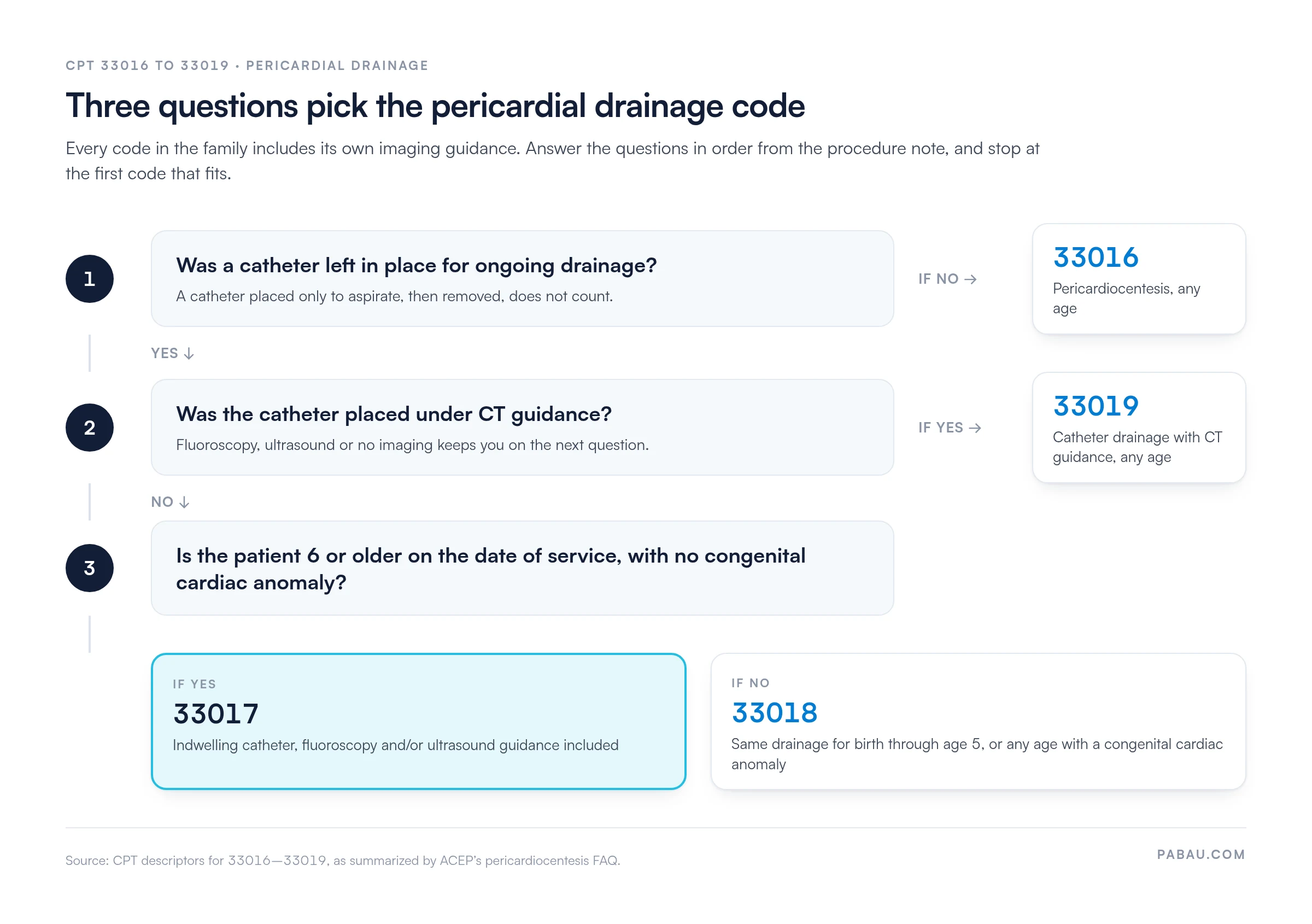
All four codes treat a pericardial effusion through the skin, and all four include their imaging guidance. In short, three questions separate them. Was a catheter left in place? How old is the patient, and do they have a congenital cardiac anomaly? Which imaging guided the placement?
A catheter placed only to aspirate the effusion and then removed at the end of the procedure does not make the service 33017. That is pericardiocentesis, so report 33016. Instead, choose 33017 only when the note shows the catheter stayed in for ongoing drainage. The decision path below runs the three questions in order.
Medical necessity for 33017 rests on the ICD-10-CM code submitted with the claim. Pericardial effusion and tamponade codes are the main supporting diagnoses. Confirm each code against the current CDC ICD-10-CM files before you submit.
Congenital malformations of the circulatory system sit in Q20-Q28. When one of those codes is on the record, the patient falls outside 33017, and 33018 is the code for catheter drainage. Read the record for the anomaly itself, not only the claim’s diagnosis list.
Modifier selection for 33017 follows standard surgical billing rules. The code is a global procedure with no professional and technical split, so -26 and -TC do not apply.
However, modifier -59 draws close review from Medicare contractors. Use it only when NCCI edits would bundle a distinct service, and record the clinical reason in the procedure note. Never use it to unbundle imaging guidance, which 33017 already includes.
Before appending modifier -59 to a 33017 claim, run the code pair through the current CMS NCCI edit table. CMS updates NCCI edits every quarter, so a pair that was allowed last quarter may now be bundled. The check takes minutes, while an incorrect -59 can trigger an audit.
Medicare pays 33017 from the CMS Physician Fee Schedule. Payment comes from three relative value units, for work, practice expense and malpractice. Each is then adjusted for location and multiplied by the annual conversion factor.
Use the CMS Physician Fee Schedule lookup tool to pull the current national and locality payment amounts for 33017. The tool shows facility and non-facility rates. They differ because the practice expense component is lower when a facility covers the costs.
In contrast, commercial payer rates are set by contract and vary widely. Many practices use the Medicare rate as a reference point when they review those contracts.
Prior authorization rules for 33017 vary by payer and plan year, and no single rule applies. Medicare fee-for-service, for instance, does not require prior authorization for this procedure. However, Medicare Advantage plans and commercial payers may set their own requirements.
Confirm requirements with each payer before the procedure date. Insurance eligibility verification before the encounter confirms active coverage and shows any authorization the plan adds. When authorization is required, the request usually includes:
In fact, many 33017 procedures are urgent. Late authorization windows for emergencies are payer-specific, so check each payer’s policy rather than guessing at a standard deadline. Also, record the urgent nature clearly in the procedure note.
Payers and auditors expect the record to show the patient criteria and show that a catheter was left in place. The elements below are the basic checklist for a clean 33017 claim.
Applying medical billing compliance checks to the record before submission is the cheapest way to prevent denials. A clean claim submission for a procedure like this one settles faster than any refiled claim.
A few services are often reported with 33017. Imaging guidance is not one of them, because it is part of the code. Confirm every pair against the current CMS NCCI table before submitting, since edits change each quarter.
The AAPC Codify CPT lookup shows NCCI edit flags next to code descriptors. It also helps coders see which pairs need modifier support before submission.
The denial triggers below come up most often on pericardial drainage claims. Each has a simple prevention step.
Steady denial management workflows help practices spot these patterns across claims and fix the cause before it repeats. For a full reference, the guide to common denial codes in medical billing maps CARC codes to the denial types that appear on 33017 remittances.
Review the last 90 days of 33017 claims once a quarter. Pull the denial rate, the top three denial reason codes, and the average days to payment. A high denial rate on one code usually traces back to one or two causes, such as unbundled imaging or the wrong age band.
Cardiology and cath lab teams often track pericardial drainage claims across a procedure note, a spreadsheet and a clearinghouse portal. As a result, details such as the patient’s age band, the authorization number and the denial reason end up in different places.
Pabau, a practice management platform, keeps those details on one patient record. Pabau’s claims management software submits the claim through its Claim.MD clearinghouse integration, using the codes your team enters. It then tracks the claim status and the remittance that comes back.
Authorization codes and their dates sit on the patient’s case, with a warning when one is missing. Your coders still choose 33017, 33016, 33018 or 33019 from the procedure note, but the follow-up work stays in one place.
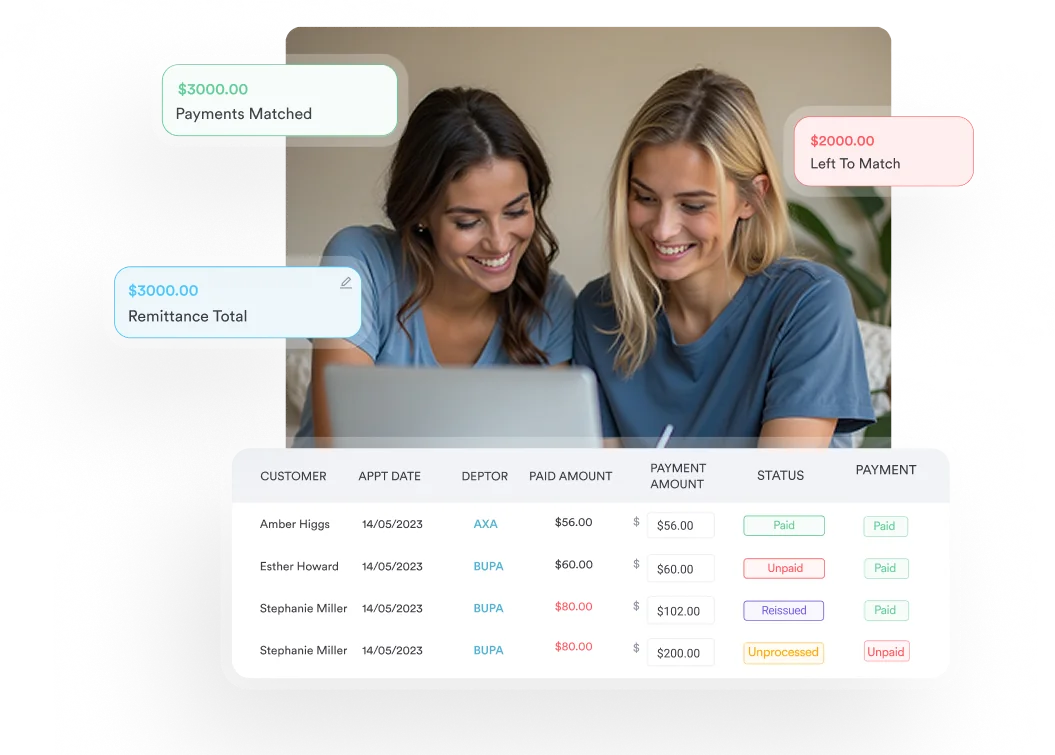

Pabau submits CPT claims such as 33017 through Claim.MD and tracks each response against the patient record. Your team sees authorizations, claim status and remittances in one place.

CPT Code 33017 turns on one fact in the procedure note: a catheter left in the pericardial space for ongoing drainage. Age and congenital status then decide between 33017 and 33018, and CT guidance moves the claim to 33019.
Two checks before submission prevent most denials. No guidance code should sit on top of a code that already includes it, and aspiration alone is never 33017. So build both checks into claim review once, and every claim in the 33016-33019 family benefits.
Book a demo to see how Pabau helps billing teams submit and track procedural claims like 33017.

Need a clearinghouse that handles cardiology CPT submissions? Claim.MD clearinghouse guide explains how the integration connects Pabau to electronic claim submission and ERA matching.
Confused by claim rejection codes on your 33017 remittances? Electronic remittance advice explained breaks down how to read ERA files and act on CARC/RARC codes before resubmission.
Looking to benchmark your overall billing accuracy? Revenue cycle management guide covers the end-to-end workflow from eligibility verification through final payment posting.
CPT Code 33017 reports percutaneous pericardial drainage with insertion of an indwelling catheter. It includes fluoroscopy and ultrasound guidance when performed. It applies to patients aged 6 or older without a congenital cardiac anomaly. Its siblings are 33016, 33018 and 33019.
Code 33016 is pericardiocentesis, where fluid is aspirated and no catheter is left in place. Code 33017 leaves an indwelling catheter for patients 6 and older without a congenital anomaly. Code 33018 is the same drainage from birth through age 5, or at any age with a congenital anomaly. Code 33019 is catheter drainage under CT guidance.
CPT 33017 applies to patients aged 6 years or older on the date of service. For a patient from birth through age 5, report 33018 for the same catheter drainage. Code 33018 also applies at any age when the patient has a congenital cardiac anomaly.
Report 33016. If a catheter is placed only to aspirate the effusion and is removed before the procedure ends, the service is pericardiocentesis. Code 33017 applies only when the catheter stays in place for ongoing drainage.
No. The pericardiocentesis code is 33016, which covers aspiration with imaging guidance included when performed. Code 33017 describes pericardial drainage with an indwelling catheter left in place. Both include their imaging guidance, so neither is billed with separate ultrasound or fluoroscopy guidance codes.