

CCSD code G5100: Bypass of duodenum billing guide
CCSD code G5100 bills a bypass that leaves the duodenum in place CCSD code G5100...

Last Updated: Oct 16, 2026
58562 is the CPT code for hysteroscopy, surgical; with removal of impacted foreign body.
The code sits inside the 58555-58565 hysteroscopy family, and selecting the wrong neighbor code is the most common reason OB-GYN practices see these claims denied. Most confusion centers on the word "impacted". A lost IUD with strings still visible at the cervix is a straightforward removal. An embedded or fractured device requiring hysteroscopic dissection is what 58562 describes.
Let Pabau's smart automation suggest the right codes, reduce claim denials, and keep your practice compliant—effortlessly.
Automate repetitive tasks and focus on what matters most—your patients.
Reduce coding errors and ensure compliance with the latest regulations.
Clean claims, fewer denials, and faster reimbursements.
Powerful insights and reporting to help your practice thrive.
HIPAA compliant SOC 2 certified GDPR-compliant Trusted by 4,000+ clinics worldwide

CPT Code 58562 covers hysteroscopic surgical removal of a physically impacted or embedded foreign body from the uterine cavity, not a routine IUD retrieval.
The operative report must describe the impacted nature of the object, the hysteroscopic approach, and the instruments used for extraction.
Diagnostic hysteroscopy (CPT 58555) is bundled into 58562 per NCCI edits and usually cannot be billed on its own without a modifier override.
Medicare assigns 58562 a 000-day global period, so no post-operative visits are bundled and follow-up care is billed separately.
Practice management software like Pabau submits these claims through Claim.MD and checks each one for administrative completeness before it leaves the practice.
CPT Code 58562 describes hysteroscopy, surgical, with removal of impacted foreign body. The American Medical Association’s CPT code set places it in the surgical endoscopy/hysteroscopy family (58555-58565). The surgical action performed after the hysteroscope enters the uterine cavity defines each code in that family.
A standard operative hysteroscopy sequence guides the procedure covered by 58562. The surgeon dilates the cervix, installs distension media, and inserts the hysteroscope. Next, the surgeon visualizes the foreign body, works it free or fragments it, and extracts it. “Impacted” is the word that separates this code from simpler retrievals. It signals that the object took meaningful surgical effort to remove, beyond grasping and pulling.
Where 58562 sits among the other gynecologic surgical codes matters when one operative session involves multiple procedures. Medicare assigns the code a 000-day global period, which places it in the minor-procedure category rather than the major surgical package.
The term “impacted” is a clinical determination, not a coder’s call. The operative report must make the case, and payers review it closely on audit. These are the objects that often meet the threshold:
The key distinction is that “impacted” implies the object resists routine retrieval. A coder who sees “removed retained IUD” in the operative note, with no further description, should query the physician. That phrasing alone does not confirm the impacted threshold, so defaulting to 58562 is a risk.
Payers treat 58562 claims as audit targets because the “impacted” designation justifies a higher reimbursement than routine hysteroscopy. The operative report must contain all of the following to support the claim, and the absence of any single element is a common denial trigger.
The diagnosis code on the claim must also reflect the documented foreign body with the correct ICD-10-CM specificity. That includes the 7th character extension for encounter type, one of the clean claim submission requirements.
The hysteroscopy family from 58555 to 58565 shares a common setup. What happens after the scope enters the cavity differentiates each code. One principle decides the choice every time. The most specific code that matches the documented procedure wins.
The decision tree is straightforward. If the object is biological tissue (polyp, fibroid), choose 58558 or 58561. If the object is non-biological and its removal required operative instrumentation beyond simple traction, CPT Code 58562 applies. A common error is using 58562 for any IUD removal, including those completed with a simple hook or forceps under direct visualization. That scenario may warrant 58558 or another code depending on the approach.
Payers cross-reference the ICD-10-CM diagnosis code against the procedure code for medical necessity. A mismatched or vague diagnosis is one of the most preventable denial causes on 58562 claims. The rule is to use the most granular code the operative documentation supports.
The 7th character on T19 codes is a frequent claim rejection source. The first procedure for a given foreign body uses “A” (initial encounter). A follow-up visit for the same episode uses “D.” Using “D” on the initial operative claim, or mixing encounter types across related claims, triggers an instant edit at many clearinghouses. The T19 category follows the same 7th-character logic used across the injury and foreign body chapters. Verify the current ICD-10-CM tabular list each fiscal year, since code additions within T19 are possible at annual update.
Run a quarterly review of your 58562 denial log specifically filtering for CO-4 (inconsistent modifier) and CO-11 (diagnosis inconsistent with procedure) denial reason codes. Those two account for most preventable 58562 rejections. Both trace back to ICD-10 specificity and to operative-note wording a coder can correct before submission.
Modifier selection on 58562 claims is an audit trigger. The AAPC Codify CPT lookup provides modifier guidance alongside code descriptors. Your billing team should consult the current NCCI edits table rather than relying on historical practice.
The National Correct Coding Initiative bundles diagnostic endoscopy into surgical endoscopy of the same anatomical site. This directly affects 58562 claims when a diagnostic hysteroscopy (58555) was performed in the same session. That sequence is common, since surgeons confirm the foreign body location under direct visualization before operative removal.
Under standard NCCI logic, do not bill 58555 separately from CPT Code 58562 on the same date of service. The operative fee for 58562 is understood to include the diagnostic visualization. Submitting both without a modifier results in an instant bundling denial.
There is one exception. If the diagnostic hysteroscopy happened at a separate patient encounter, on a different date, 58555 is billable on its own for that date. Modifier 59 may override the NCCI edit where the procedures were distinctly separate in scope. Payers vary on whether they accept that override, and the documentation has to be unambiguous. Verify the current NCCI Procedure-to-Procedure edit table quarterly, as edit pairs update regularly.
Other codes often bundled with or mutually exclusive to CPT Code 58562 in the same session include 58558, 58561, and 58563. Sometimes a single session includes more than one hysteroscopic procedure, such as foreign body removal plus endometrial ablation. Select the primary procedure code and append modifier 51 to any extra procedure, where payer policy permits separate billing. Some commercial payers do not allow multiple hysteroscopy codes on the same date regardless of modifier.
CMS calculates Medicare reimbursement for CPT Code 58562 from the Physician Fee Schedule, using RBRVS. The figures below are the CY2026 national non-facility and facility values from the CMS RVU file. Apply your geographic practice cost index (GPCI) in the CMS lookup tool, since it shifts payment by MAC jurisdiction.
CY2026 has two conversion factors, so the allowable depends on your billing entity. At $33.4009 (non-qualifying-APM), the non-facility total of 11.93 RVUs pays about $398; at $33.5675 (qualifying-APM), about $400. The facility total of 5.84 RVUs pays $195-$196 on the same two factors. The chart below shows which component separates the two settings.
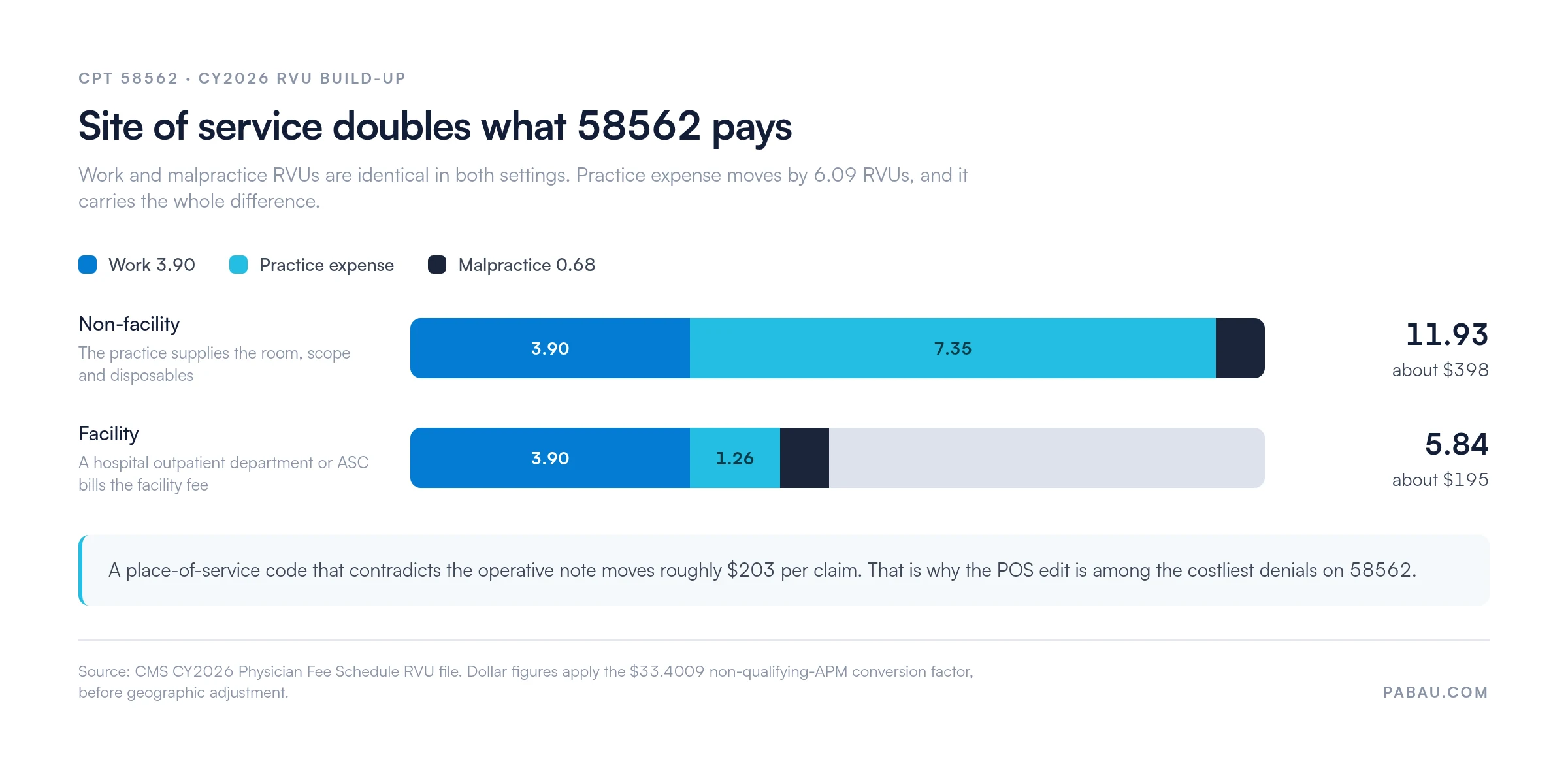
Verify current RVU values and your geographic adjustment in the CMS lookup tool before quoting a figure. Pabau sends electronic claims through Claim.MD, which reaches thousands of US payers, with a maintained CPT catalog that keeps billing off a stale fee schedule.
Prior authorization requirements for CPT Code 58562 vary widely by payer and plan year. There is no universal rule, and stating otherwise creates compliance risk. The following framework reflects general industry patterns rather than a binding payer policy for any specific plan.
Tracking authorization status works at the point of scheduling rather than at the point of claim submission. A PA that expires between approval and the procedure date is a preventable denial.
CPT Code 58562 generates a higher denial rate than routine hysteroscopy codes because it requires documentation that specifically justifies the “impacted” classification. These are the most frequent denial categories and the corrective action for each.
Sorting 58562 denials by CARC code and root cause exposes recurring patterns before they compound into revenue losses. The reference list of denial codes covers the CARC and RARC values that appear on hysteroscopy remittances. The AAPC CPT-to-ICD-10 crosswalk then lets billing staff confirm a medical necessity pairing before the claim reaches the payer.
CPT Code 58562 carries a 000-day global period on the Medicare Physician Fee Schedule, with pre-operative, intra-operative, and post-operative percentages of 0.00. The allowable covers only the procedure and same-day services. No follow-up visits are bundled.
Billing teams that treat 58562 as a major surgical package leave money uncollected and append modifiers the code does not take. Here is what a 000-day designation carries.
CPT 58565, hysteroscopic sterilization by tubal implant, is the exception: it carries a 090-day global period and a larger non-facility practice expense. A practice billing both codes needs two sets of post-operative rules, so check the fee schedule to confirm which applies.
Billing accuracy on CPT Code 58562 depends on information flowing correctly from the operative report through to the claim. Practice management software built for gynecologic surgery works on that path at four points.
Pabau’s claims management software handles that administrative layer. Pabau checks claims for completeness, then submits them electronically to US payers through Claim.MD, with the status message coming back into the same record. The clinical judgment stays with the coder and the surgeon. That covers whether the object was impacted, which T19 character applies, and whether a modifier is defensible.
Keeping documentation, coding, and submission in one system removes the re-keying step. That step is where hysteroscopy codes and modifiers get lost between the operative note and the claim form.
Before submitting any 58562 claim, audit the operative report against four points. Is the hysteroscopic approach confirmed? Is the foreign body described as impacted? Are the instruments and technique noted? Does the diagnosis code 7th character match the encounter type? Claims that pass all four points have a substantially lower denial rate at initial submission.

Pabau checks each claim for administrative completeness, verifies eligibility before the visit, and submits electronically through Claim.MD. Claim status comes back into the same record your OB-GYN coders already work from.

CPT Code 58562 has a narrow application. It covers hysteroscopic removal of a foreign body that required operative instrumentation rather than simple retrieval. The difference between a clean claim and a denial almost always traces back to the operative note. What matters is whether it documents the impacted nature of the object well enough to satisfy a payer’s medical reviewer.
Three habits raise first-pass acceptance on this code. Standardize the 58562 documentation checklist, map the correct T19 codes with accurate 7th characters, and check the NCCI table before a same-date pairing goes out. Those three stay with your coding team. Pabau handles the administrative half, from completeness checks and eligibility to electronic submission through Claim.MD. Book a demo to see that workflow applied to your own hysteroscopy volume.

Getting OB-GYN claims to US payers electronically? Claim.MD clearinghouse integration explains how Pabau submits claims and returns eligibility and status messages.
Coding a routine IUD removal instead? 58301 is the code for a removal that needs no operative hysteroscopy.
Was tissue removed rather than a device? 58558 is the biopsy and polypectomy code in the same hysteroscopy family.
Ablation performed in the same session? 58563 is bundled against 58562 in many payer policies, so read its rules before billing both.
Building the OB-GYN surgical superbill? Medical superbill guide covers how to structure a superbill for hysteroscopy procedures.
CPT Code 58562 describes hysteroscopy, surgical, with removal of an impacted foreign body from the uterine cavity. It is used when operative hysteroscopic instrumentation was required to free, fragment, or extract the object, distinguishing it from simple IUD retrieval or diagnostic hysteroscopy.
Modifier 22 applies when the procedure was far more complex than typical (requires operative narrative). Append modifier 51 when 58562 is billed alongside another surgical code in the same session. Modifier 59 may override an NCCI bundling edit when procedures are clearly distinct. Use modifier 58 when 58562 is a planned staged procedure within a prior surgical global period.
CPT 58562 carries a 000-day global period, so it is treated as a minor procedure. Payment covers the hysteroscopy and same-day services only, and no post-operative visits are bundled. Follow-up care is billed as a standard E/M service, and modifiers 24, 58, and 78 do not apply. Sibling code 58565 is the exception in this family, with a 090-day global period.
Generally no. Per NCCI edits, diagnostic hysteroscopy (CPT 58555) is bundled into the surgical hysteroscopy fee for CPT Code 58562. Billing both on the same date of service results in a CO-97 bundling denial. Modifier 59 can override the edit only where documentation shows a truly separate encounter, and payers review those claims carefully. Verify current NCCI edit tables quarterly as they update.



