CPT code 21011: Excision of soft tissue tumor of the face
CPT code 21011: Official descriptor and procedure overview CPT code 21011, as pu...

Last Updated: Oct 8, 2026

CPT code 29807 is the AMA descriptor for arthroscopic shoulder surgery with repair of a SLAP lesion.
29807 applies to superior labral repairs, while CPT 29806 covers anterior-inferior Bankart repairs. Choosing the wrong one is the leading denial trigger.
A Type I SLAP lesion is usually debrided rather than repaired, so it maps to CPT 29823 instead of 29807.
CPT 29826 is a fixed add-on code, so it needs a listed primary procedure and takes no NCCI bypass modifier.
Pabau’s claims management software runs CPT validation and ICD-10 crosswalk checks at charge capture, before claims reach the payer.
CPT Code 29807 reports the arthroscopic repair of a SLAP lesion, a tear of the superior glenoid labrum. It is a Category I surgical code, and it sits in the Endoscopy/Arthroscopy subsection of the CPT code set.
The code covers superior labral repairs only. Anterior-inferior repairs, known as Bankart lesions, belong to CPT 29806, and mixing the two is the leading denial trigger on shoulder arthroscopy claims. Medical necessity comes from the S43.43 ICD-10 series, and payers expect a laterality modifier on every line.
The official AMA description for CPT Code 29807 is: Arthroscopy, shoulder, surgical; repair of SLAP lesion. The code set is maintained by the American Medical Association (AMA). It reports arthroscopic repair of the superior glenoid labrum, specifically tears classified as SLAP (Superior Labrum Anterior to Posterior) lesions.
CPT Code 29807 is billable when a surgeon repairs a SLAP lesion arthroscopically, confirmed by clinical examination, MRI, or direct arthroscopic visualization. Overhead athletes account for most of the volume, so orthopedic and sports medicine practices report this code most often.
SLAP lesions fall into four types under the Snyder classification, and not every type is repaired. Medical necessity documentation has to name the type and record the failure of conservative management.
The type drives the code, and two of the five findings a shoulder coder meets are not 29807 at all.
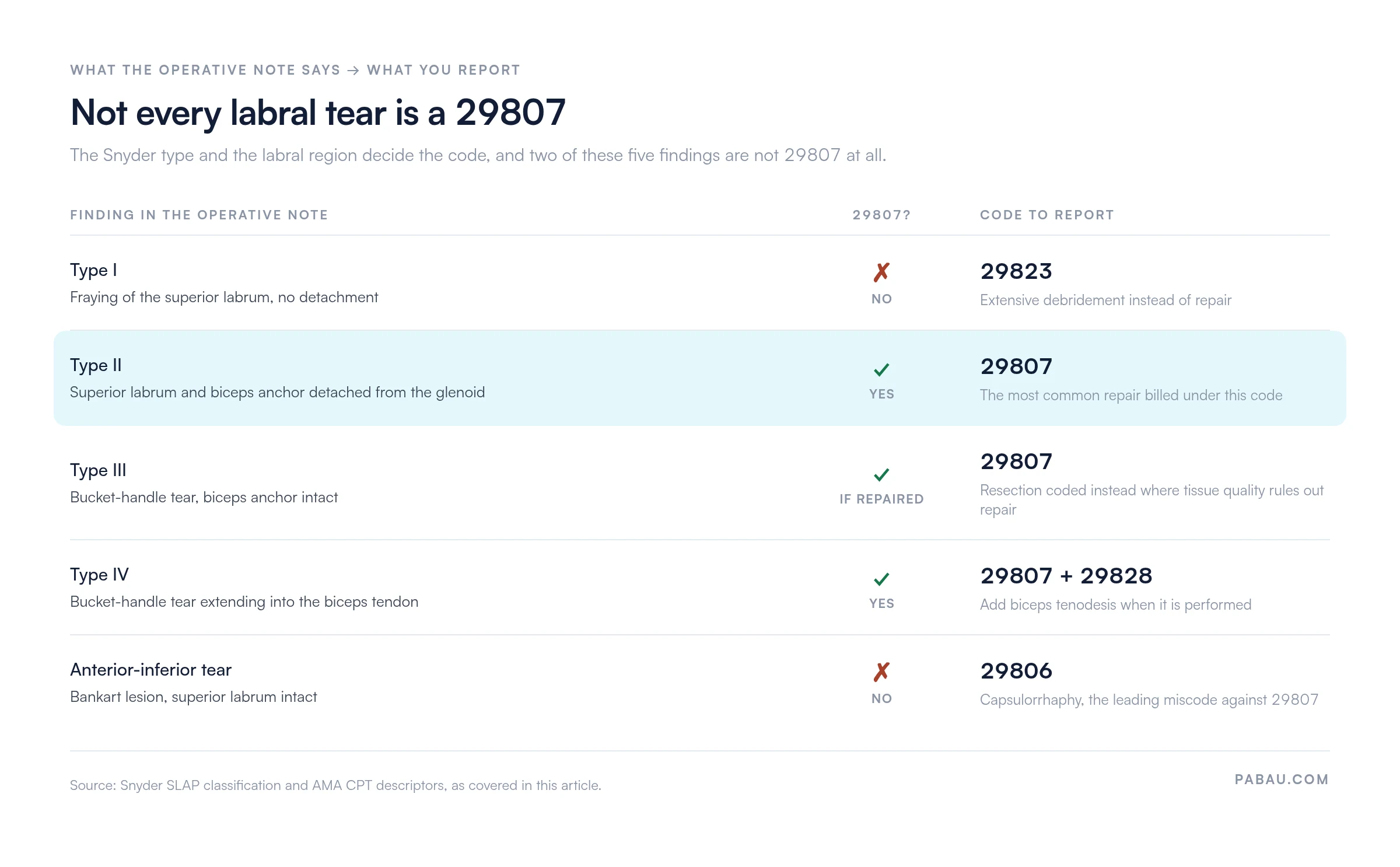
The operative note must establish that the lesion involved the superior labrum, not the anterior-inferior labrum, which maps to CPT 29806. Documenting suture anchor placement, the number of anchors, and the repair technique strengthens the medical necessity record and reduces audit exposure.
The 29807 versus 29806 distinction is where most SLAP repair denials originate. Both codes describe arthroscopic labral repair, but they cover anatomically distinct regions. Submitting the wrong one misstates the procedure performed as well as the charge.
When a SLAP repair and a Bankart repair happen in the same session, both codes may be reported. The operative note has to document each repair as a distinct procedure at a separate anatomical location. Without that specificity, payers bundle one code and deny it.
Every CPT 29807 claim needs a supporting ICD-10 diagnosis code that establishes medical necessity. The CDC/NCHS ICD-10-CM web tool is the authoritative source for confirming that a code is still valid for the current fiscal year.
Always append the correct 7th character extension: “A” for initial encounter (surgical admission), “D” for subsequent encounter (follow-up), and “S” for sequela. Submitting S43.431 without the 7th character produces an invalid code and an automatic claim rejection.
Modifier selection for CPT 29807 depends on the surgical setting, the laterality, and whether other procedures were performed in the same session. Payer policies vary, so verify modifier requirements with each payer before submission.
Bilateral SLAP repair in a single session is rare clinically. When it does occur, append modifier 50 (bilateral procedure) or submit two line items with RT and LT. Payers differ on which they accept, so check the bilateral surgery rules before submitting.
The same payer split runs through other specialties. On CPT 67904, blepharoptosis repair, most Medicare contractors accept modifier 50 while many commercial payers want RT and LT lines.
Route of administration decides code selection on drug lines, not just the modifier. HCPCS code J2792 is the intravenous formulation, so it carries modifier JA, and billing it for an intramuscular dose is a route mismatch denial.
Medicare reimbursement for CPT 29807 is set through the annual CMS Physician Fee Schedule lookup tool, which publishes facility and non-facility rates. Pull your locality-specific rate from that tool. National averages are useful for reference, but they should not be used for claim submission without GPCI verification.
Practices that submit 29807 claims electronically route them through a clearinghouse, which reaches thousands of payers and carries its own CPT and ICD-10 catalogues.
That catalogue check is what stops a mistyped code before the claim reaches the Medicare Administrative Contractor (MAC). Take your 2026 RVU values from the CMS file itself rather than an aggregator, since third-party listings lag the annual update.
CPT 29807 belongs to a family of shoulder arthroscopy surgical codes. Reading the family together helps a coder pick the most accurate code, avoid unbundling errors, and report co-procedures correctly.
One relationship in that table gets described incorrectly almost everywhere. CPT 29826 is a fixed add-on code under the CMS Type 1 designation.
It carries no procedure-to-procedure edit against its listed primaries, and 29807 is one of them. So there is no bundling to bypass and no modifier 59 or XS to append. What the payer needs on that line is the primary procedure on the same claim.
Check the current quarter NCCI (National Correct Coding Initiative) edits before you report CPT 29807 with 29823 or 29806. Edit status changes each quarter, and a pair that paid in Q1 can bundle in Q2. Add-on codes such as 29826 are the exception, because they carry no procedure-to-procedure edit against their primaries. Pull the current NCCI table from cms.gov before you submit any multi-code shoulder claim.
Payers deny CPT 29807 claims for documentation deficiencies more often than for the wrong code. The operative note is the claim’s medical necessity record, so a pre-billing checklist should read it before the charge goes out.
The operative report for CPT 29807 must include all of the following elements to withstand payer review:
Prior authorization is a separate requirement, and many commercial payers apply it to CPT 29807. An eligibility and authorization check belongs in the workflow before the procedure date. Practices that verify eligibility in real time catch a missing authorization while the surgery can still be rescheduled.
Orthopedic billing teams see a predictable set of denial patterns on 29807 claims, and each one is preventable with a workflow control. Our denial code reference explains the CARC codes that appear on the explanation of benefits, which is where these patterns surface first.
Run a quarterly denial audit on your CPT 29807 claims using the ERA reports from your clearinghouse. Filter by CARC. CO-4 flags a procedure code inconsistent with the modifier used, or a required modifier that is missing. CO-97 flags payment already included in another adjudicated service. If one reason passes 15% of your 29807 volume, the fix is a workflow change rather than a run of appeals.
The same laterality and encounter-type requirements apply to every surgical claim. A control you build for shoulder codes usually pays off across the rest of the surgical schedule too.
A code reference answers one question, which is what to bill. It does nothing about the mistyped codes, missing modifiers, and unbundling errors that come back as denials weeks later. Those start at charge capture, so the control has to sit there too.
Practice management software like Pabau checks the CPT code, the modifier set, and the ICD-10 crosswalk while the charge is still being entered.
Pabau’s claims management software submits through the Claim.MD clearinghouse in the 837P format, and it reaches thousands of payers. Eligibility checks run in real time, and ERA (835) remittances match back against the charge automatically.
For shoulder surgery that order matters. Staff confirm that a plan covers arthroscopy before the procedure date, instead of finding the missing authorization on a denied claim. Denials then group by CPT code in reporting, so you can see whether 29807 is failing at one payer or across all of them.

Pabau’s claims management integration validates CPT codes, modifiers, and ICD-10 crosswalks at charge capture, so shoulder arthroscopy claims reach payers clean the first time.

CPT Code 29807 bills cleanly when the operative note names the superior labrum, the biceps anchor, and the fixation used. Most denials trace back to a note that skipped one of those three. The rest come from a missing laterality modifier, or a code assigned before anyone read the report.
Two habits are worth building. Route every shoulder claim through a pre-billing check that reads the operative note against the code, and audit your 29807 denials once a quarter. Both cost less than the resubmission cycle they prevent.
Claims validation at charge capture makes both habits routine instead of a monthly scramble. Book a demo to see how Pabau handles surgical billing, from charge entry through to remittance matching.

Need to understand how electronic claims reach payers? Medical claims clearinghouse overview explains how 837P files, ERA remittances, and payer routing work end to end.
Want to reduce surgical billing errors before they become denials? Clean claim standards and requirements covers the validation checks every surgical claim should pass before submission.
Looking for guidance on insurance credentialing for orthopedic providers? How to get credentialed with insurance companies walks through the payer enrollment process for surgical practices.
CPT Code 29807 is used to report arthroscopic surgical repair of a SLAP (Superior Labrum Anterior to Posterior) lesion of the shoulder. It applies when a surgeon uses arthroscopic technique to reattach the detached or torn superior glenoid labrum, typically with suture anchors. This code does not apply to anterior-inferior (Bankart) labral repairs, which are reported with CPT 29806.
CPT 29807 covers repair of the superior glenoid labrum (SLAP lesion), while CPT 29806 covers capsulorrhaphy and repair of the anterior-inferior labrum (Bankart lesion). The anatomical distinction is the billing distinction. A superior labral repair is 29807, and an anterior-inferior repair is 29806. Both can be reported in the same session with modifier 59 or XS when separate repairs are performed at each anatomical site.
Medicare reimbursement for CPT 29807 varies by geographic locality and setting (facility vs. non-facility). The authoritative source for current figures is the CMS Physician Fee Schedule Look-Up Tool at cms.gov, which is updated annually. Published rates from third-party aggregators may lag behind the official PFS update, so verify any figure against the current CMS data file before you submit.
The modifier most often required on a CPT 29807 claim is RT or LT for laterality. Modifier 59 or XS applies when 29807 and 29806 are both reported for separate repairs. Modifier 22 covers a procedure of significantly increased complexity, with supporting documentation. Modifier 51 applies to the secondary procedure when multiple arthroscopy codes are billed together. Payer requirements vary, so verify each payer’s modifier rules before submission.
The primary ICD-10 codes for CPT 29807 come from the S43.43 series. They are S43.431A for the right shoulder, S43.432A for the left, and S43.439A when laterality is unspecified, each for an initial encounter. Secondary diagnosis codes from the M75 series (rotator cuff syndrome) may be added when concurrent shoulder pathology is documented in the operative report.
Yes. CPT 29826 is a fixed add-on code, so it is reported with a listed primary procedure, and 29807 is one of those primaries. There is no procedure-to-procedure NCCI edit between the two codes, so no modifier 59 or XS is needed to bypass a bundle. Report 29826 on the same claim as its primary procedure, and append no bypass modifier to that line.
The operative report for CPT 29807 must document arthroscopic visualization of the SLAP tear and the biceps anchor assessment. It also needs the repair technique, the suture anchor type and number, and the anchor placement locations. Pre-operative evidence of failed conservative treatment completes the record. Missing any of these elements leaves the medical necessity record incomplete, which typically results in a payer denial or a post-payment audit recovery request.
The most frequent denial reasons for CPT 29807 are wrong code selection between 29807 and 29806, and a missing laterality modifier. Others include an add-on code such as 29826 reported without its primary procedure, and an invalid or incomplete ICD-10 code. Missing medical necessity documentation and missing pre-authorization round out the list. Most of these are preventable through pre-billing charge review and real-time eligibility verification.