



CCSD code G5100: Bypass of duodenum billing guide
CCSD code G5100 bills a bypass that leaves the duodenum in place CCSD code G5100...

Last Updated: Oct 16, 2026

CPT code 27446 covers unicompartmental knee arthroplasty, meaning the medial or the lateral compartment, never both.
The operative note decides between 27446 and 27447, so it has to name the compartment that was resurfaced.
Every 27446 claim carries LT or RT, and modifier 50 covers both knees treated on the same date.
The diagnosis has to match the knee you billed, which makes the unspecified code M17.9 a fast route to review.
Most rejections trace back to three things: laterality, compartment wording, or a thin conservative treatment history.
CPT code 27446 is the procedure code for arthroplasty of the knee, condyle and plateau, medial OR lateral compartment. In plain terms, it is the partial knee replacement code. One tibiofemoral compartment gets resurfaced, and the rest of the joint is left alone.
That capitalized “OR” is the whole billing story. Resurface both tibiofemoral compartments and the correct code becomes 27447 instead. So the operative note has to name the compartment, and the claim has to carry LT or RT.
What follows is the detail that keeps these claims moving: the rates, the modifiers, the diagnosis pairing, and the notes payers will read.
CPT code 27446 is the billable code for arthroplasty, knee, condyle and plateau, medial OR lateral compartment.
That wording comes straight from the American Medical Association’s CPT code set, and it sits in the Musculoskeletal System surgery section.
The knee has three compartments: medial tibiofemoral, lateral tibiofemoral, and patellofemoral. Code 27446 covers resurfacing of the condyle and plateau in exactly one of the first two.
Surgeons call it a unicompartmental or unicondylar replacement. Read the descriptor literally, because that “OR” sets an anatomical limit on what the code can cover.
Payers approve 27446 when the arthritis sits in one compartment and the rest of the joint still works.
The surgeon removes and resurfaces the cartilage and subchondral bone of one tibiofemoral compartment. A femoral component goes on the condyle, a tibial component on the plateau. A single focal cartilage defect calls for a different operation, and the open osteochondral allograft that treats it is reported with 27415.
Because the procedure preserves the anterior cruciate ligament and the untouched compartment, that preserved anatomy is what supports the code.
If the ACL is gone, or the opposite tibiofemoral compartment is badly involved, the clinical picture points to a total arthroplasty instead. Reviewers know this, so they read the imaging notes closely.
On medical necessity, payers want documented evidence that the disease is confined to one compartment. Qualifying indications usually include:
That last point causes the most trouble later. Conservative care is easy to capture while it is happening, and painful to reconstruct months afterward for a prior authorization request.
Compartment involvement decides the code, and nothing else does. Implant brand, surgical approach, and robotic assistance have no bearing on it.
27447 is the total knee arthroplasty code, covering both tibiofemoral compartments, with patella resurfacing at the surgeon’s discretion. The diagram below shows how the two codes split on the operative note alone.
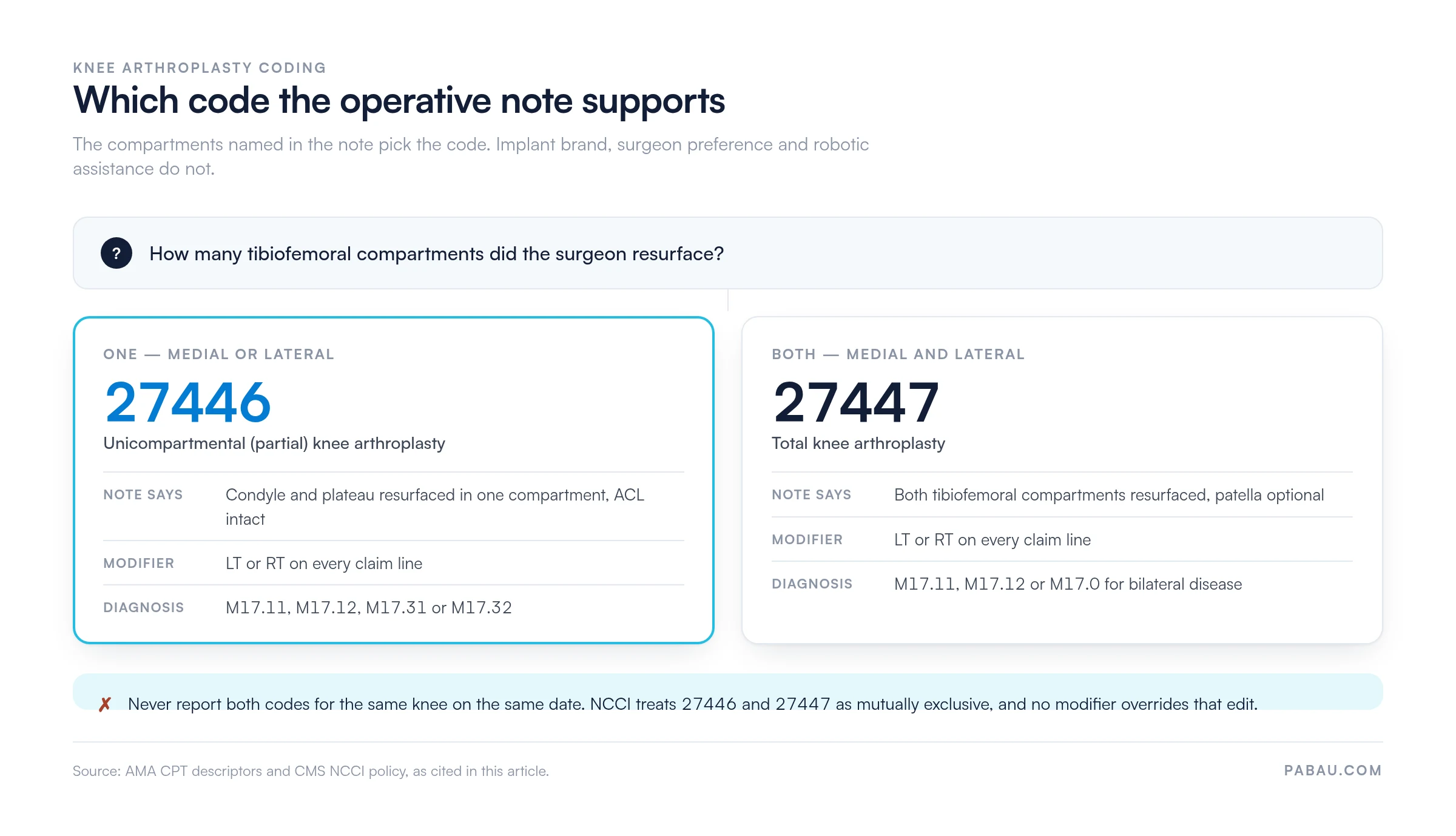
The National Correct Coding Initiative, known as NCCI, treats 27446 and 27447 as mutually exclusive for the same knee on the same date of service.
Submitting both would need supporting documentation that almost never exists in practice. Payers reject the pair as a bundling violation.
Medicare pays 27446 from Relative Value Units, not from a fixed national price. The Medicare Physician Fee Schedule holds the current values, and the Geographic Practice Cost Index then adjusts them for your locality.
So two identical claims in different states pay differently.
Here is how that plays out. A medial compartment replacement on the left knee, done in a hospital outpatient department, goes out as 27446-LT with M17.12.
The surgeon is paid on the facility values in the table above. The hospital bills its own facility claim for the same encounter, which is why the physician line looks small on its own.
Commercial contracts usually start from the Medicare rate and negotiate upward. Rather than assume parity, pull your own contracted rate for 27446 before you quote a patient. Pull the Medicare figure fresh each January too, since the values move every year.
A laterality modifier is mandatory on 27446. Submitting the code without LT or RT is one of the most common clean-claim failures across Medicare and commercial payers.
Several other modifiers apply to specific billing scenarios, and the table sorts them out.
Bilateral billing needs a second look before you send it. Medicare pays roughly 150% of the single-procedure rate for bilateral procedures on the same date.
Many commercial payers apply their own reduction rules instead, and some want LT and RT on separate lines rather than modifier 50.
The ICD-10 code on a 27446 claim has to document the compartment and the side. Put M17.11 for the right knee on a claim carrying modifier LT and the edit fires automatically, before a human ever reads the claim.
The laterality has to agree on every line. Our ICD-10-CM codes index is the quickest way to check a neighboring code.
Keep M17.9 off 27446 claims altogether. Reviewers running a medical necessity check expect a laterality-specific diagnosis. The unspecified code reads as incomplete documentation, and it invites an information request or a flat denial.
The record has to prove both the diagnosis and the surgical approach before a payer will process the claim. Thin operative notes are the main driver of post-payment audits on this code.
Six items carry most of the weight:
Pull your last six months of 27446 claims and sort them by diagnosis code. If M17.9 appears at all, the problem sits upstream in the operative note, not in the billing office. Fixing the note template is faster than appealing the claims one by one.
Traditional Medicare does not universally require prior authorization for 27446, but many Medicare Advantage and commercial plans do.
Requirements also change often, plan by plan. Verify them before the surgery is booked, never at the point of billing, because an unmet authorization after the fact is rarely recoverable.
CMS sets medical necessity criteria through Local Coverage Determinations, or LCDs, written by each Medicare Administrative Contractor. Criteria vary by jurisdiction, but most contractors look for the same things:
You can read the active LCDs for knee arthroplasty in the CMS Medicare Coverage Database. Before you add any adjunct code to a 27446 claim, check the NCCI edits for the pair.
Orthopedic surgery codes are among the most heavily audited in outpatient and ASC settings.
Knowing the route helps, because most 27446 denials happen at a handoff rather than in the billing software. A clean claim usually travels like this:
Steps two and three are where the money is won or lost. If the dictation and the code disagree, no amount of clean submission fixes it. The appeal then costs more staff time than the correction would have.
Knee arthroplasty cases bring a small cluster of related codes with them. Knowing the boundaries between them prevents both mis-selection and NCCI bundling problems.
The two revision rows in that table assume a total knee prosthesis is already in place. 27487 applies only when the femoral component and the entire tibial baseplate are removed and replaced, so a partial knee never qualifies.
This code denies more often than other major surgical codes, because the clinical detail behind it is narrow and specific. Four errors account for most of the rejections.
This is the most common error on these claims. Intentional or not, it counts as upcoding, and it triggers post-payment recovery. Reviewers compare the compartment language in the note against the billed code. Read the note for “medial compartment” or “lateral compartment” before you choose between the two codes.
Sending 27446 with no laterality modifier, or pairing modifier RT with M17.12, produces an automatic edit. No clinician reviews these. They are system-level rejections, and the fix belongs at the pre-submission scrubbing stage rather than after the remittance posts.
Many practices record conservative treatment across a dozen progress notes and never pull it together. A reviewer wants one clear timeline, not a reading exercise. Filing a consolidated conservative treatment summary as its own document in the record cuts information request turnaround dramatically.
Choosing M17.9 over M17.11 or M17.12 tells the payer the documentation is incomplete. Specificity means matching the code to the detail already in the record. Picking the broadest available option is what invites the review. In a high-volume practice, an audit of six months of 27446 claims will usually surface M17.9 as a recurring pattern.
Two minutes on this list is cheaper than a 30-day appeal. Work through it before the claim leaves the practice:
If any line fails, hold the claim and fix the record first. A query to the surgeon takes a day. Denials take a month, and they usually come back asking for the same information.
In most orthopedic practices the 27446 trail is split across systems. The operative note sits in one place, and the authorization in an email thread. The claim lives in a billing tool, and the remittance in a bank file. Reconstructing all of it for an audit takes hours nobody has.
Practice management software like Pabau keeps that trail on one record, with claims management built in. The procedure code attaches to the encounter, and the supporting documents stay with the patient file.
Claims go out electronically to thousands of US payers through the Claim.MD clearinghouse. Remittances post back against the same record.
So when a 27446 claim is questioned six months later, the whole trail sits in one thread. The note, the code, the submission, and the payer’s response are all there. Your team answers the request instead of assembling it.

Pabau attaches procedure codes to the encounter they came from, submits claims electronically, and posts remittances back against the same patient record. Your coders stop chasing paperwork across systems to answer a payer request.

Billing 27446 comes back to one word in the descriptor: “OR.” Medial or lateral, one compartment, not both. When the note, the diagnosis, the modifier, and the code all agree on that single fact, these claims clear on the first pass.
So the work is upstream of the billing office. Fix the dictation template so the compartment is always named, and the denials mostly stop. Keep treating it as a claims problem and you will keep appealing the same rejection every month.
If your 27446 documentation currently lives in four systems, that is what to change first. Book a demo to see how Pabau keeps the operative note, the procedure code, and the claim on one patient record.

Need to understand the clearinghouse submission process? EDI 837 file submission explains how CPT claims reach payers electronically and what the file format requires.
Want to reduce claim denials before they reach the payer? Clean claim requirements covers the pre-submission checklist that orthopedic billing teams use to prevent edits.
Handling ERA reconciliation after 27446 payments post? Electronic remittance advice (ERA) explains how 835 files map back to your CPT claims and what denial codes to watch for.
Yes, 27446 carries a 90-day global surgery period. Routine post-operative visits inside those 90 days are bundled into the surgical payment. A planned return to the operating room needs modifier 78, and an unrelated procedure needs modifier 79. Confirm the global indicator on the current fee schedule.
Report only the procedure the surgeon completed, which is 27447. Do not bill 27446 alongside it, and do not bill the abandoned partial separately. The operative note should explain why the plan changed, because payers often ask for that detail on review.
Yes. Partial knee arthroplasty has been on Medicare’s ASC covered procedures list for years, so the case does not have to happen in a hospital. The surgeon still bills the professional fee at facility rates, and the ASC bills its own facility claim.
Modifier 79 covers an unrelated procedure by the same surgeon during a global period. Pair it with the laterality modifier for the second knee. Without modifier 79, the payer reads that second claim as post-operative care and denies it.
Send a provider query before the claim goes out. Guessing between 27446 and 27447 risks either underpayment or an upcoding finding. A short addendum naming the medial or lateral compartment usually settles it within a day.



