

CCSD code G5100: Bypass of duodenum billing guide
CCSD code G5100 bills a bypass that leaves the duodenum in place CCSD code G5100...

Last Updated: Oct 16, 2026
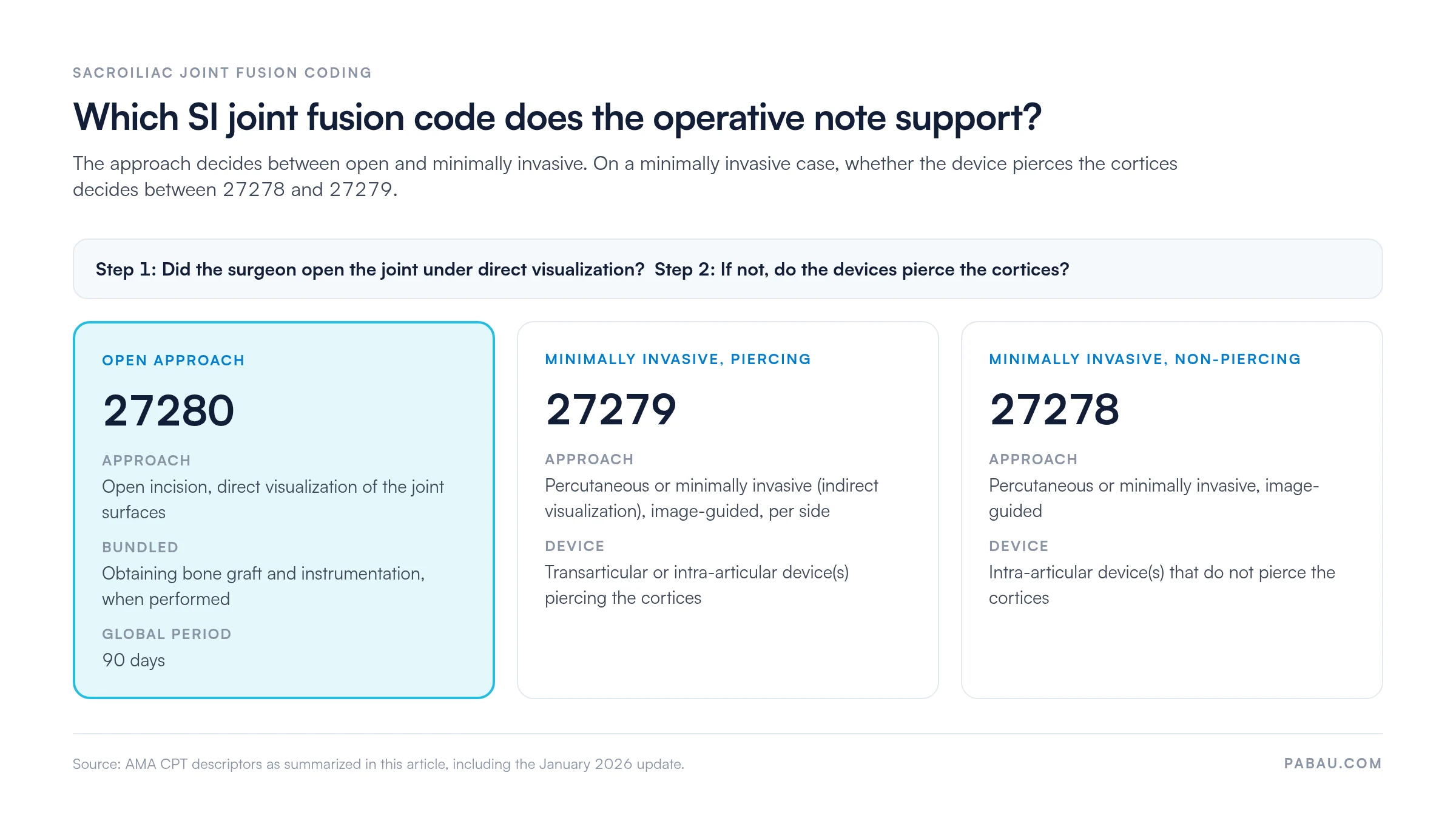
27280 is the CPT code for open arthrodesis of the sacroiliac joint, which includes obtaining bone graft and instrumentation when performed. The surgeon fuses the joint through an incision, with direct visualization of the joint surfaces.
Minimally invasive SI joint fusion is reported with 27278 or 27279 instead. Both are percutaneous or minimally invasive, image-guided, per-side codes, so the operative note's description of the approach decides the code.
Let Pabau's smart automation suggest the right codes, reduce claim denials, and keep your practice compliant—effortlessly.
Automate repetitive tasks and focus on what matters most—your patients.
Reduce coding errors and ensure compliance with the latest regulations.
Clean claims, fewer denials, and faster reimbursements.
Powerful insights and reporting to help your practice thrive.
HIPAA compliant SOC 2 certified GDPR-compliant Trusted by 4,000+ clinics worldwide

CPT code 27280 describes open sacroiliac joint arthrodesis, distinct from the minimally invasive fusion reported with 27279 or 27278.
Medicare covers 27280 under specific LCD criteria, and documented conservative treatment failure and diagnostic injection results are standard prerequisites.
A 90-day global surgical package applies, so routine post-op visits are bundled into the procedure payment.
Most commercial payers, Medicare Advantage plans, and workers’ compensation carriers require prior authorization for this procedure.
Obtaining bone graft and instrumentation are both bundled into 27280, so neither is billed separately, whatever the harvest site.
CPT code 27280 covers open arthrodesis of the sacroiliac joint, as defined by the American Medical Association (AMA) CPT code set. “Arthrodesis” means surgical fusion. The surgeon removes cartilage from the joint surfaces and packs bone graft into the space. Fixation hardware then holds the two bones while they fuse over weeks to months.
The procedure uses an open approach. The surgeon makes a direct incision and sees the joint under direct line of sight, rather than placing hardware percutaneously under image guidance alone. The code sits with the other pelvis and hip joint procedures in our searchable CPT code library.
The descriptor says 27280 “includes obtaining bone graft, including instrumentation, when performed.” Bone graft is bundled into the code wherever it was harvested, and so is the fixation hardware. Neither can be billed separately.
Knowing what the code bundles prevents unbundling errors that trigger NCCI audit flags.
Included in 27280 (not separately billable):
Potentially separately reportable (verify NCCI edits before billing):
Posterior spinal instrumentation add-on codes cannot be reported with 27280. Always confirm National Correct Coding Initiative (NCCI) column assignments against the current-year CMS NCCI Policy Manual before billing any add-on alongside 27280. Rules change with annual updates.
27280 is the open code, and minimally invasive sacroiliac joint fusion is reported with 27279 or 27278 instead. 27279 covers a percutaneous or minimally invasive approach (indirect visualization), with image guidance, per side, with devices that pierce the cortices.
Since the January 2026 CPT update, 27278 covers the same approach with intra-articular devices that do not pierce the cortices. Payers treat open and minimally invasive fusion as separate procedures with different coverage criteria. Coding one when the operative note describes another is an audit risk.
The operative note must state whether the surgeon opened the joint under direct visualization. On a minimally invasive case, it must also say whether the devices pierce the cortices. An ambiguous note will likely land on a lower-paying code or trigger a medical records request, so the panel below walks through the two-step decision.
Payers expect a diagnosis code that clinically justifies open sacroiliac fusion. The CMS ICD-10-CM code files list every valid code. The table below covers the diagnoses most often seen on SI joint fusion claims, but each payer’s own covered list has the final say.
Sacroiliitis coded as M46.1 carries the strongest signal when the record shows conservative treatment has failed. Payer-specific ICD-10 edits still apply. A diagnosis covered under the Medicare LCD may still be denied under a commercial payer’s own clinical policy. Verify each payer’s accepted code list before submitting.
Medicare covers sacroiliac joint fusion under policies maintained by Medicare Administrative Contractors (MACs). SIJ fusion coverage is contractor-specific, so indications and exclusions vary by MAC jurisdiction. Noridian, CGS, Palmetto, and WPS each maintain their own policies, and their requirements can differ meaningfully.
Common coverage indications across most MAC LCDs include:
The diagnostic injection is billed on its own with 27096, and its pain scores become part of the evidence for the fusion claim. Search the CMS Medicare Coverage Database for the current LCD in your MAC jurisdiction before submitting a 27280 claim. LCDs are updated periodically, and a policy that was valid six months ago may carry new documentation requirements now.
Most commercial payers, most Medicare Advantage plans, and virtually all workers’ compensation carriers require prior authorization for CPT 27280. Traditional fee-for-service Medicare does not require it. Even so, MAC LCDs create a de facto documentation standard that serves the same gating function.
Documentation typically required to support a prior auth submission:
Prior auth requirements vary by payer, plan type, and geography. Never assume approval for one plan carries to another, even within the same insurer family. Workers’ compensation billing for 27280 follows jurisdiction-specific fee schedules and authorization rules, which differ substantially from commercial payer requirements.
The CMS Physician Fee Schedule Look-Up Tool gives the current Relative Value Units (RVUs) and locality-adjusted payment rates for 27280. Medicare payment rates change on January 1 each year, so verify current figures through the CMS tool rather than relying on any published table.
The tool breaks the payment into work, practice expense, and malpractice RVUs, then adjusts each one for the locality. CY2026 uses two conversion factors: $33.5675 for qualifying alternative payment model participants and $33.4009 for everyone else. Check which one applies to the operating surgeon before you estimate the payment.
Commercial payer rates for 27280 vary widely. Some payers pay a multiple of Medicare rates, while others apply their own fee schedule. Your contract with each payer is the only reliable source for its rate.
CPT 27280 carries a 90-day global surgical package. For 90 days after the procedure date, routine post-operative care is bundled into the surgical payment. Separate E/M codes for wound checks, suture removal, brace changes, or standard progress visits in this window will be denied.
What is included in the 90-day global:
What can be separately billed during the global period:
Set a calendar alert at 91 days post-surgery for each 27280 case. Billers who do not track global period end dates often submit routine E/M codes too early, and each denial then needs an appeal.
The operative note is the claim’s primary supporting document. For 27280, it must make the open approach and the full fusion process clear to an auditor who has never spoken to the surgeon. Strong medical billing compliance at the documentation stage prevents most 27280 denials before they occur.
An operative note that supports 27280 must clearly document:
Review the operative note against the claim at the coding stage, before submission. A missing approach statement or graft detail is quick to fix with a query to the surgeon, and slow to fix through an appeal.
27280 claims deny for predictable reasons. Most denials trace back to one of six failure points:
For a high-value surgical code like 27280, denial management workflows work best as a pre-submission checklist tied to the operative note. Review each claim against clean claim submission standards before sending it.
A 27280 claim passes through several hands: the surgeon’s operative note, the coder, the prior auth coordinator, and the biller. Each handoff is a chance for the approach, the diagnosis, or the auth number to drift out of step with the record.
Pabau, the practice management platform we build, keeps the patient record, clinical notes, and invoices in one system. Its end-to-end claims management submits and tracks claims electronically through Claim.MD. Your billing team can see where each 27280 claim stands without logging in to a separate portal.
For workers’ compensation 27280 cases, keep the payer-specific fee schedule separate from your commercial plans. Workers’ comp reimbursement follows state fee schedules. It often needs authorization from the employer or third-party administrator on top of clinical pre-authorization.

Pabau keeps the patient record, clinical notes, and invoices together, and submits claims through Claim.MD. Your team can follow each 27280 claim without a second portal.

Payers look hard at every 27280 claim because open SI joint fusion pays well. The work that protects the claim happens before surgery. That means an operative note that names the open approach, six months of documented conservative care, and an auth number on file.
If the note leaves the approach unclear, hold the claim until the surgeon clarifies it. A query takes a day, while an appeal over 27280 versus 27279 or 27278 can take months.
To see how Pabau keeps surgical documentation and claim submission in one system, book a demo.

Need a framework for managing claim denials across surgical codes? Denial management in healthcare covers the workflows and escalation processes that reduce denial rates for high-value procedures.
Submitting 837P claims electronically for surgical procedures? Understanding the 837 EDI file explains the transaction format, loop structure, and common submission errors for professional claims.
Want to understand how clearinghouse submissions work for musculoskeletal codes? Medical claims clearinghouse guide explains how payer routing, validation, and ERA return work in a standard clearinghouse workflow.
Billing the minimally invasive version of the procedure? CPT code 27279 covers percutaneous SI joint fusion and how to document it.
Coding the diagnostic injection before fusion? CPT code 27096 explains how to bill the sacroiliac joint injection that confirms the pain generator.
CPT code 27280 is the procedure code for open arthrodesis of the sacroiliac joint, which includes obtaining bone graft and instrumentation when performed. It covers open surgical fusion of the SI joint through an incision, with direct visualization, joint surface preparation, bone grafting, and fixation.
Yes, Medicare covers CPT 27280 when coverage criteria in the applicable MAC Local Coverage Determination are met. Documentation requirements typically include confirmed SIJ pathology on imaging, failure of at least 6 months of conservative treatment, and positive diagnostic SIJ injection results. Coverage criteria vary by MAC jurisdiction, so verify the LCD specific to your geographic area.
The global period for CPT 27280 is 90 days. Routine post-operative E/M visits, wound checks, suture removal, and dressing changes are bundled into the surgical payment and cannot be separately billed during this window. Services for unrelated conditions or complications requiring return to the OR may be separately reported with appropriate modifiers.
ICD-10-CM codes often paired with CPT 27280 include M46.1 (sacroiliitis), M53.3 (sacrococcygeal disorders), and S33.2XXA or S33.2XXD for traumatic dislocation of the sacroiliac joint. The chosen diagnosis must match the documented clinical findings and appear on the payer’s covered diagnosis list for SIJ fusion.
The billing code for a sacroiliac joint injection is CPT 27096, which covers injection into the SI joint under image guidance. It is a separate code from 27280. The injection is often part of the pre-surgical workup, confirming the SIJ as the primary pain generator before fusion.



