HCPCS Code J1110: Dihydroergotamine mesylate injection billing guide
HCPCS Code J1110: Official descriptor and drug overview HCPCS Code J1110 is the ...

Last Updated: Oct 29, 2026
26990 is the CPT code for incision and drainage, pelvis or hip joint area; deep abscess or hematoma. It covers opening past the fascia to drain pus or blood from the deep soft tissue of the pelvis or hip, outside the joint itself.
A collection above the fascia is coded 10060 or 10061 instead, and drainage of the hip joint space is 27030. Medicare gives 26990 a 90-day global period and 7.75 work RVUs for 2026.
Let Pabau's smart automation suggest the right codes, reduce claim denials, and keep your practice compliant—effortlessly.
Automate repetitive tasks and focus on what matters most—your patients.
Reduce coding errors and ensure compliance with the latest regulations.
Clean claims, fewer denials, and faster reimbursements.
Powerful insights and reporting to help your practice thrive.
HIPAA compliant SOC 2 certified GDPR-compliant Trusted by 4,000+ clinics worldwide

CPT Code 26990 covers incision and drainage of a deep (subfascial) abscess or hematoma in the pelvis or hip area, outside the joint itself.
The 90-day global surgical package bundles routine post-op visits, and modifier 78 covers an unplanned return to the OR within that window.
Add LT or RT when the collection is clearly one-sided and the payer asks for laterality, since a midline pelvic collection may take neither.
Drainage inside the hip joint is coded 27030, and Medicare’s bilateral indicator of 0 means 26990 earns no 150% bilateral payment.
CPT Code 26990 describes “Incision and drainage, pelvis or hip joint area; deep abscess or hematoma,” as published by the American Medical Association. The code sits within the Musculoskeletal System section of the CPT manual, subsection covering the pelvis and hip joint.
First, the surgeon opens tissue past the fascia to drain pus or blood from the deep soft tissue of the pelvis or hip. The collection sits outside the joint space. In short, depth separates 26990 from the superficial drainage codes, and location separates it from 27030, which drains the hip joint itself.
CPT Code 26990 covers surgical drainage of a deep, subfascial abscess or hematoma whose anatomical location is the pelvis or hip joint area. Two conditions must both hold. First, the lesion must be deep (past the fascia). Second, it must sit in the pelvis or hip area outside the joint space.
The exclusions matter as much as the inclusions, because a miscoded drainage usually belongs to a neighboring code family. A superficial abscess, for example, is billed as 10060 or 10061.
Knowing the surgical steps helps coders find the note language that justifies 26990. It also separates 26990 from simpler drainage procedures.
Every step above maps to a note requirement. For example, a note that says only “incision and drainage of hip abscess” without fascial depth will trigger a depth-classification denial.
The operative note is the claim. Payers use automated edits that flag missing elements before a human reviewer sees the record. Therefore, meeting billing compliance requirements for CPT 26990 means the following elements must be clear, not implied.
A clean claim for CPT 26990 has these elements in place before it leaves the practice, so problems do not surface during an appeal.
CPT 26990 sits next to two hip codes that describe similar surgery for different findings. The deciding factors are where the collection sits and whether a prosthesis comes out, as the chart below shows.
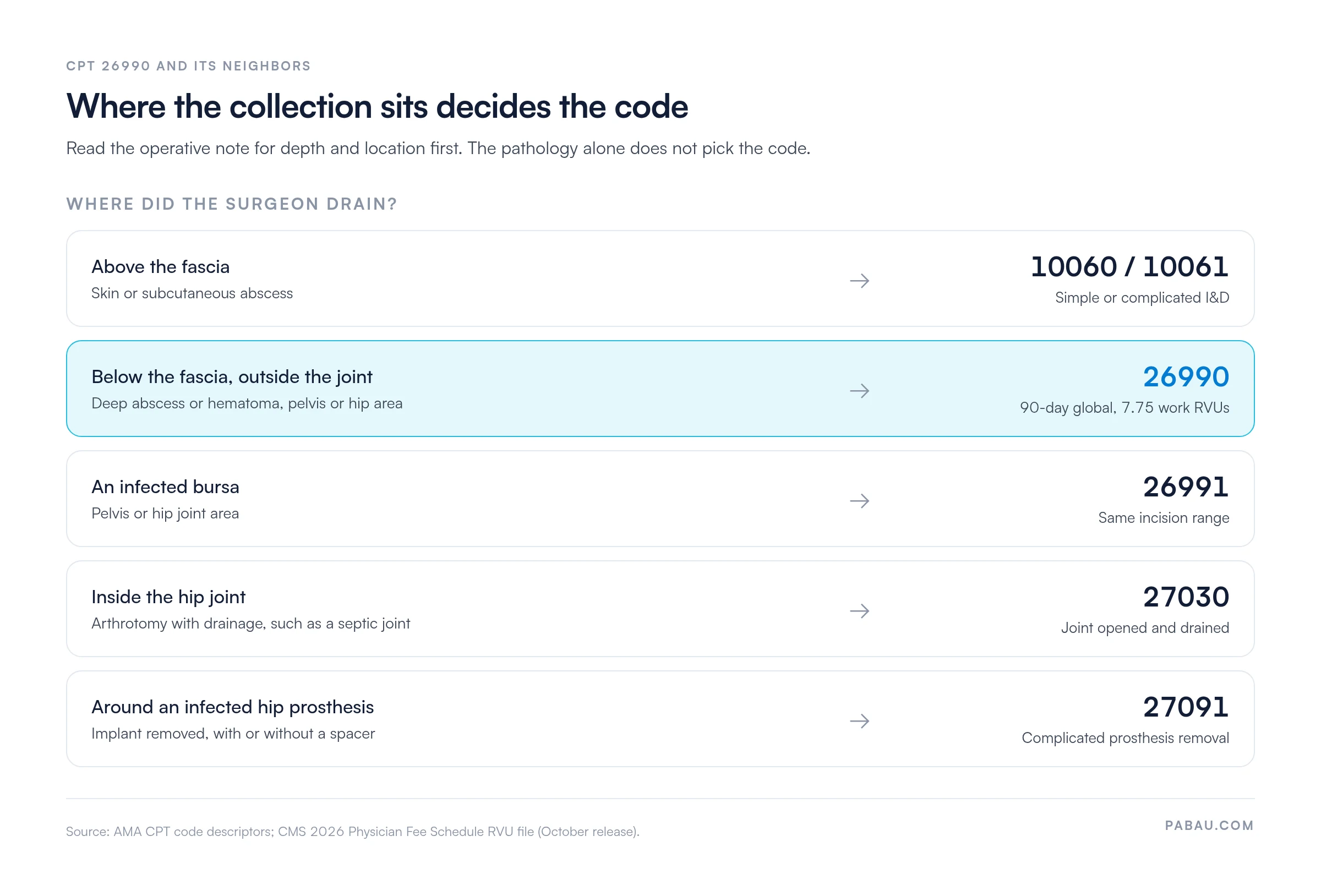
The hardest case is a deep infection after hip surgery that needs irrigation, debridement and drainage. If a total hip arthroplasty is in place and the prosthesis is removed, 27091 applies. However, if no hardware comes out and the surgeon drains a subfascial collection outside the joint, 26990 applies.
If the surgeon opens the joint capsule and drains the joint space, 27030 applies instead. Also check the NCCI edit tables before billing 26990 with either neighboring code in the same session.
The ICD-10-CM diagnosis code must confirm the medical necessity for a deep incision and drainage of the pelvis or hip. Codes describing superficial skin infections or non-purulent inflammatory conditions will not support 26990. As a result, they trigger an automatic medical necessity denial.
Also verify all codes below against the CDC/NCHS ICD-10-CM web tool for the current fiscal year before billing, because codes update every October 1.
Septic arthritis codes such as M00.051 (staphylococcal arthritis, right hip) support 27030 rather than 26990, because that drainage happens inside the joint. Similarly, a skin-level abscess code supports 10060 or 10061.
For inpatient cases, the CMS MS-DRG Definitions Manual groups pelvis and hip drainage procedures by principal diagnosis. The presence of complications or comorbidities then sets the specific MS-DRG. So confirm current DRG assignment with your facility coding team when billing 26990 in the inpatient setting.
Laterality modifiers apply to CPT Code 26990 when the collection is clearly on one side and the payer requires them. A midline pelvic collection may take neither LT nor RT, and a wrong or missing modifier is a common denial reason.
Verify modifier indicators for CPT 26990 in the current CMS Medicare Physician Fee Schedule Look-Up Tool before filing, because indicators can change with each annual MPFS update.
Medicare reimbursement for CPT Code 26990 rests on the total relative value units (RVUs) CMS assigns. Each locality then adjusts them by its geographic practice cost index (GPCI). National rates are only a baseline, so local payments move with the GPCI.
The figures below come from the CMS 2026 National Physician Fee Schedule Relative Value File, October release. Also, use the FastRVU 2026 RVU lookup to verify current work, practice expense, and malpractice RVU values and apply your local GPCI multiplier.
CMS marks the non-facility setting NA for 26990, which means the procedure is rarely or never performed in an office. Therefore, expect to bill it at the facility rate, in a hospital or an ambulatory surgery center.
CPT 26990 carries a 90-day global surgical package under the Medicare Physician Fee Schedule. The 2026 RVU file lists it as 090, and CMS can revise the designation in any annual update.
Included in the global package: Routine pre-operative evaluation on the day of surgery, the procedure itself, and normal post-operative visits within the 90-day window. Billing an E/M service for a routine wound check during the global period will therefore be denied.
Separately billable with documentation: A same-day E/M takes modifier 57 when the decision to operate was made during that visit. However, a routine pre-op assessment does not qualify. Also, a new, unrelated problem arising during the global period can be billed with modifier 24 and a distinct ICD-10 code identifying the separate condition.
Complications during the global period: Some patients return to the operating room for a complication of the original 26990. Typical examples are an expanding hematoma or wound dehiscence with deep infection. Bill the return procedure with modifier 78. This signals an unplanned return to OR for a related complication, so it prevents automatic denial under the global period bundling rule.
Medicare does not require prior authorization for CPT 26990 in most settings. However, commercial payer requirements vary widely by plan and by setting.
So always verify authorization requirements with each payer before elective or semi-elective procedures. The rules below are general patterns, not guarantees. In addition, using a medical claims clearinghouse with real-time eligibility verification lets you confirm payer-specific requirements before the procedure date.
Most denials for CPT 26990 are preventable. This is because they usually trace back to missing paperwork or a wrong code choice that a review could have caught before submission. Denial management workflows for this code should address the six root causes below.
Understanding denial codes in medical billing for musculoskeletal procedures helps your billing team triage these faster. Appeals then reach the right reviewer with the right supporting documentation.
Most 26990 denials start before the claim is built, with a missing depth statement, a missing laterality modifier or no authorization on file. So a short checklist in your own billing workflow catches them.
Pabau, the practice management platform we build, handles the submission step. Its claims management software works with Claim.MD to send claims electronically and track their status and payer eligibility. However, your coders still choose the codes and modifiers, and Pabau shows where each finished claim stands.

Pabau’s claims management works with Claim.MD to submit claims electronically and track their status and payer eligibility. See how surgical practices keep musculoskeletal claims moving once the coding is done.

Code 26990 from the operative note, not from the diagnosis. First, confirm the collection sat below the fascia and outside the joint before anyone builds the claim. Otherwise, a note that cannot show both points to 10060, 10061 or 27030 instead.
The payoff is fewer appeals on a code worth about $660 nationally under the 2026 Medicare fee schedule. The cost, however, is a few extra minutes on the note before signing. Book a demo to see how Pabau submits and tracks your surgical claims once the coding is done.

Need to understand how claims move from submission to payment? Revenue cycle management fundamentals walks through every stage from charge capture to ERA posting.
Working through a claim denial and need to decode the reason code? Reading an electronic remittance advice (ERA) explains how to map denial reason codes to corrective actions.
Want to verify eligibility before your next surgical case? Insurance eligibility verification covers how to confirm coverage and authorization status before the procedure date.
CPT Code 26990 covers incision and drainage of a deep abscess or hematoma in the pelvis or hip area, outside the joint. It covers only subfascial lesions, and superficial drainage uses CPT 10060 or 10061.
CPT 26990 covers drainage of a deep abscess or hematoma in the soft tissue of the pelvis or hip, outside the joint. CPT 27030, arthrotomy of the hip with drainage, covers opening and draining the hip joint itself, such as a septic hip.
LT and RT apply when the collection is clearly on one side and the payer requires laterality. Modifier 78 applies to an unplanned return to the OR for a related complication during the global period. Modifier 22 applies to documented unusual complexity, and modifier 59 to a distinct service confirmed by NCCI edit review.
The operative note must state that dissection passed through the fascia, name the anatomical site, and give laterality for a one-sided collection. It should also record the anesthesia type and reference pre-operative imaging or cultures. Missing depth language is the usual reason a claim is downcoded to superficial drainage.