

HCPCS Code E0272: Foam rubber mattress billing guide
HCPCS Code E0272: official descriptor and code overview HCPCS Code E0272 is the ...

Last Updated: Nov 6, 2026
26011 is the CPT code for drainage of finger abscess; complicated (eg, felon). It covers incision and drainage of a deeper or more serious finger infection, such as a felon in the closed fingertip pulp.
Its sibling, CPT 26010, covers simple drainage at the same site, so the procedure note decides which code holds up. That note has to show why the drainage went beyond a superficial incision. What follows covers the 26010 split, ICD-10-CM pairings, 2026 Medicare rates, NCCI bundling, and a pre-submission checklist.
Let Pabau's smart automation suggest the right codes, reduce claim denials, and keep your practice compliant—effortlessly.
Automate repetitive tasks and focus on what matters most—your patients.
Reduce coding errors and ensure compliance with the latest regulations.
Clean claims, fewer denials, and faster reimbursements.
Powerful insights and reporting to help your practice thrive.
HIPAA compliant SOC 2 certified GDPR-compliant Trusted by 4,000+ clinics worldwide

CPT code 26011 reports drainage of a complicated finger abscess, and CPT names a felon as its only example.
CPT 26010 covers simple drainage at the same site, so the procedure note has to show why the drainage went deeper.
In 2026, Medicare pays about $517 for 26011 in the office and about $182 in a facility, before GPCI adjustment.
Same-finger 26010 and 26011 are generally bundled, and a same-day E/M needs modifier 25 to be paid separately.
Finger modifiers (FA, F1 to F9) identify each digit when you drain more than one finger on the same date.
CPT code 26011 is a musculoskeletal surgery code maintained by the American Medical Association (AMA). Its official descriptor is “Drainage of finger abscess; complicated (eg, felon).” The text before the semicolon is shared with 26010, and the qualifier after it is what sets 26011 apart.
CPT defines “complicated” only through that example. In practice, the code is for a more serious finger infection, such as a felon, rather than a superficial pocket under the skin. The findings below are common clinical and documentation indicators that support 26011. They are not CPT-defined requirements.
Swapping 26010 and 26011 is the most common error in finger abscess coding. The table below sets the two codes side by side.
A practical rule follows from the table. A nick-and-squeeze note with local infiltration supports 26010. A note describing a felon, loculations broken down by blunt dissection, or deeper-plane drainage supports CPT code 26011.
A block and packing strengthen that note, but they do not decide the code alone. Billing 26011 when the note supports only 26010 is upcoding, and it creates compliance risk.
Four codes are often confused when billing finger and hand abscess drainage. Picking the wrong one usually leads to a site-mismatch denial or a bundling edit.
Two rules keep these straight. 10060 covers superficial abscesses at other sites, so it should not replace the finger codes when the finger is the documented site. CPT 26025 covers the palmar bursa, so billing it for a finger abscess is a site mismatch.
Check whether the claim goes to the facility or non-facility fee schedule before you submit. CPT code 26011 carries different practice expense RVUs in each setting. A hospital outpatient department or ASC bills its own facility fee, so the physician’s facility rate is lower. A wrong place-of-service code leaves the payment mismatched until the payer corrects it.
The diagnosis code should describe the infection documented in the note, including laterality. A generic hand abscess code alongside complicated drainage can trigger medical-necessity review when the payer compares diagnosis and procedure.
Always document laterality, because these codes are laterality-specific. Use L02.519 only when the chart does not record right versus left. Some payers route unspecified-laterality claims to manual review, which slows payment.
Documentation decides the outcome when a payer audits a 26011 claim. A note that reads “incised and drained finger abscess, applied dressing” supports 26010, whatever the surgeon intended to bill. The note is also the source document for every later step in medical billing, from charge entry to appeal.
A strong 26011 note covers these five elements:
Once the note supports the code, the next question is what Medicare pays for it.
Medicare pays CPT code 26011 through the RVU framework of the Medicare Physician Fee Schedule (MPFS). The non-facility rate is higher because the physician carries the overhead of performing the procedure outside a hospital or ASC.
The facility rate is lower for the opposite reason. It leaves out the practice-expense cost of supplies and space, because the facility bills its own costs. The chart shows how far that setting moves the payment for both codes.
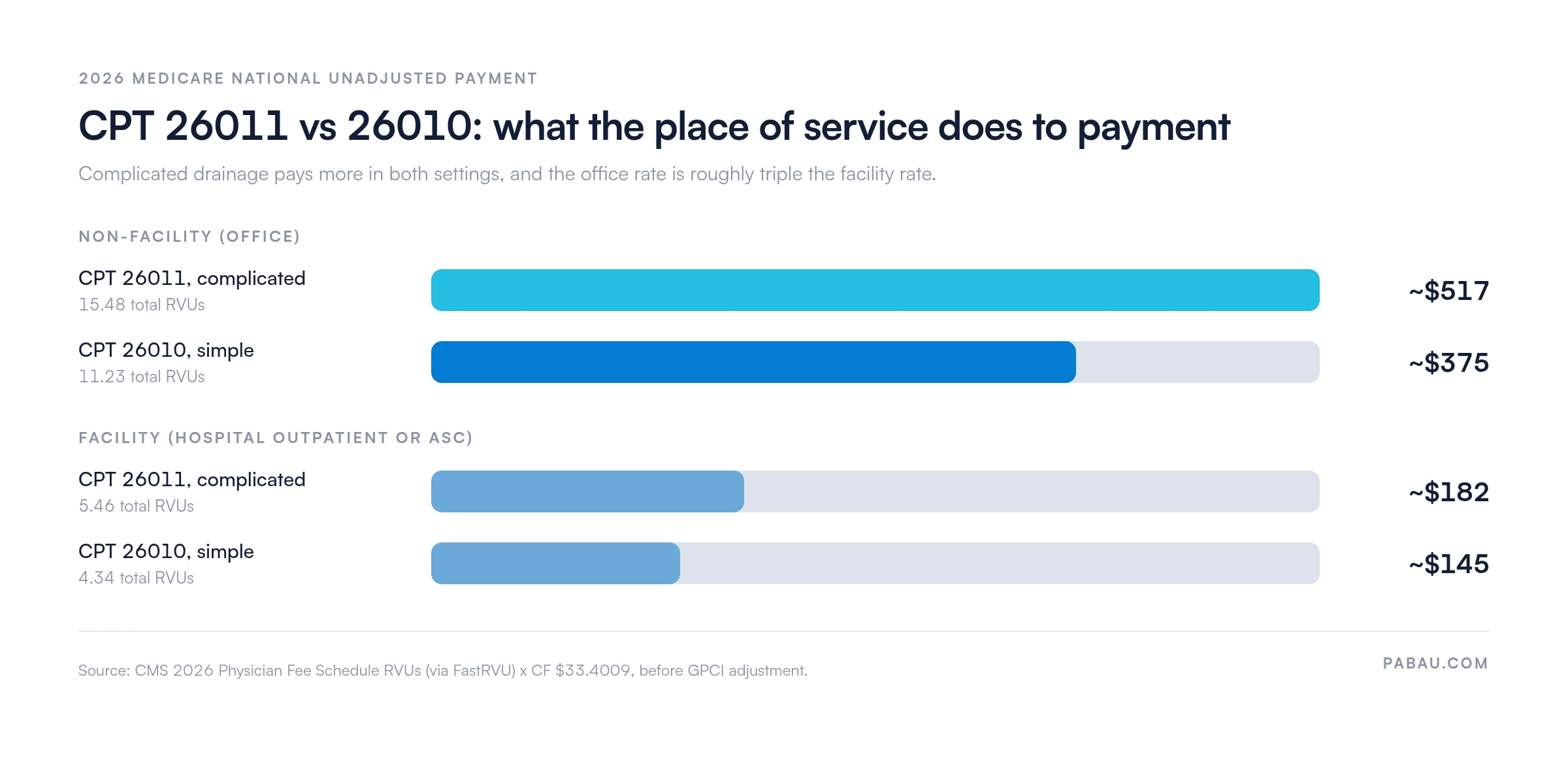
These are 2026 national unadjusted values at a conversion factor of $33.4009, before GPCI adjustment. Your locality will differ, so check FastRVU’s CPT 26011 listing or the CMS fee schedule before quoting a patient.
Practices on Pabau, the practice management platform we build, can submit claims electronically via Pabau’s Claim.MD integration. Build a superbill from the encounter first, so the CPT and diagnosis details travel with the claim.
Traditional Medicare generally does not require prior authorization for CPT 26011. Some Medicaid managed care plans and commercial carriers do apply site-of-service rules or pre-certification for OR drainage. Check each payer’s policy before you schedule the procedure.
National Correct Coding Initiative (NCCI) edits define which code pairs cannot be billed together for one patient on one date. Several apply to CPT code 26011. Use Pabau’s claims management software to submit and track claims, and check NCCI edits against the CMS tables before submission.
CMS updates NCCI edits quarterly, so a static bundling list goes stale. Check the current Medicare NCCI PTP edits before you submit high-value claims.
Denials for CPT code 26011 follow a consistent pattern, so a review of these six triggers catches most errors before submission. Your practice’s common denial codes show which ones hit your own claims.
Good denial management catches these triggers at charge capture, before the remittance arrives.
Run a 90-day audit of your practice’s CPT 26011 claims. Compare the procedure note wording on denied claims with the wording on paid ones. The denials usually share a pattern, such as no loculation description or no felon finding. Fix the note template first, then appeal with the corrected documentation.
A 26011 claim moves from the procedure note to charge entry, then through the clearinghouse to the payer. Each handoff can drop the detail that justifies the code. Before you submit, confirm these five points:
Many CPT code 26011 denials come from documentation that never reached the payer, rather than from the wrong code. An appeal can reverse them when the record supports complicated drainage.
Resubmit a clean claim with the supporting records, following these steps.
Most payers allow 60 to 180 days from the denial date to file an appeal, depending on the plan. Commercial plans often run two levels: reconsideration first, then a formal appeal or independent review. Track every deadline, because a missed window ends the chance to recover payment.
A 26011 claim often fails at a handoff. The clinician writes the note in one system, a coder reads it in another, and the claim leaves with less detail than the chart holds.
In Pabau, the procedure note, the diagnosis, and the claim sit in the same patient record. Your coder can check the felon or loculation detail against the claim, then submit it through the Claim.MD integration and track its status.
That way, the evidence for 26011 and the claim that bills it stay side by side until payment.

Pabau keeps clinical notes, CPT and ICD-10 codes, and electronic claim submission in one system, so the evidence for 26011 travels with the claim.

CPT 26011 is worth billing whenever the note shows a felon or a deeper, loculated finger infection. Without that description, 26010 is the correct code, however much effort the drainage took.
The fix sits upstream of billing. Build the five documentation elements into your procedure template, pair a laterality-specific diagnosis, and add finger modifiers when you drain more than one digit. The trade-off is a few extra lines per note against a 2026 office payment roughly $140 higher than 26010.
Pabau keeps procedure notes and claims in one system, so that detail reaches the payer intact. Book a demo to see how it handles finger procedure billing for your practice.

Need to understand how clearinghouse claim submission works? Medical claims clearinghouse guide explains how electronic claims move from practice to payer and where errors occur.
Want to reduce claim rejection rates across your practice? Medical billing compliance guide covers documentation standards, payer requirements, and NCCI audit triggers.
Need a primer on revenue cycle management for a procedure-based practice? What is revenue cycle management breaks down the end-to-end billing workflow from charge capture to payment posting.
CPT defines it only by example: a felon. In practice, coders use 26011 for a felon, a loculated abscess, or a deep-space or tendon sheath infection of the finger. Packing and a nerve block support the note but are not CPT requirements.
At 2026 national unadjusted rates, Medicare pays about $517 non-facility and about $182 facility. That reflects 2.18 work RVUs and 15.48 or 5.46 total RVUs. Your locality’s GPCI changes the final figure.
ICD-10-CM indexes felon to L03.01-, so use L03.011 for the right finger and L03.012 for the left. Add M65.041 or M65.042 when the infection involves the tendon sheath.
Yes. 26010 and 26011 are generally bundled for the same finger on the same date, so verify the current NCCI PTP table. For different fingers, append the finger modifier (FA, F1–F9) to each code, using 59 or XS only where no anatomic modifier applies.
CPT 26011 carries a 10-day global period. Wound checks and packing changes in that window are included in the procedure payment. A same-day E/M without modifier 25 is bundled, not separately paid.




