CCSD Code L6000: Endarterectomy of femoral artery
CCSD Code L6000: official descriptor and clinical scope CCSD Code L6000 is defin...

Last Updated: Oct 27, 2026
23076 is the CPT code for excision, tumor, soft tissue of shoulder area, subfascial (e.g., intramuscular); less than 5 cm. It covers removal of a tumor lying below the deep fascia, often within muscle, that measures under 5 cm.
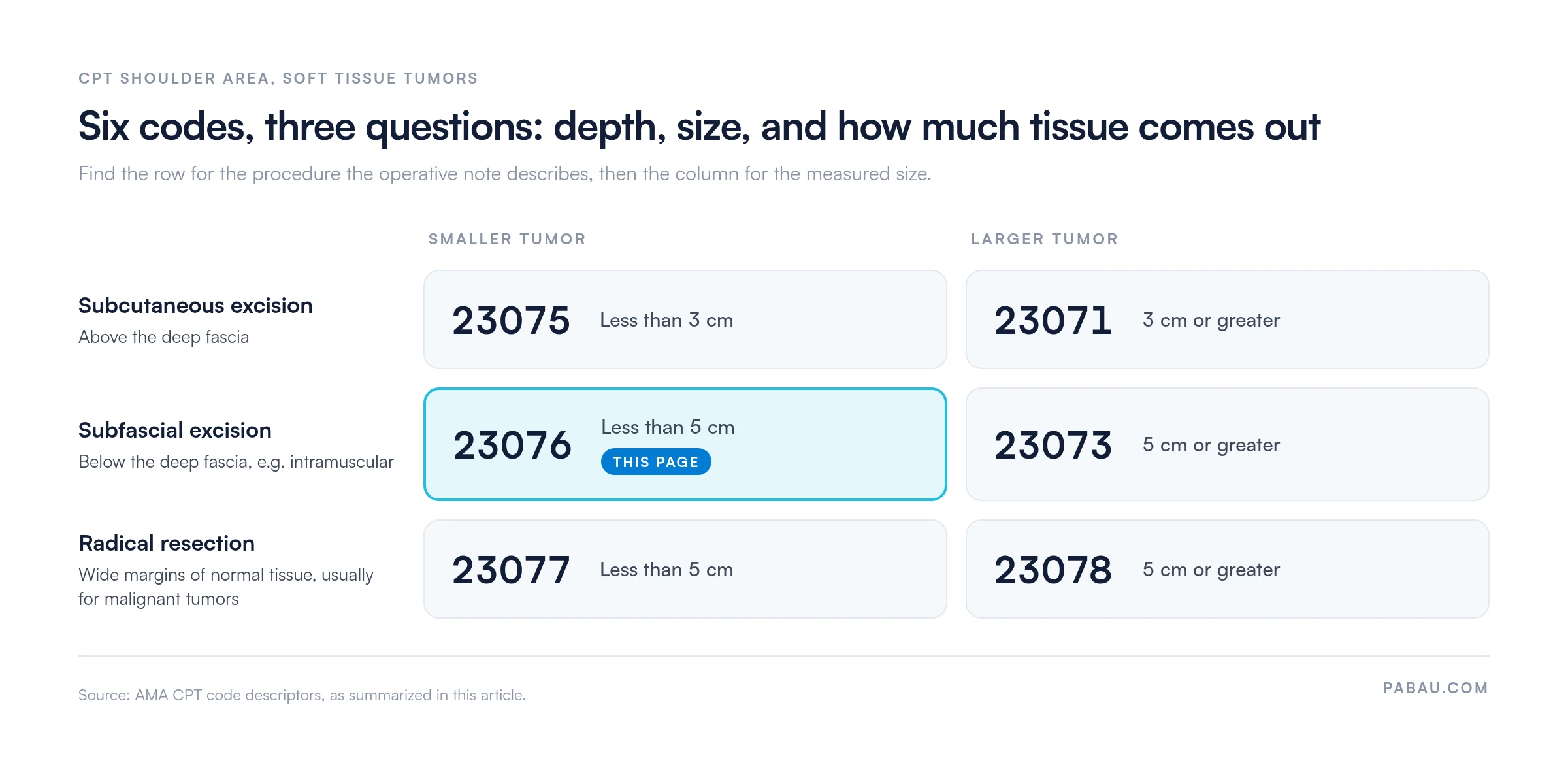
It sits in the Musculoskeletal System section of CPT, among six adjacent shoulder soft tissue tumor codes: 23071, 23073, 23075, 23076, 23077 and 23078. They are separated by depth, size, and excision versus radical resection. Common 23076 denial causes include a missing size measurement or a depth mismatch.
Let Pabau's smart automation suggest the right codes, reduce claim denials, and keep your practice compliant—effortlessly.
Automate repetitive tasks and focus on what matters most—your patients.
Reduce coding errors and ensure compliance with the latest regulations.
Clean claims, fewer denials, and faster reimbursements.
Powerful insights and reporting to help your practice thrive.
HIPAA compliant SOC 2 certified GDPR-compliant Trusted by 4,000+ clinics worldwide

CPT code 23076 covers subfascial (intramuscular) shoulder tumor excision under 5 cm. Subfascial tumors of 5 cm or greater go to 23073, and subcutaneous tumors go to 23075 or 23071.
Codes 23077 and 23078 are radical resections, a different procedure from simple excision, split at the same 5 cm threshold.
The operative report must document both the tissue layer (subfascial or intramuscular) and a measured tumor size under 5 cm. Missing either one invites a denial.
A 90-day global period applies, and related routine follow-up inside it is bundled and not billable. Modifier 24 applies only to an unrelated E/M service in that window.
Pabau, the practice management platform we build, submits 23076 claims electronically through Claim.MD and tracks each claim’s status through to payment or denial.
CPT code 23076 describes excision, tumor, soft tissue of shoulder area, subfascial (e.g., intramuscular); less than 5 cm. The American Medical Association (AMA) owns and maintains the CPT code set. It places 23076 in the Musculoskeletal System section, Shoulder subsection, under the Excision heading.
Two criteria must both be present for 23076 to apply. The tumor must be subfascial (below the deep fascia, including intramuscular locations), and it must measure less than 5 cm. Neither criterion alone is sufficient.
A subcutaneous tumor goes to 23075 when it is under 3 cm, and to 23071 when it is 3 cm or greater. A subfascial tumor of 5 cm or greater goes to 23073. The grid below maps all six shoulder codes by procedure and size.
The code is billable and carries a 90-day global period, meaning routine post-operative visits are bundled into the surgical payment.
A subfascial shoulder tumor excision begins with an incision over the mass. The surgeon dissects through the subcutaneous layer, then through or around the deep fascia to reach the tumor. The tumor is excised with a margin of surrounding tissue, and the specimen is sent for pathology. Closure proceeds in layers.
For coders, the operative note must confirm three things before 23076 can be assigned.
If the operative note describes dissection limited to the subcutaneous layer, 23076 cannot be used regardless of tumor size. Depth is a clinical judgment made by the surgeon and documented in the operative report. Coders should never determine tissue layer from imaging alone.
The shoulder soft tissue tumor codes form a six-code family. Depth and size separate the four excision codes (23071, 23073, 23075 and 23076), while 23077 and 23078 are radical resections. The American College of Surgeons bulletin on reporting excision of soft tissue tumor codes is the most authoritative specialty-society reference for this family.
A frequent miscoding error is selecting 23073 when the operative note shows a subfascial dissection but the specimen measures 4.8 cm. Billing 23073 without a documented size of 5 cm or more is an audit risk. When the tumor does reach 5 cm, our guide to CPT 23073 covers the larger excision.
Two fields in the operative report are payer audit triggers for CPT code 23076: tissue layer confirmation and measured tumor size. Both must appear explicitly. For clean claim submission, the operative report should document all of the following.
ICD-10 code selection should be based on the pathology report, not a pre-operative assumption. Payer coverage criteria can differ between benign and malignant diagnoses, so assign the final diagnosis code only once pathology results are available.
The ICD-10-CM codes most often submitted with CPT code 23076 depend on whether the mass is still uncharacterized, benign, or malignant. The pathology report drives final code selection.
Laterality matters: D21.11 and D21.12 are distinct codes, not interchangeable. A claim coded for one shoulder against a clinical note that specifies the other is a documentation mismatch. Payers flag it on audit.
Modifier selection for CPT code 23076 depends on the clinical scenario. The most commonly applied modifiers and their triggers are listed below.
Modifier 50 vs. LT/RT is a common point of confusion. Medicare generally prefers a single line item with modifier 50. Many commercial payers prefer two separate line items, one with LT and one with RT. The wrong format for the payer usually triggers a claim edit rather than an outright denial, but it adds processing time.
Reimbursement for CPT code 23076 is calculated using relative value units (RVUs) from the CMS Physician Fee Schedule. Compare the facility and non-facility rows on the CMS lookup for the setting where the procedure is performed.
For 2026 RVU values and national fee schedule rates, use the FastRVU 2026 RVU lookup tool or the CMS MPFS lookup directly. The table below shows how the RVU breakdown is structured. Always verify current figures from CMS before billing.
Commercial payers typically reimburse at a contractual multiple of the Medicare rate, commonly ranging from 100% to 200% depending on the payer contract. Always verify the contracted rate in the payer agreement rather than assuming Medicare equivalence.
Pull the 2026 CMS MPFS data for 23076 from the CMS fee schedule search tool before quoting a fee or forecasting revenue. Rates change each year with the conversion factor update. Compare the facility and non-facility rows for the setting you actually use.
Prior authorization requirements for CPT code 23076 vary by payer type. Insurance eligibility verification before scheduling the procedure is the most reliable way to catch PA requirements before the surgical date.
A PA request should document why conservative management is not appropriate and reference the imaging study showing the mass location. It should also state the anticipated tissue layer and size, which justifies the code selection upfront.
Most denials for CPT code 23076 are preventable. Effective denial management workflows for surgical codes start with knowing which documentation elements payers audit most closely. The leading denial causes for 23076 are:
Our guide to denial codes in medical billing explains the reason and remark codes (CARCs and RARCs) on a remittance. It also covers how to respond to each one.
The National Correct Coding Initiative (NCCI) publishes bundling edits that govern which procedures can be billed separately alongside CPT code 23076. According to CMS NCCI policy, certain component services are integral to the surgical excision and are bundled into the payment for 23076.
Services typically bundled into 23076 include wound closure (layered or simple repair of the surgical incision) and surgical preparation of the excision site. Imaging interpretation by the same provider on the same day, as part of surgical planning, is bundled too. These cannot be billed separately.
Services that may be separately billable with the correct modifier:
NCCI edits are updated quarterly. Check the current edit tables in the CMS NCCI policy manual before unbundling any procedure with modifier 59.
CPT code 23076 carries a 90-day global surgical period, assigned by CMS. The surgical payment bundles all routine post-operative care for 90 days after the procedure. Knowing what the global package covers prevents claims that payers deny automatically.
Services included in the 90-day global package for 23076:
Services that can be billed separately during the 90-day global period with the appropriate modifier:
Billing a related follow-up visit separately during the 90-day global period is a common post-surgical billing error for this code family. Only an unrelated E/M visit takes modifier 24. Pabau’s guide to revenue cycle management shows how the global period fits the wider claim-to-remittance flow.
Set a 90-day flag in your practice management system at the time of surgery for every 23076 case. When a post-op appointment is scheduled, the flag prompts the coder to check whether the visit falls in the global period. A related visit is bundled, and only an unrelated E/M visit takes modifier 24.
Without a connected system, a coded 23076 claim often gets rekeyed into a separate clearinghouse portal. Its status then lives on payer websites, and a denial can sit unnoticed until the remittance arrives.
In Pabau’s claims management software, the claim is built from the invoice your team already raised. It goes out electronically as a CMS-1500 through Claim.MD, our US clearinghouse partner, to thousands of US payers. Real-time eligibility checks run from the patient’s record before the surgery date.
Each claim’s status then updates from the payer through acceptance, payment or denial, and remittance advice comes back into Pabau. Your coders still own the depth and size checks. What changes is that they see a denial soon after it lands and can correct it while the case is fresh.
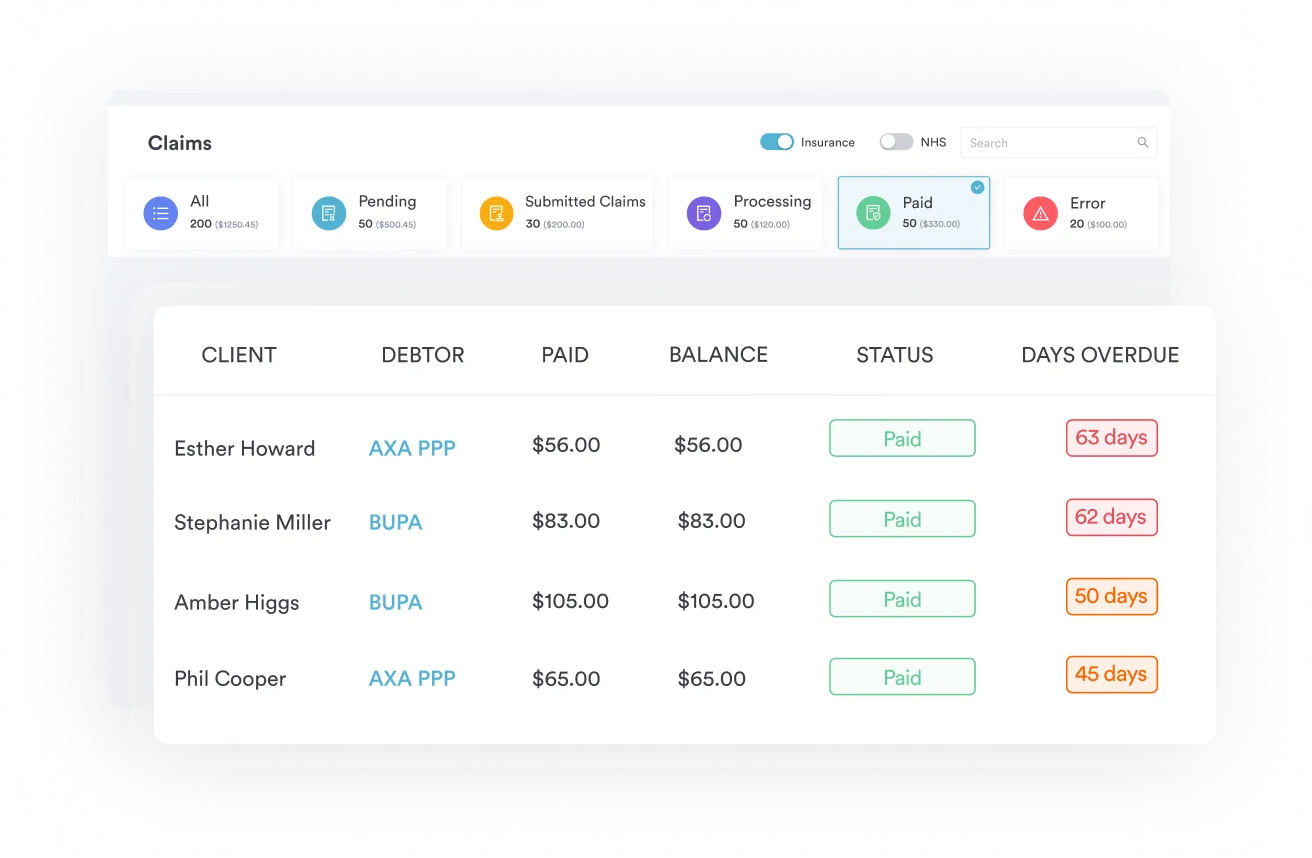

Pabau submits CPT 23076 claims electronically through Claim.MD and shows each claim’s status through to payment. Denials surface while the case is still fresh.

CPT code 23076 is won or lost in the operative report. When the surgeon documents subfascial depth and a measured size under 5 cm, the code holds up at audit.
So treat depth and size as required fields in every operative note review. Check each shoulder tumor case against all six codes before you assign one. A few extra minutes per case costs far less than a denial and an appeal.
Book a demo to see how Pabau submits and tracks your surgical claims, so 23076 denials surface while the case is still fresh.

Need to understand how clearinghouse submission works for surgical codes? Claim.MD clearinghouse guide explains how electronic claim routing and real-time edits reduce rework on procedure codes.
Looking to reduce denials across your billing workflow? Medical billing compliance guide covers documentation standards and payer audit triggers for surgical practices.
Want to understand 837 transaction file requirements for surgical claims? 837 file guide covers the electronic claim format used to submit CPT codes to payers and clearinghouses.
CPT code 23076 covers excision of a shoulder-area soft tissue tumor that lies in the subfascial or intramuscular layer. The tumor must measure less than 5 cm. Both the tissue layer and the size must be documented in the operative report for the code to apply.
Both describe subfascial shoulder tumor excision. 23076 applies when the tumor measures less than 5 cm, and 23073 applies at 5 cm or greater. 23077 is a different procedure: a radical resection of a tumor under 5 cm.
CPT code 23075 covers subcutaneous shoulder tumor excision (above the deep fascia), while 23076 covers subfascial excision (below the deep fascia). Both depth and size differ: 23075 is subcutaneous under 3 cm, and 23076 is subfascial under 5 cm.
Not automatically. CPT code 23076 is defined for the shoulder area, and an axillary mass may fall outside it. Check the CPT guidelines for how the shoulder area is defined. Then compare the soft tissue tumor codes for the neighboring sites before choosing one.
Frequent reasons are a missing centimeter measurement in the operative note, or coding 23075 or 23073 when 23076 applies. Missing LT or RT modifiers also cause denials. So does billing a related follow-up visit inside the 90-day global period.
The 5 cm threshold is based on the measured size of the excised tumor, documented in the operative report or the pathology report. The measurement must be explicit, because approximate descriptions (“small mass”) do not hold up at audit. If the specimen measures exactly 5 cm, 23073 applies rather than 23076.