



HCPCS code E0198: Water pressure pad billing guide
HCPCS code E0198 is a water pad for a standard mattress HCPCS code E0198 is the ...

Last Updated: Oct 13, 2026

CPT Code 22586 describes a pre-sacral interbody arthrodesis at the L5-S1 interspace. It is a lumbar procedure, not a cervical one.
The code carries 60.12 total RVUs for 2026, which pays roughly $2,008 at the non-qualifying conversion factor of $33.40.
Posterior instrumentation, bone graft and image guidance already sit inside the descriptor, so billing 22840 or 20930-20938 beside it is unbundling.
Aetna, Premera and Anthem each label axial lumbosacral interbody fusion investigational, so the coverage check matters more than the coding here.
Practice management software like Pabau tracks CPT codes, modifiers and authorization status together, so surgical claims leave the practice verified.
CPT Code 22586 covers arthrodesis by pre-sacral interbody technique at the L5-S1 interspace. It is a lumbar fusion, reached through a corridor in front of the sacrum. It is not a cervical procedure, though the layout of the CPT book suggests otherwise.
The code is printed under an “Anterior or Anterolateral Approach” heading, beside the cervical fusion codes. Coders working from a shortened description read it as a neck code. That single mistake changes the diagnosis codes, the bundling rules and the payer policy that applies.
This guide covers the descriptor, the 2026 Medicare rates and RVUs, modifier rules and the ICD-10 crosswalk. It also covers what the code already includes, and the coverage position that decides whether the claim gets paid at all.
The full descriptor for CPT Code 22586 is longer than most code lookups show. The American Medical Association (AMA) wording bundles disc space preparation, discectomy, posterior instrumentation, image guidance and bone graft into that single code. Every component applies at the L5-S1 interspace only.
In practice, the surgeon enters through a small incision beside the tailbone and works up a corridor in front of the sacrum. Instruments pass through that corridor to clear the L5-S1 disc and place graft material and a threaded rod.
The technique is marketed as axial lumbar interbody fusion, or AxiaLIF. Reading the full descriptor is the first step in the wider medical billing workflow for surgical codes.
The code is level-specific and single-level. It applies to L5-S1 only, and it has no add-on code for a second pre-sacral level. Its placement in the CPT book, under the anterior and anterolateral arthrodesis heading, is what causes the confusion with the cervical codes. That heading describes the direction of approach, not the region of the spine.
Medicare pays CPT Code 22586 under the Medicare Physician Fee Schedule (MPFS), published each year by the Centers for Medicare and Medicaid Services (CMS). Two conversion factors apply from 2026 onward. Clinicians in a qualifying alternative payment model are paid at $33.57, and everyone else at $33.40.
Geographic Practice Cost Indices then adjust the figure by locality, which can move the allowed amount well above or below the national number. Practices submitting electronic claims via Claim.MD can confirm payer-specific rates and eligibility before the case is booked.
These are national unadjusted allowed amounts before beneficiary cost-sharing. Commercial contracts can sit far above or below them, and several payers do not cover the procedure at all.
Review the electronic remittance advice after payment to catch any difference between the expected and the posted amount.
Site of service does not change the payment for CPT Code 22586. The practice expense component is 21.11 RVUs in both the facility and the non-facility column, so the physician payment is the same either way.
That is unusual, and it is worth knowing before someone builds a site-of-service argument around this code. The procedure needs fluoroscopy and a sterile pre-sacral corridor, so it is performed in a hospital or an ambulatory surgery center regardless.
Relative Value Units drive the Medicare calculation. CPT Code 22586 carries a high work value because the descriptor rolls several billable services into one code. The malpractice component is also unusually large, which reflects the risk profile of working in front of the sacrum. A 2026 RVU lookup will confirm the current components.
RVU values change with each annual MPFS final rule. Confirm them against the CMS Physician Fee Schedule lookup tool before using them in contract talks or internal benchmarking.
Compare the 60.12 total RVUs for 22586 against a posterior interbody fusion coded as 22633 with 22840 and 22853 added. The bundled code often lands lower than the unbundled stack, which surprises surgeons reviewing their productivity reports. Explain the bundling before the first case, not after the first remittance.
Modifier choice on CPT Code 22586 turns on staffing, complexity and the 090-day global period. Two modifiers that coders reach for by habit do not belong here. Modifier -50 does not apply, because the pre-sacral approach is midline and the code covers one interspace.
Modifier -51 is rarely needed either, since most of what a surgeon might add is already bundled. Read the AAPC modifier guidance alongside the payer policy before you append anything.
Medical necessity for CPT Code 22586 rests on a lumbosacral diagnosis at L5-S1. A cervical or thoracic diagnosis code on this claim is an automatic denial.
That happens often on claims built from a shortened code description. Payer criteria for the procedure center on degenerative disc disease and low-grade spondylolisthesis at the lumbosacral junction.
The diagnosis link is necessary but not sufficient. Payer policies for this procedure set their own criteria, and several rule it out entirely. Document the conservative care trial, the imaging findings and the functional limitation in the clinical record before the case is scheduled.
Unbundling is the single largest coding error on this code, and the descriptor explains why. Most of the services a spine coder would normally add to a fusion claim are already inside 22586. Instrumentation, graft and imaging are all named in the descriptor.
The National Correct Coding Initiative (NCCI) edits back that up, so a separately billed component usually needs a modifier that cannot be justified. Check the CMS NCCI edits before you add anything to a 22586 claim.
Practices billing across several service lines will notice that bundled codes behave differently from the add-on stacks used elsewhere. Our guide to procedure-specific CPT code documentation shows how those rules shift by specialty.
Coverage is the harder problem on this code, and it comes before authorization. Several large payers classify axial lumbosacral interbody fusion as investigational, which means no amount of documentation will get it paid under those policies.
Aetna Clinical Policy Bulletin 0772 calls the pre-sacral approach experimental and investigational. Premera policy 7.01.130 reaches the same conclusion and was reaffirmed in June 2026.
Anthem SURG.00111 and several Blue Cross Blue Shield affiliates hold similar positions. Confirm insurance eligibility verification and the medical policy before the patient is booked, not after.
Medicare Advantage plans apply their own rules and often adopt the commercial policy wholesale. Re-check every payer annually, because these policies are reviewed and reissued on a fixed cycle.
Choosing between 22586 and the other lumbar arthrodesis codes comes down to the approach documented in the operative report. Each approach has its own code family, and the bundling rules differ sharply across them. The table below sets 22586 against the codes it is most often confused with, all of which are lumbar.
The practical rule is short. If the operative report describes a buttock incision and a corridor in front of the sacrum, 22586 is the code.
A retroperitoneal anterior exposure or a midline posterior approach belongs to another family, and the add-on codes come back into play. The chart below runs that decision in the order a coder meets it.
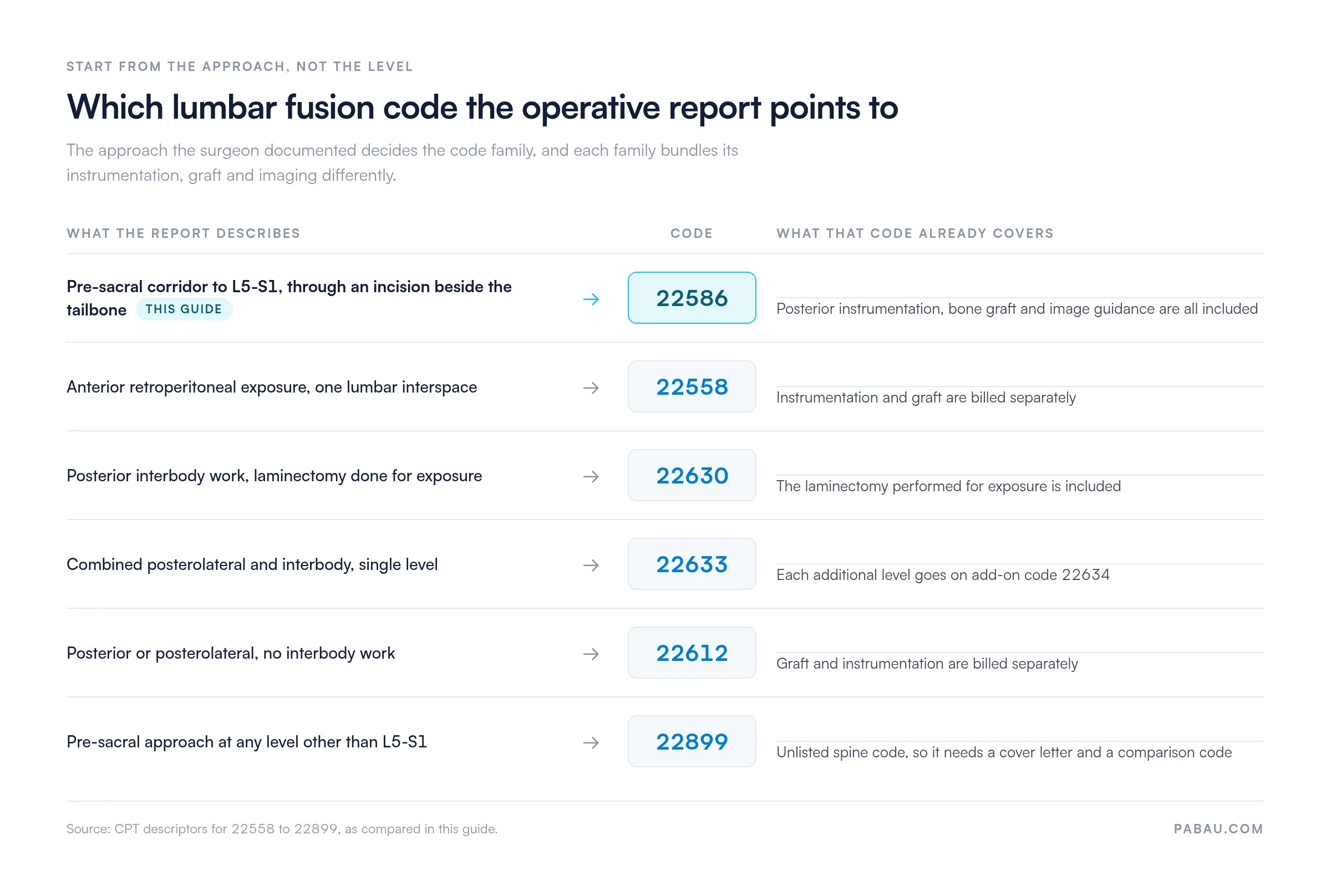
Audit any 22586 claim that also carries 22840, 22853 or a graft code. That combination is the clearest sign the coder worked from a shortened code description instead of the full descriptor. Load the complete descriptor into your code library so the bundled components are visible at the point of coding.
Spine claims draw more audit attention than almost any other surgical specialty, and this code draws more than most. Volumes are low, the payment is high, and the coverage position is contested, so payer systems flag it for review. The patterns below account for most of the denials on 22586.
A pre-submission checklist catches almost all of these. For spinal arthrodesis it should confirm the level from the operative report and run every appended code through the NCCI edits. It should also record the authorization number and verify that the medical policy covers the approach.
Practices with structured medical billing compliance protocols run that review before anything leaves the practice.
Where denials keep recurring on a single code, claim denial management workflows track the pattern, name the cause and fix the step that produced it.
Holding a clean claim rate above 95% on surgical codes takes documented pre-submission review rather than reactive follow-up. The same principles apply across specialties, as our guide to accurate CPT code documentation shows.
In most spine practices the information needed to bill 22586 correctly lives in three places. The operative report sits in the clinical record. The authorization number sits in an email or a spreadsheet.
The payer medical policy sits in a browser tab somebody closed. Coders reconcile those sources by hand for every case, which is where bundled components and missing authorizations slip through.
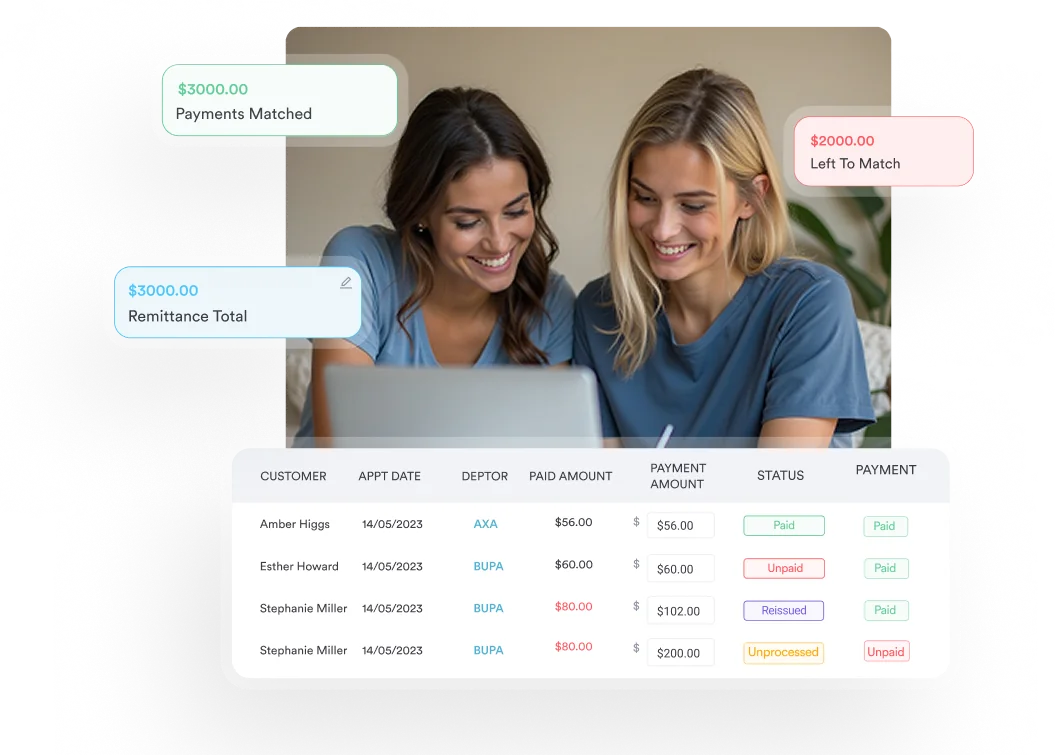
Practice management software like Pabau keeps them together. The clinical note, the linked diagnosis codes, the CPT code and the authorization status sit on the same patient record. A coder sees the full picture without chasing it. Claims route out electronically through our Claim.MD integration, and remittances post back against the same record.
The outcome is fewer reworked claims on high-value surgical codes. When a denial does arrive, the operative note, the authorization and the submitted codes are already in one place. The appeal takes minutes instead of an afternoon.

Pabau’s claims management software holds the operative note, the CPT code, the linked diagnosis and the authorization status together. Spine practices submit verified claims the first time.

CPT Code 22586 rewards precision in two places, and a code lookup gives you neither. The first is the descriptor. This is an L5-S1 pre-sacral fusion, and it already includes the instrumentation, graft and imaging that coders habitually add.
The second is the coverage policy, where an investigational label at Aetna, Premera or Anthem settles the claim before a coder touches it. Read both before the case is booked, and the 60.12 RVUs on this code stand a chance of being collected.
Pabau’s claims management software gives spine and surgical practices pre-submission verification, electronic routing through Claim.MD, and denial tracking on every code. To see how it handles surgical billing from operative note to posted payment, book a demo.

Want to know what belongs on a claim before it goes out? Superbill outlines the elements that need to be present before submission on complex surgical codes.
Checking coverage before you schedule? Insurance eligibility verification walks through the checks that catch a non-covered procedure early.
CPT Code 22586 describes arthrodesis by pre-sacral interbody technique at the L5-S1 interspace. The surgeon works through a small incision beside the tailbone and up a corridor in front of the sacrum. Instruments clear the L5-S1 disc, then place graft and a threaded rod. The technique is marketed as axial lumbar interbody fusion, or AxiaLIF. It is a lumbar procedure, not a cervical one.
It is lumbar. CPT Code 22586 applies to the L5-S1 interspace only. The confusion comes from its placement in the CPT book. It is printed under an anterior and anterolateral approach heading, beside the cervical fusion codes such as 22548 and 22554. That heading names the direction of approach, not the region of the spine.
For 2026, CPT Code 22586 carries 60.12 total RVUs. That works out to about $2,008 at the $33.40 conversion factor for clinicians outside a qualifying alternative payment model. The qualifying rate of $33.57 gives about $2,018. Geographic Practice Cost Indices then adjust the figure by locality, so check the CMS lookup tool for your MAC.
CPT Code 22586 carries a work RVU of 27.42, a practice expense RVU of 21.11 and a malpractice RVU of 11.59, for 60.12 total RVUs. The practice expense value is the same in the facility and non-facility columns, so site of service does not change the physician payment. Values are reset in each annual MPFS final rule.
The descriptor already includes disc space preparation, discectomy, posterior instrumentation, image guidance and bone graft. That means 22840, 22853, 22854, the graft codes 20930 to 20938, and fluoroscopy codes 77002 and 77003 should not be billed separately with 22586. Adding them is unbundling, and NCCI edits will catch it.
Report it with 22899, the unlisted spine procedure code, and include the operative note plus a comparison code in your cover letter. The former L4-L5 add-on code 0309T was deleted on January 1, 2018. Add-on code 22585 belongs to the anterior cervical, thoracic and lumbar family and cannot be appended to 22586.
Commercial payers that cover the procedure require prior authorization, but coverage is the larger question. Aetna Clinical Policy Bulletin 0772, Premera policy 7.01.130 and Anthem SURG.00111 all treat axial lumbosacral interbody fusion as investigational. Medicare fee-for-service has no national coverage determination for the code, though a local coverage determination may apply.
Use a lumbosacral diagnosis. The common ones are M51.37 for disc degeneration at L5-S1, M43.17 for lumbosacral spondylolisthesis. Also use M51.17 for disc disorders with radiculopathy, M48.07 for lumbosacral stenosis and M53.2X7 for documented instability. A cervical or thoracic diagnosis on this claim will be denied automatically.
CPT Code 22586 has a 090-day global period, which makes it a major surgical procedure. Related postoperative care falls inside that window and is not separately billable. A return to the operating room during those 90 days needs modifier -78 for a related procedure or -79 for an unrelated one.



