



CCSD code G5100: Bypass of duodenum billing guide
CCSD code G5100 bills a bypass that leaves the duodenum in place CCSD code G5100...

Last Updated: Oct 16, 2026

CPT code 01930 covers anesthesia for a therapeutic interventional radiology procedure on the venous or lymphatic system only, not diagnostic imaging and not arterial work.
The code carries 5 base units. Total reimbursement is (base units + time units) multiplied by the payer’s anesthesia conversion factor.
Modifiers AA, QK, QX, QY, and QZ identify who provided the anesthesia and how the claim splits between physician and CRNA. A missing modifier is the most common reason a claim gets kicked back.
01930 sits inside a four-code venous/lymphatic family alongside 01931 (intrahepatic or portal circulation), 01932 (jugular vein or intrathoracic veins), and 01933 (intracranial). The site named in the operative note decides which code applies, not the anesthesia plan.
Practice management software like Pabau checks that the required insurer-submission fields on a claim are complete and keeps pre-anesthesia and procedure documentation attached to the patient record, though it doesn’t select CPT codes or modifiers for you.
A biller sees “interventional radiology” on the operative note and reaches for CPT code 01930 as the safe, catch-all choice. It isn’t one. CPT code 01930 has a narrow, specific scope: anesthesia for a therapeutic procedure on the venous or lymphatic system, one that doesn’t reach the central circulation.
Diagnostic angiograms, arterial interventions, uterine fibroid embolization, hepatic TACE, and myelography, five procedures this code gets wrongly billed for in practice, all belong to other codes entirely.
Knowing exactly where that line sits, and which sibling code picks up on the other side of it, is what keeps a claim from bouncing back for a rewrite.
The American Medical Association (AMA), which maintains the CPT code set, defines CPT code 01930 as anesthesia for a therapeutic interventional radiological procedure involving the venous or lymphatic system, not to include access to the central circulation, and not otherwise specified.
Three qualifiers do the real work in that sentence: therapeutic (not diagnostic), venous or lymphatic (not arterial), and not otherwise specified (meaning no more specific code in the same family names the exact site).
That last qualifier matters most in day-to-day billing. 01930 is the not-otherwise-specified code for the venous/lymphatic family, used only when the operative note doesn’t name a more specific site.
If it does, a narrower sibling code applies instead: 01931 for the intrahepatic or portal circulation (a TIPS procedure, for example), 01932 for the jugular vein or intrathoracic veins, and 01933 for intracranial venous or lymphatic access.
Central circulation access and any arterial work sit outside this code family entirely. Those belong to CPT code 01920 (cardiac catheterization) or the 01924-01926 arterial family.
Not every case that touches a vein in the IR suite qualifies. Two filters decide it: the procedure has to be therapeutic, and it has to work on the venous or lymphatic system rather than an artery. A diagnostic venogram doesn’t qualify no matter how it’s performed, and neither does an arterial intervention, even a therapeutic one. Time-based and complexity-based selection can point at different codes, so the documented medical decision making decides. Secondary payers often allow a shorter window than the primary, so the filing deadline differs by claim.
Procedures genuinely billed under 01930 include:
Monitored anesthesia care (MAC) is the most common anesthesia type for these cases, with general anesthesia reserved for higher-risk patients or longer interventions. That clinical decision belongs to the anesthesia provider, not the billing team, and it doesn’t change which CPT code applies.
CPT code 01930 carries 5 base units. That’s a fixed value the American Society of Anesthesiologists (ASA) assigns through its Relative Value Guide (RVG) to reflect the complexity and risk of the anesthesia service, independent of how long the case runs.
Time units are added on top. Medicare counts one time unit per 15 minutes of anesthesia care, from induction through to transfer of care. Some private payers use a different increment, so confirm the time-unit convention in the payer contract before billing.
The standard Medicare anesthesia billing formula, confirmed by CMS’s Medicare Physician Fee Schedule, is:
Reimbursement = (Base Units + Time Units) x Conversion Factor
Here’s a worked example for a 60-minute interventional procedure billed under 01930 using Medicare rates:
Medicare doesn’t add units for the ASA physical status modifier (P1-P6) on this or any anesthesia code. Those modifiers are informational on a Medicare claim and change nothing about the payment. Some private payers do add a unit or two for a higher physical status under their own contract.
For comparison, a private payer that prices physical status might value the same 60-minute case at 5 (base) + 4 (time) + 1 (P3, per that payer’s policy) = 10 units. Confirm this against the specific payer’s own anesthesia policy. Don’t assume it applies to a Medicare claim.
Geographic payment adjustments (locality modifiers) also apply. Medicare reimbursement for CPT code 01930 will differ between Manhattan and rural Mississippi for an identical procedure. Use the AAPC Codify lookup or the CMS fee schedule tool to verify locality-adjusted rates before estimating expected reimbursement.
Every CPT code 01930 claim needs an anesthesia qualifier modifier. Submit without one, and the claim gets an automatic denial. The modifier tells the payer who performed the anesthesia, whether medical direction applies, and how reimbursement splits between providers.
Modifier AA means the physician anesthesiologist was physically present and personally provided all anesthesia services, with no CRNA or resident involved. The claim receives 100% of the Medicare allowable for CPT code 01930 under this scenario.
AA can’t be appended if the anesthesiologist was simultaneously directing other cases. CMS sets strict limits on concurrent case supervision. If the physician was overseeing more than one case at the same time, AA is the wrong modifier and QK applies instead.
Medical direction applies when a physician anesthesiologist supervises a CRNA and meets all seven CMS conditions of participation. When those conditions are met, the physician bills QK or QY, and the CRNA bills QX. Both receive 50% of the allowable.
When no physician is directing, the CRNA bills QZ and receives 100% of the allowable. Independent CRNA billing rights depend on state opt-out laws.
In states that have opted out of the federal physician supervision requirement, a CRNA may bill QZ without restriction. In states that haven’t opted out, hospital or facility credentialing rules may still require physician involvement. Verify current state status before billing QZ for CPT code 01930.
Track which modifier combination applies to each anesthesia provider at your practice. A provider configuration change mid-year (e.g., adding a CRNA to an all-physician team) means historical claims used AA while new claims should use QK/QX. Billing software that doesn’t update provider profiles will generate incorrect modifiers automatically.
CMS requires specific documentation for every anesthesia claim. Missing any element from the anesthesia record is a leading cause of post-payment audits and recoupment. The digital intake forms and structured clinical records used to capture pre-procedure data are the foundation of a defensible claim.

Required documentation elements for CPT code 01930 include:
For medical direction claims (QK or QY), CMS requires documentation of all seven conditions:
CPT code 01930 requires a supporting ICD-10 diagnosis code to establish medical necessity. The diagnosis code should reflect the venous or lymphatic condition prompting the procedure, not the anesthesia itself.
This crosswalk covers common pairings for the venous and lymphatic procedures 01930 actually applies to. As with any anesthesia claim, the diagnosis code must reflect what’s documented in the record, not the anesthesia service itself.
Coding a condition incorrectly, or borrowing a diagnosis from an unrelated arterial or malignancy procedure to justify a venous claim, is a compliance risk independent of whether the CPT code itself is correct.
CPT code 01930 sits inside a family of anesthesia codes for radiological and related interventional procedures, split into two branches: arterial.
Picking the wrong branch, or the wrong sibling within the venous/lymphatic branch, is one of the most common coding errors in interventional radiology billing.
A vascular procedure billed outside interventional radiology follows a completely different numbering scheme. Anesthesia for a forearm or wrist embolectomy, for example.
The selection rule is simple in principle: confirm arterial vs. venous/lymphatic first, then check whether the operative note names a specific site inside the venous/lymphatic family (01931, 01932, or 01933) before defaulting to 01930’s not-otherwise-specified status.
Confirm the current code descriptions and base units against your payer’s local coverage determination or the current-year CPT codebook before submitting, since anesthesia code definitions can be updated through annual CPT revisions.
Most CPT code 01930 denials trace back to a handful of errors. Each is preventable with the right documentation and billing workflow in place.
Anesthesia records containing protected health information need the same HIPAA compliance safeguards as the rest of a practice’s documentation, stored and transmitted in line with CMS and HIPAA requirements, separately from the claim submission process itself.
Missing documentation, and picking the wrong code from a crowded family, are the two things that drive most CPT code 01930 denials, and both are preventable with the right workflow.
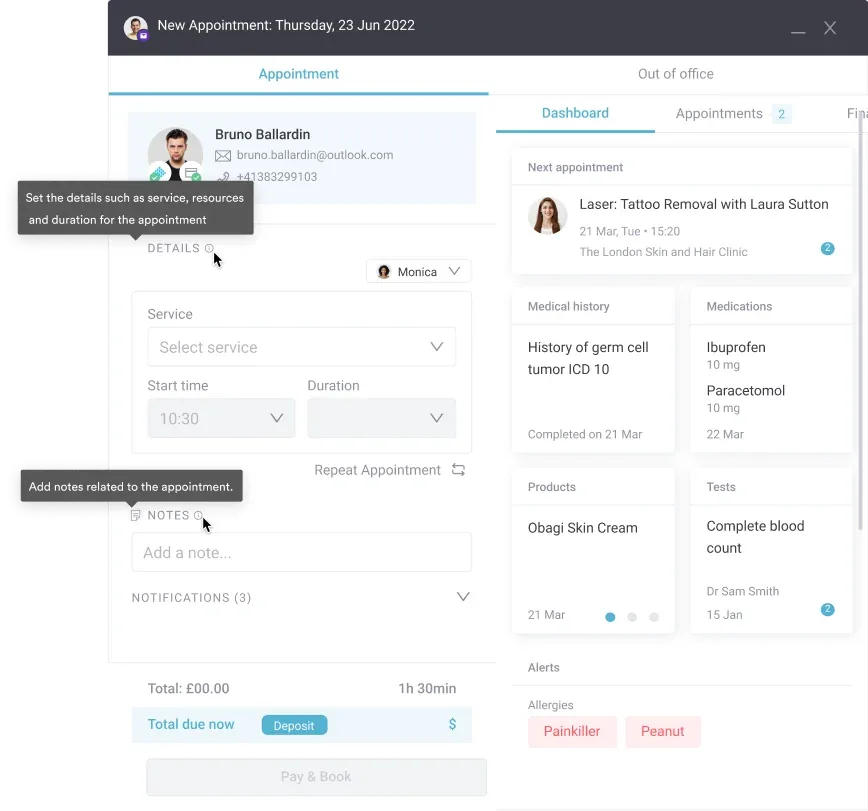
Practice management software like Pabau connects clinical documentation directly to claims management, so the pre-anesthesia evaluation, the anesthesia record, and the post-anesthesia note all sit against the same patient file instead of being pieced together from separate systems.
Pabau also supports pre-procedure evaluation forms, intraoperative record capture, and post-anesthesia note templates aligned with CMS documentation requirements. Practices that standardize these forms tend to see fewer audit flags, because the record structure matches what payers expect to find.
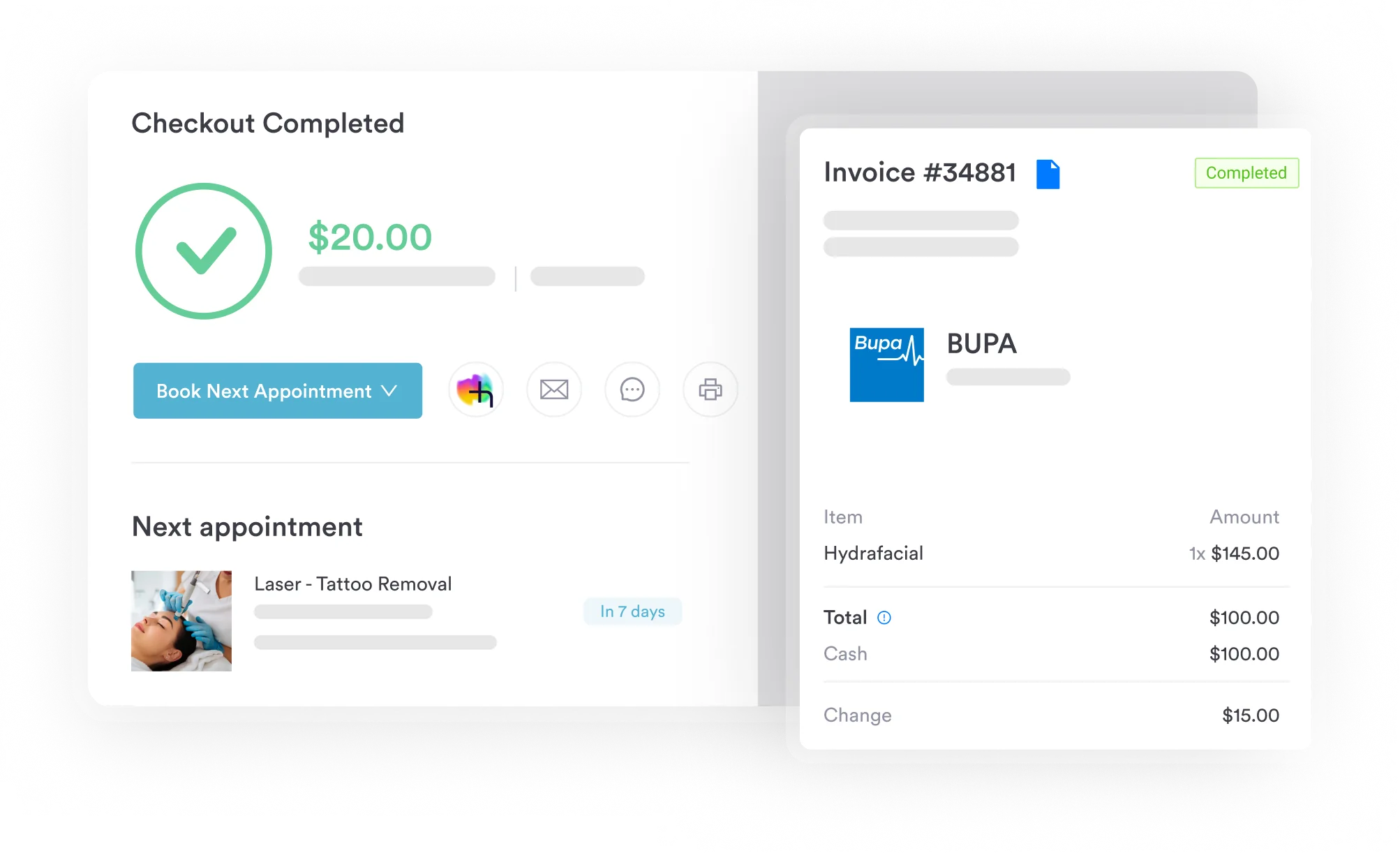
Pabau’s claims management checks that the required insurer-submission fields, like membership and authorization details, are complete before a claim is allowed to go out, and gives the billing team one dashboard to track status from submission through payment.
The same documentation handoff shows up in outpatient specialties too.
What Pabau doesn’t do is choose between CPT code 01930 and its siblings, or decide whether AA or QK applies to a given case. That coding judgment still sits with the anesthesia biller.
The tool’s job is making sure a claim doesn’t get denied over an administrative field that had nothing to do with the anesthesia itself, keeping documentation, billing.

Pabau helps anesthesia and interventional radiology practices capture structured pre-procedure evaluations, anesthesia records, and post-procedure notes in a single system, reducing documentation-related claim denials.

CPT code 01930 billing comes down to three checks, done in order: confirm the procedure is therapeutic rather than diagnostic, confirm it’s venous or lymphatic rather than arterial, and confirm the operative note doesn’t name a specific site that belongs to 01931, 01932, or 01933 instead.
Skip any one of those, and the claim is coded for a procedure the code was never meant to cover.
Get the code selection right, pair it with the correct modifier, and back it with complete documentation, and a CPT code 01930 claim moves through payment on the first pass instead of the third.
Book a demo to see how Pabau keeps that documentation and claims workflow in one place for anesthesia and interventional radiology practices.

Need the code for the catheter itself, not just the anesthesia? C1751 covers peripheral, central, and midline infusion catheters billed separately under OPPS.
Coding the vascular surgeon’s side of a related case? 33321 covers suture repair of the aorta or great vessels using a temporary shunt bypass.
Handling anesthesia billing outside interventional radiology too? 01968 bills the cesarean portion of a labor epidural that converts to a C-section.
Yes. The anesthesia service and the IR procedure are reported under separate CPT codes on separate claim lines – 01930 is never bundled into the proceduralist’s code. Some payers apply National Correct Coding Initiative edits that call for a distinguishing modifier when both are submitted together, so check the payer’s specific bundling edits before filing.
The CPT code itself doesn’t change by setting. What can differ is the facility billing arrangement and, occasionally, a site-of-service payment adjustment. Confirm with the payer whether a differential applies before estimating reimbursement for an outpatient case.
Age doesn’t change the CPT code, but a qualifying circumstance add-on code, such as 99100 for a patient under 1 or over 70, may be reported separately when documented. Medicare treats these add-on codes as bundled with no separate payment, though some commercial payers still price them individually.
Most state Medicaid programs cover 01930 when medical necessity is documented, but the conversion factor and time-unit increment are state-specific rather than the Medicare figures used elsewhere in this guide. Verify the current state Medicaid fee schedule before billing.



