



HCPCS code E0198: Water pressure pad billing guide
HCPCS code E0198 is a water pad for a standard mattress HCPCS code E0198 is the ...

Last Updated: Oct 13, 2026

CPT Code 01758 covers anesthesia for open or surgical arthroscopic excision of a cyst or tumor of the humerus.
It is a specific code, not a catch-all. Unspecified elbow procedures belong to CPT 01740 instead.
CPT Code 01758 carries 5 ASA base units. Confirm the figure against the current ASA Relative Value Guide.
Anesthesia reimbursement is calculated as (base units + time units) x conversion factor. One time unit equals 15 minutes under Medicare.
Modifier selection is critical. AA, QZ, QX, and QY each reflect a different supervision level and directly affect payment.
Pabau’s claims management software helps anesthesia billing teams track time units, apply correct modifiers, and reduce claim denials.
CPT Code 01758 stands for anesthesia for humerus cyst or tumor excision and covers anesthesia for open or surgical arthroscopic excision of a cyst or tumor of the humerus. It carries 5 ASA base units, and it is paid on anesthesia time rather than a flat fee.
The code is narrow by design, and that is where most claims come apart. It applies only when the surgeon removes a lesion from the bone, not to elbow surgery in general.
This guide covers the official descriptor, the base unit and time unit math, and modifier selection. It also covers the ICD-10 codes that support the claim and the documentation payers expect.
The American Medical Association (AMA) gives CPT Code 01758 this official descriptor.
Anesthesia for open or surgical arthroscopic procedures of the elbow; excision of cyst or tumor of humerus.
The semicolon matters. CPT Code 01758 is an indented child of parent code 01740, so it inherits the parent’s opening phrase and then narrows it. The billable scope is only what follows the semicolon, which is excision of a cyst or tumor of the humerus.
That makes 01758 a specific code rather than a catch-all. If the surgery was an unspecified open or arthroscopic elbow procedure, the correct code is 01740. Coders who read 01758 as a default selection routinely misreport the case.
CPT Code 01758 pairs with the surgical codes for removing a cyst or benign tumor from the humerus. The most common are excision or curettage procedures on the shaft or distal humerus.
Typical lesions include unicameral (solitary) bone cysts, aneurysmal bone cysts, enchondromas, osteochondromas, and fibrous dysplasia. Each one is a benign or indeterminate lesion treated by removing the abnormal bone. In many cases the surgeon then packs the cavity with graft material.
Draining a lesion with a needle is a different procedure from excising it. Aspiration elsewhere in the body is reported with codes such as 19000, and it does not support 01758.
Do not reach for 01758 just because the surgery involved the humerus. Fracture fixation, osteotomy, joint replacement, and unspecified elbow surgery each have their own code. Read the operative report for the words excision or curettage of a cyst or tumor before you assign 01758.
Every anesthesia CPT code carries an ASA-assigned base unit value. CPT Code 01758 is assigned 5 base units under the American Society of Anesthesiologists (ASA) Relative Value Guide. That value is corroborated by the AAPC code reference and by federal anesthesia base unit tables.
Verify the figure against the current ASA RVG before billing, because base unit values can be updated annually. If a billing sheet in your practice still shows 4 base units for 01758, correct it. That value belongs to parent code 01740.
Base units alone do not determine the claim value. The full anesthesia billing formula is:
Under Medicare, one time unit equals 15 minutes of anesthesia time. A 60-minute procedure generates 4 time units, and a 90-minute procedure generates 6. Anesthesia time starts when the anesthesiologist begins preparing the patient in the operating suite. It ends when the anesthesiologist hands patient care to post-anesthesia recovery staff.
Some commercial payers use 10-minute increments instead of 15 minutes. Always confirm the payer’s specific time unit policy before submitting a claim. Missing this detail is one of the most common sources of underpayment on anesthesia claims.
Modifier selection for CPT Code 01758 is not optional. The wrong modifier changes the allowed amount and can trigger a full denial. Each modifier tells the payer which provider delivered the anesthesia service, and under what supervision model.
When QX and QY are paired, both parties each receive 50% of the allowed amount. That happens when the CRNA and the directing anesthesiologist each submit a claim for the same case. The combined total equals 100%, not 200%. This pairing requirement is a common source of audit flags.
Before submitting a CPT Code 01758 claim, confirm the modifier matches the supervision arrangement documented in the anesthesia record. Modifier AA on a case where a CRNA independently performed the service is a compliance risk. CMS has targeted anesthesia modifier accuracy in OIG Work Plans.
Medicare reimbursement for CPT Code 01758 is not a fixed dollar amount. It varies by year, by locality, and by how the claim is modified. The formula stays the same. (Base units + time units) x conversion factor x Geographic Practice Cost Index (GPCI).
The anesthesia conversion factor is updated each January by CMS. For the 2026 payment year, verify the current figure with the CMS fee schedule tool. The GPCI adjustment varies by Medicare Administrative Contractor (MAC) locality. High-cost markets such as Manhattan and San Francisco produce higher multipliers than rural localities.
The surgeon’s claim on the same case is paid on a different basis. A surgical code such as 22318 is paid on RVUs, while the anesthesia code is paid on base units plus time.
The figures below are illustrative. Verify current rates with CMS before you bill.
The FastRVU lookup tool models payment by locality and modifier, using the same CMS data files.
Every CPT Code 01758 claim requires a supporting diagnosis code that medically justifies the surgery. Because 01758 covers excision of a cyst or tumor, the diagnosis must describe a bone lesion of the humerus.
Fracture, osteoarthritis, and epicondylitis codes do not support this claim. They justify a different surgery, so a payer will not reconcile them with a cyst or tumor excision.
The diagnosis has to reflect the pathology report, and laterality has to match the operative note. A claim listing M85.421 for a left humerus cyst will be denied. Upper-limb codes such as codes such as S44.42XA build the side into the code itself, so one transposed character loses the claim.
Malignant lesion codes need extra care. A C40.0- diagnosis often means the surgeon performed a radical resection rather than a simple excision. In that case the anesthesia code is 01756, not 01758.
Selecting the wrong code from the upper arm and elbow family is the most expensive mistake on these claims. CPT Code 01758 sits among six neighbors that share almost identical wording. Choosing on anatomy alone, rather than on what the surgeon did, can result in upcoding or downcoding allegations.
The boundary between 01756 and 01758 is surgical extent. A radical resection for a malignant humeral tumor is 01756. A curettage or marginal excision of a cyst or benign lesion is 01758.
The boundary between 01740 and 01758 is what the surgeon removed. Loose body removal, synovectomy, and joint debridement all fall under 01740. Only removal of a cyst or tumor from the bone itself qualifies for 01758. A closed reduction or manipulation without an incision leaves the group entirely and maps to 01730.
Fracture fixation and joint replacement leave the family entirely. Humeral fracture fixation maps to 01742 or 01744 depending on the repair, and total elbow arthroplasty maps to 01760. Review the operative report before assigning the anesthesia code, not just the scheduling diagnosis. The same documentation-first rule decides bone excision codes elsewhere in the body, as it does for 22102. Time-based and complexity-based selection can point at different codes, so the documented medical decision making decides. Patients paying up front and claiming later need a superbill, which itemizes the service, the code and the charge.
CMS and commercial payers require specific documentation before an anesthesia claim will pay. Missing any of these elements gives the payer grounds for a technical denial. Digital anesthesia forms that capture structured fields reduce the risk of incomplete documentation at the time of service.

HIPAA compliance rules also govern how long anesthesia records are kept. State law sets the minimum, commonly six to ten years, so confirm the retention schedule with your compliance officer.
Anesthesia billing denials follow predictable patterns. Most CPT Code 01758 rejections trace back to five recurring errors.
Run a monthly audit of CPT Code 01758 claims using your practice management system. Filter by denial reason code. If modifier or diagnosis denials cluster around one provider, that points to a training need rather than a random error pattern. Corrective action is faster when you can show a code-level trend.
Anesthesia billing for CPT Code 01758 has more moving parts than most surgical codes. The practice management software a practice runs on either absorbs that work or hands it back to the billing team as manual checks.
Pabau, practice management software for healthcare practices, keeps the anesthesia record and the claim in one place. Its claims management software builds the claim from the documentation your team already captured, so nobody re-keys times or modifiers from a paper chart.
Automated billing workflows flag a missing modifier before the claim reaches the payer. That matters on anesthesia codes, where one omitted modifier can halve the allowed amount or trigger a denial.
Surgical teams get the same support across the care pathway. Sports medicine software covers pre-operative documentation and claim tracking, and physical therapy software carries the record through post-operative rehab.
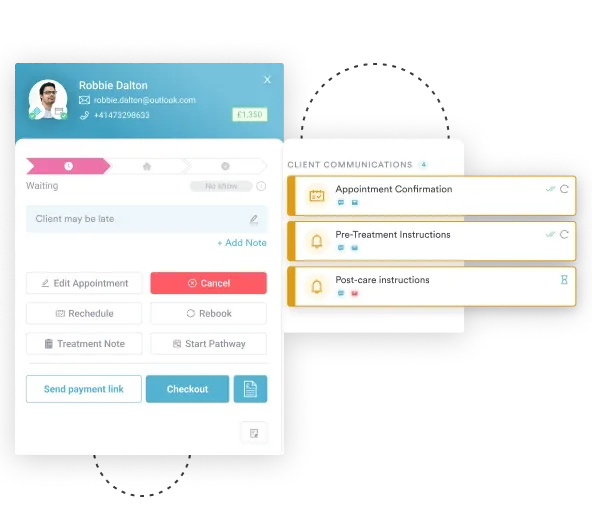

Pabau keeps the anesthesia record, the modifier, and the claim in one system, so your billing team submits from documentation that is already complete. Fewer technical denials, less rework after the fact.

The safest habit with 01758 is to read the operative report before assigning anything. The code follows what the surgeon removed, and the anatomy alone will never tell you that.
A wrong base unit or a wrong modifier is rarely one bad claim. It sits on a fee sheet or in a template, and it repeats across every case the practice bills. That is why the correction is worth making today.
Book a demo to see how Pabau keeps anesthesia documentation, modifiers, and claims together for your billing team.

Billing an arthroscopic procedure in another joint? G0289 sets out how the knee arthroscopy add-on is reported and documented.
Coding a bone graft on the operative note? 21267 covers orbital repositioning with bone grafts and the documentation it needs.
Harvesting cartilage in the same session? 21235 explains ear cartilage graft billing and when the harvest is separately reportable.
Billing a percutaneous bone procedure? 22510 walks through vertebroplasty billing, imaging guidance, and payer rules.
Draining a lesion rather than excising it? 19020 covers mastotomy with exploration or drainage of an abscess.
CPT Code 01758 is used to bill anesthesia for open or surgical arthroscopic excision of a cyst or tumor of the humerus. Typical surgical pairings are CPT 24110, 24115, and 24116. Those codes cover excision or curettage of a humeral bone cyst or benign tumor, with or without a graft.
CPT Code 01758 carries 5 ASA base units under the American Society of Anesthesiologists Relative Value Guide. A value of 4 belongs to parent code 01740, and it is a common transcription error on internal fee sheets. Verify the figure against the current year’s ASA RVG before billing.
CPT Code 01758 uses the standard anesthesia supervision modifiers. AA means the anesthesiologist personally performed the service, and QZ means a CRNA worked without medical direction. QX covers a CRNA with medical direction, and QY covers an anesthesiologist directing one CRNA. QK covers direction of 2-4 concurrent cases, and AD covers supervision of more than 4. The modifier must match the supervision arrangement in the anesthesia record.
Medicare reimbursement for CPT Code 01758 is calculated as (base units + time units) x anesthesia conversion factor x GPCI. With 5 base units, a 75-minute case produces 10 total units. The dollar amount varies by locality and is updated annually by CMS, so check the CMS Physician Fee Schedule Look-Up Tool for your MAC locality.
Both codes cover tumor surgery in the upper arm and elbow family, and the difference is surgical extent. CPT 01756 covers radical procedures, meaning a wide resection of bone and surrounding soft tissue for a malignant lesion. CPT 01758 covers excision or curettage of a cyst or tumor of the humerus. CPT 01756 carries 6 base units and 01758 carries 5.
Required documentation includes a pre-anesthesia evaluation, exact anesthesia start and stop times, and the type of anesthesia used. You also need the provider credentials, the supervision arrangement, the intraoperative monitoring record, and a post-anesthesia note. For this code specifically, the operative note must describe the cyst or tumor and the excision performed.
Common pairings include M85.421 and M85.422 for a solitary bone cyst of the humerus. M85.521 and M85.522 cover an aneurysmal bone cyst of the upper arm. D16.01 and D16.02 cover a benign neoplasm of the long bones of the upper limb, and D48.0 covers a lesion of uncertain behavior. Fracture and osteoarthritis codes do not support this claim.
No. CPT 01758 is specific to excision of a cyst or tumor of the humerus. The catch-all in this family is CPT 01740, which covers open or surgical arthroscopic elbow procedures not otherwise specified. Loose body removal and joint debridement belong to 01740, not 01758.



