CCSD code XR940: Foreign body retrieval billing guide
CCSD code XR940 is the UK private healthcare code for retrieval of a foreign bod...

Last Updated: Nov 26, 2026
W0284 is the CCSD code for total excision of trapezium and ligament reconstruction. It covers removal of the whole trapezium at the base of the thumb, with a ligament reconstruction in the same operation. Surgeons usually perform it for advanced thumb base osteoarthritis.
It sits in section 16.6.1 of the CCSD schedule, Hand incision and excision. Total excision alone is W0282, and excision with a spacer is W0283.
Let Pabau's smart automation suggest the right codes, reduce claim denials, and keep your practice compliant—effortlessly.
Automate repetitive tasks and focus on what matters most—your patients.
Reduce coding errors and ensure compliance with the latest regulations.
Clean claims, fewer denials, and faster reimbursements.
Powerful insights and reporting to help your practice thrive.
HIPAA compliant SOC 2 certified GDPR-compliant Trusted by 4,000+ clinics worldwide

CCSD code W0284 covers total excision of the trapezium and ligament reconstruction as one bundled procedure.
The primary indication is first CMC joint osteoarthritis (rhizarthrosis) that has not responded to conservative treatment.
An operative note that doesn’t document the ligament reconstruction supports only W0282, total excision of trapezium.
W0284 shares its CCSD section with W0282 (excision alone), W0283 (excision with spacer) and W0285 (joint surface replacement).
Pabau, a practice management platform, lets you record CCSD codes against the patient episode, track pre-authorization, and use structured operative note templates.
CCSD code W0284 covers total excision of the trapezium and the ligament reconstruction that follows it, billed as one procedure. The CCSD schedule gives the full descriptor as “Total excision of trapezium and ligament reconstruction.”
Both parts are bundled into the one code. A practice can’t split them into separate line items, or claim the ligament reconstruction under another code in the same operative episode.
The trapezium is the most radial of the four distal carpal bones, at the base of the thumb. It meets the base of the first metacarpal at the first carpometacarpal (CMC) joint. Removing it is a standard surgical option when osteoarthritis at that joint has become severe. Ligament reconstruction follows to stop the first metacarpal migrating into the space the excised bone leaves. A fractured trapezium is a different claim, because open fixation of a carpal fracture is billed as code W1940. An osteotomy of a small hand bone, which cuts and realigns the bone rather than removing it, is billed as W1641.
Billing staff who know the surgical steps behind W0284 can check that the operative note records each one before the claim goes out.
The operative note must record the ligament reconstruction as a distinct surgical step. Without it, the note supports only total excision, which is a different code. Insurers reviewing W0284 claims expect explicit documentation of tendon harvest, ligament reconstruction technique, and interposition placement.
W0284 is performed mainly for first CMC joint osteoarthritis, also known as rhizarthrosis or basal thumb arthritis. The British Society for Surgery of the Hand describes surgery as a last resort after activity changes, pain medication, splinting, and steroid injection. It names removal of the trapezium as the most commonly performed operation for the condition.
Typical clinical criteria for surgery include all of the following:
Less commonly, W0284 may follow failed CMC implant arthroplasty, where the implant is removed and the ligament is reconstructed. It can also be used for complex post-traumatic CMC arthritis. State these indications clearly in the pre-authorization request to avoid delay or denial. Silastic implants are used in the fingers too, where replacing one MCP or PIP joint is billed as W0512.
Record the Eaton-Littler grade in both the pre-authorization request and the operative note for W0284. The grade shows the reviewer how advanced the joint disease is. A request without radiological grading is more likely to come back with questions.
W0284 shares CCSD section 16.6.1, Hand incision and excision, with three other trapezium codes. Each one turns on a single detail in the operative note, as the decision below shows.
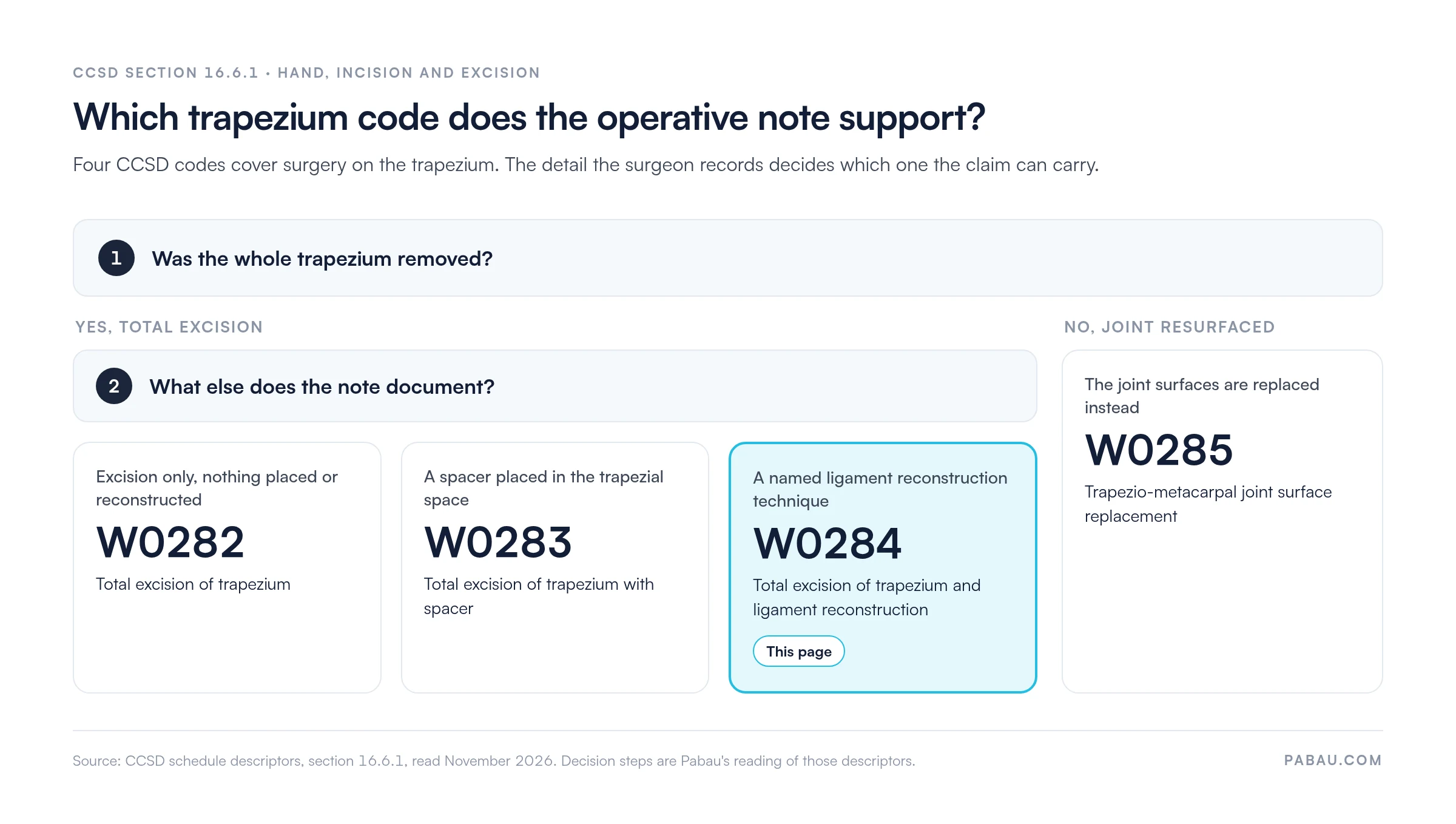
Check two things before submission. A note that describes excision alone supports W0282, not W0284. A note that names a spacer but no ligament reconstruction points to W0283 instead.
The same section also holds the Dupuytren’s fasciectomy codes, from T5202 to T5410. Our CCSD code reference lists them with the rest of the schedule.
A complete operative note is the foundation of every W0284 claim. A structured template that prompts the surgeon for each element catches missing detail at the point of care, before claim review does. The operative note must contain all of the following:
The M18 category in the WHO ICD-10 classification codes one thumb and both thumbs separately. When primary arthritis affects both thumbs, the bilateral code M18.0 applies instead of M18.1.
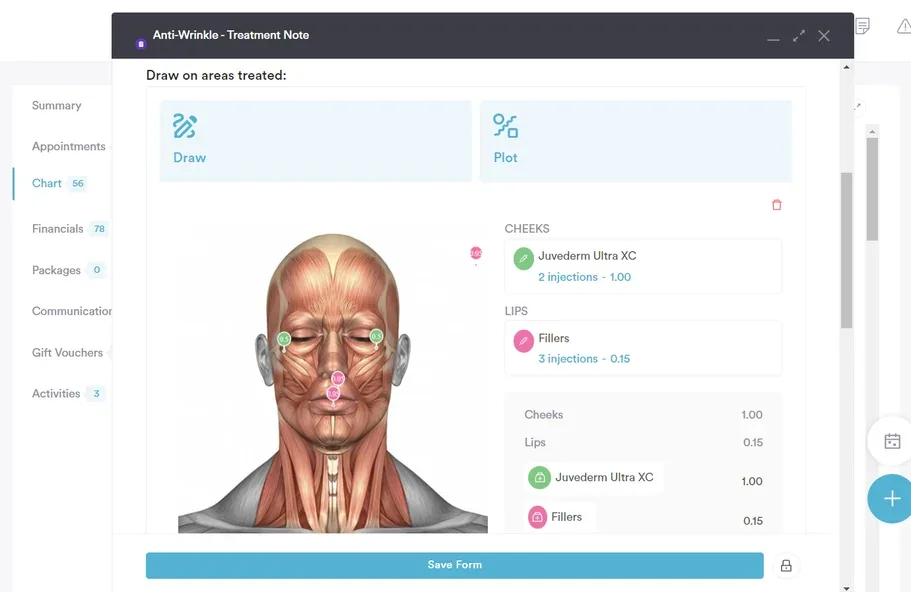
Storing these records in line with UK GDPR is a separate obligation. The practice management system should keep each operative note retained, retrievable, and attached to the right patient episode.
Insurers typically require pre-authorization for W0284 before the procedure takes place. Confirm W0284 acceptance and the evidence each insurer wants on its own portal before you submit. The package below is a common starting point.
Submit the W0284 claim with its pre-authorization reference number. Without one, an insurer can reject the claim whatever its clinical merit. Fees differ by insurer too, and the Bupa procedure fee schedule guide explains how Bupa structures them.
Set up a pre-authorization checklist in your practice management system for every surgical procedure that needs insurer approval, W0284 included. Record the authorization reference number, the approval date, and the clinical indication documented. Authorization validity windows vary by insurer, so record the expiry date and schedule surgery inside it.
These denial patterns follow from the code descriptor and the documentation requirements above:
W0284 trapeziectomy billing follows a consistent workflow from surgical planning through to payment. Each step below maps to a specific failure risk if skipped.
In many hand surgery practices, a W0284 claim is assembled from several places. The pre-authorization reference sits in an email, the operative note in a dictation system, and the invoice in a billing tool. Each handoff is a chance for the ligament reconstruction or the authorization number to drop out.
Pabau’s claims management software keeps those steps on one patient record. Key capabilities for W0284 billing include:
The result is a W0284 claim that matches its operative note when it leaves the practice. Your team spends less time chasing missing references after the insurer queries them.

Pabau helps UK private practices track pre-authorization, record CCSD codes against patient episodes, and build invoices. Your team spends less time chasing claims and more time on patient care.

W0284 is only the right code when the operative note proves both halves of the procedure. Before a claim goes out, check that the note names the ligament reconstruction technique and the tendon used. If it doesn’t, the case codes as W0282 or W0283, and billing W0284 invites a denial.
The admin side carries the same risk. A missing authorization reference or a mismatched M18 code can stop a well-documented case from paying. Keeping the note, the authorization, and the invoice on one record is the surest way to catch both.
Book a demo to see how Pabau keeps CCSD claims and their operative notes in step for UK hand surgery practices.

Need a full reference for Bupa CCSD codes? Bupa CCSD codes explains how the CCSD schedule maps to Bupa claims, with guidance on code submission and common billing pitfalls.
Looking for broader CCSD billing context? Bupa procedure codes fee schedule covers how UK private insurer fee structures work across CCSD-coded orthopedic and surgical procedures.
Want to reduce claim denials across your practice? Claims management software from Pabau keeps pre-authorization, invoicing, and claim tracking together for UK private practices.
Billing a trapeziectomy without ligament reconstruction? CCSD code W0282 covers total excision of trapezium on its own, with the documentation that separates it from W0284.
Coding other hand surgery in the same CCSD section? CCSD code T5202 covers Dupuytren’s fasciectomy confined to the palm.
CCSD code W0284 covers total excision of the trapezium and ligament reconstruction as a single bundled procedure. Both the bone removal and the ligament reconstruction are included within the code. They can’t be split into separate line items or billed individually on the same claim.
A trapeziectomy with ligament reconstruction is billed under W0284. A simple trapeziectomy without ligament reconstruction is W0282, and excision with a spacer is W0283. Selecting W0284 when no ligament reconstruction was performed is a common source of denial, because the insurer can check it against the operative note.
The operative note must confirm total trapezium excision, name the ligament reconstruction technique and tendon used, and describe the interposition placement. The claim must also carry the M18 diagnosis code for first CMC osteoarthritis and a valid pre-authorization reference number from the insurer.
Insurers typically require pre-authorization for W0284, but acceptance and requirements vary by insurer. Bupa, AXA Health, Aviva and WPA each run their own specialist portals for code lookup and submission. Confirm W0284 acceptance and the evidence needed on each insurer’s portal before surgery.
Yes, in certain circumstances. A separate procedure in the same operative sitting can take its own CCSD code on the invoice. Carpal tunnel decompression and nerve repair are common examples. Ligament reconstruction and tendon interposition that are part of the trapeziectomy can’t be unbundled from W0284 and billed as separate codes.
Rejections usually come from four problems. The operative note doesn’t document the ligament reconstruction, or the code is applied to a partial excision. The claim may also lack a pre-authorization reference, or carry a diagnosis code outside the M18 first CMC arthritis category.