

CCSD code XR940: Foreign body retrieval billing guide
CCSD code XR940 is the UK private healthcare code for retrieval of a foreign bod...

Last Updated: Nov 26, 2026
W1641 is the CCSD (Clinical Coding and Schedule Development) code for osteotomy of a short bone of the hand, including fixation and bone grafting. It covers a planned corrective cut through a metacarpal or phalanx, with any wires, plate or graft placed at the same operation.
Bupa’s 2026 schedule lists W1641 in band INTER 4, with a fee of £369. Other UK insurers, such as AXA Health, Vitality and WPA, set their own fees for the code.
Let Pabau's smart automation suggest the right codes, reduce claim denials, and keep your practice compliant—effortlessly.
Automate repetitive tasks and focus on what matters most—your patients.
Reduce coding errors and ensure compliance with the latest regulations.
Clean claims, fewer denials, and faster reimbursements.
Powerful insights and reporting to help your practice thrive.
HIPAA compliant SOC 2 certified GDPR-compliant Trusted by 4,000+ clinics worldwide

CCSD code W1641 covers osteotomy of a metacarpal or phalanx, with fixation and bone grafting bundled into the one code. Never bill them as separate lines.
Bupa’s 2026 schedule places W1641 at INTER 4 with a fee of £369. Other UK insurers, such as AXA Health, Vitality and WPA, set their own fees.
UK private insurers expect pre-authorisation for an elective osteotomy. Quote the authorisation number on the invoice you send through Healthcode.
Pabau, a practice management platform, sends CCSD-coded invoices through Healthcode. It keeps the authorisation, operative note and claim in one patient record.
CCSD code W1641 covers osteotomy of a short bone of the hand, including fixation and bone grafting. That descriptor is set by Clinical Coding and Schedule Development (CCSD), which maintains the procedure codes UK private insurers use.
AXA Health’s specialist code schedule lists W1641 with the same wording, fixation and grafting included. Internal fixation and bone grafting at the same operation, on the same bone, are included in the code. Billing them on separate lines is unbundling.
Orthopaedic and plastic hand surgeons use W1641 when they bill UK private medical insurers. It is a surgical procedure code. The anaesthetist invoices separately, quoting the same CCSD code against their own fee schedule.
W1641 applies to the short bones of the hand: the five metacarpals and the proximal, middle and distal phalanges of each finger and thumb. The table below maps each bone group to its status under W1641.
Carpal bones, such as the scaphoid, lunate and triquetrum, are not short bones of the hand for W1641. Scaphoid non-union surgery, for example, has its own codes, W3200 and W3202. For any other carpal procedure, check the current CCSD schedule for the matching code.
UK insurers code diagnoses with the World Health Organization’s ICD-10, not the US ICD-10-CM. Every W1641 claim needs a diagnosis code that explains why the bone was cut. The table maps the common indications to their WHO ICD-10 codes.
WHO ICD-10 has no laterality characters, so state the side in the clinical summary and on the invoice instead. Use the most specific four-character code the notes support. Check codes against the current WHO ICD-10 browser before you submit.
The phrase “including fixation and bone grafting” is the most important part of the W1641 descriptor. The CCSD technical guide treats bundled components as part of the main procedure. Adding them as separate lines is unbundling, and insurers will reject the extra lines.
Run a bundling check before you submit any W1641 invoice. If a separate K-wire fixation or local bone graft line sits alongside W1641, the insurer will reject it. Remove the extra line, and record in the operative note that fixation and grafting were part of the osteotomy.
Several codes in the CCSD code library sit close to W1641, and choosing the wrong one is a common reason for a rejected invoice. A planned cut through a long bone, such as the radius or ulna, is billed under CCSD code W1080 instead. The bands and fees below come from Bupa’s 2026 schedule.
Read as a decision, the choice turns on what the operation set out to do, then on which bone was cut. The chart below follows that order.
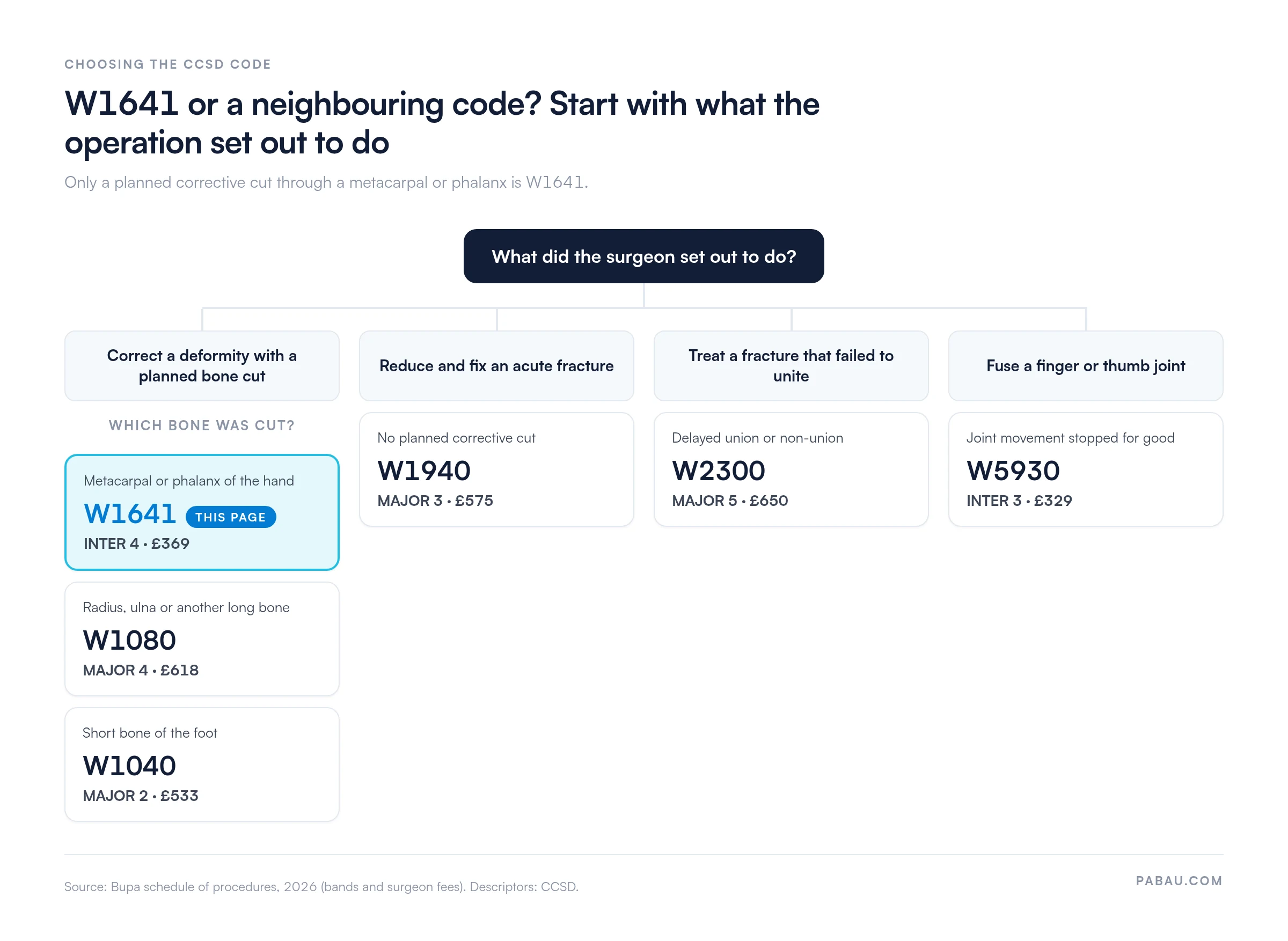
Check each code against the current CCSD schedule and the insurer’s own fee list on the date of service. Insurers update their schedules during the year.
CCSD sets the codes, and each insurer sets its own fee against them. Bupa’s 2026 schedule places W1641 in band INTER 4, with a fee of £369. AXA Health, Vitality and WPA set their own fees in provider schedules, so check each insurer’s schedule or fee finder before treatment.
A surgeon who charges more than the insurer pays leaves the patient with a shortfall. Tell the patient about any shortfall in writing before surgery. The Bupa code search shows the current Bupa figure for each code. Our Bupa CCSD codes guide explains how the bands work across the schedule.
UK private medical insurers expect pre-authorisation before an elective osteotomy. The patient usually calls the insurer for an authorisation number, using the CCSD code and diagnosis from the specialist’s letter. Confirm the number yourself before the date of surgery. Requirements differ between insurers and policies.
Trauma cases that go straight to theatre follow each insurer’s own urgent-treatment process, so check it at admission. Compliance tracking in your practice software can flag booked procedures that still lack an authorisation number. That catches the most common process failure: a completed operation that was never authorised.
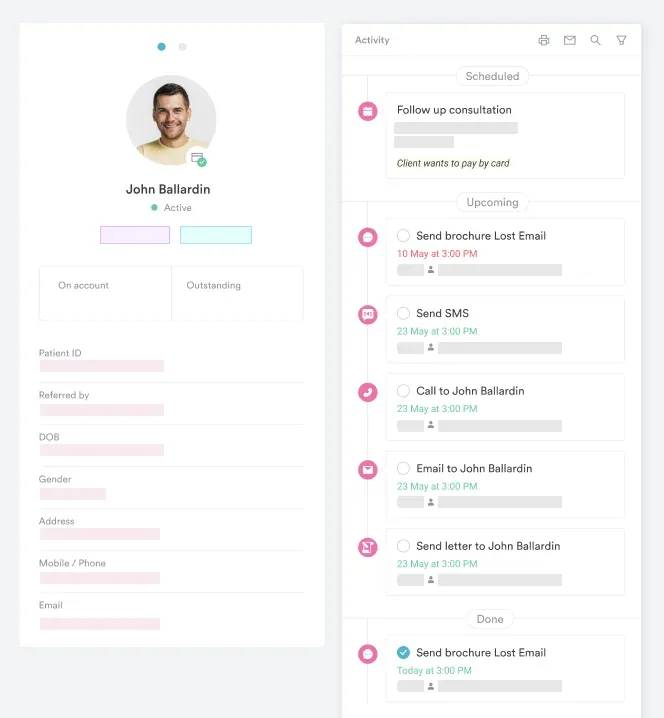
Vague operative notes are the most common reason an insurer queries a W1641 invoice after an audit. The note must show that a planned bone cut corrected a deformity. An acute fracture fixation, which is billed as W1940, does not meet the descriptor. Neither does an arthrodesis.
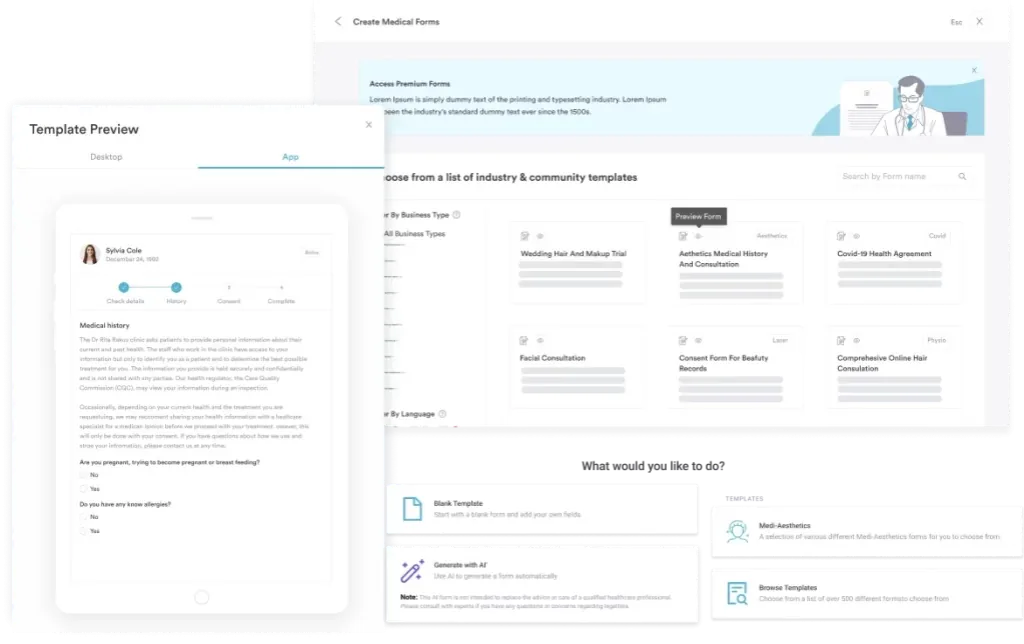
Digital operative documentation that prompts for each field reduces the risk of an incomplete note. When every element is captured at the time of surgery, the billing team can defend the invoice if the insurer queries it.
W1641 invoices fail for predictable, preventable reasons. The table maps each one to its fix and the next step if the insurer still declines.
If an insurer still declines, raise it with its provider services team. A patient whose claim the insurer still refuses can use the insurer’s complaints process, then the Financial Ombudsman Service.
CCSD has no modifier system like the US CPT set, and the schedule has no separate bilateral code for W1641. When the surgeon cuts the same bone in both hands at one operation, bill W1641 once for each side. Write “right” and “left” on each line and in the operative note.
A finished osteotomy turns into a paid invoice only when the code, the diagnosis and the authorisation agree. Pabau’s claims management software links each CCSD procedure code to its WHO ICD-10 diagnosis code. The billing team then sends the right pairing the first time.
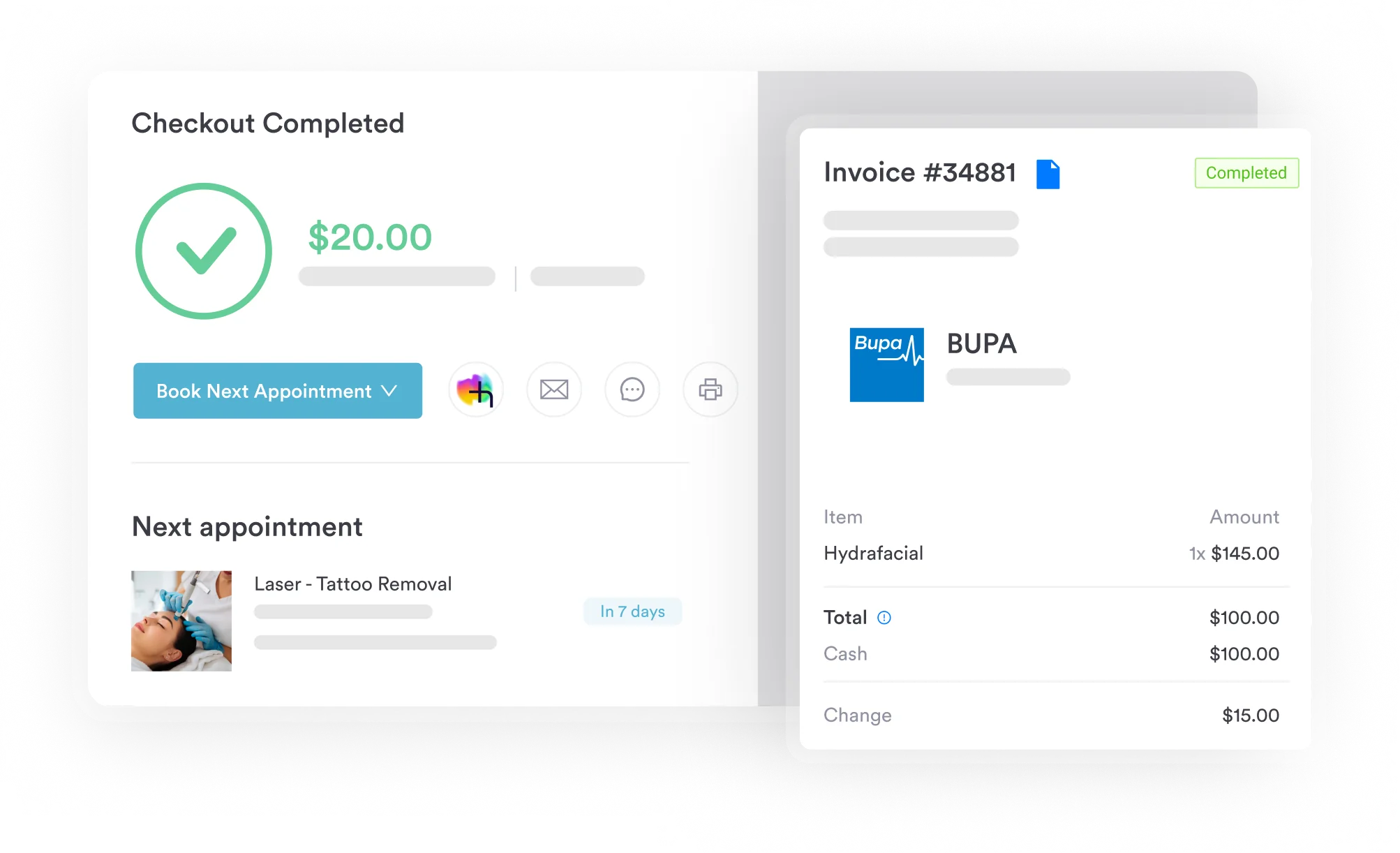
Pabau sends invoices to UK insurers electronically through Healthcode. The authorisation number, operative note and invoice sit in the same patient record. If an insurer queries a W1641 claim, the evidence is already in one place.
For practices comparing UK medical billing software, check that it holds each insurer’s fee schedule against the CCSD code. That shows any shortfall before surgery rather than after the remittance arrives.

Pabau links CCSD codes to WHO ICD-10 diagnosis codes, tracks pre-authorisation numbers and sends invoices to UK insurers through Healthcode.

W1641 pays for one operation, not three. The bone cut, the fixation and the graft all sit inside a single INTER 4 code, so the invoice carries one line per bone. The money is lost elsewhere: in an authorisation number nobody chased, or a note that never named the bone.
Get those two things right before the patient reaches theatre, and the Healthcode invoice is a formality. Book a demo to see how Pabau keeps authorisation, operative notes and insurer billing in one workflow.

Want fewer rejected insurer invoices? Denial management in healthcare explains how to find the cause of a rejection, correct it and resubmit.
CCSD code W1641 covers osteotomy of a short bone of the hand: a metacarpal or a phalanx. It includes internal fixation and bone grafting at the same operation. Those components are part of the descriptor and must not be billed on separate lines.
Yes. The descriptor states “including fixation and bone grafting”, so both are part of W1641. A separate K-wire or graft line alongside it is unbundling and will be rejected. If graft is taken from a distant site through a separate incision, ask the insurer before adding anything.
UK insurers use WHO ICD-10. Common pairings are M84.0 (malunion of fracture), T92.2 (sequelae of a wrist or hand fracture) and S62 (hand fracture). Q68.1 (congenital deformity of finger(s) and hand) and M20.0 (deformity of fingers) also fit. WHO ICD-10 has no laterality characters, so state the side in the clinical summary.
Yes, for elective surgery. Bupa, AXA Health, Vitality and WPA all expect an authorisation number before an elective osteotomy. The patient usually obtains it using the CCSD code and diagnosis from the specialist’s letter. Quote the number on the invoice you send through Healthcode.
Bupa’s 2026 schedule places W1641 at INTER 4, with a fee of £369. AXA Health, Vitality and WPA set their own fees in provider schedules, so check each insurer’s schedule or fee finder before treatment. Tell the patient in writing about any shortfall before surgery.
Yes. CCSD has no bilateral modifier and no separate bilateral code for W1641, so bill one W1641 line for each side. Write “right” and “left” on each line and in the operative note. Each insurer applies its own rule for a second procedure, so check before you submit.
W1641 is an osteotomy: the bone is cut to correct a deformity, and the joint keeps its movement. W5930 covers fusion of digit joints of the hand, where the aim is to stop movement at a joint for good. If the operation fuses a finger or thumb joint, use W5930 instead.



