

CCSD Code D1010: Radical mastoidectomy including meatoplasty
CCSD Code D1010: Definition and clinical scope CCSD Code D1010 is the UK private...

Last Updated: Nov 25, 2026
V3350 is the CCSD code for combined anterior approach discectomy, decompression and fusion and posterior fusion (lumbar region) including spinal cord monitoring. It applies when the surgeon treats both columns of the lumbar spine in one operative episode, often called a 360-degree fusion.
An anterior-only fusion is coded V3340 or V3341, and a posterior-only fusion V2500 or V3362. UK private medical insurers, including Bupa and AXA Health, use the code on specialist claims.
Let Pabau's smart automation suggest the right codes, reduce claim denials, and keep your practice compliant—effortlessly.
Automate repetitive tasks and focus on what matters most—your patients.
Reduce coding errors and ensure compliance with the latest regulations.
Clean claims, fewer denials, and faster reimbursements.
Powerful insights and reporting to help your practice thrive.
HIPAA compliant SOC 2 certified GDPR-compliant Trusted by 4,000+ clinics worldwide

CCSD Code V3350 covers combined anterior and posterior lumbar fusion, with discectomy, decompression and spinal cord monitoring, under one code.
The operative note must describe both the anterior and the posterior stage, or the claim reads as a single-approach fusion.
Never split one combined operation into V3340 and V3362. AXA Health lists both as unacceptable combinations with V3350.
UK private medical insurers such as Bupa, AXA Health, Aviva and Vitality expect pre-authorisation before major spinal surgery goes ahead.
Pabau’s claims management software sends UK claims through Healthcode and Bupa, with the operative note held in the same record.
CCSD Code V3350 covers combined anterior approach discectomy, decompression and fusion and posterior fusion of the lumbar region. AXA Health’s chapter 3 listing gives the full descriptor, which includes spinal cord monitoring. The code sits in Chapter 3 of the CCSD Schedule, Spine, spinal cord and peripheral nerves, among the lumbar spinal column codes.
The schedule is set by the Clinical Coding & Schedule Development (CCSD) Group, whose members are Aviva, AXA Health, Bupa and VitalityHealth. UK private medical insurers use CCSD procedure codes to identify procedures on specialist claims. Healthcode, the UK clearinghouse for private healthcare, carries those claims electronically.
V3350 describes one operative episode in which both columns of the lumbar spine are treated. The surgeon reaches the anterior column through the abdomen and the posterior column through the back. Surgeons often call this a 360-degree or circumferential lumbar fusion.
The procedure runs in two stages. Most surgeons complete both under one anaesthetic, although some patients have the stages on separate days.
Anterior stage (ALIF): The patient lies supine. The surgeon reaches the front of the lumbar spine through a retroperitoneal or transperitoneal incision, often with a vascular surgeon providing access. The disc is removed and the nerves are decompressed through the anterior corridor. An interbody cage packed with bone graft then restores disc height and fuses the anterior column.
Posterior stage: The patient is turned prone. Through a midline incision, the surgeon decompresses the nerves by laminectomy or laminotomy where needed. Pedicle screws and rods are placed, and bone graft is laid for a posterolateral fusion. Throughout both stages, intraoperative neuromonitoring (IONM) tracks motor and somatosensory evoked potentials.
Each approach does a job the other cannot. Anterior column support gives better interbody fusion and helps restore sagittal alignment. Posterior instrumentation gives immediate stability and deals with posterior element pathology. Complex instability and deformity usually need both. When both approaches are used to correct scoliosis, the operation is coded separately as CCSD V4000.
Not every lumbar fusion justifies a combined approach. The insurer’s clinical reviewers look for a diagnosis that explains why one approach alone would fall short. The strongest indications are:
The clinical letter sent for pre-authorisation should tie the diagnosis to the reason for a combined approach. A simple disc prolapse without instability will not justify V3350 on its own.
The descriptor sets the scope. Work the descriptor names belongs to the V3350 fee and should not appear as a second code on the same claim. AXA Health publishes a list of codes it will not accept alongside V3350, which is a useful check before submission.
The descriptor ends with “including spinal cord monitoring”, so the surgeon’s V3350 fee covers monitoring as part of the procedure. A separate neurophysiologist who runs IONM provides a distinct professional service. Each insurer decides whether and how it pays for that service.
Confirm the neurophysiologist’s billing with the insurer at pre-authorisation, not after the claim is rejected. Whoever bills it, the operative note should record baseline evoked potentials, any signal change and the surgical response, and the final readings at closure.
The lumbar spinal column section of the schedule holds several fusion codes, and the approach decides which one applies. An anterior-only or posterior-only code for a combined operation under-codes it. V3350 for a single-approach operation over-codes it.
Fusion in the neck sits in a separate section of the schedule. A posterior fusion of one or two cervical levels is billed as CCSD code V3720. Cement injected into one fractured vertebral body involves no fusion, so that procedure is billed under code V2570 instead.
The chart sorts these codes by the approach the operative note records. The table below it gives each full descriptor.
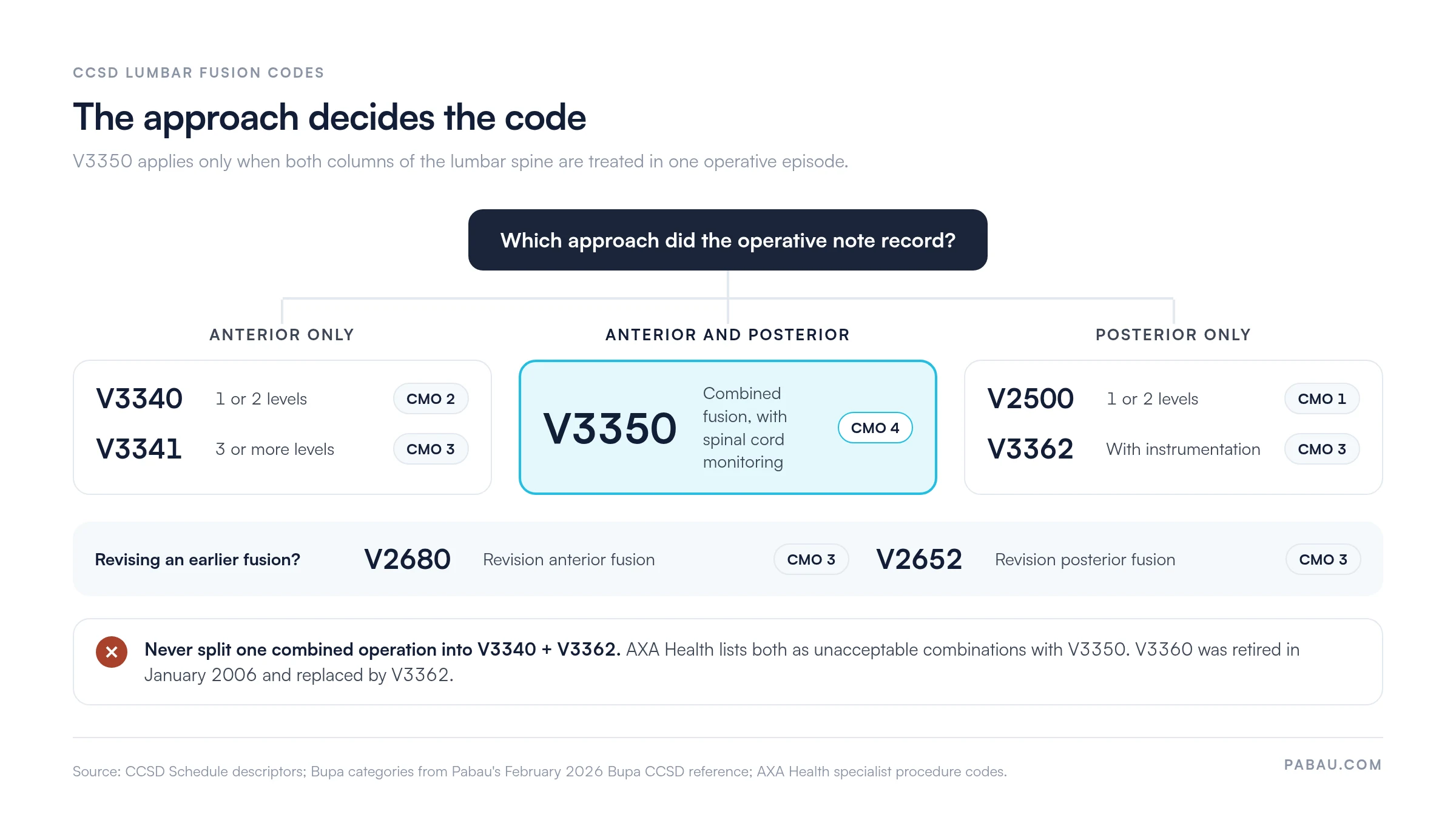
Older guides still show V3360 for posterior lumbar fusion. That code was retired in January 2006 and replaced by V3362, so a claim that carries V3360 will not match the current schedule.
If the anterior stage is planned but abandoned, for example after a vascular complication, V3350 no longer fits. Bill the posterior-only code that matches the work done, and record in the operative note why the anterior stage stopped. Our Bupa CCSD codes reference lists the other codes in the spinal chapter.
AXA Health’s specialist procedure codes place V3350 in the Complex hospital category. AXA Health lists a £1,600 procedure fee and a £714 general anaesthesia fee for it.
Pabau’s February 2026 Bupa CCSD reference lists V3350 at Bupa category CMO 4, with a £1,811 fee. Fees differ by insurer and change with each schedule update. Check the current figure in our Bupa fee schedule guide before you quote a patient for any shortfall.
UK private claims use the WHO edition of ICD-10, not the US ICD-10-CM. The diagnosis code must explain why a single-approach fusion would not be enough. A code that points to a condition usually managed with one approach invites a query from the insurer.
Check each code in the WHO ICD-10 browser before submission. Pick the most specific code the clinical record supports.
Combined lumbar fusion is major elective surgery, and UK private medical insurers expect pre-authorisation before it goes ahead. The patient usually contacts their insurer with the procedure code the surgeon gives them. Treatment without it puts the claim at risk.
Have these ready before the patient calls their insurer:
Requirements vary by insurer and change over time, so confirm the current rules with each one. Record the authorisation number against the booking. If the operation performed differs from the one authorised, contact the insurer before you submit the claim.
The operative note is the most important document behind a V3350 claim. The descriptor names two surgical approaches plus spinal cord monitoring, so the note must show all three. A note that reads as a posterior-only operation supports V3362, not V3350.
Record these elements in every V3350 operative note:
Structured clinical record templates keep operative notes consistent across the surgical team. Digital clinical forms can prompt the surgeon for each element before sign-off, including the monitoring readings that are easiest to leave out.
Run a short check before you submit any V3350 claim. Confirm the operative note names both the anterior and the posterior stage. Check that it records baseline and final monitoring readings and lists the implant reference numbers. Five minutes here saves weeks of resubmission.
V3350 is a high-value code with several documentation checkpoints, and one missing element can hold up the whole fee. These are the usual triggers and how to prevent them.
When a claim comes back, ask the insurer for the specific reason. Correct the record or add the missing document, then resubmit through Healthcode. Resending the original claim unchanged rarely helps.
In many spinal practices, the operative note lives in one system and the claim in another. The pre-authorisation number sits in an email thread. Each handover is a chance for the anterior stage, the monitoring readings or the authorisation to drop out.
Pabau, practice management software for private practices, keeps the clinical record and the claim together. Its claims management software sends UK claims through Healthcode and Bupa. The billing team sees each claim’s progress by insurer.
The result is fewer claims sent back for a missing stage or a lapsed authorisation. When an insurer does query a V3350 claim, the answer is already in the same record.

Pabau keeps the operative note, the pre-authorisation details and the CCSD claim in one record. It sends UK claims through Healthcode and Bupa.

A V3350 claim is won or lost in the operative note. The insurer pays for two approaches and spinal cord monitoring only when the note shows all three. A note that reads as a posterior-only fusion supports V3362, whatever happened in theatre.
Get pre-authorisation for the exact code, keep W3100 and other unacceptable combinations off the claim, and use WHO ICD-10 diagnoses. Book a demo to see how Pabau keeps operative notes and CCSD claims in one workflow.

Coding a revision lumbar disc operation? CCSD Code V2543 explains revision disc excision with undercutting facetectomy.
Billing a repeat decompression? CCSD Code V2660 covers revision of decompression for central spinal stenosis.
CCSD Code V3350 covers combined anterior approach discectomy, decompression and fusion plus posterior fusion of the lumbar spine, including spinal cord monitoring. It applies when both columns are treated in the same operative episode. Anterior-only fusion is V3340 or V3341, and posterior-only fusion is V3362 or V2500.
The descriptor includes spinal cord monitoring, so the surgeon’s V3350 fee covers it. A separate neurophysiologist who runs the monitoring provides a distinct service, and each insurer sets its own rules for paying it. Confirm them at pre-authorisation.
UK insurers use WHO ICD-10. Common pairings are M43.1 (spondylolisthesis), M51.3 (disc degeneration) and M51.1 (disc disorders with radiculopathy). Others are M47.2 and M47.8 (spondylosis), M48.0 (spinal stenosis), M53.2 (spinal instabilities) and M96.0 (pseudarthrosis after fusion). The diagnosis must justify a combined approach.
Yes. A 360-degree or circumferential lumbar fusion is the combined anterior-posterior operation that V3350 describes. Anterior column support comes from an interbody cage, and posterior fusion from screws, rods and graft. V3350 applies when both are done in the lumbar region.
CCSD has no modifier codes for staging. If the anterior and posterior stages are planned on separate days, agree with the insurer at pre-authorisation how the procedure will be claimed. Record both dates in the operative notes.
No. V3360 was retired in January 2006 and replaced by V3362, primary posterior fusion with instrumentation in the lumbar region. A claim that carries V3360 will not match the current CCSD Schedule.
The usual reasons are missing pre-authorisation and an operative note that shows only one approach. Others include absent monitoring readings, splitting the operation into V3340 and V3362, and adding an unacceptable code such as W3100. A US ICD-10-CM diagnosis code also triggers queries.




