

CCSD code XR940: Foreign body retrieval billing guide
CCSD code XR940 is the UK private healthcare code for retrieval of a foreign bod...

Last Updated: Nov 26, 2026
V2980 is the CCSD code for combined anterior and posterior fusion of the cervical spine. It applies when one operation fuses the neck through both a front (anterior) and a back (posterior) approach.
The code sits in group 3.1.1, Cervical Region, of the spine chapter of the CCSD schedule. A fusion from the front only is billed as V2950 or V2951, and one from the back only as V3720 or V3721.
Let Pabau's smart automation suggest the right codes, reduce claim denials, and keep your practice compliant—effortlessly.
Automate repetitive tasks and focus on what matters most—your patients.
Reduce coding errors and ensure compliance with the latest regulations.
Clean claims, fewer denials, and faster reimbursements.
Powerful insights and reporting to help your practice thrive.
HIPAA compliant SOC 2 certified GDPR-compliant Trusted by 4,000+ clinics worldwide

CCSD code V2980 covers combined anterior and posterior fusion of the cervical spine, billed as one code for both approaches.
A fusion from the front only is V2950 (1 or 2 levels) or V2951 (3 or more levels). A fusion from the back only is V3720 or V3721.
Billing an anterior fusion code and a posterior fusion code for one combined operation is unbundling, because V2980 covers both.
The operative note must document both approaches, the levels treated and the implants used, or the claim will fail insurer review.
UK private insurers including Bupa, AXA Health and Aviva generally require prior authorization before a combined cervical fusion goes ahead.
Pabau, a practice management platform, tracks the authorization code, dates and sessions on the case and sends UK claims through Healthcode and Bupa.
CCSD code V2980 covers combined anterior and posterior fusion of the cervical spine. The CCSD schedule gives it one short descriptor: “Combined anterior and posterior fusion of cervical spine”. It applies when a single operation fuses the neck through both a front (anterior) and a back (posterior) approach.
The code sits in group 3.1.1, Cervical Region, of chapter 3 (Spine, Spinal Cord & Peripheral Nerves). The schedule is maintained by the Clinical Coding & Schedule Development (CCSD) Group and is the standard procedure code set for UK private healthcare. Our list of CCSD codes for specialists covers the other procedures in it.
An earlier version of the descriptor ended with “including instrumentation”, and the current wording drops it. The descriptor itself sets no timing rule. General coding practice applies V2980 when both approaches are completed in the same operation, under one anesthetic. A fusion from one direction only takes a single-approach code instead, as the related codes section below shows.
Combined anterior and posterior cervical fusion uses two distinct surgical corridors to achieve arthrodesis and neural decompression across one or more cervical motion segments. Understanding the operative sequence helps coders verify that the documentation supports V2980.
The anterior component typically involves a cervical discectomy or corpectomy via a neck incision. The disc or vertebral body is removed to decompress the spinal cord and nerve roots. An interbody device, most commonly a PEEK cage or structural allograft, is then placed to restore disc height and facilitate fusion. A cervical plate with screws is usually applied to the anterior vertebral column for stability. Anterior vertebrectomy with decompression and implant has its own entry, the V4300 code.
The posterior component is performed through a midline dorsal incision. Lateral mass screws or pedicle screws are placed and connected by rods to stabilize the operated levels. Additional decompression, such as a laminectomy or foraminotomy, may be performed at this stage. Bone graft material, either autograft from the iliac crest or allograft, is packed posterolaterally to promote arthrodesis.
Some surgeons stage the two approaches as separate operations on different dates. The CCSD descriptor does not address staging. General coding practice is to code each stage on its own date under its single-approach code. For example, the anterior stage might take V2950 and the posterior stage V3720. Confirm the insurer’s policy on staged spinal surgery at authorization.
V2980 is appropriate when the clinical situation demands both decompression and stabilization from two directions in the same sitting. The following table summarizes accepted clinical indications and the supporting diagnostic context coders should verify in the medical record.
The diagnosis codes follow WHO ICD-10, the edition UK private claims use, so none of them carries a US-style 7th character. The fifth character 2 on the M codes marks the cervical region. For a failed fusion, M96.0 records the pseudarthrosis that drives the revision.
A single-approach procedure does not qualify for V2980, however many vertebral levels are treated. Level count matters for the single-approach codes instead, which split at 1 or 2 levels and 3 or more levels.
V2980 sits among the cervical spine codes in CCSD group 3.1.1. Its nearest neighbors are the anterior-only and posterior-only fusion codes, which split by the number of levels treated. The order of the decision matters, as the diagram shows: the approach comes first, and levels come second. Lumbar operations sit in group 3.1.3, where a revision anterior lumbar fusion is billed as V2680. Back in the cervical group, trans-oral surgery at the top of the spine is coded separately as CCSD code V3730. That descriptor already includes posterior fixation.
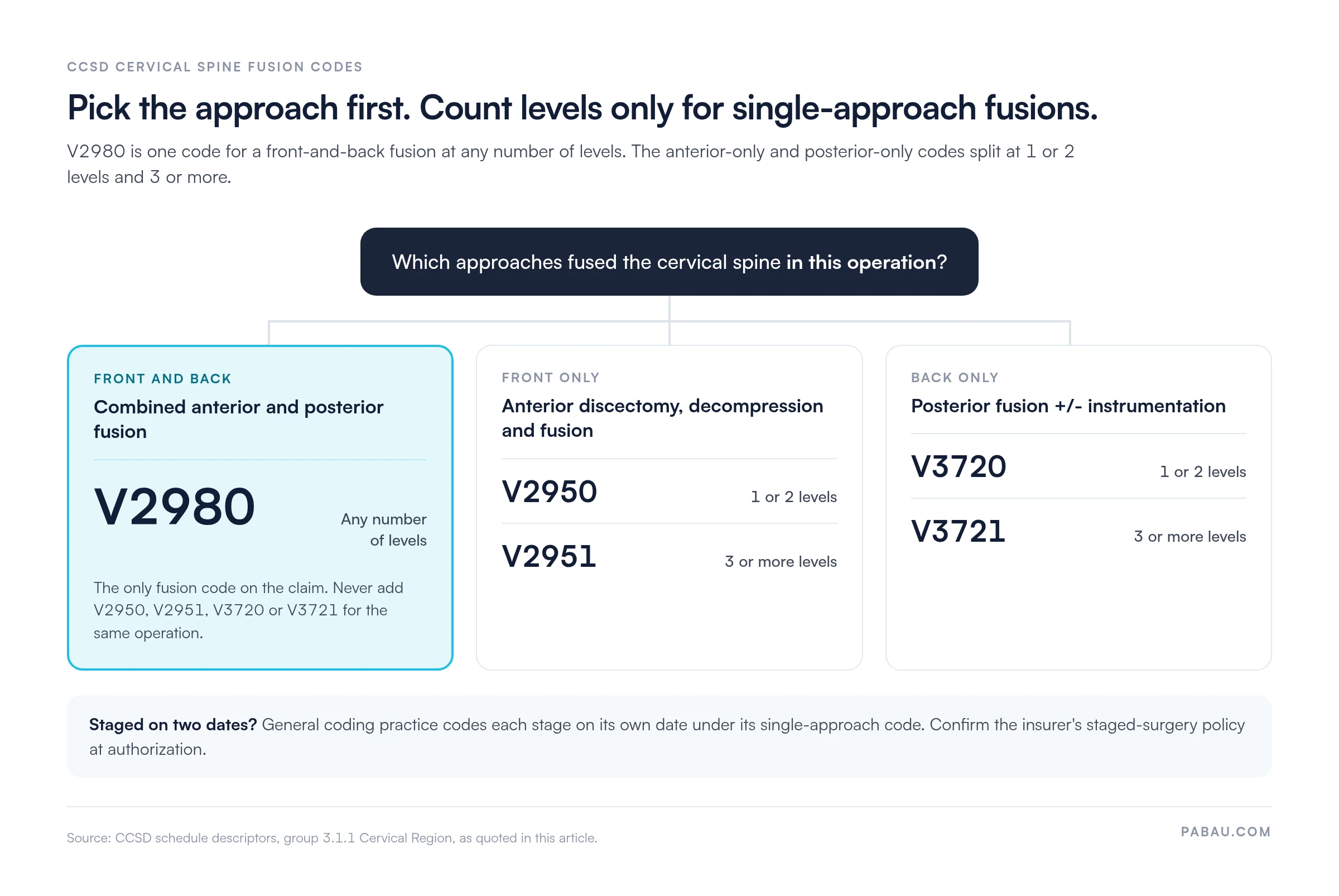
The table below quotes each CCSD descriptor and shows how the code relates to V2980. Insurers price these codes in their own fee schedules, and the Bupa CCSD codes guide covers how Bupa does it.
Key rule: V2980 covers both halves of a combined cervical fusion. When it is billed, no anterior fusion code (V2950 or V2951) and no posterior fusion code (V3720 or V3721) should appear for the same operation. Billing that pair instead of V2980 is unbundling and will trigger insurer review or denial.
Thin operative documentation is one of the most common reasons a V2980 claim fails review. The operative note must show unambiguously that both surgical approaches were completed in the same operation. A structured operative note template makes it harder to leave a required detail out.
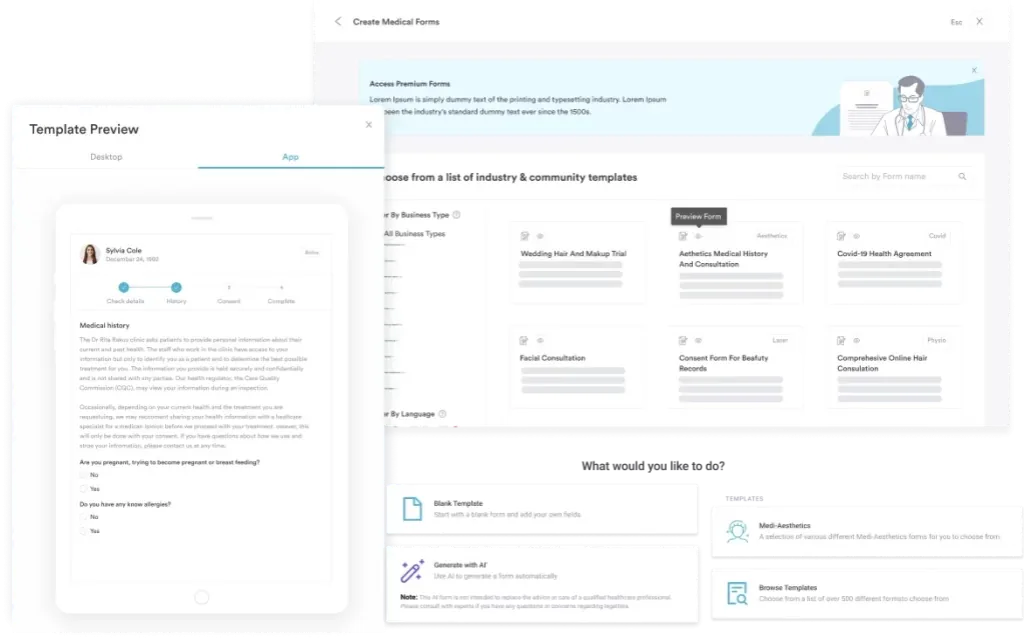
A defensible V2980 operative report records these elements:
A generic spinal surgery template without procedure-specific detail will not validate a V2980 claim on insurer review. Neither will a note that describes only one approach.
Create a V2980-specific operative note checklist and attach it to your surgical booking workflow. Before the claim is submitted, the billing team should verify that the note contains all eight elements above. Complete documentation reduces the chance of a secondary review or appeal.
UK private medical insurers treat combined cervical spine fusion as a high-cost elective procedure. All major insurers, including Bupa, AXA Health, Aviva, Vitality Health, and WPA, generally require prior authorization before this procedure proceeds. Combined-approach spinal surgery attracts additional scrutiny compared with single-approach procedures because of its higher operative cost and longer inpatient episode.
Getting authorization before the operation protects both the patient and the practice from unexpected non-payment. Insurers tend to ask for the same evidence on high-cost spinal procedures.
The following documentation is typically required when applying for prior authorization for V2980:
Authorization granted for V2980 does not automatically cover associated implant or material costs unless these are explicitly included in the authorization letter. If the surgical plan changes from a single approach to a combined fusion, ask the insurer to update the authorization before the claim goes in.
V2980 denial patterns are consistent across UK private insurers. Knowing them in advance means coders can build the checks into the submission workflow rather than handling them at the appeal stage.
V2980 covers the core surgical procedure. Several supplementary CCSD codes may be legitimately billable alongside it, but the specific rules vary by insurer and CCSD edition. Always verify against the insurer’s current fee schedule before including supplementary codes on a claim.
Insurer-specific bundling rules differ across Bupa, AXA Health, Aviva, WPA, and Healix. Each insurer publishes its own fee schedule and supplementary code policy, and these are updated periodically. Cross-check each insurer’s current schedule before finalizing a V2980 claim with add-on codes.
A combined cervical fusion claim depends on three records staying in step: the operative note, the prior authorization and the claim. Often the authorization sits in an email and the claim is keyed in by hand. The code on the claim can then drift from the code the insurer approved.
Pabau’s claims management software holds the prior authorization on the patient’s case. The authorization code, its dates and the approved sessions are tracked there. A warning shows when one is missing, so the team can chase it before the operation goes ahead.
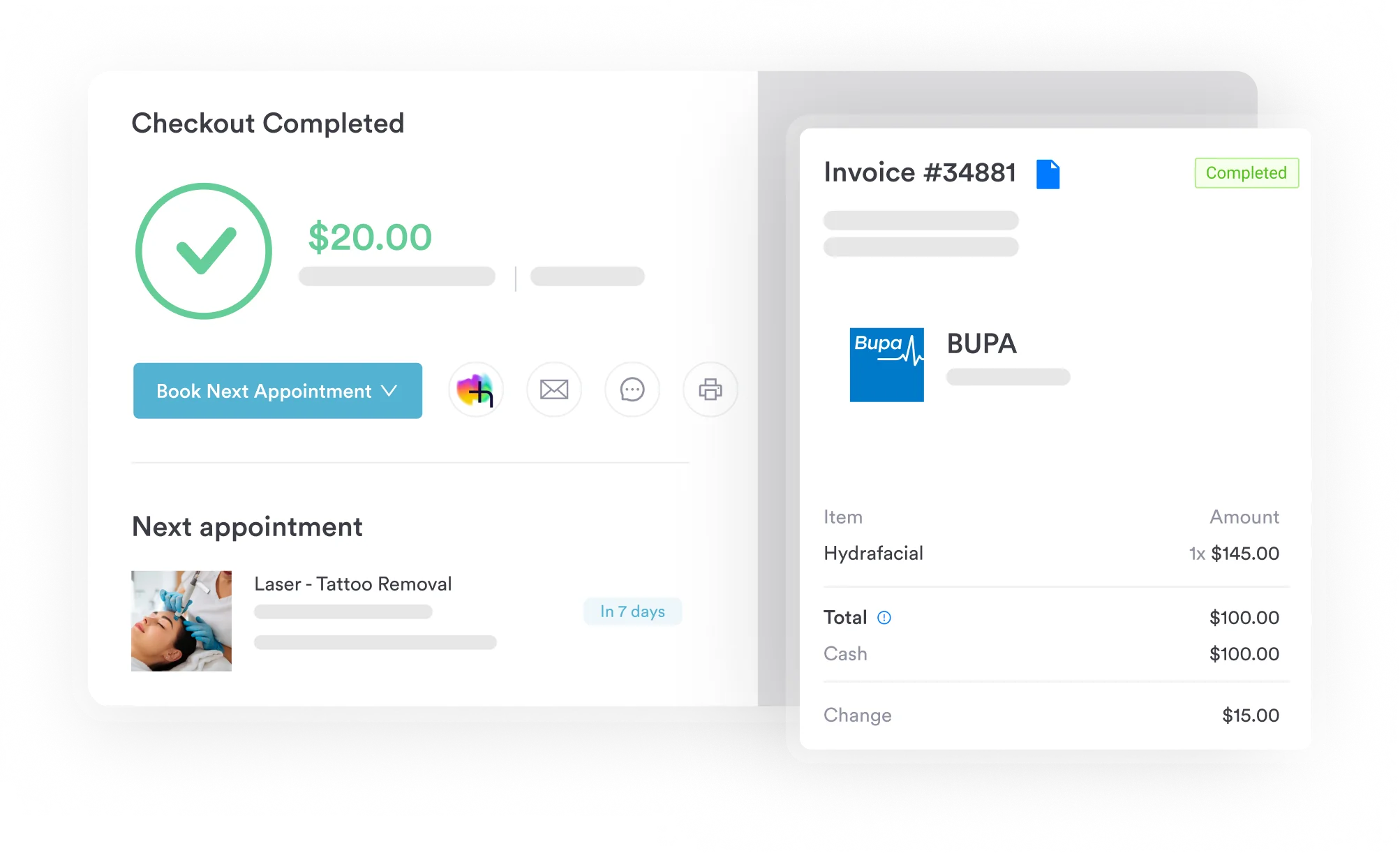
Claims to UK private insurers go out through Healthcode and Bupa from that same system. The V2980 claim is built where its authorization is already recorded, which cuts the re-keying between booking and billing.

Pabau keeps the prior authorization code, dates and sessions on the patient’s case and sends UK claims through Healthcode and Bupa. See how it fits your spinal surgery practice.

The approach decides V2980, however complex the case was. If the operative note does not show a front and a back fusion in one operation, a single-approach code applies.
The cheapest place to settle that is before surgery. Request authorization for V2980 itself, and update it as soon as a single-approach plan turns into a combined one. A staged case swaps one claim for two, so agree the insurer’s staged-surgery policy up front.
To see how Pabau keeps the authorization, the operative note and the claim on one patient case, book a demo with the Pabau team.

Need a broader CCSD billing reference for Bupa procedures? Bupa CCSD codes guide covers the full Bupa procedure code schedule and fee structure for UK private practice billing.
Billing a posterior-only cervical fusion? CCSD code V3720 explains the code for posterior fusion at 1 or 2 cervical levels and what its claim needs.
Want a repeatable way to get procedures approved? The prior authorization process walks through each step of getting approval before the procedure goes ahead.
CCSD code V2980 covers combined anterior and posterior fusion of the cervical spine, which is its full CCSD descriptor. It is used when one operation fuses the neck from both the front and the back. General coding practice applies it only when both approaches are completed under the same anesthetic.
V2980 covers fusion from both the front and the back in one combined procedure. Anterior-only cervical fusion is billed as V2950 for 1 or 2 levels, or V2951 for 3 or more levels. Posterior-only fusion is V3720 or V3721. Billing an anterior and a posterior fusion code together for one combined operation is unbundling.
Accepted indications include cervical myelopathy, multilevel spondylosis with instability, cervical deformity correction and cervical trauma with instability. A failed anterior fusion or adjacent level disease also qualifies when the revision is done from both the front and the back. The primary ICD-10 diagnosis on the claim must reflect the complexity that justifies the combined approach.
Yes, all major UK private medical insurers generally require prior authorization for V2980. Request it for V2980 itself, because an authorization for an anterior-only or posterior-only fusion does not cover the combined procedure. A claim submitted without a valid authorization reference is likely to be denied.
Common denial reasons are missing prior authorization and an operative note that documents only one approach. Others include billing separate anterior (V2950/V2951) and posterior (V3720/V3721) fusion codes instead of V2980, and coding staged operations as one episode. Supplementary codes left out of the original authorization are also often stripped from payment.
No. V2990 is open door laminoplasty of the cervical region (Hirobyashi), which widens the spinal canal without fusing it. Posterior cervical fusion is billed as V3720 for 1 or 2 levels, or V3721 for 3 or more levels. Neither replaces V2980 when the same operation also includes an anterior fusion.



