CCSD code XR940: Radiology billing guide for UK private practice
CCSD code XR940 is a UK private healthcare radiology procedure code used to bill...

Last Updated: Nov 26, 2026
V4300 is the CCSD code for anterior vertebrectomy with decompression and implant. The surgeon removes all or part of a vertebral body from the front. The cord or nerve roots are decompressed, and an implant rebuilds the column.
CCSD is the procedure coding schedule used across UK private healthcare, and Bupa lists V4300 at complexity CMO 5. An operation that adds posterior fusion and instrumentation is coded V4302.
Let Pabau's smart automation suggest the right codes, reduce claim denials, and keep your practice compliant—effortlessly.
Automate repetitive tasks and focus on what matters most—your patients.
Reduce coding errors and ensure compliance with the latest regulations.
Clean claims, fewer denials, and faster reimbursements.
Powerful insights and reporting to help your practice thrive.
HIPAA compliant SOC 2 certified GDPR-compliant Trusted by 4,000+ clinics worldwide

CCSD code V4300 covers anterior vertebrectomy with decompression and implant. Bupa lists it at complexity CMO 5, with a £2,172 surgeon fee.
Three elements must all be present: an anterior approach, resection of the vertebral body (not just the disc) and an implant.
An anterior vertebrectomy with posterior fusion and instrumentation in the same operation is coded V4302, not V4300 plus a second code.
UK private medical insurers such as Bupa, AXA Health, Vitality and Aviva expect pre-authorisation before V4300 surgery goes ahead.
CCSD code V4300 is the UK private healthcare code for “Anterior vertebrectomy with decompression and implant.” AXA Health’s spine code schedule lists V4300 under that exact descriptor. The code sits in chapter 3 of the CCSD coding schedule (spine, spinal cord and peripheral nerves), under scoliosis, kyphosis, fractures, tumours and infections.
Bupa, AXA Health, Vitality, Aviva and other UK private medical insurers use CCSD codes to price and pay specialist claims. The code is a composite. One fee covers the vertebral body resection, the decompression of the spinal cord or nerve roots, and the implant that rebuilds the column. Bupa lists V4300 at complexity CMO 5.
Three elements must all be present for V4300 to apply. The surgeon uses an anterior approach, formally resects the vertebral body (not just the disc), and places an implant. If one is missing, a different code in the CCSD spine chapter applies.
Anterior vertebrectomy with decompression and implant is a multi-step open spinal procedure performed under general anaesthesia. Coders who know the operative sequence can check quickly whether the operation note supports the code.
The procedure is most often performed at cervical levels (C3 to C7) and less often at thoracic levels (T1 to T12). Lumbar anterior vertebrectomy is rare and carries a different approach and risk profile. Confirm the insurer’s view before applying V4300 to a lumbar case.
Insurers assess every V4300 claim against the indication in the operative report. The diagnosis code on the claim must match it, so the ICD-10 pairing table follows this list.
Every V4300 claim needs a diagnosis code that matches the indication. UK private medical insurers use the WHO edition of ICD-10, not the US ICD-10-CM. Check each code against the WHO ICD-10 browser. The table lists the codes most often paired with V4300.
Use the most specific code available, including the character that names the level or type. A vague diagnosis code is a common reason for an insurer query and can delay payment.
Pair the ICD-10 code with the imaging report, not just the operative report. Say the MRI reads ‘C5 burst fracture with cord compression’ and the claim carries a non-specific stenosis code. The insurer’s clinical reviewer will flag the mismatch.
V4300 is a composite code. Knowing what it bundles prevents under-billing, where a legitimately separate item is left off, and double-billing, where a bundled step is claimed twice.
Implants cause the most confusion. In UK private care, the hospital usually charges for the cage, plate and screws under its own contract with the insurer. Keep device costs off the consultant invoice unless the insurer says otherwise.
Run a component audit before you submit a V4300 claim. List every step performed in the operation and map each to the V4300 bundle, V4302 or a legitimate separate code. Any step you cannot map is a double-billing risk.
The codes most often confused with V4300 are V4302 and V4310. Neither is simply V4300 by a different approach. V4302 adds a posterior stage to an anterior vertebrectomy, and V4310 is a different procedure bundle.
The check is simple. Did the surgeon remove vertebral body bone from the front and place an implant, with no posterior stage? Then V4300 fits. A posterior stage in the same operation points to V4302, and disc removal alone points to the V29 discectomy codes. The chart below runs the same check as two questions.
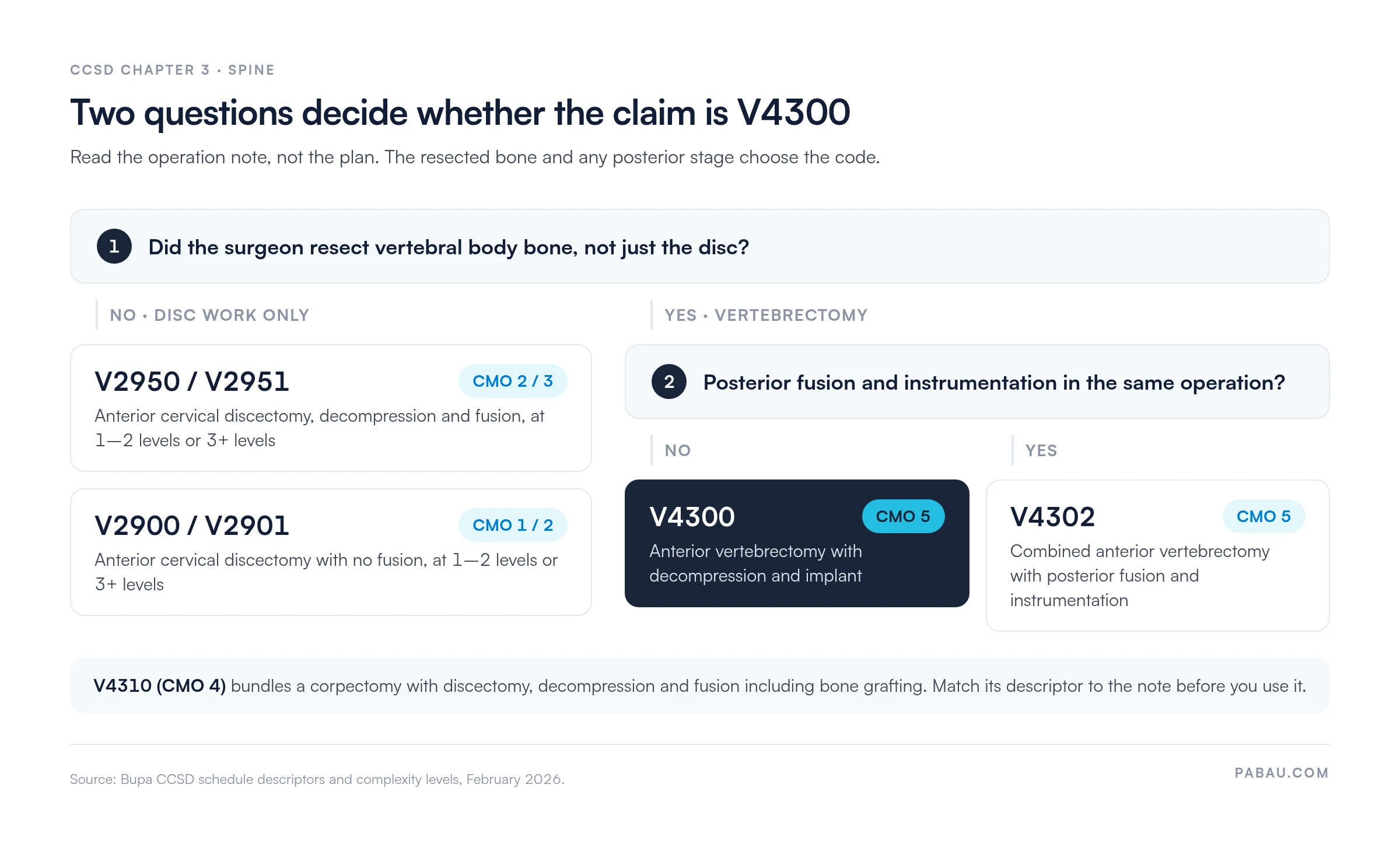
Before choosing V4310, read its descriptor against the operation note. It bundles a discectomy, fusion and bone grafting, so it describes a different operation from V4300.
A combined anterior and posterior cervical fusion with no vertebrectomy is coded V2980. For the rest of the spine chapter, search our library of CCSD codes for surgeons.
CCSD code V4300 maps most closely to CPT 63081 (cervical vertebral corpectomy, anterior approach, single segment) and CPT 63085 (thoracic vertebral corpectomy, single segment). These are reference crosswalks only.
The American Medical Association maintains CPT for US billing, and UK private medical insurers do not accept CPT codes. Use the mapping for clinical literature, international patients with US cover, or audits against US coding.
Confirm CPT code currency against the AMA’s annual CPT code set before using these in a cross-system document. CPT add-on codes 63082 (cervical) and 63086 (thoracic) cover each additional segment, which links to the multi-level section below.
Bupa lists V4300 at complexity CMO 5, with a surgeon fee of £2,172 in its February 2026 schedule. V4302 sits at the same level and fee, while V4310 is CMO 4 at £1,811.
AXA Health lists V4300 as Complex, with a £2,500 procedure fee and £1,299 for general anaesthesia. Vitality and Aviva publish their own fee schedules, so check the patient’s insurer before you quote. Any fee above the insurer’s limit becomes a shortfall the patient pays.
Insurers audit V4300 claims closely because the fee is high and the surgery is major. A generic “spinal surgery” operation note invites queries and rejections. The operative report must state each of the following explicitly.
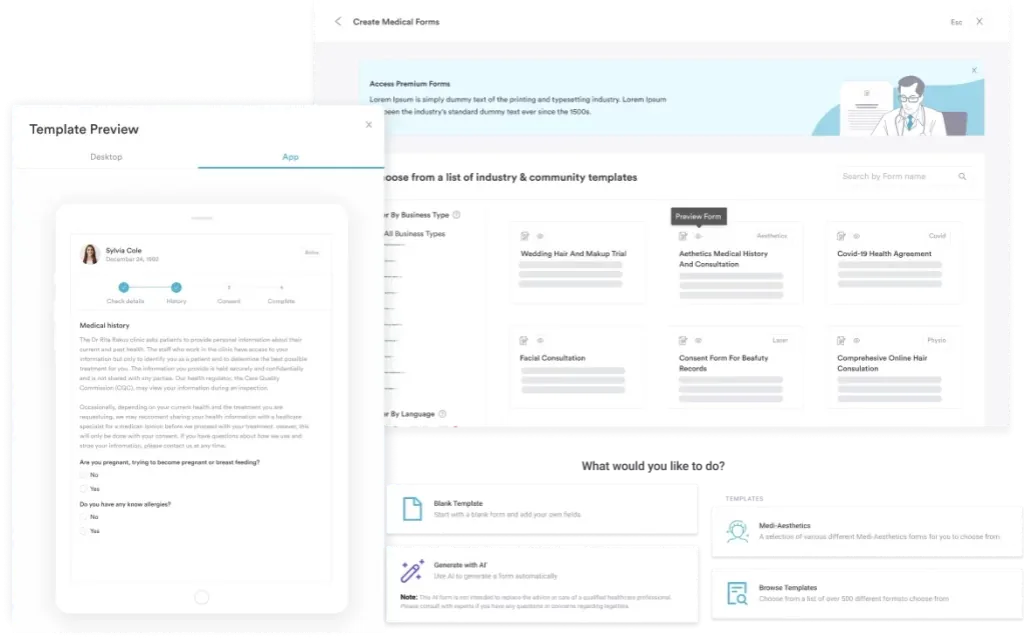
In Pabau, a practice management platform, you can build the operation note as a structured digital form. The template prompts for each element above while the surgeon writes the note.
UK private medical insurers such as Bupa, AXA Health, Vitality and Aviva expect pre-authorisation before an anterior vertebrectomy goes ahead. Authorisation does not guarantee payment, but operating without it often leads to a rejected claim.
The pathway usually follows these steps, though requirements vary by insurer. Check the patient’s policy with the insurer each time.
The V4300 descriptor carries no level count, unlike the cervical discectomy codes, which split 1 or 2 levels from 3 or more. Whether a second corpectomy level can be claimed depends on the insurer’s multiple-procedure rules.
Some insurers pay a reduced fee for a second procedure in the same operation. Others treat a multi-level corpectomy as one episode. AXA Health, for one, does not pay multi-level spinal surgery as a multiple procedure outside the cervical region. Agree the position at pre-authorisation, because it is harder to win on appeal.
Three practical steps reduce per-level disputes.
Most V4300 rejections trace back to the code choice, the authorisation or the operation note. The table maps each common reason to its fix.
Spinal practices often keep pre-authorisation numbers, operation notes and insurer portals in separate places. Each handoff is a chance to lose the authorisation number or submit V4300 when the note supports V4302.
Pabau’s claims management software keeps the CCSD code, the ICD-10 diagnosis and the authorisation number on one claim record. You submit the claim through Healthcode and track its status in the same place. Pabau does not choose the code, so the approach and posterior-stage checks above still apply.

Pabau helps spinal surgery teams track pre-authorisation, capture structured operation notes and monitor claims across UK private medical insurers.

Three facts in the operation note decide V4300: an anterior approach, a resected vertebral body and an implant. A posterior stage in the same operation moves the claim to V4302. Disc work alone belongs to the V29 discectomy codes.
Put those facts on paper, pair them with the matching WHO ICD-10 code, and pre-authorise the code you will bill. The CMO 5 fee is then far less likely to be queried.
To see how Pabau keeps the code, diagnosis and authorisation number together on one Healthcode claim, book a demo.

Need the full CCSD schedule used by UK insurers? Bupa CCSD codes explains how the schedule is structured and how private insurer claims are processed.
Checking what Bupa pays for other spinal codes? The Bupa procedure codes and fee schedule guide links each code to its published fee so you can spot shortfalls before you invoice.
Choosing software to bill UK insurers? Our roundup of the best medical billing software in the UK compares tools for insurer claims, invoicing and payment tracking.
CCSD code V4300 covers anterior vertebrectomy with decompression and implant. One fee bundles the vertebral body resection, the decompression of the spinal cord or nerve roots, and placement of the implant. The anaesthetist bills separately, and the hospital usually charges for the implant itself.
V4310 is not a posterior version of V4300. Its descriptor is vertebral corpectomy, discectomy, decompression and fusion (including bone grafting), a different procedure bundle at Bupa complexity CMO 4. V4300 is an anterior vertebrectomy with decompression and implant at CMO 5. Choose the code whose descriptor matches the operation note.
No. Anterior cervical discectomy and fusion (ACDF) removes the disc and leaves the vertebral bodies in place. It is coded V2950 for 1 or 2 levels, or V2951 for 3 or more. V4300 needs removal of all or part of a vertebral body, so using it for a disc-only operation is upcoding.
Yes, in practice. Bupa, AXA Health, Vitality, Aviva and other UK private medical insurers expect pre-authorisation for major spinal surgery. They usually ask for the referral, the diagnosis, the imaging and the planned CCSD code. Put the authorisation number on every invoice for the episode.
Bupa lists V4300 at complexity CMO 5, with a surgeon fee of £2,172 in its February 2026 schedule. AXA Health, Vitality and Aviva set their own fees, so check the patient’s insurer before you quote.
CPT 63081 (cervical) and CPT 63085 (thoracic) are the closest US equivalents. Both describe anterior vertebral corpectomy with decompression at a single segment. They are cross-reference aids only, because UK private medical insurers do not accept CPT codes.
The most common reasons are the wrong code (V4302, V4310 or a disc code) and a missing pre-authorisation. An operation note that does not name the approach and the resection is another. Device costs on the consultant invoice and a diagnosis code that does not match the indication also cause rejections.