CPT Code 25210: Excision of a single carpal bone
CPT Code 25210: Official descriptor and quick-reference data CPT Code 25210 is a...

Last Updated: Nov 26, 2026
V3730 is the CCSD code for transoral surgery (including posterior fixation), an operation on the upper cervical spine. The surgeon reaches the front of the craniovertebral junction through the mouth. Posterior fixation, which stabilizes the junction from behind, is included in the code.
The code sits in group 3.1.1, Cervical Region, of the spine chapter of the CCSD schedule. Posterior cervical fusion on its own is billed as V3720 or V3721.
Let Pabau's smart automation suggest the right codes, reduce claim denials, and keep your practice compliant—effortlessly.
Automate repetitive tasks and focus on what matters most—your patients.
Reduce coding errors and ensure compliance with the latest regulations.
Clean claims, fewer denials, and faster reimbursements.
Powerful insights and reporting to help your practice thrive.
HIPAA compliant SOC 2 certified GDPR-compliant Trusted by 4,000+ clinics worldwide

CCSD code V3730 covers transoral surgery, including posterior fixation, and sits in group 3.1.1 Cervical Region of the CCSD schedule.
The descriptor folds posterior fixation into the code itself, so check insurer guidance before adding a separate fixation code to the claim.
The CCSD record carries no coding principles or notes for V3730, so confirm staged or anterior-only cases with the insurer before you bill.
Most private insurers require pre-authorization before V3730 surgery, backed by imaging and a consultant’s clinical justification letter.
Pabau, a practice management platform, keeps pre-authorization references, operative notes and Healthcode claims on one patient record.
CCSD code V3730 covers transoral surgery (including posterior fixation), an operation on the upper cervical spine. That is the official descriptor in the schedule kept by the Clinical Coding and Schedule Development (CCSD) Group. The group is run by representatives of major UK private health insurers, including Bupa, AXA Health, Aviva and Vitality. Its schedule is the standard procedure code set for UK private surgical claims.
V3730 sits in group 3.1.1, Cervical Region, next to the posterior cervical fusion codes V3720 and V3721. Its CCSD reference is Fc.007, and the record carries no inactive date. Neurosurgeons and spinal surgeons use it in private hospitals and independent treatment centers.
The word “including” carries most of the meaning. It tells you posterior fixation is covered by V3730. It does not say the code applies only when both parts happen in one operation, and the CCSD record sets no such condition.
Transoral surgery reaches the craniovertebral junction (CVJ) through the mouth and the back of the throat. The surgeon works through a mouth retractor, with no external neck incision. The usual aim is decompression, which means removing bone or soft tissue that presses on the brainstem or upper cervical cord. Where a vertebral body lower in the neck compresses the cord, an anterior vertebrectomy with an implant is coded V4300 instead.
The structure removed is most often the odontoid process (dens) of C2 or the front arch of C1.
Removing those structures can leave the CVJ unstable, so posterior instrumentation restores and holds alignment. The construct usually spans the occiput, C1 and C2. Screws, rods or wires go in through a separate incision at the back of the neck.
Surgeons may complete both parts under one anesthetic or stage them across separate operations. A typical single-session sequence runs like this:
The CCSD record gives no instruction for a staged case, or for one where the posterior fixation is not done. Confirm the coding with the CCSD schedule’s coding guidance or the insurer before you submit.
Surgeons use this operation for a narrow set of conditions that compress the front of the CVJ, often alongside instability. Common indications in the neurosurgical literature include:
V3730 is the only code in the cervical region group that names a transoral approach. The other active codes in group 3.1.1 cover anterior or posterior neck surgery, split by the number of levels treated. The Bupa CCSD procedure codes guide explains how one insurer applies the wider schedule.
No CCSD code in this group covers transoral surgery without posterior fixation. The group also holds the legacy records V2300, V2990, V2902 and V2980. V2980 describes a combined anterior and posterior cervical fusion.
Important: Check every descriptor against the current CCSD schedule before you code. Wording and numbering can change in schedule updates. To check a neighboring procedure quickly, browse our CCSD code reference pages, then confirm the wording in the schedule itself.
Most questions about V3730 come from three scenarios: transoral surgery without posterior fixation, staged operations, and posterior fusion on its own. The schedule gives a clear code for only the last of these. For the first two, confirm with the CCSD schedule’s coding guidance or the insurer before the claim goes in. The decision tree below follows the two facts in the operative note that settle the path.
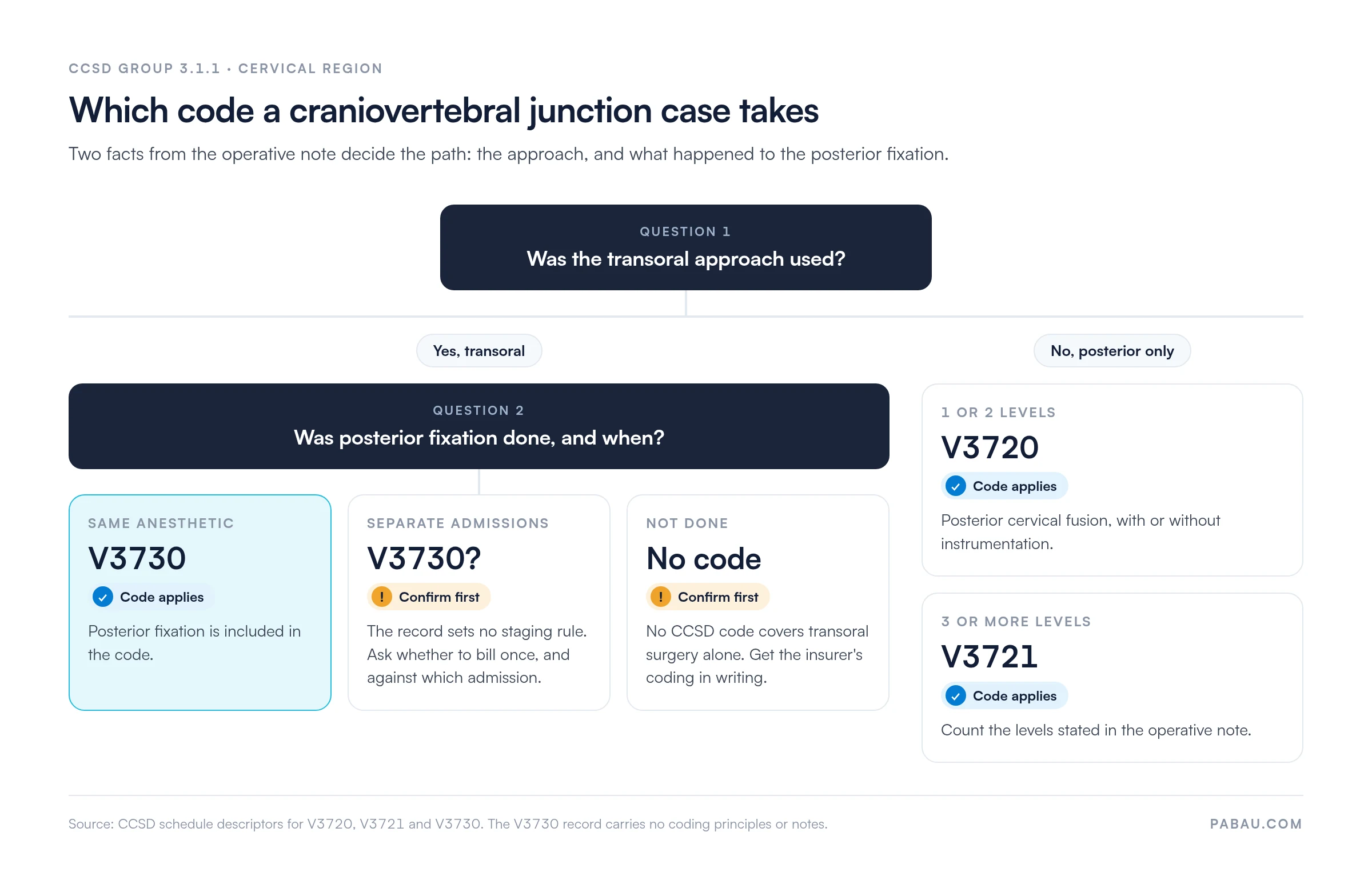
Keep the insurer’s answer on file, with the date and the name or reference of the person who gave it. That record settles the question if the claim is queried later.
The operative note is the main document behind a V3730 claim. Insurers expect it to describe the surgical approach and the fixation construct in specific terms, and a vague note invites a query.
Include these elements in every V3730 operative note:
Build a V3730 operative note template before the case, not after. Add fields for the transoral approach, decompression extent, posterior construct, timing and IONM data. A checklist completed at closure cuts the omissions that trigger claim reviews.
Most private insurers require pre-authorization before V3730 surgery, so confirm each payer’s pathway before the operation is booked. The requirements below are typical, and they differ by insurer and policy. Aviva and Vitality both publish fees searchable by procedure code. Aviva’s practitioner pages link to its online fee schedule, and the Vitality fee finder lists the fees Vitality providers agree to.
Log each pre-authorization number, submission date and approval status against the patient episode. Build that log into the admission pathway from the first referral, so no case reaches the operating room without an approval on file.
V3730 is a high-value surgical code, so insurers review its claims closely. Denials on complex spinal claims often trace back to paperwork and process rather than to the surgery itself. These are the common triggers and how to prevent them.
Run a pre-submission check on every V3730 claim. Confirm the pre-authorization reference, the operative note detail, the implant invoices, the surgeon’s recognition and the hospital grade. Five minutes here can save weeks of appeals.
V3730 covers the main surgical procedure. Other services in the same admission may be billed separately, subject to each insurer’s bundling rules.
The posterior fusion codes V3720 and V3721 name spinal cord monitoring in their descriptors, but V3730’s descriptor does not. Ask each payer whether IONM is paid within the V3730 fee or as an extra item.
A V3730 case passes through several hands before it is paid. A secretary chases pre-authorization, the surgeon writes the operative note, and someone else gathers implant invoices and extra codes. When that work lives in spreadsheets and email, a missing piece often surfaces only after the insurer queries the claim.
Pabau keeps those steps on the patient’s record. Its claims management software attaches the pre-authorization reference and approval date to the episode. Your team can see authorization status before the patient is admitted.
Operative note templates built with Pabau’s digital forms and operative checklists capture the approach, the construct and the timing at closure. The insurer’s coding answer can sit on the same record, so it travels with the claim.
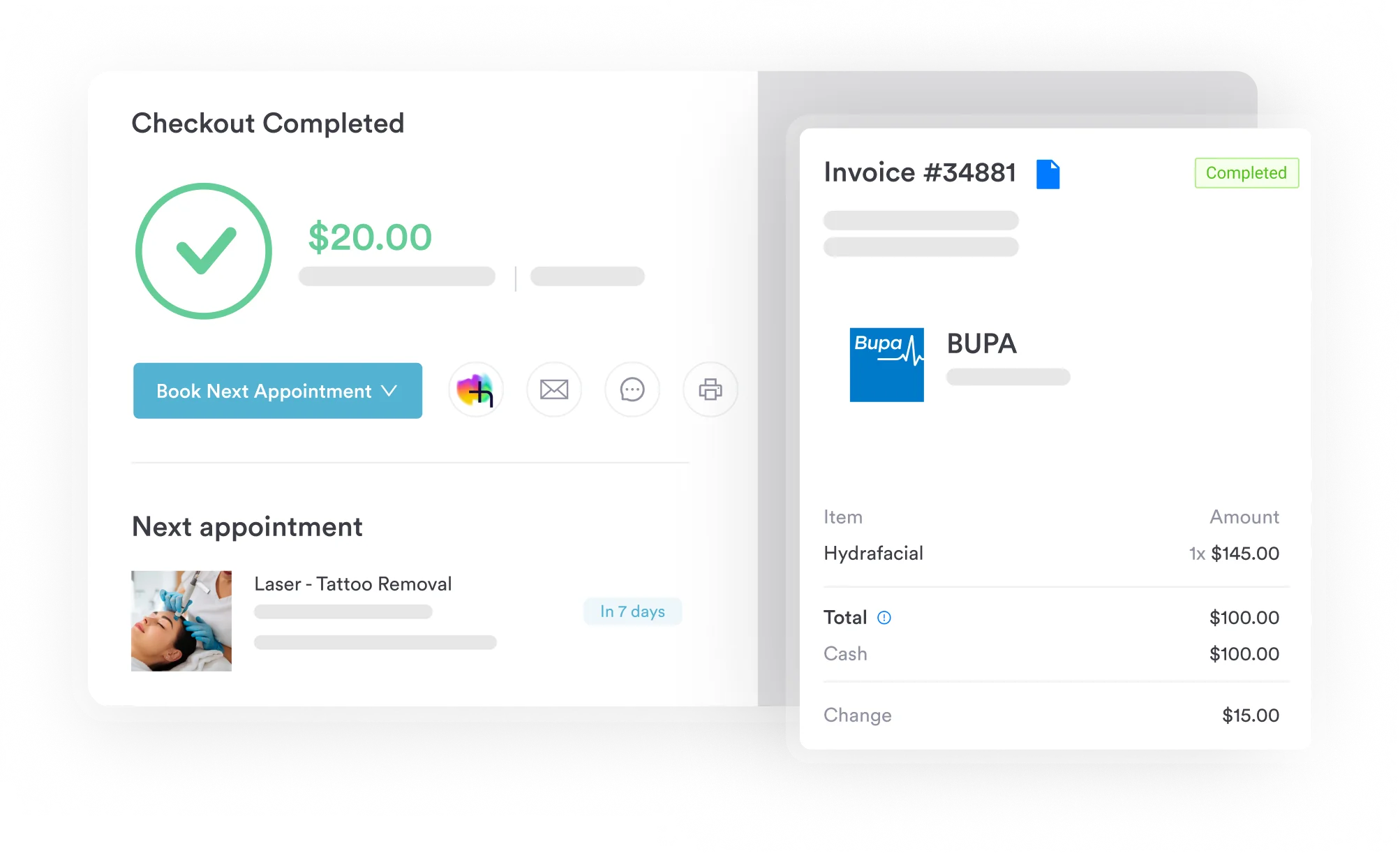
Claim status for Bupa, AXA Health and Aviva can be tracked against each episode, with outstanding items flagged before submission deadlines. Check the current V3730 fee in the Bupa code search portal before you submit.

Pabau keeps pre-authorization references, operative notes and claim status on one patient record, so your team submits CCSD claims without chasing paperwork.

Code V3730 from what its descriptor says. The code covers transoral surgery, and posterior fixation is part of it. When a case is staged or skips the fixation, get the answer from the schedule’s guidance or the insurer before the claim goes in.
The fee itself is usually won or lost on paperwork. A specific operative note, a confirmed pre-authorization and the insurer’s coding answer on file will protect a V3730 claim better than any coding shortcut.
Book a demo to see how Pabau keeps pre-authorization, operative notes and CCSD claims on one record for spinal practices.

Need a broader view of CCSD surgical procedure codes? Bupa CCSD procedure codes covers how Bupa structures its surgical classification and fee schedule for UK private practitioners.
Looking to streamline surgical claim submissions? Pabau’s claims management software supports CCSD billing workflows for private practices across the UK.
Coding a combined front-and-back neck fusion? CCSD code V2980 covers combined anterior and posterior cervical spine fusion in the same schedule group.
Billing posterior cervical fusion on its own? CCSD code V3720 explains the posterior fusion code for one or two cervical levels.
CCSD code V3730 describes transoral surgery (including posterior fixation), in group 3.1.1 Cervical Region of the CCSD schedule. The surgeon reaches the craniovertebral junction through the mouth, usually to remove bone pressing on the brainstem or cord. Posterior fixation, which stabilizes the junction from behind, is included in the code.
Most private insurers require pre-authorization before V3730 surgery, so confirm each payer’s pathway. Typical requirements include a consultant’s clinical justification letter and MRI and CT imaging of the craniovertebral junction. Insurers also check the surgeon’s recognition and the hospital’s grade.
The CCSD record does not say. It lists V3730 as transoral surgery including posterior fixation, with no coding principles or notes. No CCSD code covers transoral surgery without posterior fixation, so confirm the code with the CCSD schedule’s coding guidance or the insurer before submitting.
The CCSD record for V3730 gives no rule on staged surgery. Confirm with the CCSD schedule’s coding guidance or the insurer whether to bill V3730 once, and against which admission. Record the date and anesthetic episode of each stage in the operative notes.
Whether IONM is paid separately varies by insurer. Some include intraoperative neuromonitoring in the surgical fee, and others pay it as an additional item. V3730’s descriptor does not mention it, unlike posterior fusion codes V3720 and V3721, so confirm with each payer first.
Common reasons are missing pre-authorization, an operative note without detail on the approach or fixation, and surgeon or hospital recognition problems. Staged or anterior-only cases coded without checking with the insurer also draw queries. A structured pre-submission checklist helps prevent each of these.
Neurosurgeons and spinal surgeons use V3730 in UK private hospitals and independent treatment centers. The operation calls for skill in both transoral surgery and posterior cervical instrumentation. It is usually performed by consultants with sub-specialty training in craniovertebral junction surgery.