CCSD Code G3100: Laparoscopic biliary gastric bypass billing guide
CCSD Code G3100: Definition and Surgical Scope CCSD Code G3100 is the Classifica...

Last Updated: Nov 25, 2026
T0910 is the CCSD code for open pleural biopsy as sole procedure. A surgeon opens the chest between the ribs and removes a sample of the pleura for histology. No other procedure is done in that operation.
It sits in CCSD chapter 8, Thorax and intra-thoracic organs, under Lungs, bronchi and pleura. Bupa set the anesthetist's category for T0910 at MAJOR+ 5 from 3 June 2026. A needle biopsy (T1410) or a thoracoscopic biopsy (T1100) takes a different code.
Let Pabau's smart automation suggest the right codes, reduce claim denials, and keep your practice compliant—effortlessly.
Automate repetitive tasks and focus on what matters most—your patients.
Reduce coding errors and ensure compliance with the latest regulations.
Clean claims, fewer denials, and faster reimbursements.
Powerful insights and reporting to help your practice thrive.
HIPAA compliant SOC 2 certified GDPR-compliant Trusted by 4,000+ clinics worldwide

CCSD code T0910 covers an open pleural biopsy performed as the only procedure in that operation.
The access route sets the code. A needle biopsy is T1410, and a thoracoscopic biopsy falls under T1100.
Bupa raised the anesthetist’s category for T0910 from MAJOR+ 1 to MAJOR+ 5, effective 3 June 2026.
When the surgeon does a larger thoracic operation at the same sitting, the claim follows that main procedure instead.
Pre-authorization, an operation note that names the open approach and an up-to-date ICD-10 diagnosis keep the claim moving.
CCSD code T0910 is the code for an open pleural biopsy as sole procedure. That is the exact narrative in Bupa’s June 2026 schedule bulletin. A thoracic surgeon opens the chest, takes a sample of the pleura for histology and closes, with no other procedure in that operation.
The code sits in chapter 8 of the CCSD codes list, Thorax and intra-thoracic organs, under Lungs, bronchi and pleura. Surgeons choose the open route when they need a larger piece of tissue than a needle biopsy can take. Suspected mesothelioma is the most common reason.
In theater, the operation usually runs like this:
Three CCSD codes describe a pleural biopsy, and the route of access separates them. Each code carries its own insurer categories, so the wrong pick changes how the claim is assessed.
The table below matches each route to its code.
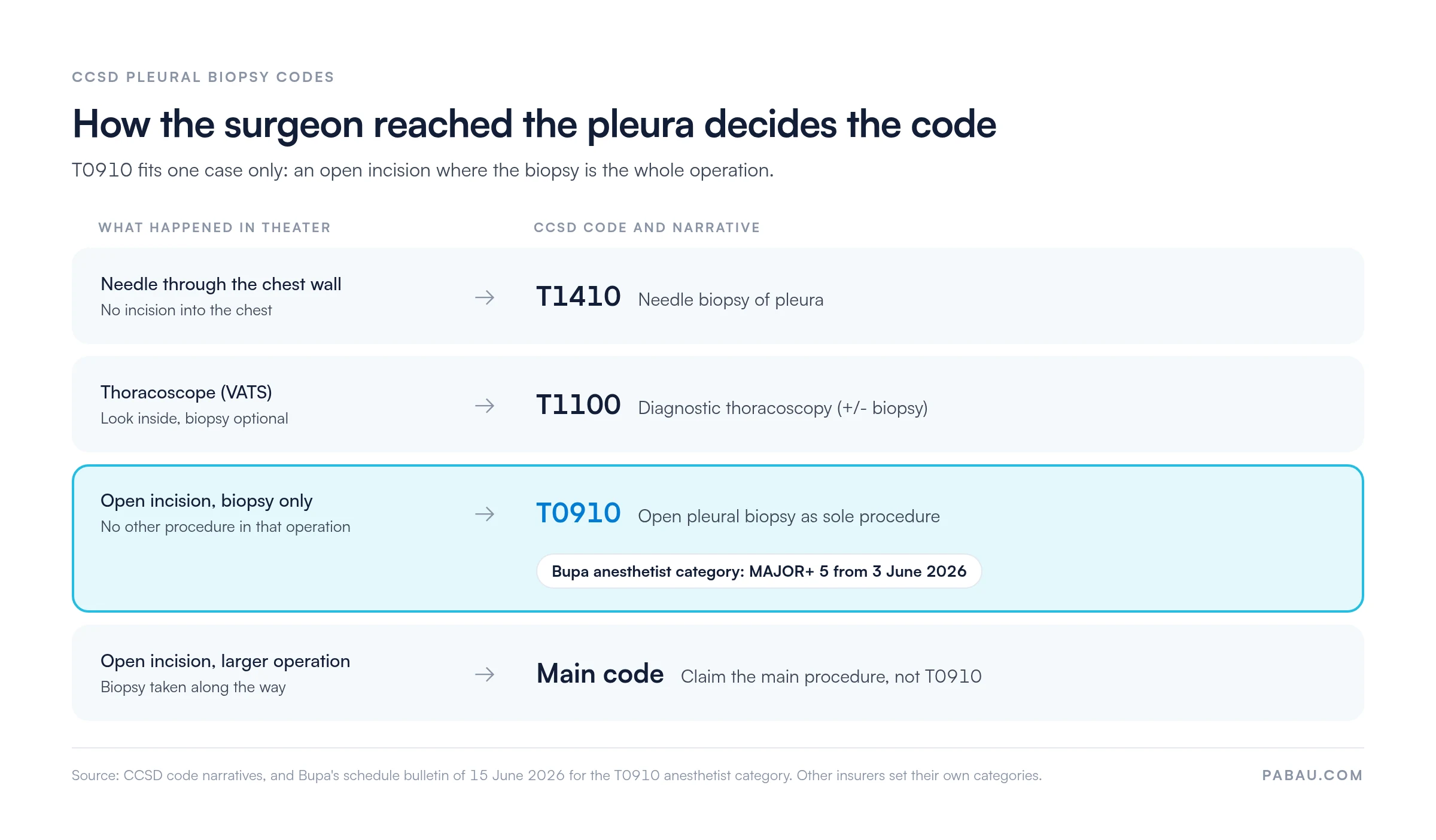
A sample taken with a needle through the chest wall is billed as T1410, the needle biopsy code. A biopsy taken through a thoracoscope belongs to T1100, the diagnostic thoracoscopy code, which already includes it.
The last row catches people out most often. “As sole procedure” means T0910 only fits an operation where the biopsy stands alone. When the surgeon also performs a larger procedure, such as a decortication, the claim normally follows that procedure. Decortication of pleura, for example, has its own code, T0710. Check the insurer’s combination rules if the note is unclear.
One more neighbor is worth knowing. T0320 covers an exploratory thoracotomy, a wider look inside the chest. Pick it only when the operation note describes exploration rather than a targeted pleural biopsy.
Bupa’s bulletin dated 15 June 2026 changed the anesthetist’s category for T0910 from MAJOR+ 1 to MAJOR+ 5. The change took effect on 3 June 2026. The surgeon’s category had no changes that month.
This matters most for anesthetists who bill from a saved fee list. A list built before June still shows MAJOR+ 1, which understates the category Bupa now applies. Update the entry before the next T0910 list, and check claims sent since 3 June.
Other insurers publish their own schedules and bands. Treat Bupa’s change as a prompt to check each one, rather than a rule that carries across.
A clean T0910 claim follows six steps. Each one leaves a document the next step depends on.
Take an illustrative patient, a 64-year-old retired electrician with a recurring right-sided pleural effusion. CT shows pleural thickening, and two needle samples have not given a diagnosis. The surgeon plans an open biopsy.
The pre-authorization request quotes T0910 with J90, pleural effusion. In theater, the surgeon takes the pleural sample through a small incision and performs no other procedure. The operation note says so in one plain line.
Histology comes back as mesothelioma. The claim then goes in under T0910 with C45.0, mesothelioma of pleura, and the original authorization number. The anesthetist’s claim uses the same code and Bupa’s MAJOR+ 5 category.
Most rejected or short-paid T0910 claims come back to a handful of mistakes:
The surgeon started with a scope and converted to open. Which code? Ask the insurer before you submit, especially if the authorization named T1100. Make sure the operation note explains why the surgeon converted.
The sample came from the lung, not the pleura. Then T0910 is the wrong code. Bupa lists E5532 for thoracotomy and lung biopsy as sole procedure, and E5932 for a VATS lung biopsy.
Pleural fluid was drained in the same operation. Drainage of the pleural cavity has its own code, T1220. Insertion of a tube drain into the pleural cavity is coded separately again, as CCSD T1240. Because T0910 is a sole-procedure code, ask the insurer how they want the combination billed.
Most T0910 delays come from admin. An authorization number lands on the wrong invoice, a membership number is missing, or the diagnosis still reads J90.
Pabau, a practice management platform with built-in claims management, keeps those details on the patient record. The procedure code set on the service carries onto the invoice. Insurer and membership details fill in from the record, so nobody retypes them.
Before a claim can be sent, Pabau checks that required fields such as membership and authorization numbers are complete. UK practices then submit electronically through Pabau’s Healthcode integration. The operation note and histology report stay on the same record if the insurer asks for them.

Pabau fills insurer and membership details from the patient record, checks required claim fields before sending and submits to UK insurers through Healthcode.

T0910 is a narrow code. It pays for an open biopsy of the pleura with no other procedure in that operation. Most claim problems start when that limit is ignored. An open biopsy of muscle or a soft tissue lesion elsewhere is coded as T8100 instead.
If you change one habit, check the operation note against the code before the claim leaves. Then refresh any anesthetist fee list saved before 3 June 2026.
Book a demo to see how Pabau keeps the authorization, diagnosis and membership details for each T0910 claim on one patient record.

Was the sample taken with a needle? CCSD code T1410: Needle biopsy of pleura explains the percutaneous route and how its claim differs.
Did the biopsy happen through a scope? CCSD code T1100: Diagnostic thoracoscopy covers thoracoscopy with or without biopsy.
Did the surgeon open the chest to explore? CCSD code T0320: Exploratory thoracotomy sets out when the wider open procedure applies.
Was the pleural space drained after rib resection? CCSD code T0810: Rib resection and open pleural drainage covers the open drainage code in the same chapter.
Need the wider insurer schedule? Bupa CCSD codes explains how Bupa uses CCSD codes across its schedule.
No. CCSD codes are used to bill UK private medical insurers. NHS hospitals record the same operation in OPCS-4, the NHS procedure classification.
No. T0910 covers the surgical procedure. The pathologist who reports the tissue usually invoices the insurer separately, under their own codes.
It depends on the indication and the result. Common choices include J90 for pleural effusion, C45.0 for mesothelioma of pleura and C38.4 for malignant neoplasm of pleura.
Yes. The patient is asleep with a breathing tube in place, and a small chest tube may stay in afterward. That is why an anesthetist claims alongside the surgeon.