HCPCS Code V5095: Semi-implantable middle ear hearing prosthesis
HCPCS Code V5095: Definition and clinical descriptor HCPCS Code V5095 is the Lev...

Last Updated: Nov 25, 2026
T8100 is the CCSD code for open biopsy of muscle or soft tissue lesion. The surgeon makes an incision and takes a representative sample of the lesion or muscle under direct vision. The rest of the lesion stays in place until the pathology result decides the next step.
UK private insurers such as Bupa, AXA Health, Aviva and Vitality use the code to assess consultants' invoices. Removing the whole lesion, or sampling it with a needle, takes a different code.
Let Pabau's smart automation suggest the right codes, reduce claim denials, and keep your practice compliant—effortlessly.
Automate repetitive tasks and focus on what matters most—your patients.
Reduce coding errors and ensure compliance with the latest regulations.
Clean claims, fewer denials, and faster reimbursements.
Powerful insights and reporting to help your practice thrive.
HIPAA compliant SOC 2 certified GDPR-compliant Trusted by 4,000+ clinics worldwide

CCSD code T8100 covers an open biopsy of muscle or soft tissue lesion, where the surgeon cuts down and removes a sample under direct vision.
It is a diagnostic sample, not a removal. Excising the whole lesion, or a needle biopsy, takes a different code.
UK insurers such as Bupa, AXA Health, Aviva and Vitality need pre-authorisation and a WHO ICD-10 code, not a US ICD-10-CM one.
The National Friendly schedule of fees lists T8100 as Minor complexity at £197, and each insurer sets its own fee.
Pabau, a practice management platform, sends CCSD-coded claims through Healthcode and Bupa, with the operative note and authorisation on one record.
CCSD code T8100 is the UK private-practice procedure code for open biopsy of muscle or soft tissue lesion. The Clinical Coding & Schedule Development Group maintains the CCSD Schedule for independent healthcare. Insurers such as Bupa, AXA Health, Aviva and Vitality use its codes to assess and pay consultants’ invoices.
The code covers an incisional biopsy. The surgeon makes a skin incision, dissects down to the lesion or muscle and removes a representative piece of tissue. The rest of the lesion stays in place until the pathology result decides the next step. The wound is then closed in layers.
T8100 sits in Chapter 16 of the schedule, Bones, joints and connective tissue/tendon muscle, alongside the tendon and muscle release codes. So does T5540, fasciotomy of limb.
The CCSD Technical Guide (October 2025) sets the rules on unacceptable code combinations. It also explains when more than one code may go on the same invoice.
Most coding errors on T8100 come from one question: was the lesion sampled or removed? A biopsy that ends up taking the whole lump is an excision, and the insurer expects the excision code.
If that lump is a ganglion removed with its stalk, the code is T5900. The table sets out the codes most often confused with T8100, with complexity bands and fees from the National Friendly schedule of fees.
A percutaneous core needle biopsy is not T8100, because there is no open incision. It is often done under ultrasound or CT guidance, so check which code the insurer accepts for the image-guided procedure.
If an open biopsy and an excision happen in one sitting, check the CCSD unacceptable combinations before you add a second code. Our CCSD library for consultants lists the descriptor for each candidate code.
The same choice works as three questions, asked in order. The chart below follows them from access route to the tissue removed.
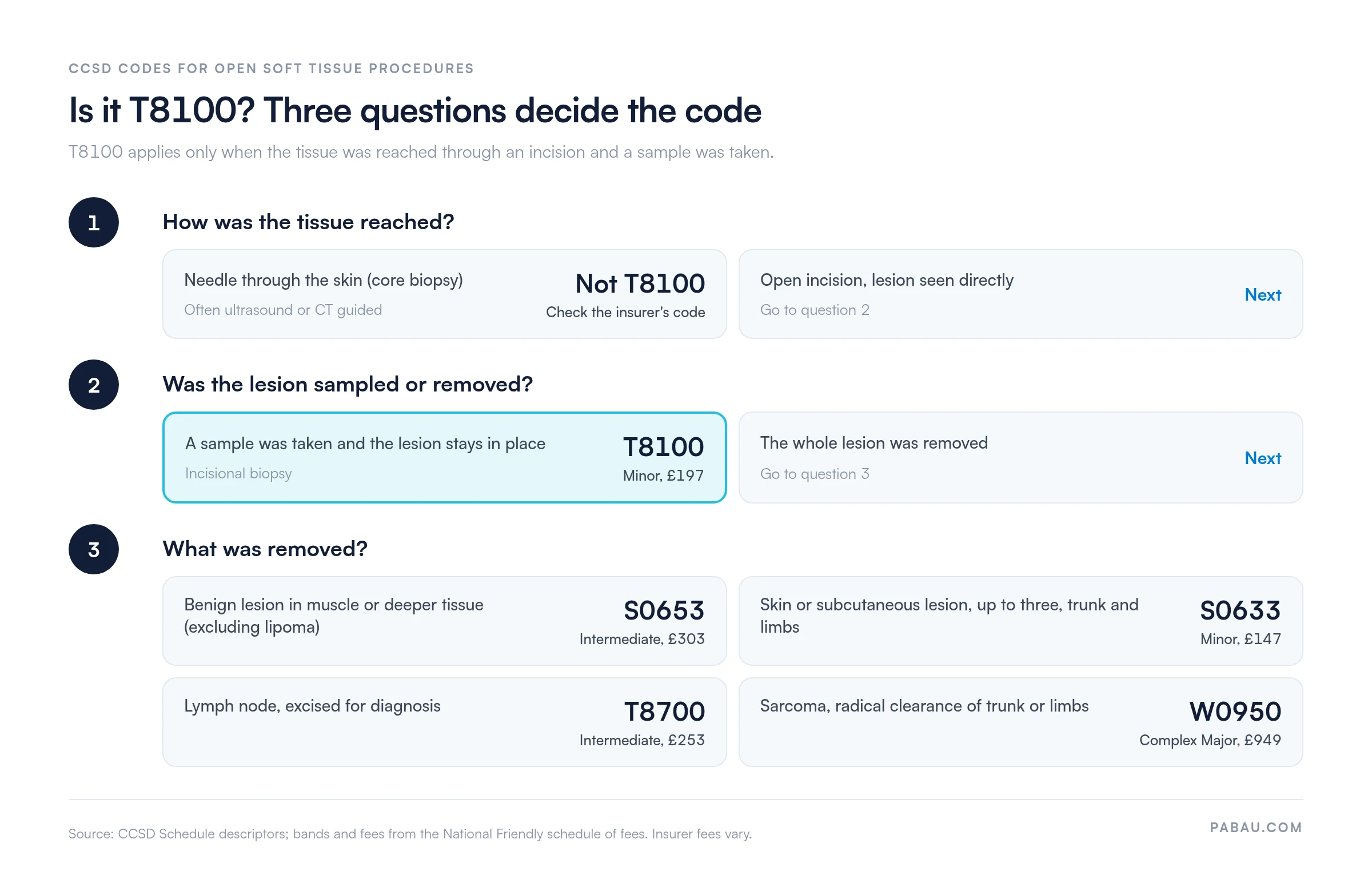
An open biopsy is chosen when a needle sample would not give the pathologist enough tissue. That usually means a deep or awkward lesion, or a needle biopsy that came back non-diagnostic. The presentations below are the ones most often behind a T8100 invoice.
Where sarcoma is possible, where the incision goes matters as much as the code. A biopsy track can seed tumour cells, so the surgeon who removes the tumour later usually excises the scar too. UK sarcoma services therefore expect the biopsy to be planned with, or carried out by, the specialist sarcoma team.
Insurers look for that reasoning in the clinical letter. A note explaining why an open biopsy was chosen over a needle, and who planned it, answers the claims assessor’s first question.
Every T8100 invoice needs a diagnosis code that explains why the biopsy was necessary. UK insurers take diagnoses in WHO ICD-10, not the US ICD-10-CM, so check each code in the WHO ICD-10 browser. The table lists the pairings most often seen with T8100.
Code the diagnosis as it stood when the biopsy was planned, not the pathology result that came back afterwards. A suspected sarcoma biopsied for diagnosis is an uncertain mass on the invoice, not C49.9. Make sure the code on the invoice matches the one on the authorisation.
A clean T8100 claim passes through five stages before it reaches the insurer. Each stage produces something the insurer checks when it assesses the invoice.
CCSD sets the codes, and each insurer sets its own fees against them. The National Friendly schedule of fees lists T8100 as Minor complexity with a £197 fee. Bupa, AXA Health, Aviva and Vitality publish their own schedules, so check the patient’s insurer before you quote.
A consultant who charges more than the insurer pays leaves the patient with a shortfall. Tell the patient about it in writing before the biopsy. When comparing UK medical billing software, check that it holds each insurer’s fee against the CCSD code.
An authorisation confirms the insurer expects to cover the biopsy under the patient’s policy. It is not a promise of payment, because the invoice still has to match the code, the notes and the policy limits. The clinical letter for a T8100 request should include the following.
If the plan changes to a full excision, ask the insurer to update the authorisation before you invoice. An authorisation issued for T8100 does not cover S0653 or W0950.
CCSD codes carry no modifiers, so the anaesthetist bills under the same procedure code with their own invoice. Insurers set their own rules on paying a surgical assistant. A Minor biopsy seldom needs one, so check with the insurer before an assistant invoices.
The pathology work sits outside T8100. The hospital’s laboratory or the consultant histopathologist invoices it separately. Tell the patient that the surgeon, anaesthetist and pathology service may each send a separate bill.
Run this checklist before you submit any T8100 claim. A missing item usually means the insurer writes back for more information, which delays payment.
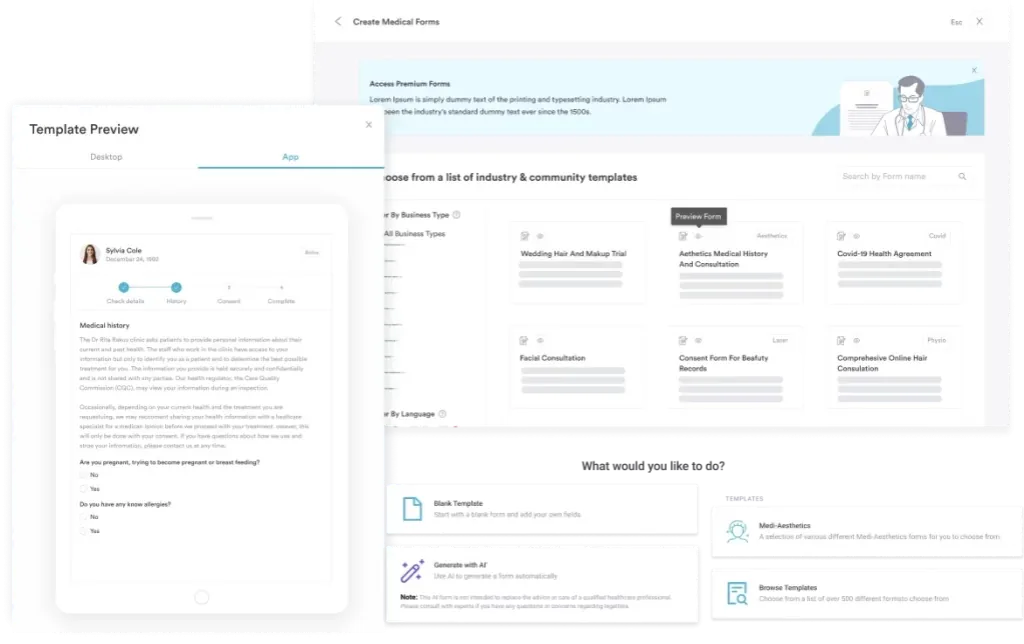
Pabau’s digital forms capture the pre-operative history and consent in a structured format. They feed the same patient record as the operative note, so the billing team builds a T8100 claim from one place.
T8100 claims are rejected for predictable, preventable reasons. The table maps each one to the action that fixes it.
Most rejections are fixed by correcting the data and resubmitting through Healthcode. When the insurer has applied its rules and you disagree, the route runs through the insurer first.
A T8100 claim holds up when three records agree: the authorisation, the operative note and the invoice. In most practices they live in different places, and the mismatch only shows when the insurer rejects the claim.
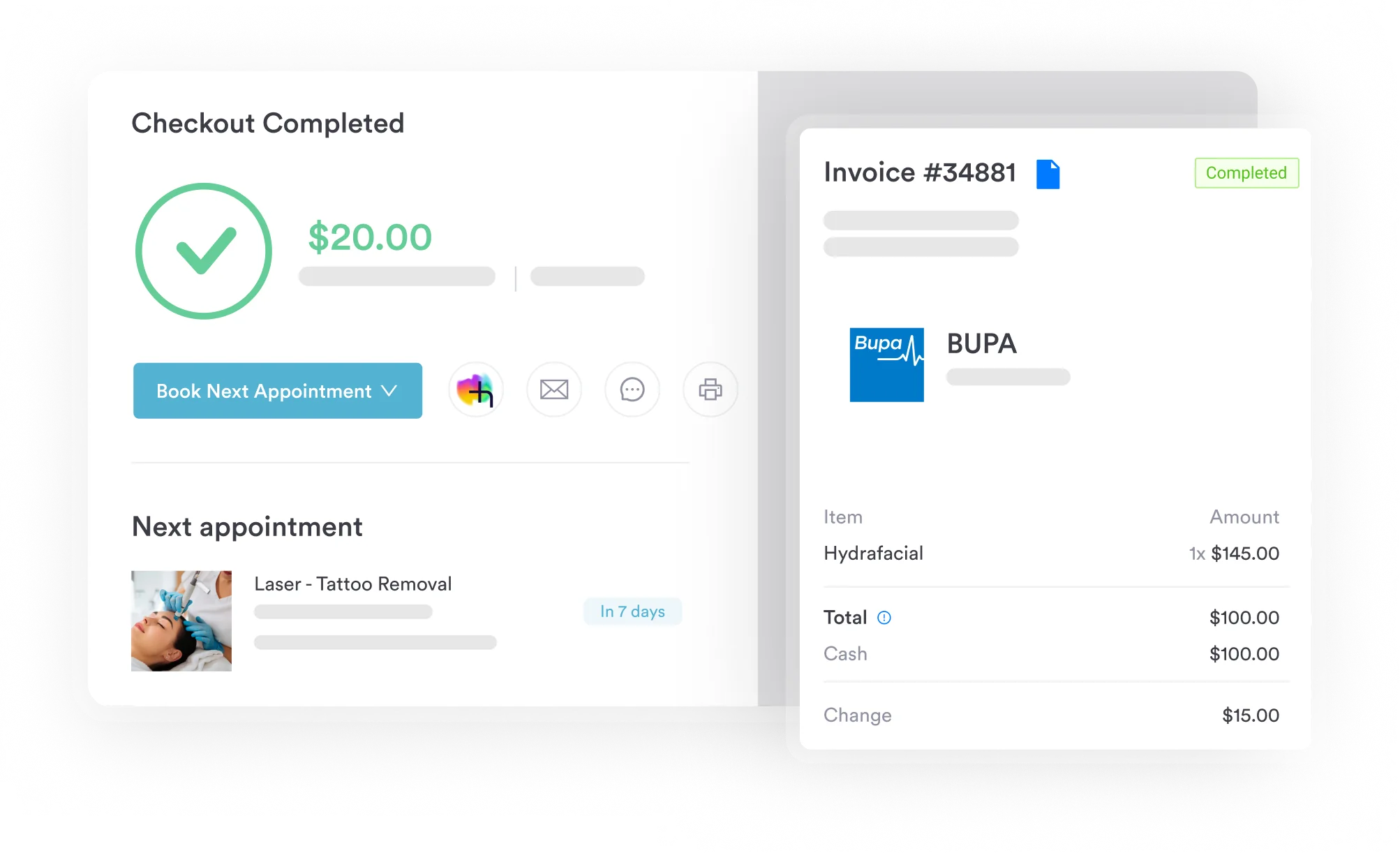
Pabau keeps all three on one patient record. Its claims management software sends CCSD-coded claims to UK insurers through Healthcode and Bupa, then tracks each claim on one dashboard. The authorisation number sits on the patient’s case, with a warning when one is missing.
For a fuller code reference, the Bupa CCSD codes guide explains how the schedule and insurer fees fit together.

Pabau helps UK private practices keep operative notes, authorisation references and ICD-10 codes together, then sends CCSD-coded claims to insurers through Healthcode.

T8100 pays for a sample taken through an incision, with the lesion left in place. Once the surgeon removes the whole lesion, the claim belongs to a different code, and the insurer will notice. Most rejected T8100 claims trace back to that one distinction.
So write the operative note to settle it: open approach, sample taken, lesion left in place. Code the diagnosis as it stood before the pathology came back, and check the insurer’s own fee. Book a demo to see how Pabau sends CCSD claims through Healthcode with the note beside each one.

Did the histology confirm a benign tumour? CCSD code T7790 covers the follow-up excision of a benign soft tissue tumour, with its own authorisation and fee rules.
Is the patient facing a shortfall after the insurer pays? Patient self-pay billing guide explains how to quote, invoice and collect the balance the patient owes.
Want clinical notes that stand up to an insurer query? Write faster, safer clinical notes is a practical guide to recording findings clearly and quickly.
CCSD code T8100 covers an open biopsy of muscle or soft tissue lesion. The surgeon makes an incision, removes a representative sample under direct vision and closes the wound. It does not cover needle biopsies or removal of the whole lesion.
No. T8100 is an incisional biopsy, so only a sample is taken and the lesion stays in place. Removing a benign lesion from muscle or deeper tissue is S0653. A superficial skin or subcutaneous lesion removed whole takes an S06 excision code.
Yes. UK private insurers such as Bupa, AXA Health, Aviva and Vitality expect authorisation before an elective biopsy. The request needs the WHO ICD-10 code, imaging findings and the reason an open biopsy is needed. Quote the authorisation number on the invoice.
Each insurer sets its own fee against the CCSD code. The National Friendly schedule of fees lists T8100 as Minor complexity at £197. Check the patient’s own insurer schedule, and tell the patient in writing about any shortfall.
UK insurers use WHO ICD-10, not ICD-10-CM. Common pairings are R22.3 or R22.4 for an undiagnosed limb mass, M79.8, M62.8, M33.2, D48.1 and D21.9. Code the diagnosis as it stood before the biopsy, not the pathology result.
No. T8100 covers the surgeon’s operation only. The hospital laboratory or the consultant histopathologist invoices the pathology separately, and the anaesthetist sends their own invoice under the same procedure code.
The usual reasons are the wrong code for what was done and a missing authorisation. Others are a diagnosis that differs from the authorised one, US ICD-10-CM codes and a thin operative note. Each one is preventable with a pre-submission check.