HCPCS Code Q4175: Billing, coverage, and documentation guide
HCPCS Code Q4175: Code Description and Product Identity HCPCS Code Q4175 is the ...

Last Updated: Nov 20, 2026
T8910 is the CCSD code for vascularized lymph node transfer (VLNT) performed as a sole procedure. A surgeon moves a flap of healthy lymph nodes, with its own artery and vein, to an area affected by lymphedema. The vessels are then joined to local ones by microsurgery.
The code sits in the lymphatic system section of chapter 9 of the CCSD schedule used by UK private medical insurers. The same transfer on both sides is billed as T8911. A transfer done during a DIEP breast reconstruction goes to B2990 or B2992 instead.
Let Pabau's smart automation suggest the right codes, reduce claim denials, and keep your practice compliant—effortlessly.
Automate repetitive tasks and focus on what matters most—your patients.
Reduce coding errors and ensure compliance with the latest regulations.
Clean claims, fewer denials, and faster reimbursements.
Powerful insights and reporting to help your practice thrive.
HIPAA compliant SOC 2 certified GDPR-compliant Trusted by 4,000+ clinics worldwide

CCSD code T8910 covers vascularized lymph node transfer (VLNT) performed as a sole procedure, usually to treat lymphedema.
T8911 is the bilateral version. Bill it when the surgeon transfers lymph nodes to both sides in the same session.
A transfer done during a DIEP breast reconstruction is coded B2990 or B2992, not T8910.
CCSD also lists T8810, free microvascular lymph-node transfer, so check which code each insurer recognizes before you submit.
Not every insurer schedule carries T8910. National Friendly’s October 2025 schedule lists B2990 but not T8910, T8911 or T8810.
Most insurers expect pre-authorization for planned surgery, so get the reference number before the operation date.
CCSD code T8910 is the code UK private insurers use for vascularized lymph node transfer (VLNT) performed as a sole procedure. The CCSD schedule gives its narrative as “Vascularised lymph node transfer as sole procedure”.
VLNT is a microsurgical operation for lymphedema, the chronic swelling that builds when lymph fluid can’t drain from a limb or body area. The surgeon harvests a flap of healthy lymph nodes with its own artery and vein. The flap is moved to the affected area, and its vessels are joined to local ones under the microscope.
The words “as sole procedure” carry the coding weight. They mean the transfer was the only operation in that session. When nodes are transferred during a DIEP breast reconstruction, the schedule uses separate codes.
The CCSD Group updates its schedule over time, so check the edition your insurer works from. The CCSD index for practices lists the neighboring procedure codes in this series.
CCSD has several codes that move lymph nodes, and the operation note decides which one applies. The diagram shows the order to read the note in, and the table lists each code with the narrative CCSD publishes.
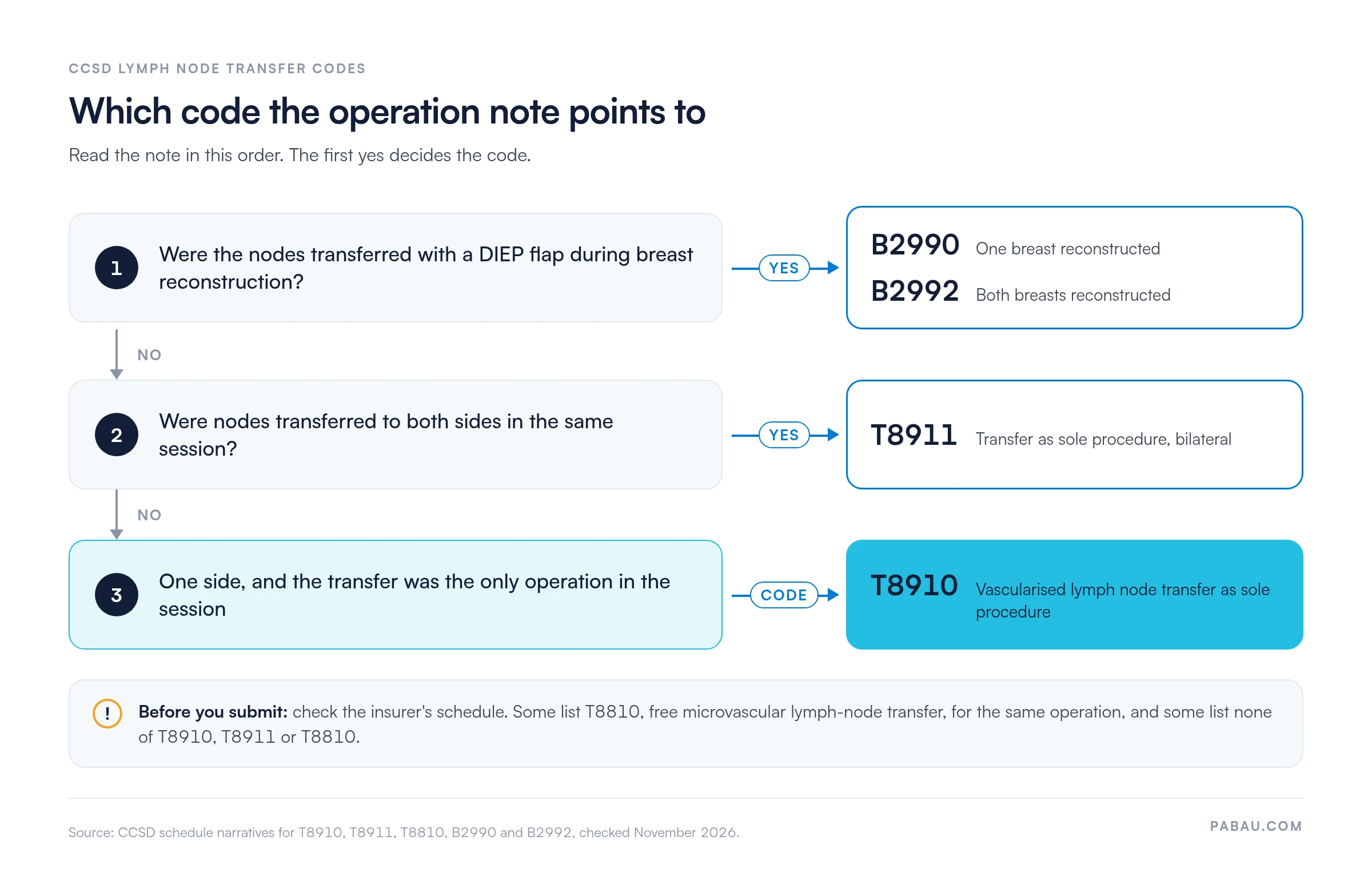
The narratives for T8910 and T8810 overlap, and CCSD’s public listing carries no note that separates them. CCSD added T8810 in August 2016, two years after T8910. Ask the insurer which one it recognizes, and keep its answer on file.
Coverage on insurer lists is uneven too. National Friendly’s October 2025 schedule of fees carries B2990 as a Complex Major procedure, and it lists T8820. It lists none of T8910, T8911 or T8810, so a claim to that insurer needs a conversation before the operation.
A T8910 claim is only as strong as the operation note behind it. A note that says only “lymph node surgery” leaves the coder unable to tell a transfer from a biopsy or a dissection. The insurer may then query it. A diagnostic excision biopsy of a node, for example, is coded T8700.
Agree a standard procedure title with your surgeons, such as “VLNT, sole procedure, left upper limb”. When the title carries the side and the word “sole”, the person coding the claim reads it in seconds.
The work starts before the operation. Most insurers want planned surgery approved in advance, and the patient’s policy decides what is covered.
The table below is a starting point, so confirm each detail with the payer before the procedure date.
Once the operation is done, the claim follows the same five steps whichever insurer pays it.
Each slip below can stall a lymph node transfer claim, and each one can be caught before the claim goes out.
If a claim is still refused, check the insurer’s current provider manual for its appeal process. Only commit to a deadline you have confirmed there.
In many surgical practices, the authorization lives in an email and the operation note sits in another system. Then someone keys the claim in by hand. Every handoff is a chance to lose the reference number or bill the wrong side.
Pabau keeps those steps on the patient record instead. Its private practice claims software sends claims electronically through Healthcode and to Bupa. The authorization code, dates and sessions sit on the patient’s case, with a warning when one is missing.
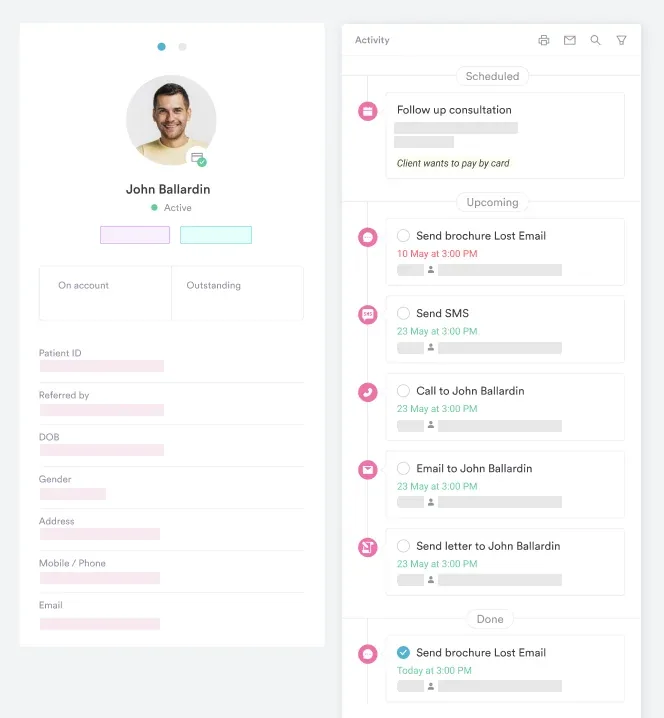
The result is fewer claims bounced for a missing reference, and a clear view of what each insurer still owes. Your billing team answers fewer insurer queries, because the reference number and the side are on the claim from the start.

Pabau tracks authorization codes on the patient’s case and sends claims electronically through Healthcode and to Bupa. You see each claim’s status without phoning the insurer.

T8910 is a narrow code, and the narrow wording is deliberate. It fits one stand-alone transfer on one side, while neighboring codes catch bilateral and combined operations.
Before each claim, check that the note names the side and the word “sole”, and that the insurer’s schedule carries T8910 at all. Book a demo to see how Pabau keeps authorizations, notes and Healthcode claims on one patient record.

Need a full Bupa CCSD billing reference? Bupa CCSD codes covers Bupa’s procedure list and how its claims work.
Checking Bupa fees before you invoice? Bupa procedure codes and fee schedule walks through Bupa’s recognized codes and fee tiers.
Looking up another CCSD procedure? CCSD codes lists every CCSD procedure code page we publish.
CCSD code T8910 covers vascularized lymph node transfer performed as a sole procedure. The surgeon moves a flap of lymph nodes, with its blood supply, to an area affected by lymphedema. The CCSD narrative is “Vascularised lymph node transfer as sole procedure”.
T8911 is the bilateral version of T8910, and CCSD added it in May 2015. Use T8911 when nodes are transferred to both sides in the same session. Use T8910 when one side is treated.
Use B2990 for a one-sided DIEP breast reconstruction with vascularized lymph node transfer, and B2992 when both sides are reconstructed. T8910 applies only when the transfer is the sole procedure.
CCSD lists T8810 as “Free microvascular lymph-node transfer”, and its public listing carries no note that separates it from T8910. Ask each insurer which code it recognizes for the operation, and keep the answer on file.
When an insurer asks for a diagnosis, UK claims use WHO ICD-10 codes. Common choices are I89.0 for lymphedema not elsewhere classified, and I97.2 for postmastectomy lymphedema syndrome. Use the diagnosis the surgeon documented.
Not all of them. National Friendly’s October 2025 schedule of fees lists B2990 but not T8910, T8911 or T8810. Check the insurer’s current schedule, or ask the insurer, before the operation date.