Pabau Engage inbox

Pabau Engage is here: every patient conversation in one inbox.

Learn more
Book a demo Book a demo
☰
CCSD Code

CCSD code L8780 – Bilateral saphenous vein ligation and stripping


Code Definition

L8780 is the CCSD code for ligation/stripping of long and short saphenous veins (including local excision/multiple phlebectomy) - bilateral. UK private insurers use it when both saphenous veins are tied and stripped on both legs in one operation.

L8780 sits in the varicose veins section of chapter 9 of the CCSD schedule. The same operation on one leg is L8700, and phlebectomy on its own is L8750 or L8751.

Group
9 Vascular system
Category
Varicose Veins
Subcategory
Saphenous ligation and stripping (L8510, L8520, L8700, L8780)
Billable
No
Code also known as
saphenous vein stripping, bilateral vein surgery, varicose vein surgery both legs, saphenous ligation bilateral
Save time. Improve accuracy. Get paid faster.
Automate coding with Pabau

Let Pabau's smart automation suggest the right codes, reduce claim denials, and keep your practice compliant—effortlessly.

  • AI-powered code suggestions
  • Real-time compliance checks
  • Faster claims, fewer denials
Why practices choose Pabau
Save hours every week

Automate repetitive tasks and focus on what matters most—your patients.

Improve accuracy

Reduce coding errors and ensure compliance with the latest regulations.

Get paid faster

Clean claims, fewer denials, and faster reimbursements.

Grow with confidence

Powerful insights and reporting to help your practice thrive.

HIPAA compliant SOC 2 certified GDPR-compliant Trusted by 4,000+ clinics worldwide

Key takeaways

Key takeaways

CCSD code L8780 covers ligation and stripping of the long and short saphenous veins on both legs, with local excision and multiple phlebectomy included.

The same operation on one leg is L8700. L8770 is a different procedure, subfascial endoscopic perforator surgery (SEPS) on one leg.

Phlebectomy in the same operation is part of L8780, so the phlebectomy codes L8750 and L8751 stay off the claim.

The operation note has to state that both legs were treated, or the insurer may query the code.

UK insurers such as Bupa, AXA Health, Aviva and Vitality usually need pre-authorization for elective vein surgery, and the reference goes on the claim.

CCSD code L8780 covers bilateral saphenous ligation and stripping

CCSD code L8780 is the code UK private insurers use for ligation and stripping of the long and short saphenous veins on both legs. It comes from the schedule kept by the Clinical Coding & Schedule Development Group (CCSD). Insurers such as Bupa, AXA Health, Aviva and Vitality build their procedure lists on that schedule.

The official narrative reads Ligation/stripping of long and short saphenous veins (including local excision/multiple phlebectomy) – bilateral. Both saphenous systems are treated on each leg in one operation. Phlebectomy of the remaining varicose tributaries is part of the code, not an extra line.

FieldDetail
CodeL8780
CCSD narrativeLigation/stripping of long and short saphenous veins (including local excision/multiple phlebectomy) – bilateral
Schedule locationChapter 9, vascular system, varicose veins section
CCSD referenceFI.078
LateralityBilateral, both legs in the same operation
One-leg equivalentL8700, the same narrative without “bilateral”
Maintained byThe Clinical Coding & Schedule Development Group (CCSD), UK
JurisdictionUK – private healthcare billing
Billing routeSubmitted electronically via Healthcode or direct to the insurer

The CCSD Group updates its schedule over time, so check the edition your insurer works from. Pabau, the practice management platform we build, keeps an index of CCSD codes that lists the other procedure codes we cover.

What the operation involves

Bilateral saphenous ligation and stripping is done under general or spinal anesthesia. A duplex ultrasound scan beforehand maps reflux in the long and short saphenous veins of both legs. That map guides where the surgeon works.

  1. Groin incision. The surgeon exposes the saphenofemoral junction and ties the long (great) saphenous vein flush with it, along with the tributaries there.
  2. Long saphenous stripping. A stripper is passed along the long saphenous vein, and the main trunk is removed.
  3. Popliteal incision. The saphenopopliteal junction behind the knee is exposed, and the short (small) saphenous vein is tied and stripped.
  4. Phlebectomy. Remaining varicose tributaries come out through small stab incisions. The L8780 narrative includes this step.
  5. Second leg. The same steps are repeated on the other leg in the same operation, which completes the bilateral scope of L8780.

L8780 and the neighboring varicose vein codes

The varicose veins section of the CCSD schedule gives open surgery, endovenous treatment and sclerotherapy their own codes. For open ligation and stripping, the code depends on how many saphenous veins were treated and on how many legs.
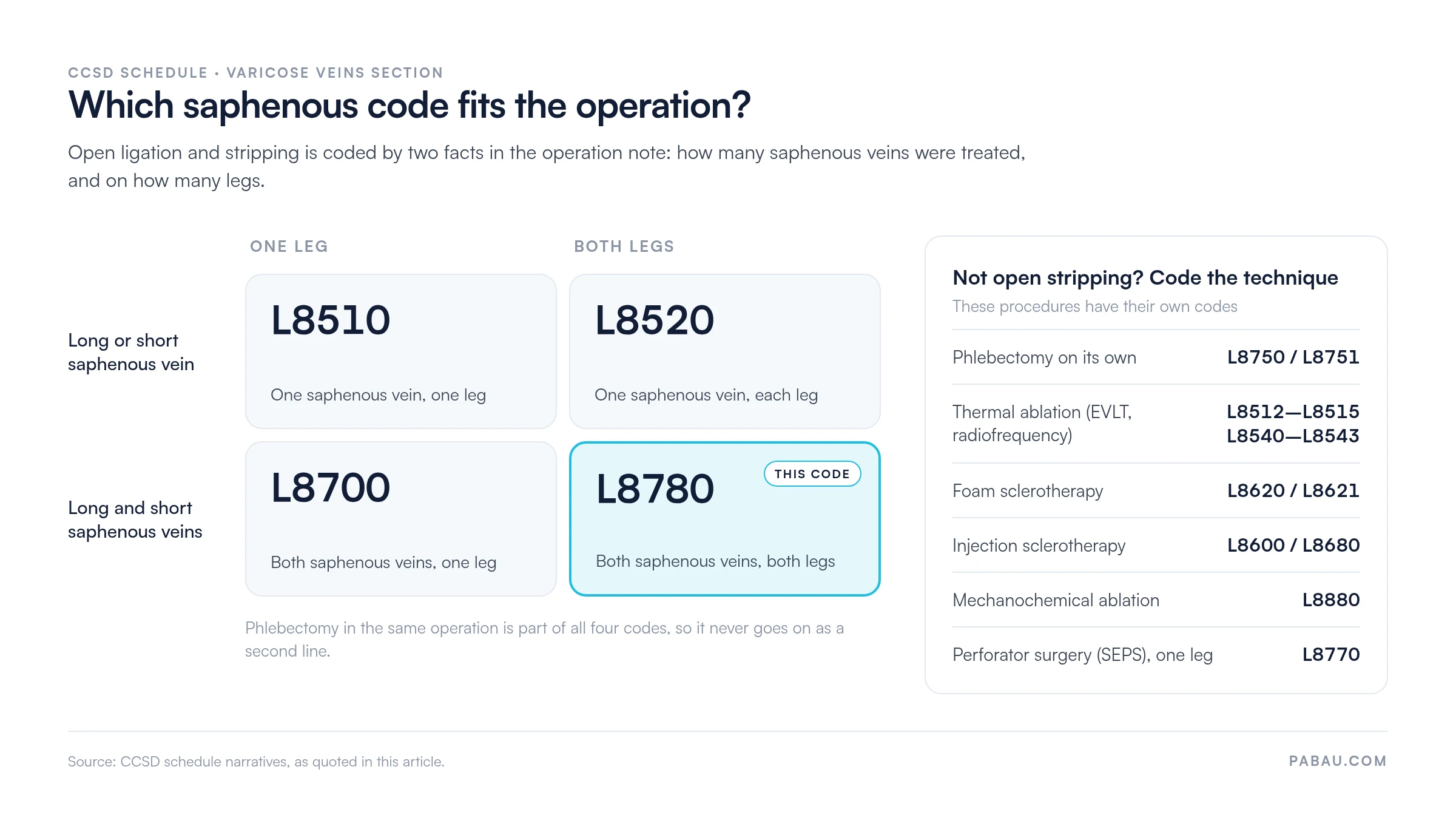
Decision grid for CCSD saphenous ligation and stripping codes: one vein on one leg is L8510, one vein on each leg is L8520, both veins on one leg is L8700, both veins on both legs is L8780. Other techniques: phlebectomy alone L8750 or L8751, thermal ablation L8512 to L8515 and L8540 to L8543, foam sclerotherapy L8620 or L8621, injection sclerotherapy L8600 or L8680, mechanochemical ablation L8880, SEPS on one leg L8770.
L8780 is the only open saphenous code for both veins on both legs. Each technique in the right-hand panel takes its own code instead. The codes come from the CCSD schedule narratives quoted in this article.

The table maps the neighbors most often confused with L8780, with the CCSD narrative for each one.

CodeCCSD narrativeWhen it fits instead of L8780
L8700Ligation/stripping of long and short saphenous veins (including local excision/multiple phlebectomy)Both saphenous veins treated on one leg only
L8510Ligation/stripping of long or short saphenous vein (including local excision/multiple phlebectomy)One saphenous vein treated, on one leg
L8520Ligation/stripping of long or short saphenous vein (including local excision/multiple phlebectomy) – bilateralOne saphenous vein treated on each leg
L8750 / L8751Local excision (multiple phlebectomy) of varicose vein(s) of leg – unilateral / – bilateralPhlebectomy on its own, with no saphenous ligation or stripping
L8770Subfascial endoscopic perforator surgery (SEPS) – unilateralEndoscopic perforator surgery on one leg. It is not the one-leg version of L8780
L8512 to L8515, L8540 to L8543Endovenous laser treatment (EVLT) and radiofrequency ablation, coded by number of trunks and sideTruncal reflux closed by thermal ablation in place of open stripping
L8620 / L8621Ultrasound-guided foam sclerotherapy of varicose veins – unilateral / – bilateralVeins closed by foam injection rather than surgery

The schedule has no L8760, L8800 or L8820. Thermal ablation and foam sclerotherapy use the codes in the table above. Injection sclerotherapy has its own codes, L8600 and L8680, and mechanochemical ablation is L8880.

Codes that describe part of the same operation, such as L8700, L8510, L8520, L8750 and L8751, are not billed with L8780 for the same session. Check the schedule’s unacceptable combinations before any second varicose vein code goes on the claim. Our page on CCSD code L8700 covers the one-leg operation.

Clinical indications that support an L8780 claim

Insurers want a documented clinical reason before they authorize surgery on both legs. Clinicians grade chronic venous disease with the CEAP classification, and a duplex scan should confirm reflux in each leg.

CEAP classClinical findingWHO ICD-10 code (examples)
C2Varicose veins, symptomaticI83.9 Varicose veins of lower extremities without ulcer or inflammation
C3Edema caused by venous diseaseI83.9, with the edema recorded in the notes
C4Skin changes such as varicose eczema or lipodermatosclerosisI83.1 Varicose veins of lower extremities with inflammation
C5Healed venous ulcerCode the findings present now, since I83.0 applies to an open ulcer
C6Active venous ulcerI83.0 with ulcer, or I83.2 with both ulcer and inflammation

These codes are examples, and the treating clinician and coder pick the one that matches the consultation notes. UK claims use WHO ICD-10, which you can check in the WHO ICD-10 browser. US ICD-10-CM sub-codes such as I83.90 belong on US claims, not UK ones.

Insurers also tend to expect a trial of conservative care first, such as compression stockings. Each insurer sets its own rule on this, so check the policy before you submit.

The operation note has to say bilateral

A claim for L8780 is only as strong as the note behind it. A note that describes the same incisions on each leg, without stating that both legs were treated, can be read as a one-leg operation.
  1. Duplex ultrasound report. A written report confirming reflux in the long and short saphenous veins of both legs.
  2. Operation note. The word “bilateral” in the procedure title, plus each vein tied and stripped on each leg.
  3. Phlebectomy detail. Record the stab avulsions as part of the same operation, so no one codes them as a separate line.
  4. Surgeon details. The treating surgeon’s GMC number and their recognition with the insurer, which the insurer checks against the claim.
  5. Diagnosis. A WHO ICD-10 code from the I83 group, or another venous code, matched to the documented findings.
  6. Conservative care record. What compression or other non-surgical care was tried, and for how long.
  7. Histology, if sent. The lab report reference for any tissue sent for analysis.
Pabau digital forms for vein surgery operation notes
Pabau’s digital forms let a practice build an operation-note template with a laterality field and a line for each vein treated. The coder then reads “bilateral” from the note instead of inferring it.

Pro Tip

Agree a standard procedure title with your vascular surgeons, such as “Bilateral long and short saphenous ligation and stripping with phlebectomy”. When the title names both legs, the person coding the claim sees it straight away.

How an L8780 claim moves from booking to payment

Check cover first, because policies differ on elective vein surgery. Confirm with the insurer that the patient’s plan covers the operation before the date is set.

The table below shows what each insurer usually expects, and the payer has the final word on every detail.

InsurerPre-authorizationWhat to check
BupaUsually needed for planned surgeryThe authorization number goes on the claim
AXA HealthUsually needed for inpatient and day-case treatmentRequest it through AXA’s provider channels before treatment
AvivaUsually needed for surgeryCheck Aviva’s CCSD-based fee schedule before invoicing
VitalityDepends on the policyConfirm the procedure is covered at the patient’s plan level
WPADepends on the policyWPA’s published fee schedule sets the reimbursable amount

A pre-authorization request for L8780 usually carries these four items.

  • A letter from the treating surgeon giving the CEAP class, how long symptoms have lasted and why both legs need surgery.
  • The duplex ultrasound report, with reflux recorded for each leg.
  • Notes showing the conservative care already tried.
  • The planned operation date, the hospital and the ICD-10 code.

Authorization confirms the insurer accepts the clinical case. It does not guarantee payment for L8780 if the operation note later fails to show that both legs were treated.

Once the operation is done, the claim follows the same five steps whichever insurer pays it.

  1. Pull the authorization reference. Have the insurer’s reference number ready before you create the claim.
  2. Code L8780 against the note. Check that the note names both legs and both saphenous veins. If only one leg was treated, the code is L8700.
  3. Add the diagnosis. Use a WHO ICD-10 code such as I83.9 or I83.0, matched to the documented findings.
  4. Check the fee. Compare your charge with the payer’s current schedule. A stale figure is a common reason for rejection.
  5. Submit and track. Send it electronically via Healthcode or direct to the insurer, then follow it until it pays.

The anesthetist bills separately under their own fee, and the hospital bills its own charges to the insurer. Keep those lines off the surgeon’s claim.

Common mistakes that stall L8780 claims

L8780 claims are held up for a handful of predictable reasons. The table pairs each one with its fix.

MistakeWhat happensFix
“Bilateral” missing from the operation noteThe insurer queries the code or reads the note as a one-leg operationAsk the surgeon for a dated addendum confirming both legs, then resubmit
No pre-authorizationThe claim is rejected, and the insurer may refuse a retrospective authorizationRequest retrospective authorization with the surgeon’s clinical letter. The outcome depends on the insurer
Wrong or missing ICD-10 codeThe claim is returned as incompleteCheck the code against the clinical record and resubmit
Phlebectomy billed as its own lineThe extra line is refused, since phlebectomy is part of L8780Remove the L8750 or L8751 line and resubmit L8780 alone
Two L8700 lines for one operationThe insurer queries a likely duplicateBill a single L8780 line for both legs
L8770 used as the one-leg codeL8770 describes perforator surgery, so the claim does not match the noteUse L8700 for one leg, and keep L8770 for SEPS
Missing duplex reportThe authorization is declined or the claim is heldSend the full report with reflux recorded for each leg
Ablation code used for open surgeryThe insurer flags a mismatch with the operation noteKeep EVLT and radiofrequency codes for those techniques, and L8780 for open ligation and stripping
Claim sent after the insurer’s deadlineThe insurer may refuse to process itSubmission windows differ, so verify the deadline with each insurer

CCSD codes carry laterality in the narrative, so there is no bilateral modifier to add. The bilateral scope is already part of L8780.

If a claim is still refused, check the insurer’s current provider manual for its appeal process. Our guide to denial management in healthcare covers the follow-up work in more depth.

Bupa claims for L8780 need a few extra checks

Bupa is one of the UK’s largest private health insurers. Its rules are worth knowing before the first vein surgery claim goes out.

  • Recognition. Only a consultant recognized by Bupa in the relevant specialty can bill it for L8780.
  • Authorization number. Every surgical claim to Bupa needs the authorization number on the invoice.
  • Referral. Bupa expects a GP or specialist referral for planned treatment, dated before the operation.
  • Fee check. Use Bupa’s procedure code search to confirm the code and its current fee. Charging above it leaves a shortfall the patient should hear about in advance.

Our guide to Bupa CCSD codes explains how Bupa’s procedure list works, and our Bupa fee schedule guide covers fee tiers. Healix publishes its own CCSD-based fee schedule with unbundling rules.

How Pabau keeps L8780 claims moving through Healthcode

On a vein surgery case, the duplex report, the authorization email and the operation note often sit in three different places. The claim then gets keyed in by hand, and the authorization reference is easy to lose on the way.

Pabau keeps the billing side of those steps on the patient record. Its claims management software sends claims electronically through Healthcode and to Bupa. The insurance policy, the case and its authorization code sit on the patient’s file, with a warning when the code is missing.
Pabau claims sent through Healthcode
Pabau sends insurer claims through Healthcode, so an L8780 claim goes out with the authorization code held on the patient’s case.

The result is fewer claims bounced for a missing reference, and a clear view of what each insurer still owes. Your billing team stops rebuilding claims from emails and hospital notes.

Send vein surgery claims without the paper chase

Pabau tracks authorization codes on the patient’s case and sends claims electronically through Healthcode and to Bupa. You see where each claim stands without phoning the insurer.

Pabau practice management software for UK private practices

Conclusion

L8780 is straightforward once the note names both legs and both saphenous veins. Claims stall when the side is left unclear, when phlebectomy goes on as a second line, or when L8770 is mistaken for the one-leg code.

Standardize the procedure title with your surgeons, and check each insurer’s authorization and fee rules before the operation. Those two habits settle the code before the claim leaves the practice. Book a demo to see how Pabau keeps authorizations and Healthcode claims on one patient record.

Continue your research

Continue your research

Coding one leg only? CCSD code L8700 covers ligation and stripping of the long and short saphenous veins on a single leg.

Phlebectomy without stripping? CCSD code L8750 covers local excision of varicose veins on one leg when no saphenous vein is tied or stripped.

Looking up another procedure code? CCSD codes lists the CCSD procedure codes Pabau covers.

Need a full Bupa CCSD billing reference? Bupa CCSD codes covers Bupa’s procedure list and how its claims work.

Checking Bupa fees before you invoice? Bupa procedure codes and fee schedule walks through Bupa’s recognized codes and fee tiers.

Frequently asked questions

What does CCSD code L8780 cover?

CCSD code L8780 covers ligation and stripping of the long and short saphenous veins on both legs in one operation. Local excision and multiple phlebectomy of varicose tributaries are included in the code.

Which CCSD code covers the same operation on one leg?

L8700 covers ligation and stripping of the long and short saphenous veins on one leg. L8770 is a different procedure, subfascial endoscopic perforator surgery on one leg. Bill one L8780 line for both legs, never two L8700 lines.

Is pre-authorization required for CCSD code L8780?

Most UK private insurers, including Bupa, AXA Health and Aviva, expect pre-authorization for planned surgery, and cover depends on the patient’s policy. Send the duplex report, the surgeon’s clinical letter and the ICD-10 code. Then put the reference number on the claim.

Can L8780 be billed with phlebectomy on the same claim?

No. Local excision and multiple phlebectomy are part of the L8780 narrative. Adding L8750 or L8751 for the same operation gets the extra line refused.

Why would an insurer query an L8780 claim as a one-leg operation?

Usually the operation note does not state that both legs were treated. Put “bilateral” in the procedure title and record each vein tied and stripped on each leg.

What ICD-10 codes support an L8780 claim?

UK claims use WHO ICD-10. Common choices are I83.9 for varicose veins of lower extremities without ulcer or inflammation, I83.1 with inflammation, I83.0 with ulcer and I83.2 with both. Pick the code that matches the documented findings.
Avatar photo
Maja Popovska
Content Writer

Maja is a Senior Content Writer at Pabau, where she covers everything from practice management and compliance to medical aesthetics and patient experience. Off the clock: binging true crime docuseries, baking and dreaming about travel.
×