CPT Code 25210: Excision of a single carpal bone
CPT Code 25210: Official descriptor and quick-reference data CPT Code 25210 is a...

Last Updated: Nov 26, 2026
L1890 is the CCSD code for repair of leaking aneurysm of thoracic aorta. It covers open surgical repair of a contained rupture, where blood tracks outside the aortic wall without free hemorrhage into the chest.
UK private medical insurers, including Bupa, AXA Health, Aviva and Vitality, use the code to identify the procedure on claims. Endovascular repair (TEVAR), elective repair and thoracoabdominal repair each take a different code. The usual diagnosis pairing is WHO ICD-10 I71.1, thoracic aortic aneurysm, ruptured.
Let Pabau's smart automation suggest the right codes, reduce claim denials, and keep your practice compliant—effortlessly.
Automate repetitive tasks and focus on what matters most—your patients.
Reduce coding errors and ensure compliance with the latest regulations.
Clean claims, fewer denials, and faster reimbursements.
Powerful insights and reporting to help your practice thrive.
HIPAA compliant SOC 2 certified GDPR-compliant Trusted by 4,000+ clinics worldwide

CCSD Code L1890 covers open surgical repair of a leaking thoracic aortic aneurysm only. Elective repair and endovascular (TEVAR) repair use separate codes.
CCSD codes come from the UK Clinical Coding and Schedule Development Group schedule, used by insurers such as Bupa, AXA Health, Aviva and Vitality.
A leaking aneurysm is a contained rupture, so the usual WHO ICD-10 pairing is I71.1 (thoracic aortic aneurysm, ruptured), not I71.2.
Insurers expect an authorization number on the claim, and many policies are not designed to cover emergency admissions, so contact the insurer early.
Pabau, a practice management platform, sends UK insurer claims through Healthcode and Bupa and tracks the authorization on each case.
CCSD Code L1890 describes open surgical repair of a leaking aneurysm of the thoracic aorta. CCSD codes come from the Clinical Coding and Schedule Development (CCSD) Group. Its CCSD schedule of standard codes is the procedure reference for UK private healthcare. UK private medical insurers, including Bupa, AXA Health, Aviva and Vitality, use the schedule to identify procedures on claims. Those claims usually go electronically through Healthcode.
Understanding the CCSD billing code structure helps before coding any complex vascular procedure, because the L-series holds several adjacent codes that are easy to confuse. Our CCSD billing guides walk through those neighbors one code at a time.
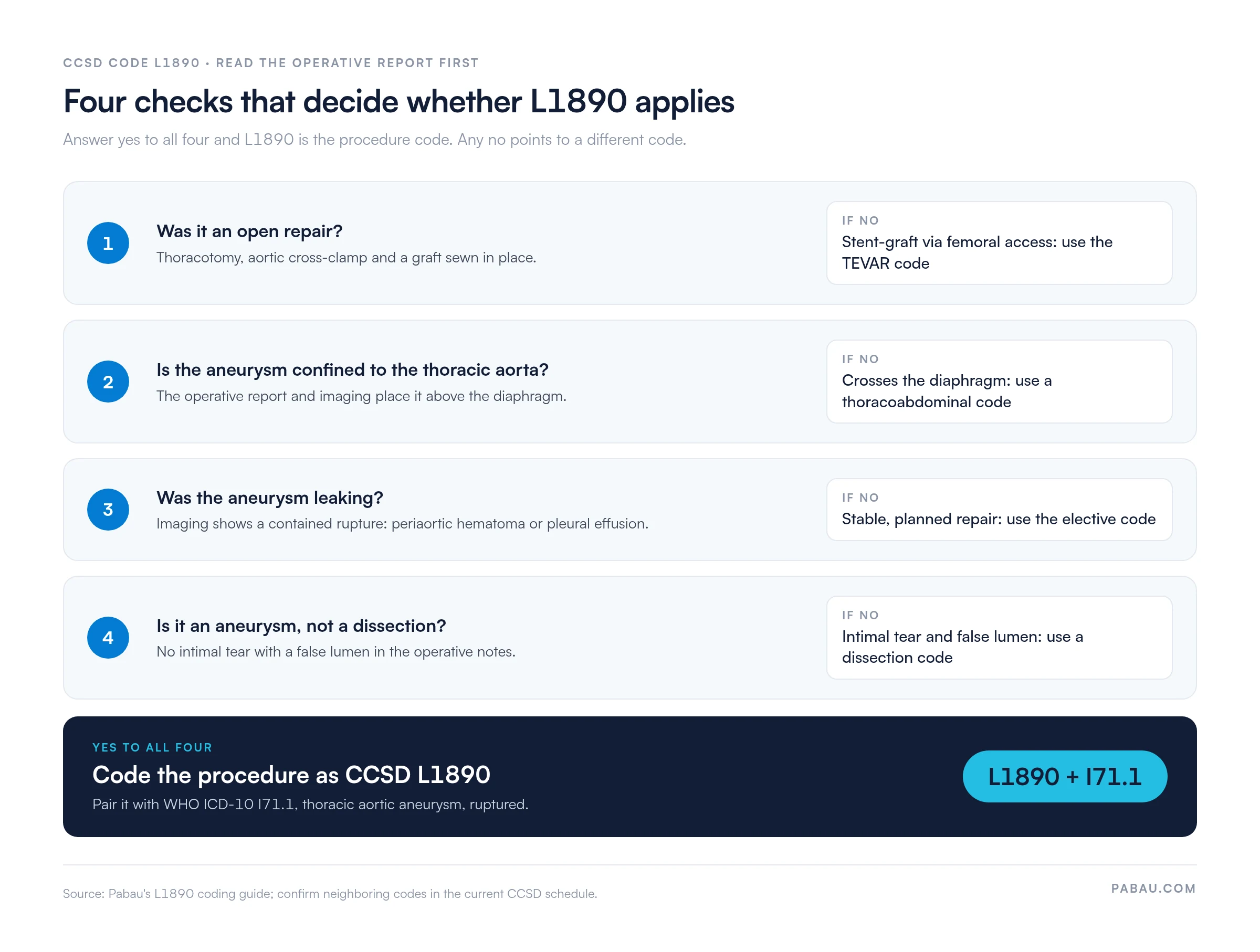
A leaking aneurysm is distinct from both a free rupture and an asymptomatic (elective) aneurysm. Clinically, it refers to a contained rupture, with blood tracking outside the vessel wall but no free hemorrhage into the chest cavity. Patients typically present with severe chest or back pain, and imaging shows periaortic hematoma or pleural effusion. This presentation sits between elective repair (planned, stable) and frank rupture (an exsanguinating emergency), and L1890 captures the leaking, contained-rupture scenario.
The code is scoped to the thoracic aorta. An aneurysm that extends across the diaphragm into the abdomen is a thoracoabdominal aneurysm and falls under a different code. Matching the anatomy in the operative report to the code is a common failure point for billing staff. Confirm the exact boundaries against the current CCSD schedule.
Open repair of a leaking thoracic aneurysm follows a defined surgical sequence. Coders benefit from understanding these steps, because the operative report should reflect each of them for the claim to withstand insurer review.
Each of these steps should appear in the operative report. A note that says only “repair of thoracic aneurysm” gives an insurer too little evidence to accept L1890. Without the approach, graft details and cross-clamp time, expect the claim to be queried.
CCSD Code L1890 applies only to open surgical repair. Thoracic endovascular aortic repair (TEVAR) uses a separate CCSD code and should never be billed under L1890. Insurers check the procedure code against the operative note and the hospital’s theatre record. If the note describes stent-graft deployment through femoral access and the claim shows L1890, expect the claim to be rejected for a code mismatch.
Clinical note: The surgeon chooses between open repair and TEVAR on the basis of patient anatomy, urgency and comorbidities. The billing team then codes the approach that was performed, as documented in the operative report and confirmed by the theatre record.
Several codes cover anatomy or presentations close to L1890, and choosing the wrong one is an easy mistake on complex vascular claims. In every case, the deciding factors are the anatomy in the operative report and the clinical presentation. The schedule is login-gated, so look up the exact neighboring codes in the current CCSD schedule rather than relying on memory.
When the operative report describes a thoracoabdominal aneurysm, confirm that it extends across the diaphragm and that visceral vessels were reimplanted. If the report describes a purely descending thoracic aneurysm, L1890 or its elective equivalent applies instead of a thoracoabdominal code. A dissection repaired within two weeks of onset takes L1892.
The schedule also lists separate codes for a leaking aneurysm of the aortic arch, L1880, and of the ascending aorta, L1810. The four checks below settle the choice in the order a coder reads the operative report.
UK private medical insurers generally expect a diagnosis alongside the CCSD procedure code. The UK uses the World Health Organization’s WHO ICD-10 classification, not the US ICD-10-CM, so descriptors differ from those on American code sites. Because a leaking aneurysm is a contained rupture, the ruptured code is the usual pairing for L1890.
Sequencing rule: Place the most specific diagnosis first as the primary diagnosis. Secondary codes for comorbidities, such as hypertension (I10), atherosclerosis (I70.-) or chronic kidney disease, may follow it. Confirm sequencing with a qualified clinical coder before submission, since each insurer applies its own claim checks.
Check ICD-10 descriptors against the WHO edition used in the UK, not the US ICD-10-CM. The two use different descriptors for the I71 codes. A descriptor copied from a US site can make the diagnosis look inconsistent with the procedure.
A leaking thoracic aneurysm repair is a high-value claim, so UK insurers look closely at the supporting records. The documentation file should be complete before submission. Building a structured clinical record from admission reduces the risk of missing documents at claim time.
Insurers typically expect the following records to support an L1890 claim:
Recording the operative note as structured fields captures graft type, cross-clamp time and approach at the point of care. Those are the details insurers query most often.
UK private medical insurers expect the patient or the hospital to obtain an authorization number before treatment. For a leaking thoracic aneurysm, the clinical urgency changes the process but does not remove the need for authorization.
Many UK private medical insurance policies are not designed to cover emergency admissions, and many patients with a leaking aneurysm are treated in the NHS. Where a private hospital treats the patient and the policy may cover it, contact the insurer as early as possible. Bupa, AXA Health, Aviva and Vitality each set their own authorization rules, so confirm the process with the insurer for each case.
Practice note: A claim submitted without an authorization number is likely to be rejected outright, even for a genuine vascular emergency. Record every contact with the insurer, including the time, the person you spoke to and the reference number.
There is no single national fee for CCSD Code L1890. Each UK insurer sets its own fee schedule or benefit maximum for the consultant’s procedure fee, and these change over time. Take the figure for L1890 from the insurer’s current schedule for the date of treatment, never from an old invoice.
Several billing considerations apply to L1890:
Open thoracic aortic aneurysm repair involves a team of practitioners who bill separately, plus hospital charges for the episode. The table below shows who usually bills each element.
Bundling caution: Some procedures are treated as part of L1890 and cannot be billed separately. Check co-coding combinations against the CCSD schedule’s guidance and the insurer’s rules before submission. Billing a component that is already included in L1890 is an overclaim and can lead to the whole claim being rejected.
Claim denials on L1890 are rarely random. They cluster around a predictable set of documentation and coding errors. Fixing each one before submission is quicker than managing appeals afterward.
Run a short check before every L1890 claim goes out. Confirm the authorization number and check the diagnosis against the operative report. Make sure the note records graft details and cross-clamp time, and that co-coding follows the insurer’s rules.
An L1890 claim depends on records held by several people: the surgeon, the anesthetist, the theatre team and the billing staff. Paper operative notes, manual code lookups and authorization numbers kept in spreadsheets all invite the documentation errors that lead to rejected claims.
Pabau, a practice management platform for private practices, brings those records into one system. Its claims management software sends insurer claims through Healthcode and Bupa. The L1890 invoice goes out from the same system that holds the patient record. The authorization number is tracked on the case, so the billing team can see it before the invoice is raised.
With the operative report, imaging and anesthetic record on the patient record, the claim file is ready if an insurer asks for supporting documents.

Pabau keeps operative notes, authorization numbers and Healthcode claims for each case in one place, so your billing team spends less time chasing records.

Treat L1890 as a code you confirm from the operative report and imaging, never from the referral letter. The leak, the open approach and the thoracic anatomy all have to be on file before the claim goes out. When one is missing, the insurer queries the claim or pays it under a different code.
On an emergency admission, the authorization number is the detail most easily lost. Log it on the case at the first call to the insurer, and the rest of the claim file can follow.
Pabau gives cardiothoracic practices one place to keep the clinical record, track the authorization on the case and send the claim through Healthcode. Book a demo to see how Pabau keeps complex surgical claims complete from theatre to payment.

Need a broader CCSD billing reference? CCSD billing code structure and Bupa guidance covers how the CCSD schedule is organized and how Bupa applies it.
Looking for software that handles insurer claims? Pabau claims management software sends claims through Healthcode and Bupa and tracks the authorization on the case.
Coding a dissection rather than an aneurysm? CCSD code L1992: Delayed aortic dissection repair covers repair more than two weeks after the dissection began.
Billing a planned aortic repair? CCSD code L1910: Ascending aortic aneurysm repair covers elective repair of an aneurysm of the ascending aorta.
CCSD Code L1890 covers open surgical repair of a leaking aneurysm of the thoracic aorta, meaning a contained rupture with periaortic hematoma or pleural extension. It does not cover elective thoracic aneurysm repair, endovascular (TEVAR) repair or thoracoabdominal aneurysm repair, which each have separate CCSD codes.
A leaking aneurysm is a contained rupture, so the usual WHO ICD-10 pairing is I71.1 (thoracic aortic aneurysm, ruptured). I71.2 (without mention of rupture) applies only if the record documents the aneurysm as non-ruptured. A dissection is coded I71.0, and a thoracoabdominal aneurysm uses I71.5 (ruptured) or I71.6 (without mention of rupture).
CCSD L1890 covers open surgical repair only. Endovascular repair (TEVAR) uses a separate CCSD code. Billing L1890 for a stent-graft deployed through femoral access is likely to be rejected when the insurer checks the code against the operative report.
Common reasons are a missing authorization number, a diagnosis that does not match the presentation, and L1890 billed for an endovascular procedure. Others are an operative note without graft details or cross-clamp time, and billing components already included in L1890. A short pre-submission check catches each of these.
The anesthetist sends a separate invoice to the insurer for the same procedure. The hospital bills the critical care stay, blood products and the graft. Some insurers also pay a surgical assistant’s fee. Each invoice should carry the authorization number, and co-coding should follow the insurer’s rules.
Insurers typically look for the operative report with approach, graft details and cross-clamp time, plus pre-operative imaging confirming the leak. The anesthetic record, critical care record, theatre record and a consultant’s letter explaining the urgency and the open approach support the claim. Missing records are a common reason for claims to be queried.