CPT Code 99418: Prolonged E/M services billing guide
What CPT code 99418 covers CPT code 99418 is the add-on code for prolonged inpat...

Last Updated: Oct 22, 2026
K5380 is the CCSD code for repair of ventricular aneurysm, an open-heart operation that removes or patches a thin, scarred bulge in the ventricle wall. Most of these aneurysms follow a heart attack, and the repair is done on cardiopulmonary bypass.
K5380 sits in Chapter 8 (Thorax and intra-thoracic organs) of the CCSD schedule, under cardiac surgery, in the Complex band. UK private medical insurers pay the specialist's fee against this code and expect pre-authorisation before an elective operation.
Let Pabau's smart automation suggest the right codes, reduce claim denials, and keep your practice compliant—effortlessly.
Automate repetitive tasks and focus on what matters most—your patients.
Reduce coding errors and ensure compliance with the latest regulations.
Clean claims, fewer denials, and faster reimbursements.
Powerful insights and reporting to help your practice thrive.
HIPAA compliant SOC 2 certified GDPR-compliant Trusted by 4,000+ clinics worldwide

CCSD code K5380 bills repair of ventricular aneurysm, an open-heart operation done on cardiopulmonary bypass. UK private medical insurers pay the surgeon’s fee against it.
Lead with I25.3 (Aneurysm of heart) as the primary diagnosis, and add I25.2 (Old myocardial infarction) when the aneurysm followed a heart attack.
Bupa, AXA Health, Aviva and Vitality expect elective treatment to be pre-authorised, so record the authorisation number before admission.
Common denials stem from a missing authorisation, a heart failure code as the sole diagnosis, or an operative note that never names the technique.
Pabau, practice management software for private practices, sends CCSD claims through Healthcode with the pre-authorisation code attached.
CCSD code K5380 is the procedure code for “Repair of ventricular aneurysm” in the Clinical Coding & Schedule Development (CCSD) schedule.
UK private medical insurers and private hospitals use this schedule to bill and pay for specialist procedures. K5380 sits in Chapter 8 (Thorax and intra-thoracic organs), among the K-series cardiac surgery codes.
Cardiothoracic surgeons use K5380 to claim for open repair of a ventricular aneurysm, whether by linear repair, patch plasty or geometric reconstruction. Insurer schedules place it in the Complex band, as Freedom Health Insurance’s Chapter 8 schedule shows.
K5380 sits within a cluster of major cardiac surgery codes. Knowing where it falls in the CCSD procedure codes schedule helps coders pick the right code when the surgeon performs a related but distinct operation. A left ventricular reconstruction that goes beyond simple aneurysm repair is the usual example.
Cardiothoracic surgeons, their medical secretaries and private hospital billing teams submit K5380 across the UK. Claims go to private medical insurers such as Bupa, AXA Health, Aviva and Vitality, mostly electronically through Healthcode.
A board of insurers and hospital groups maintains the CCSD schedule. It publishes code changes in regular bulletins, so billing teams should check each new release. Teams that code several cardiac procedures can look up each one in our CCSD code library.
Repair of ventricular aneurysm involves open surgical correction of an aneurysmal segment of the ventricular wall. Most cases involve the left ventricle (LV) after a myocardial infarction.
A transmural infarction turns living myocardium into a thin, akinetic or dyskinetic fibrous scar. Congenital ventricular aneurysms (coded under Q24.8) are far less common but also captured by K5380.
Three main surgical techniques map to this code. The operative report must clearly state which was performed, because technique drives both documentation and the insurer’s view of medical necessity.
All three techniques are performed on cardiopulmonary bypass (CPB), using the heart-lung machine to maintain circulation while the surgeon works on the arrested heart. Off-pump ventricular aneurysm repair is theoretically possible but extremely rare in standard practice.
Not every ventricular aneurysm needs surgery. Many patients with a small, stable aneurysm are managed with medication and follow-up imaging. Surgery is usually considered when the aneurysm causes symptoms or complications, such as:
The referral and pre-authorisation request should state which of these indications applies. Insurers read the clinical indication alongside the imaging to judge medical necessity.
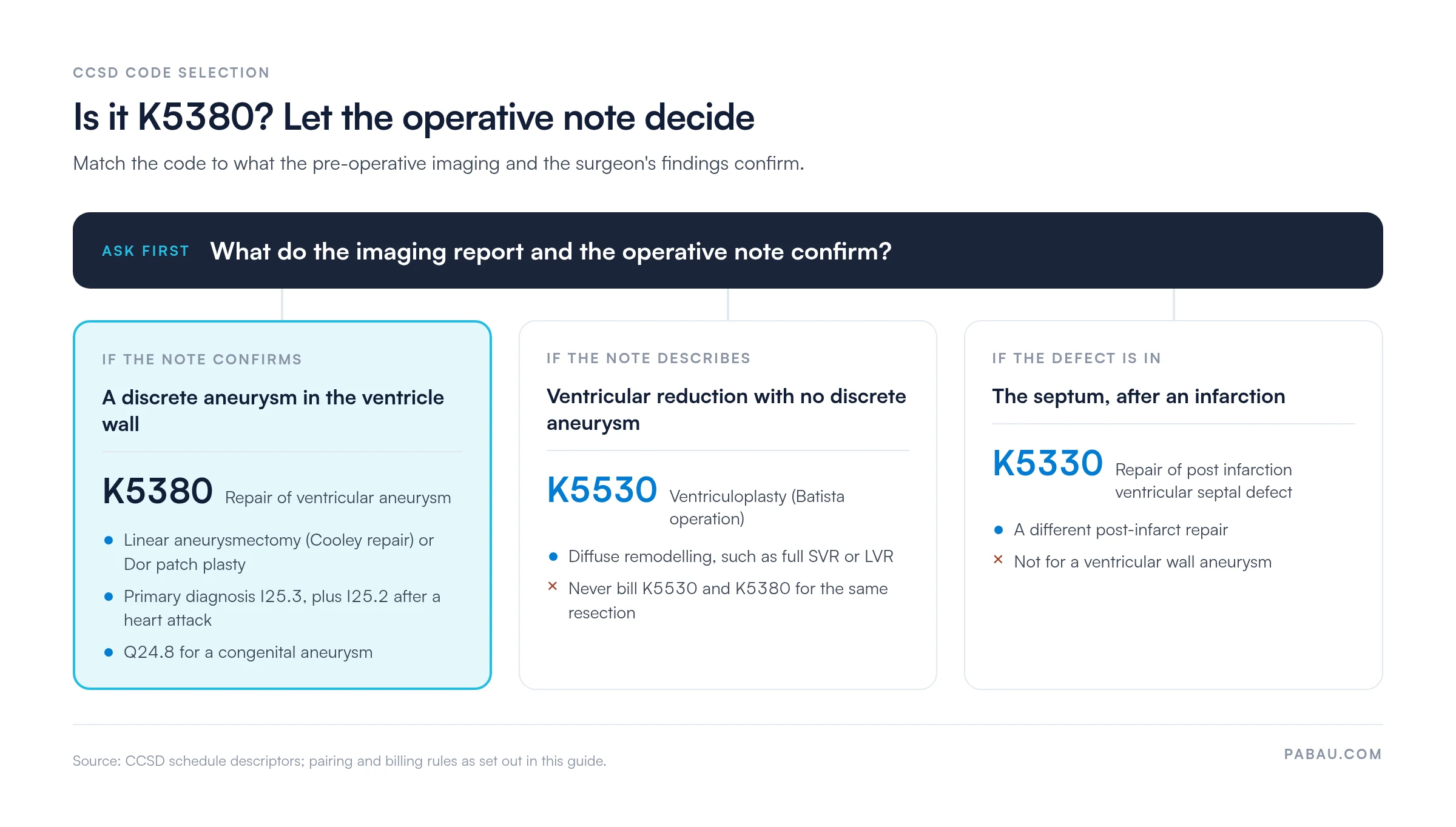
CCSD code K5380 captures both the linear aneurysmectomy (Cooley repair) and the endoventricular patch plasty (Dor procedure) when the aim is to repair the aneurysm.
The distinction matters when the operation is really a full surgical ventricular restoration (SVR) or geometric left ventricular reconstruction (LVR). Those operations target diffuse ischaemic cardiomyopathy, coded I25.5, rather than a discrete aneurysm.
Insurers may challenge a K5380 claim when the operative report describes extensive ventricular remodelling. The risk is highest when neither pre-operative imaging nor the surgeon’s findings confirm a discrete aneurysm.
To stay safe, confirm the aneurysm diagnosis in both the pre-operative investigation report and the operative note before submitting K5380. The diagram below shows how that confirmed finding decides between K5380 and two neighbouring cardiac codes.
Incorrect ICD-10 diagnosis pairing is a common cause of K5380 claim rejection. The diagnosis code must match the documented aetiology and the anatomical finding. It must also agree with the diagnosis on the pre-authorisation request.
I25.3 is the primary diagnosis for the overwhelming majority of K5380 claims. Adding I25.2 as a secondary code clarifies the post-infarct aetiology and strengthens medical necessity. Insurers may query claims coded only with a heart failure code (I50.x) without a primary aneurysm diagnosis.
Ventricular aneurysm repair is rarely an isolated procedure. Most patients also have coronary artery disease, so bypass grafting at the same operation is common. Insurers apply their own rules to multiple procedures at one sitting, so check each insurer’s guidance before you add codes.
Never bill a routine part of the main operation as a separate code. Insurers treat that as unbundling, and it is a common reason for a query from Bupa, AXA Health, Aviva or Vitality.
Before you add codes alongside K5380, check the current CCSD schedule and each insurer’s own guidance on multiple procedures. CCSD publishes changes in regular bulletins, so check them with each release, not only at onboarding.
UK private medical insurers expect elective treatment to be pre-authorised before admission, and cardiac surgery is no exception. Usually the patient calls the insurer for an authorisation number, and the surgeon supplies the clinical details.
Requirements differ by insurer and policy. The steps below reflect common practice at Bupa, AXA Health, Aviva and Vitality, but confirm the rules for each patient’s policy.
A K5380 claim supported by a thin operative note is a claim at risk. Insurers review high-value cardiac claims closely, and the operative report is the main document that justifies the code billed. The clinical documentation requirements for K5380 are specific to this procedure and cannot be satisfied with a generic post-operative summary.
The operative report must include all of the following elements to support a successful K5380 claim:
K5380 attracts insurer scrutiny because it is a high-tariff procedure and the technical distinction between aneurysm repair and broader ventricular reconstruction can be challenged. The most frequent denial reasons fall into five categories.
A denied K5380 claim can often be recovered. Start with the insurer’s own review process, because most documentation denials are fixed there.
If the claim is still declined, the patient, as the policyholder, can make a formal complaint to the insurer. The insurer has eight weeks to send a final response. After that, the patient can take the complaint to the Financial Ombudsman Service, normally within six months of the final response.
A clinical letter from the operating surgeon, sent with a corrected operative report, often resolves a documentation denial at the first review.
On a K5380 claim, the insurer’s authorisation, the surgeon’s operative note and the claim itself often sit in three different places. Pabau keeps all three on one patient record through its private practice claims software. Your billing team then codes from the surgeon’s own note, with the authorisation already attached.
For UK cardiothoracic practices, these Pabau features matter most for K5380 billing:
Still comparing systems for a UK private practice? Our guide to the best UK medical billing software sets out the options side by side.

Pabau helps UK cardiothoracic practices track pre-authorisations, attach operative notes and send clean CCSD claims through Healthcode. See how it supports high-value cardiac procedure billing.

Most K5380 queries trace back to three errors. The claim goes out without its authorisation number, a heart failure code stands in for the aneurysm, or the operative note never names the technique.
Fix them at source and the billing team rarely sees a query. The surgeon names the technique, the coder leads with I25.3, and no claim leaves without its authorisation reference.
Cardiothoracic practices that hold every claim to those checks spend far less time on appeals. Book a demo to see how Pabau keeps K5380 authorisations, operative notes and Healthcode claims in one workflow.

Billing other CCSD procedures? CCSD procedure codes and billing rules covers the wider CCSD schedule and how UK private insurers apply it.
Coding other cardiac surgery in Chapter 8? CCSD code K3210 covers closed mitral valvotomy, another cardiac surgery code in the same chapter.
Managing insurer claims across specialties? Claims management software from Pabau handles pre-authorisation cases, Healthcode submission and claim tracking for UK private practices.
Comparing billing systems in the UK? Best medical billing software in the UK compares the leading platforms for private practice billing.
Coding a cardiac tumour excision? CCSD code K2310 covers excision of cardiac tumour, another heart surgery code in Chapter 8.
CCSD code K5380 covers repair of ventricular aneurysm, an operation that removes or reconstructs an abnormal bulge in the ventricular wall. It applies to linear aneurysmectomy (Cooley repair) and endoventricular patch plasty (Dor procedure). The aneurysm must be confirmed, and it most often follows a heart attack.
Linear aneurysmectomy (Cooley repair) removes the aneurysm sac and closes the defect in a straight line. The Dor procedure uses a patch inside the ventricle to restore the cavity’s elliptical shape, which can suit larger aneurysms. Both bill under K5380, and the operative report must name the technique used.
I25.3 (Aneurysm of heart) is the standard primary diagnosis for a post-infarct ventricular aneurysm. Add I25.2 (Old myocardial infarction) as a secondary code to show the cause. For a congenital aneurysm, use Q24.8. Heart failure codes (I50.x) belong only in a secondary position.
K5380 covers the surgeon’s operation, which is performed on cardiopulmonary bypass. How the hospital and perfusion team charge for bypass depends on the insurer and the hospital’s contract, so confirm it before billing. Never add a separate code for a routine part of the main operation.
In practice, yes. UK private medical insurers such as Bupa, AXA Health, Aviva and Vitality expect elective treatment to be pre-authorised before admission. The patient usually obtains the authorisation number, and the surgeon supplies the clinical details. For an emergency admission, contact the insurer as soon as possible.
The most common reasons are a missing or expired authorisation and a heart failure code used as the sole primary diagnosis. Others are an operative note that does not name the technique, and a routine part of the operation billed separately. Claiming a broader ventricular reconstruction without operative evidence also triggers denials.