HCPCS Code J1110: Dihydroergotamine mesylate injection billing guide
HCPCS Code J1110: Official descriptor and drug overview HCPCS Code J1110 is the ...

Last Updated: Oct 29, 2026
K2610 is the CCSD code for the Ross procedure. The surgeon replaces the diseased aortic valve and root with the patient's own pulmonary valve, called a pulmonary autograft.
The right ventricular outflow tract is then rebuilt with a donor pulmonary homograft. The code sits within the K26xx aortic valve procedures, under CCSD reference Fh.098.
Let Pabau's smart automation suggest the right codes, reduce claim denials, and keep your practice compliant—effortlessly.
Automate repetitive tasks and focus on what matters most—your patients.
Reduce coding errors and ensure compliance with the latest regulations.
Clean claims, fewer denials, and faster reimbursements.
Powerful insights and reporting to help your practice thrive.
HIPAA compliant SOC 2 certified GDPR-compliant Trusted by 4,000+ clinics worldwide

CCSD code K2610 covers the complete Ross procedure: Pulmonary autograft harvest, aortic root replacement and RVOT reconstruction with a homograft.
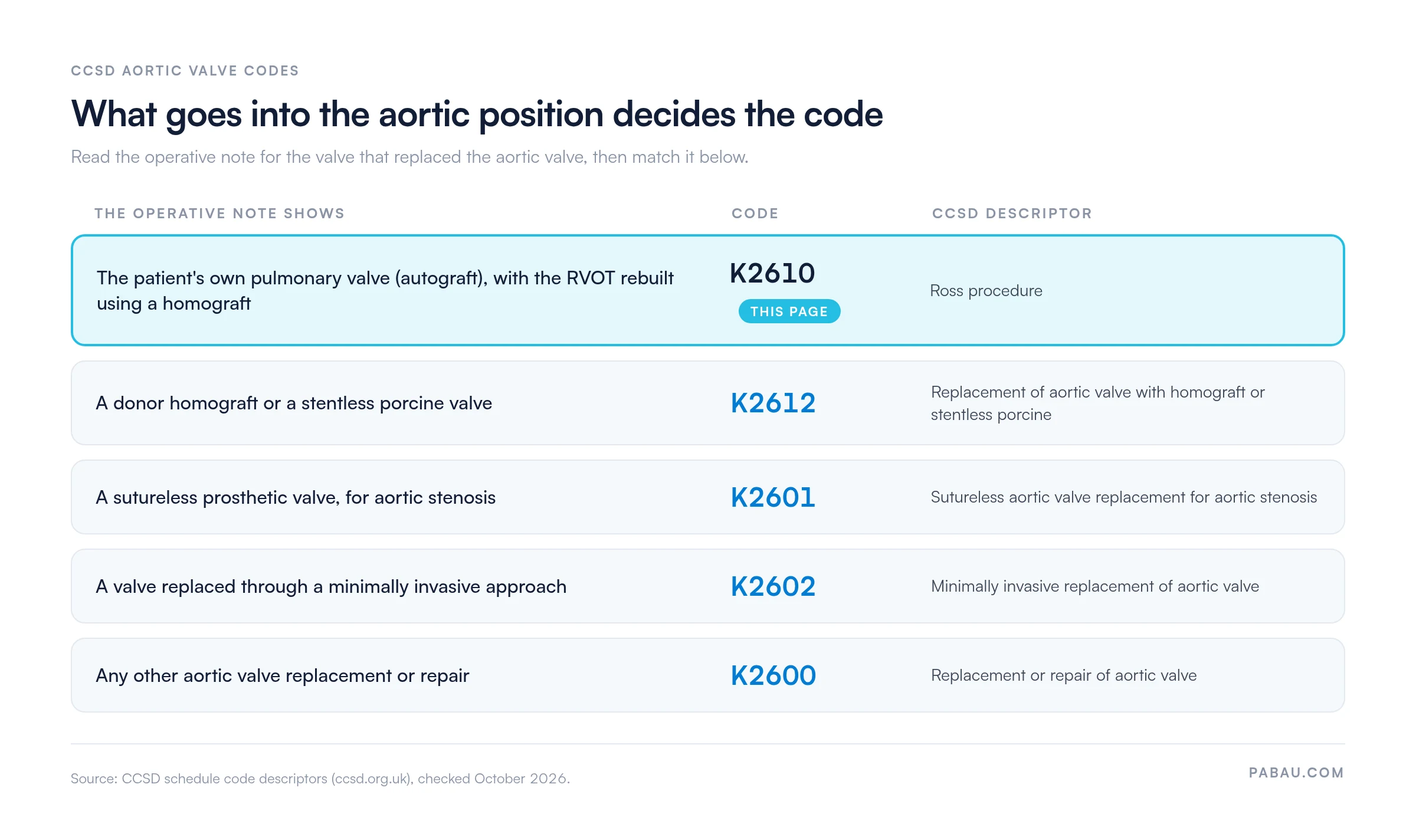
The valve placed in the aortic position decides the code, so the patient’s own pulmonary valve is K2610 and a homograft is K2612.
Cardiopulmonary bypass, perfusion and anesthesia are billed as separate lines and are never bundled within K2610.
Bupa, AXA Health and Aviva require pre-authorization before the Ross procedure, and missing pre-auth is the leading cause of K2610 denials.
Pabau’s claims management software supports CCSD code lookup and insurer pre-auth tracking for complex multi-code cardiac claims.
CCSD code K2610 is the UK private healthcare billing code for the Ross procedure. The CCSD schedule officially describes it as “Ross procedure” (a pulmonary autograft aortic valve replacement). The code sits within the K26xx aortic valve procedures, under CCSD reference Fh.098.
Two features set K2610 apart from the other aortic valve codes. First, the replacement tissue is autologous. The patient’s own pulmonary valve moves into the aortic position, instead of a mechanical prosthesis or a donor homograft.
Second, the operation has two phases, and the operative note must document both to support the code. They are the aortic autograft implantation and the right ventricular outflow tract (RVOT) reconstruction.
The Ross procedure has three operative phases, all performed under cardiopulmonary bypass (CPB). Coders check each one to confirm the operative note supports K2610 rather than a simpler aortic valve replacement code.
The Society for Cardiothoracic Surgery in Great Britain and Ireland (SCTS) recognizes the Ross procedure as a technically demanding operation. Typical CPB times run above two hours. The operative note must document all three phases explicitly. A note that describes only an aortic valve replacement, with no pulmonary autograft harvest, will not support K2610.
K2610 is appropriate whenever the Ross procedure is the operation performed. Surgeons usually reserve it for a defined group of patients rather than for all aortic valve disease. Under SCTS and NICE guidance on aortic valve disease, accepted indications include:
Check that the indication in the discharge summary matches accepted Ross procedure criteria. For acquired adult disease, the diagnosis line usually carries I35.0 for nonrheumatic aortic stenosis or I35.1 for nonrheumatic aortic regurgitation.
A K2610 claim for an older patient may draw a medical necessity query from the insurer. That happens when the notes give no reason for choosing a pulmonary autograft over a mechanical or biological valve.
Correct use of CCSD code K2610 depends on knowing exactly what the code bundles. The table below sets out the standard inclusions and exclusions under CCSD schedule conventions. Bundling rules change with schedule updates, so check the current CCSD guidance before you bill.
K2610 belongs to the K26xx aortic valve procedures. The codes most often referenced alongside it or in its place are set out below, and the CCSD code library holds the wider family. Check exact descriptors against the published CCSD schedule before use, because the schedule is updated periodically.
The most common coding error in this family is submitting K2612 when the operative note describes a Ross procedure. K2612 applies only when a homograft or stentless porcine valve sits in the aortic position. In a Ross procedure, the aortic replacement is the patient’s own pulmonary valve, and the homograft appears only in the RVOT reconstruction.
If the note shows a standard prosthetic replacement with no autograft, K2600 is usually the closer fit. The chart below maps each valve choice to its code.
RVOT reconstruction with a pulmonary homograft is usually bundled within K2610, but the answer is not uniform across insurers. It is one of the most frequent questions in Ross procedure billing.
The standard CCSD position treats RVOT reconstruction as an integral part of the Ross procedure, so it is included in K2610. Most major insurers, including Bupa, AXA Health and Aviva, apply this bundling convention. A few contracts or fee schedules may still permit a separate homograft reconstruction code. Confirm it with each insurer before billing, because submitting both codes without agreement risks a bundling rejection.
Documentation is the deciding factor. The operative note must describe the homograft used, its size and the RVOT reconstruction technique. It also needs the surgeon’s attestation that both operative phases were completed. A note that omits the RVOT phase may lead the insurer to question whether the full Ross procedure took place. That can trigger a downcode to K2600 or K2612.
K2610 claims are high value and attract close scrutiny. Incomplete documentation is a leading cause of delay, denial or post-payment audit. The operative note and discharge summary together form the primary clinical evidence for the claim. Strong billing workflows build documentation checks into pre-submission instead of reacting to denials later.
Major UK private medical insurers (PMIs) require pre-authorization before a surgeon performs a K2610 procedure. The Bupa CCSD code guide covers the pre-auth process for Bupa-covered procedures in detail. The table below summarizes the general requirements across the main UK insurers. Requirements change, so check each insurer’s provider portal before you submit.
Insurers treat pre-authorization obtained after the procedure differently. Retrospective authorization is not guaranteed, and an insurer may refuse it because it had no chance to assess clinical necessity in advance. Some contracts withhold part of the claim, or deny it outright, when pre-auth was missing before the procedure date.
K2610 claims draw denials for a handful of predictable reasons. The procedure is complex and high value, and its autograft technique carries specific documentation requirements. These are the most common denial patterns.
The Ross procedure is rarely performed in isolation. Concomitant procedures, bypass and perfusion codes, and anesthesia all need accounting for when you build the full bill. UK insurer multiple-procedure rules typically reduce fees for secondary procedures in the same operative episode, and the percentages vary by insurer contract.
The most common billing scenarios alongside K2610 are:
Build a standard billing checklist for K2610 that lists every expected code line before submission. Include the primary K2610 line, bypass and perfusion codes, the anesthesia reference and any concomitant procedure code. Add the homograft implant line and the pre-auth number too. Incomplete claims invite bundling disputes and payment delays that take weeks to resolve.
A K2610 episode tracked across spreadsheets, insurer portals and email is where multi-code cardiac claims break down. A missing auth number or implant line often surfaces only when the denial arrives.
Pabau, the practice management platform we build for private practices, keeps those pieces in one place. Its claims management software supports CCSD code lookup, pre-authorization tracking and insurer fee schedules for UK private practice teams. For a K2610 claim, that covers:
The outcome is a K2610 claim that reaches the insurer complete, so your team spends less time on resubmissions and insurer queries.

Pabau tracks CCSD codes, insurer pre-authorization numbers and multi-line claims in one place. Complex cardiac claims like K2610 reach the insurer with every line and reference attached.

K2610 claims are won or lost before the patient reaches the operating room. Secure the pre-auth number and the implant approval first. Then make sure the operative note names the autograft and the RVOT homograft.
The trade-off is extra admin up front on every Ross case. It costs far less than chasing a downcode to K2612 or a bundling dispute weeks after surgery.
Practices that build pre-auth checks and a standard Ross operative note template into their workflow see fewer K2610 disputes. Book a demo to see how Pabau tracks CCSD pre-authorization and multi-line cardiac claims for UK private practice.

Need a CCSD reference for Bupa-covered procedures? Bupa CCSD codes covers how Bupa uses CCSD procedure codes, fee schedules and pre-auth for private healthcare billing.
Managing claims across multiple insurers? Claims management software outlines how Pabau’s claims tools handle multi-insurer billing, code validation and payment reconciliation.
Was a homograft placed in the aortic position instead? CCSD code K2612 covers aortic valve replacement with a homograft or stentless porcine valve.
Coding a standard aortic valve replacement? CCSD code K2600 covers replacement or repair of the aortic valve without a pulmonary autograft.
Coding the diagnosis behind the surgery? ICD-10 code I35.0 covers nonrheumatic aortic stenosis, a common reason for aortic valve surgery.
CCSD code K2610 covers the complete Ross procedure. The patient’s native pulmonary valve is harvested as an autograft and replaces the diseased aortic valve and root. The right ventricular outflow tract is then rebuilt with a pulmonary homograft. Cardiopulmonary bypass, perfusion and anesthesia are billed separately.
Use K2610 only when the patient’s own pulmonary valve replaces the aortic valve and the RVOT is rebuilt with a homograft. If a homograft or stentless porcine valve goes into the aortic position, K2612 applies instead. A standard aortic valve replacement or repair usually falls under K2600.
Yes, in most CCSD interpretations. RVOT reconstruction is integral to the Ross procedure and is bundled within K2610. Some insurer contracts may permit a separate homograft reconstruction code. Verify the bundling rules with each insurer first, because claiming both without agreement is a common denial trigger.
All major UK private medical insurers require pre-authorization before the Ross procedure. Bupa, AXA Health and Aviva all mandate pre-auth for inpatient cardiac surgery. Retrospective authorization is not guaranteed and may lead to a partial or full denial. Get written confirmation of the auth number before the procedure.
Yes. Cardiopulmonary bypass and perfusion are not bundled within K2610 and are billed under the applicable CCSD bypass and perfusion codes. They appear as separate line items on the claim. The insurer’s multiple-procedure fee rules apply to them, not the K2610 surgical fee.
The operative note must name the Ross procedure and describe the pulmonary autograft harvest. It also documents the aortic root replacement, including coronary re-implantation, the RVOT homograft and the CPB time. The discharge summary states the clinical diagnosis and the procedure performed. Missing any of these risks a medical necessity query or an outright denial.