


CPT Code 52352: Ureteroscopic stone removal billing guide
CPT Code 52352: Official descriptor and procedure overview CPT Code 52352 descri...

Last Updated: Oct 30, 2026
CCSD code K6510 sits next to the K65 cardiac catheterisation codes in chapter 8 of the CCSD schedule, Heart – Cardiology. UK private medical insurers use that schedule to read what a cardiologist did. So K6510 belongs on a cardiology invoice, never on a skin or aesthetic claim.
The catch is that K6510’s own narrative sits behind the schedule login. Its sibling codes are visible, though, and they split the work by patient age, access route and pressure-wire use. Read the procedure report against them, and you’ll know which entry to open before the claim goes out.

K6510 sits next to the K65 cardiac catheterisation codes in chapter 8 of the CCSD schedule, Heart – Cardiology.
Its own narrative is login-gated, so open the K6510 entry in the CCSD schedule before the code goes on an invoice.
K6520 covers children. K6511, K6513 and K6514 split adult cases by access route, and K6582, K6584 and K6586 cover pressure-wire studies.
A cardiology code never belongs on a filler, toxin or other aesthetic treatment claim.
Most denials come from process, such as a missing authorisation, the wrong access-route code or a barred code combination.
CCSD stands for Clinical Coding and Schedule Development. The CCSD Group, formed by the major UK private medical insurers, maintains one shared schedule of procedure codes and narratives. Insurers use those codes to identify what a specialist did, then apply their own fees and rules.
K6510 sits in chapter 8 of that schedule, Heart – Cardiology, with the other K-prefixed heart codes. Its K65 neighbours describe cardiac catheterisation. That matches the OPCS-4 K65 category, catheterisation of heart, which UK hospital coding uses.
K6510’s own wording isn’t on the public web. The CCSD schedule needs a login, so ask your coder or the account holder to open the entry. Read its narrative and its unacceptable-combination list before the first claim goes out. If the narrative doesn’t match the report, a sibling code may fit instead.
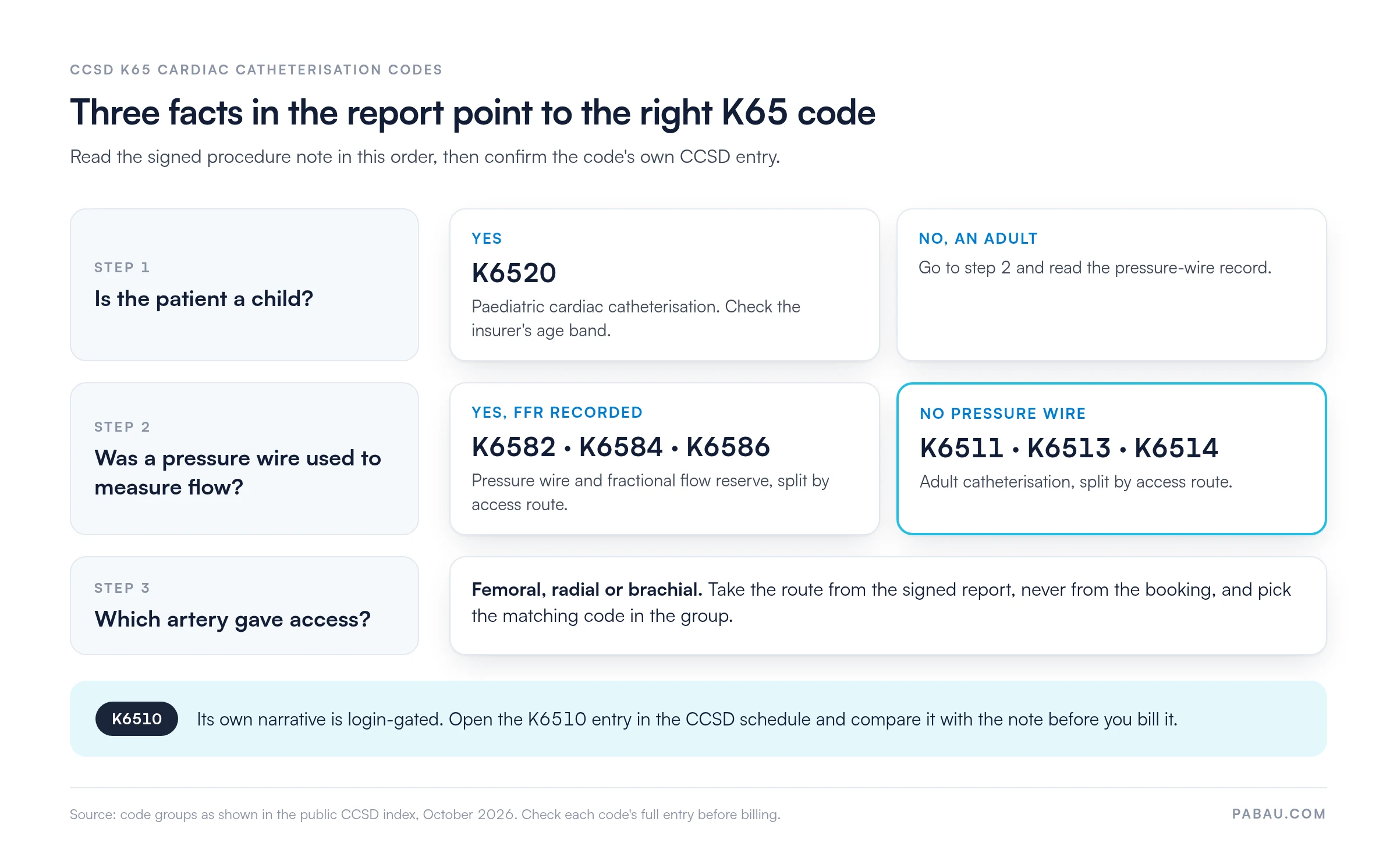
Coders choose between the K65 codes using three facts from the procedure note. Was the patient a child or an adult? Which artery gave access? And did the cardiologist measure flow with a pressure wire? The table shows the codes visible in the public CCSD index.
Read those facts in order and the choice narrows quickly. Age settles the paediatric question first. Next, the pressure-wire record splits the adult codes, and the access route then picks one code in the group.
The CCSD code K6520 guide explains the paediatric code in full, including the interventional codes CCSD lists as not billable with it.
K6510 has no link to fillers, toxin injections, mesotherapy or any other aesthetic treatment. Skin procedures sit in a different chapter of the CCSD schedule, so a K-prefixed heart code on a skin claim is a coding error.
Most UK private medical insurance policies also exclude cosmetic treatment altogether. A cosmetic procedure billed under a cardiology code would fail on both counts. The insurer would reject the code, and the policy would not cover the treatment.
Insurers check a catheterisation claim against the procedure report. When the report records the facts below, the billing team can pick the right K65 code. It can also answer an insurer query without chasing the cardiologist.
An intervention in the same session changes the coding. Angioplasty and stent codes, such as CCSD code K4902, carry their own combination rules. Check those rules on each code entry before two codes share an invoice. Those entries include K4900, which covers angioplasty where no stent is placed.
Expect to need pre-authorisation for a planned cardiac catheterisation with any major UK private medical insurer. A claim without a valid authorisation number is usually rejected before anyone reviews the clinical detail.
Each insurer runs its own process, but the request usually asks for:
Get the authorisation in writing or through the insurer’s portal before the procedure date. If the plan changes on the day, tell the insurer before you submit a different code. A planned stent insertion carries its own authorisation, and the femoral or brachial code is K4910.
A catheterisation claim passes through several hands before it’s paid. Here’s the usual path for an insured patient, step by step.
Most stalls happen between steps two and three. That’s where a route or a pressure-wire detail gets lost between the report and the invoice.
Rejected catheterisation claims usually fail on process rather than on the clinical work. The table lists the common causes and how to prevent each one.
Work through this list before the claim leaves the practice. Each line maps to one of the denial reasons above.
The CCSD Group sets codes and narratives, not fees. Its code pages state that it does not determine reimbursement or fees, and each insurer takes its own view.
So check the fee for K6510 with each insurer before you quote a patient. Bupa’s code search portal is one example, and other insurers publish their own fee schedules.
For Bupa’s own billing rules, see the Bupa CCSD procedure codes reference. When a case needs a second look-up, the CCSD codes library groups other codes by chapter.
In many practices, the authorisation number gets retyped at booking, at coding and again at invoicing. Each retype is a chance for a typo that bounces the claim.
Pabau, the practice software we build, keeps those steps on one appointment record. Its claims software for specialists stores the CCSD code against the service and the authorisation number against the appointment.
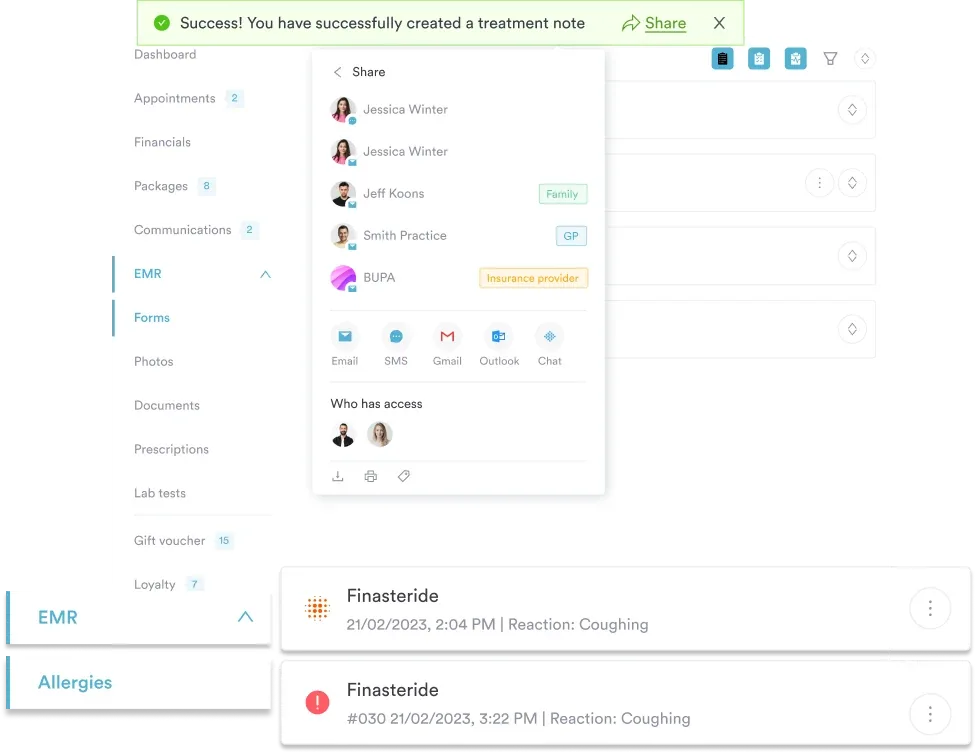
Before a claim goes out, it checks that required fields such as membership and authorisation numbers are complete. Your team then submits through Healthcode and tracks the claim until payment.
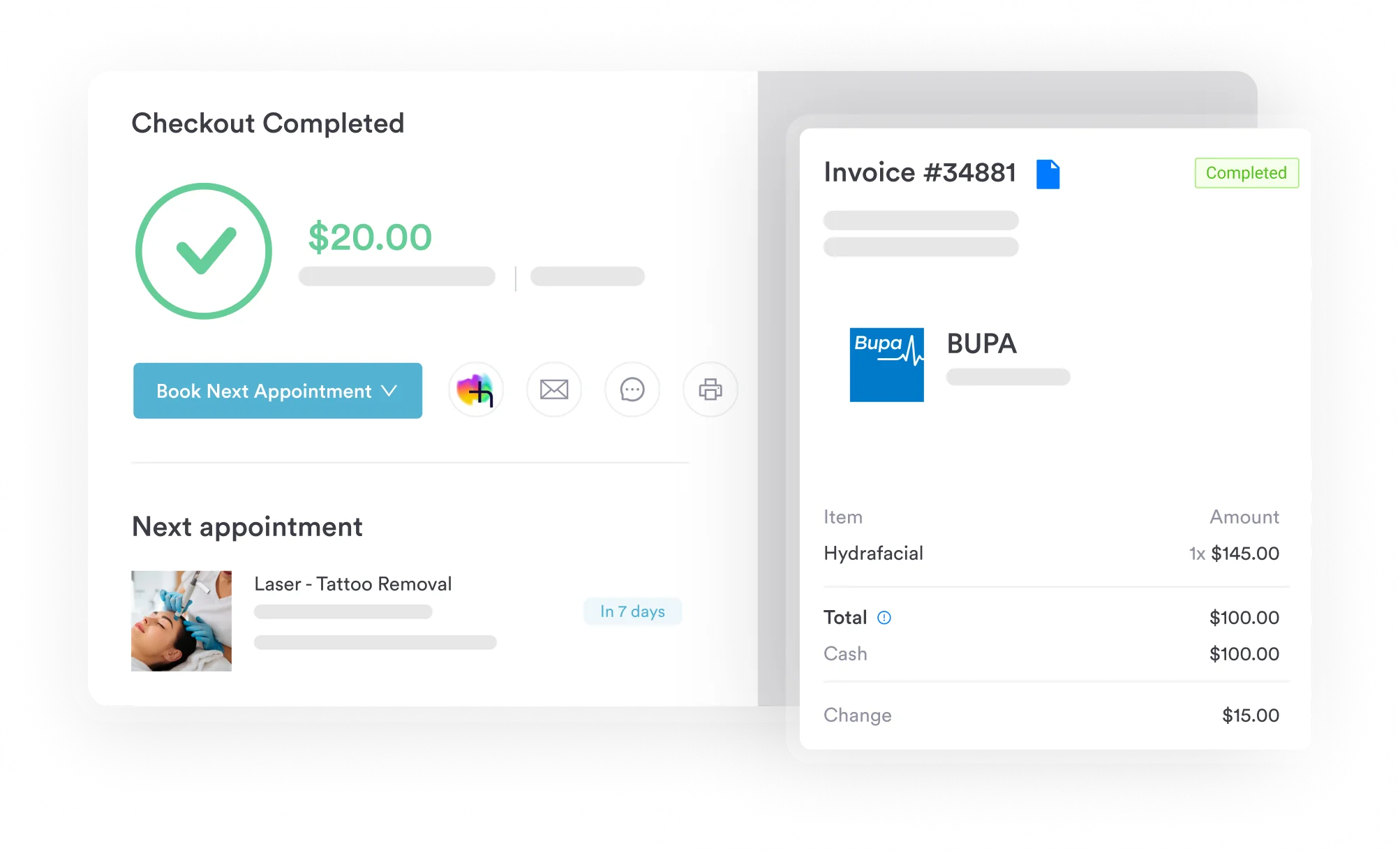
For a cardiology billing team, the outcome is one record per case, from authorisation to payment.

Pabau stores CCSD codes such as K6510 against each service, checks required claim fields and submits through Healthcode. Your billing team works from one record from booking to payment.

Treat K6510 as a cardiology code first. That alone keeps it off aesthetic and skin claims, whatever an older reference says.
The harder call is whether K6510 or a sibling fits the case. Open the K6510 entry in the CCSD schedule, then read the report for age, pressure wire and access route. That one check heads off most of the denials above, and it’s quicker than answering an insurer query later.
If your team still retypes authorisation numbers between systems, that’s where the next denial will start. Book a demo to see how Pabau keeps the code, the authorisation and the Healthcode claim on one record.

Billing a catheterisation for a child? CCSD code K6520 covers paediatric cardiac catheterisation and the codes CCSD bars alongside it.
Did the session move on to angioplasty? CCSD code K4902 explains IVUS-guided coronary angioplasty billing.
Need Bupa-specific codes and fees? Bupa CCSD procedure codes covers billing rules for the UK’s largest private medical insurer.
Looking up another CCSD code? CCSD codes lists the procedure codes Pabau covers by chapter.
K6510 sits next to the K65 cardiac catheterisation codes in chapter 8 of the CCSD schedule. Its own narrative is login-gated, so read the K6510 entry in the schedule before you bill it.
No. K6510 is a heart-chapter code. Fillers, toxin injections and other aesthetic treatments never use it, and most UK policies exclude cosmetic treatment anyway.
Only when neither CCSD entry lists the other as an unacceptable combination. Check both entries, and tell the insurer before you bill an intervention that wasn’t pre-authorised.
OPCS-4 is the procedure classification UK hospital coding uses, and its K65 category covers catheterisation of heart. CCSD is the private insurers’ schedule. Bill from the CCSD entry, never from the OPCS-4 one.
The CCSD Group, formed by the major UK private medical insurers, maintains the codes and narratives. Each insurer still sets its own fees and rules.



