

CPT code 48152: Whipple procedure without pancreatojejunostomy
CPT code 48152: Official description and procedure overview CPT code 48152 descr...

Last Updated: Nov 13, 2026
CCSD code J6730 is the UK private healthcare code for endoscopic upper gastrointestinal ultrasound (EUS), typically for pancreatico-biliary diagnosis or a transmucosal biopsy. A gastroenterologist passes an echoendoscope into the stomach and duodenum to image the pancreas, bile ducts and gut wall up close.
One rule settles most claims. H2220, the code for EUS tumour staging, can't share a claim with J6730, so the purpose written in the report picks the code. Get that wrong and the insurer will query or reject the claim. Below, you'll see what J6730 includes, how to tell it apart from H2220 and what insurers check before they pay.
Let Pabau's smart automation suggest the right codes, reduce claim denials, and keep your practice compliant—effortlessly.
Automate repetitive tasks and focus on what matters most—your patients.
Reduce coding errors and ensure compliance with the latest regulations.
Clean claims, fewer denials, and faster reimbursements.
Powerful insights and reporting to help your practice thrive.
HIPAA compliant SOC 2 certified GDPR-compliant Trusted by 4,000+ clinics worldwide

CCSD code J6730 covers endoscopic upper gastrointestinal ultrasound, for example for pancreatico-biliary diagnosis or transmucosal biopsy.
H2220, the code for EUS tumour staging, is an unacceptable combination with J6730, so only one of them goes on the claim.
The purpose written in the referral and the procedure report decides which of the two codes applies.
The J prefix places J6730 in Chapter 10 with other endoscopic GI codes, so it has no link to oral surgery.
CCSD sets codes and narratives, while each insurer sets its own fees and authorisation rules.
CCSD code J6730 is the UK private healthcare procedure code for endoscopic upper gastrointestinal ultrasound (EUS). Its official descriptor names pancreatico-biliary diagnosis and transmucosal biopsy as examples of what the scan is for.
The Clinical Coding & Schedule Development (CCSD) Group publishes the code in Chapter 10, endoscopic gastrointestinal tract procedures. J6730 joined the schedule on January 20, 2010.
Insurers, hospitals and consultants use the schedule as a shared language for private work. A J6730 claim tells the insurer that a gastroenterologist passed an echoendoscope into the upper GI tract. From there, the scan images structures such as the pancreas and bile ducts.
The first letter of a CCSD code doesn’t name a specialty. The CCSD Technical Guide lists Chapter 10 codes as starting with G, H or J. That puts J6730 beside other endoscopic GI codes.
Some sources still describe J6730 as an oral surgery code for dental practices. Billing it for dental work would misdescribe the procedure to the insurer.
J6730 describes a diagnostic EUS of the upper GI tract. The words after “e.g.” in the descriptor are examples of use, so the code isn’t limited to those two purposes. Here’s where its scope starts and stops.
Upper GI EUS puts a small ultrasound probe on the tip of an endoscope. From inside the stomach and duodenum, it images the pancreas, bile ducts and gut wall at close range. When the scan shows a bile duct lesion that needs resection, the surgeon bills that excision as J2800.
Typical reasons for a J6730 session include:
Whatever the reason, write it in the referral and the report. The insurer reads it to confirm the session matches J6730 rather than H2220.
Both codes describe endoscopic ultrasound of the upper GI tract, so they’re easy to confuse. The CCSD schedule lists H2220 as an unacceptable combination with J6730, which means only one goes on the claim.
The diagram below maps each documented purpose to its code.
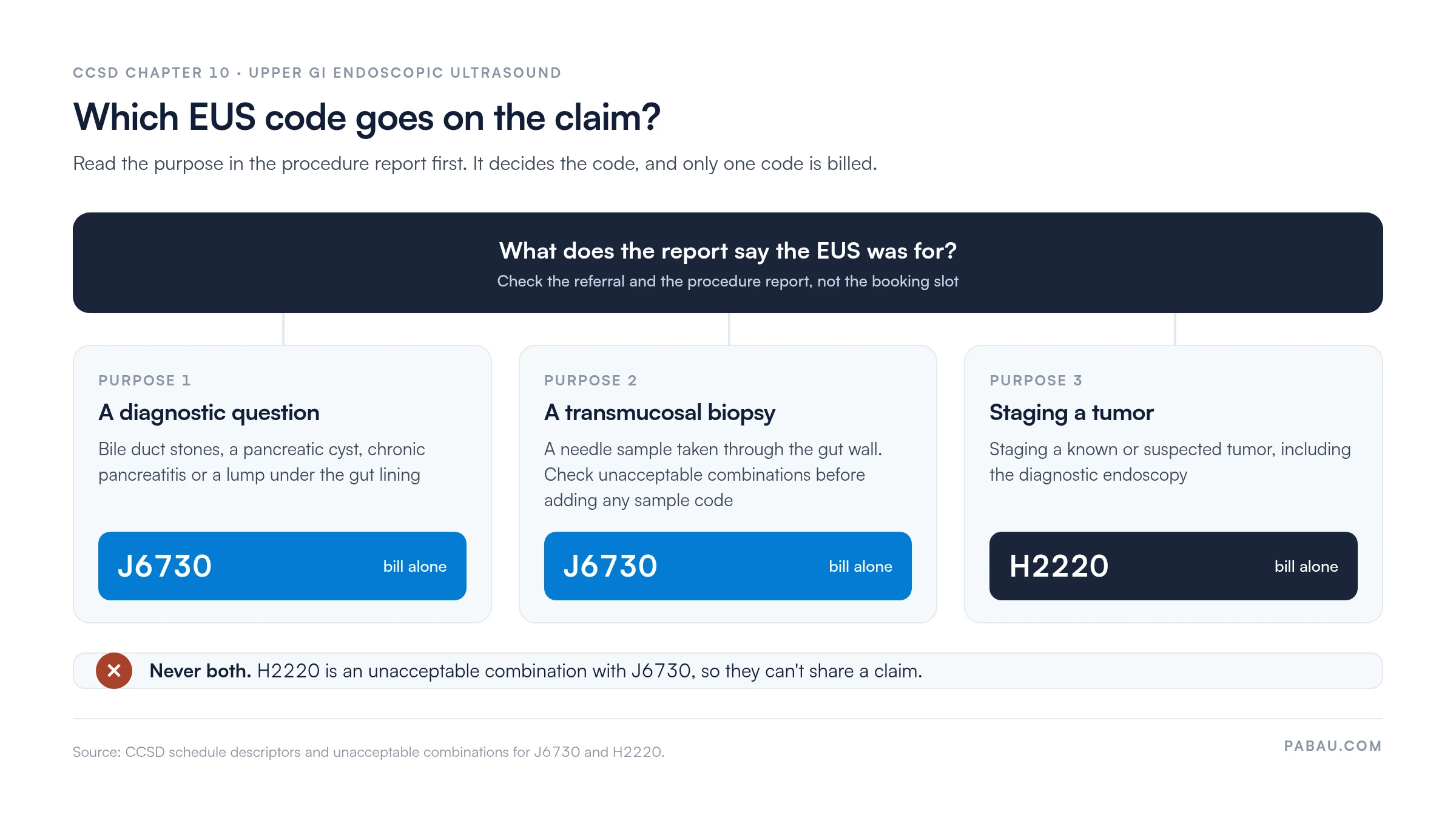
Unacceptable combinations work both ways in the CCSD schedule. If the report describes a staging EUS, use H2220 alone. If it describes a diagnostic scan or a sampling session, use J6730 alone.
The CCSD Technical Guide adds a general rule. A common clinical intervention shouldn’t routinely need more than one code, and insurers set their own rules on multiple codes. Ask the insurer before you submit two procedure codes for one attendance.
Take a patient referred with suspected common bile duct stones. Earlier imaging hasn’t settled the question, so the gastroenterologist books an upper GI EUS.
The report states that aim, records that the bile duct was examined and notes the finding. That session is J6730, billed on its own.
Now change one detail. The referral asks the team to stage a suspected pancreatic tumour before surgery is planned. Same scope, same room, same consultant, yet the claim becomes H2220, because the documented purpose changed.
And if the EUS does find a stone, the treatment that follows carries its own code. A surgeon who removes the gallbladder and explores the bile duct would bill J1820, for example. A keyhole removal with a completed cholangiogram and no duct exploration is J1880 instead. If an endoscopist clears the stone at ERCP, that therapeutic procedure is billed under CCSD J3900.
The pancreatic case follows the same pattern. If the whole pancreas and the tissue around it come out, that operation is J5500. If only the body and tail are removed through an open incision, the claim takes J5700 instead. When the surgeon opens the pancreas but removes none of it, the operation is coded J6200.
Insurers check that the report describes the procedure the code names. A clear report and a recorded authorisation reference answer most of their questions before they’re asked.
Once the report supports the code, the claim follows a similar path with most private medical insurers. Each insurer publishes its own schedule and rules, so confirm the details before the procedure.
For the wider code set, our CCSD procedure codes library explains how the schedule is organised. The Bupa CCSD codes guide shows how one insurer applies it.
Even with a clean report, a few slips can send a J6730 claim back with a query. Each one is easy to catch once you know to look for it.
In many gastroenterology practices, the EUS report sits in one system and the authorisation reference sits in an email. Then someone types the claim in by hand, and each handover is a chance to lose a detail.
Pabau, the practice software we build for private specialists, keeps those steps on one patient record. Your team builds the EUS report as a digital form, records the authorisation reference against the appointment and raises the claim from the invoice.
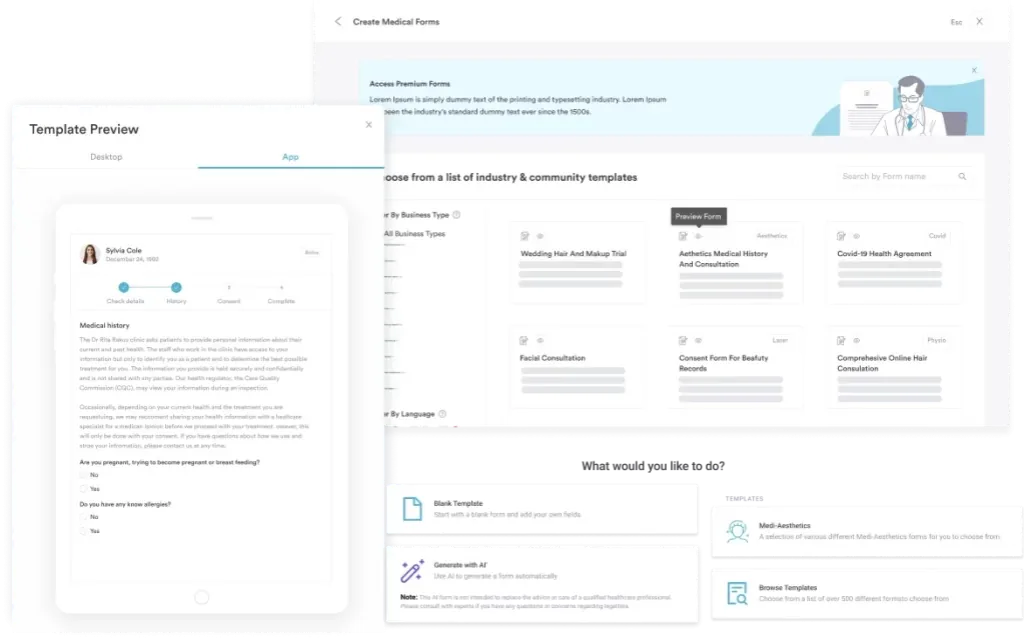
Before a claim goes out, Pabau’s claims management software checks that required fields such as the membership number are filled in. It then sends the claim through Healthcode and tracks its status, so your team sees a query the day it arrives.
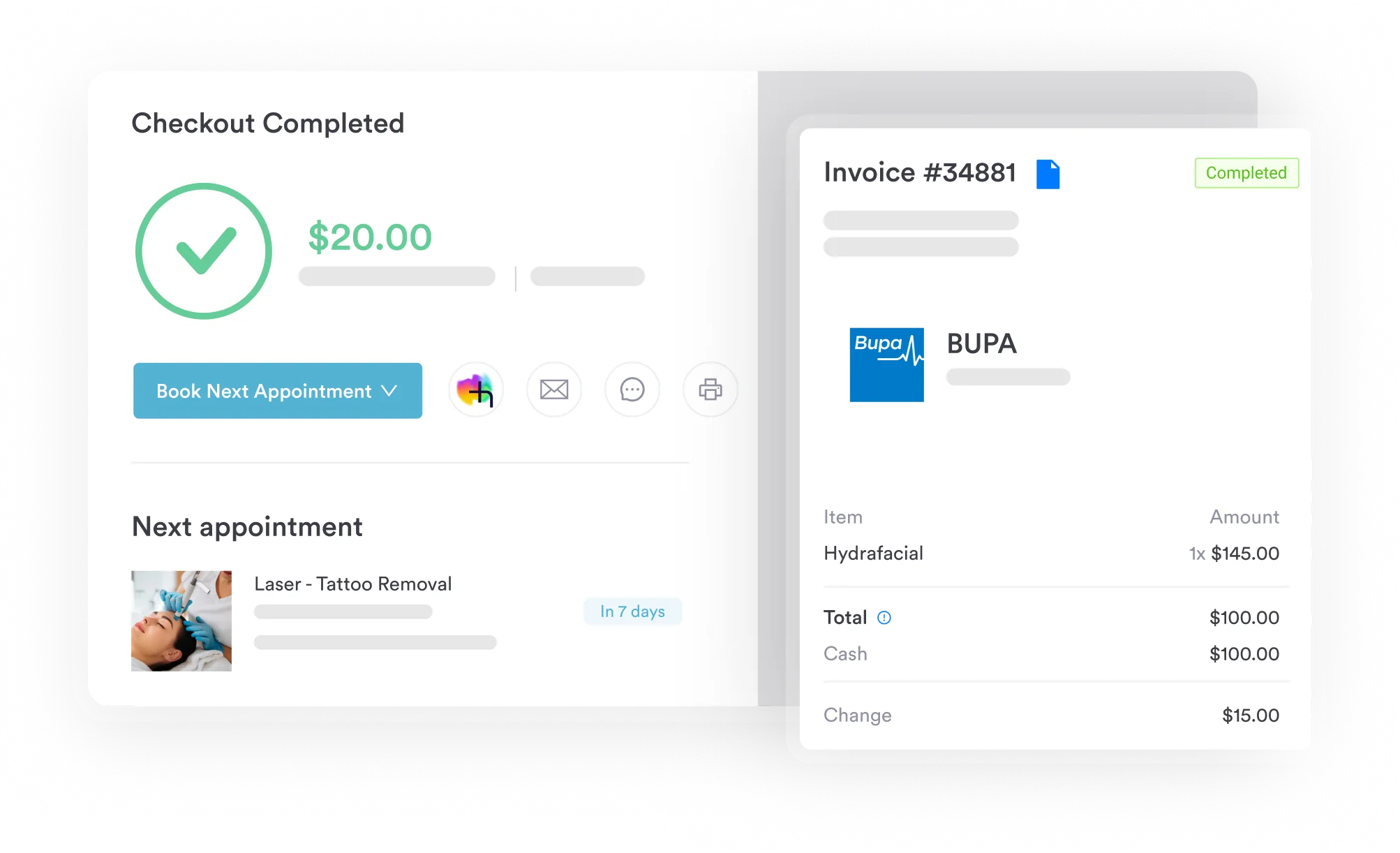

Pabau records authorisation references against the appointment, checks each claim for missing details and sends it through Healthcode. Your team spends less time chasing insurers.

J6730 pays cleanly when the report and the code tell the same story. The scan was a diagnostic or sampling EUS of the upper GI tract, and no second code on the claim duplicates it.
So choose between J6730 and H2220 from the purpose written in the report, never from habit. Build that purpose into your report template, and the coding choice is made before the patient leaves the unit.
Book a demo to watch Pabau keep the EUS report, the authorisation reference and the J6730 claim on one patient record.

Coding a staging EUS instead? CCSD code H2220 covers endoscopic ultrasound for tumour staging, including the diagnostic endoscopy.
Billing a combined upper and lower GI endoscopy? CCSD code G8082 explains how a diagnostic OGD with colonoscopy is coded.
Coding a wireless pH study during upper GI endoscopy? CCSD code G4530 covers catheterless oesophageal pH monitoring, such as Bravo.
Working through Bupa claims? Bupa CCSD codes covers how Bupa uses the CCSD schedule.
Cutting claim rejections across your practice? Claims management software in Pabau checks required fields and tracks each claim through Healthcode.
No. H2220 covers endoscopic ultrasound for tumour staging and is an unacceptable combination with J6730. Pick one code from the purpose stated in the procedure report.
No. An EUS uses an ultrasound probe on the endoscope to image the pancreas, bile ducts and gut wall. An ERCP uses X-ray contrast to image and treat the ducts, and it has its own CCSD codes.
No. The J6730 descriptor is limited to the upper gastrointestinal tract. An endoscopic ultrasound of the rectum or anal canal needs a different code, so search the CCSD schedule for the lower GI entry.
It’s a sample taken with a thin needle passed through the stomach or duodenal wall, guided by the ultrasound image. It targets a lesion or lymph node, and the specimen goes to pathology for analysis.
No. CCSD codes are built for UK private healthcare, where insurers use them to process claims. NHS hospitals record procedures in OPCS-4, so J6730 belongs on private claims only.
It varies by unit. NHS patient leaflets quote anywhere from 15 minutes to over an hour for the scan itself. Most advise patients to plan for two to four hours in the department, including recovery from sedation.



