

Pabau Engage inbox

Pabau Engage is here: every patient conversation in one inbox.

Learn more
CCSD Code

CCSD code H2220 – Endoscopic ultrasound for tumor staging


Code Definition

H2220 is the CCSD code for endoscopic ultrasound for tumor staging, including diagnostic endoscopy. It covers the whole staging session, from passing the echoendoscope through the upper GI tract to writing the staging report. Imaging of the tumor and nearby lymph nodes is included.

The diagnostic endoscopy is bundled into the code, so a separate OGD code on the same claim is rejected. EUS-guided fine needle aspiration can be coded on top when it is documented separately. Therapeutic EUS has its own Chapter 10 codes.

Group
10 Endoscopic gastrointestinal tract procedures
Category
10.1 Endoscopic gastrointestinal procedures
Subcategory
INTER 4 (Bupa CCSD schedule)
Billable
No
Code also known as
endosonography, echo-endoscopy, EUS staging, endoscopic ultrasonography
Save time. Improve accuracy. Get paid faster.
Automate coding with Pabau

Let Pabau's smart automation suggest the right codes, reduce claim denials, and keep your practice compliant—effortlessly.

  • AI-powered code suggestions
  • Real-time compliance checks
  • Faster claims, fewer denials
Why practices choose Pabau
Save hours every week

Automate repetitive tasks and focus on what matters most—your patients.

Improve accuracy

Reduce coding errors and ensure compliance with the latest regulations.

Get paid faster

Clean claims, fewer denials, and faster reimbursements.

Grow with confidence

Powerful insights and reporting to help your practice thrive.

HIPAA compliant SOC 2 certified GDPR-compliant Trusted by 4,000+ clinics worldwide

Key takeaways

Key takeaways

CCSD Code H2220 covers endoscopic ultrasound for tumor staging, and the diagnostic endoscopy is bundled into it. A separate OGD code billed alongside H2220 is the most common rejection trigger.

The code sits in CCSD Chapter 10, endoscopic gastrointestinal tract procedures. It fits pancreatic, esophageal, gastric and mediastinal tumor staging, but not therapeutic EUS.

EUS-guided fine needle aspiration (EUS-FNA) in the same session may be coded separately. The operative note has to document the sampling as its own procedure.

Most UK private medical insurers, including AXA Health, Bupa and Freedom Health, require pre-authorization for H2220. A claim without a valid authorization reference is a leading cause of denial.

What is CCSD Code H2220?

CCSD Code H2220 is the UK private healthcare procedure code for endoscopic ultrasound (EUS) for tumor staging, including diagnostic endoscopy.

The Clinical Coding and Schedule Development (CCSD) Group publishes it in Chapter 10 of the CCSD schedule. That chapter covers endoscopic gastrointestinal tract procedures, and every major UK private medical insurer uses it.

The official descriptor carries a bundling instruction. The diagnostic endoscopy used to reach and inspect the upper GI tract during the EUS session is included in the code. That one word, “including,” sets the most important billing rule for H2220.

FieldDetail
CodeH2220
Official descriptorEndoscopic ultrasound for tumour staging, including diagnostic endoscopy
CCSD chapterChapter 10: Endoscopic gastrointestinal tract procedures
Procedure categoryDiagnostic staging endoscopy
Diagnostic endoscopy bundledYes, included in the descriptor and not separately billable
Typical performerConsultant gastroenterologist or specialist endoscopist

Which procedures does H2220 cover and what is excluded?

H2220 covers the complete EUS session performed for tumor staging. That includes passing the scope through the upper GI tract to the region of interest. It also includes imaging the target lesion with a radial or linear echoendoscope.

It also covers systematic tumor and lymph node assessment and the staging report. The diagnostic endoscopy is expressly bundled and can’t be billed on its own.

What falls outside the code matters just as much for a clean claim.

  • Included in H2220: The EUS examination and passage of the echoendoscope through the upper GI tract. That includes esophagoscopy or gastroscopy where needed to reach the target. Ultrasound imaging, tumor measurement, lymph node assessment, image capture and the staging report are all covered.
  • Not included (separately codeable): EUS-guided fine needle aspiration (EUS-FNA). When tissue sampling happens in the same session, an additional CCSD code applies, as the EUS-FNA section below explains.
  • Not covered by H2220: Therapeutic EUS procedures such as cyst drainage, celiac plexus block or biliary intervention. These have their own CCSD codes, so using H2220 for a therapeutic session is a coding error.
  • Most common billing mistake: Submitting a separate diagnostic esophagogastroduodenoscopy (OGD) code from Chapter 10 alongside H2220. Because the diagnostic endoscopy is already included, payers reject the extra code as a duplicate component.

Clinical indications: When is H2220 appropriate?

H2220 is appropriate when the primary purpose of the EUS session is locoregional tumor staging. Payers expect this intent to be stated explicitly in both the referral letter and the operative note. The following clinical scenarios are the recognised indications.

  • Pancreatic and peripancreatic tumors: Staging pancreatic adenocarcinoma and assessing local vascular involvement before surgical planning. EUS provides superior resolution of the portal vein compared with CT staging alone. British Society of Gastroenterology (BSG) guidance on pancreatic cancer assessment reflects this.
  • Esophageal and gastroesophageal junction cancer: T-stage and N-stage assessment before the oncology multidisciplinary team (MDT) discussion. EUS is particularly valuable for telling T1 to T3 apart, where CT can’t reliably separate tumor depth.
  • Gastric cancer: Locoregional staging including depth of wall invasion and regional lymphadenopathy before surgery or chemotherapy decisions.
  • Mediastinal lymph node staging: Assessment of mediastinal adenopathy in lung cancer staging or unexplained mediastinal masses where transesophageal EUS access is appropriate.
  • Submucosal and subepithelial lesions: Characterization of gastrointestinal stromal tumors (GISTs) and other submucosal lesions, where staging-intent documentation supports H2220 rather than a standard diagnostic code.

EUS is chosen over CT or MRI for locoregional staging because it resolves wall layers and immediately adjacent structures more clearly. The echoendoscope images at 5-12 MHz. That shows individual GI wall layers and perigastric or periduodenal lymph nodes that cross-sectional imaging can’t reliably characterize.

This clinical advantage is the justification billing teams should cite in pre-authorization requests.

How the procedure is performed: What coders need to know

Coders do not need to perform EUS, but they do need to know which operative note elements confirm a complete, billable staging session. Missing elements are a leading cause of claim rejection after submission.

  1. Patient preparation documented: The note should confirm the patient consented to EUS staging and was prepared under the endoscopy unit’s protocol. Consent for the diagnostic endoscopy component is covered by this.
  2. Echoendoscope type stated: The operative note must name the instrument used (radial or linear echoendoscope). A radial scope provides 360-degree circumferential images. A linear (curved linear array) scope is required for EUS-FNA. Stating the scope type confirms the procedure category for the payer reviewer.
  3. Region of interest documented: The area interrogated must be identified explicitly (e.g. head of pancreas, distal oesophagus, posterior mediastinum). This maps the procedure to the stated clinical indication.
  4. Staging findings recorded: TNM findings or equivalent staging assessment must appear in the report. At minimum, this means documenting tumor dimensions, wall layer involvement, and any lymph node characteristics (size, shape, echogenicity, border).
  5. Staging intent confirmed: The operative note or request form must state that the EUS is for tumor staging. Surveillance, biopsy alone, or a routine diagnostic endoscopy with an incidental ultrasound element doesn’t qualify.

Documentation requirements for a valid H2220 claim

Payers reviewing H2220 claims look for three categories of documentation: clinical justification, procedural evidence and authorization compliance. Digital forms that capture each element at the point of care make claim preparation faster. They also cut the risk of a rejection triggered by a missing record.
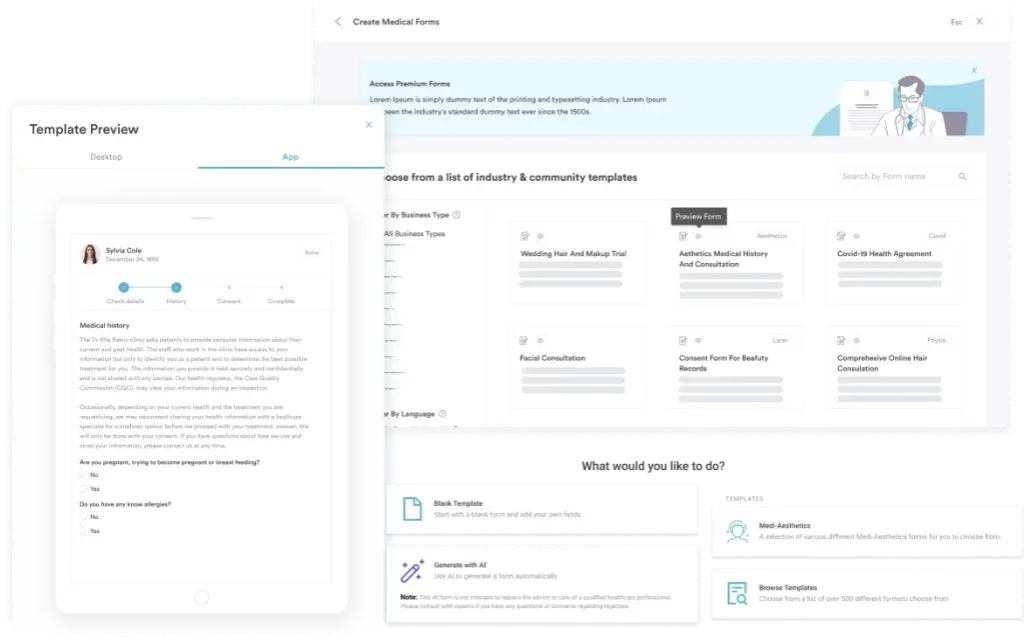
Pabau medical form builder showing a template library and a patient form preview on a tablet
Pabau’s form builder turns the H2220 documentation checklist into a required-field template, so staging intent and scope type are recorded before billing starts.
Documentation elementWhat payers expectWhere it appears
Clinical indicationNamed tumor type and anatomical locationReferral letter and/or request form
Staging intentExplicit statement that EUS is being performed for staging purposesOperative note header and body
Instrument detailEchoendoscope type (radial or linear) and model if required by payerOperative note
Staging findingsTNM findings or equivalent: tumor dimensions, wall layer involvement, lymph node assessmentProcedure report
Pre-authorization referenceValid pre-auth number from the relevant insurerClaim form (mandatory for most PMI payers)
Operator detailsConsultant name and recognized provider numberClaim form

The CCSD Technical Guide (October 2025) sets out the business rules for bundling and concurrent coding. Check it before you build claim templates for H2220, because bundling rules are updated periodically.

In England, facilities performing EUS staging also face Care Quality Commission (CQC) inspection standards that overlap with these documentation expectations.

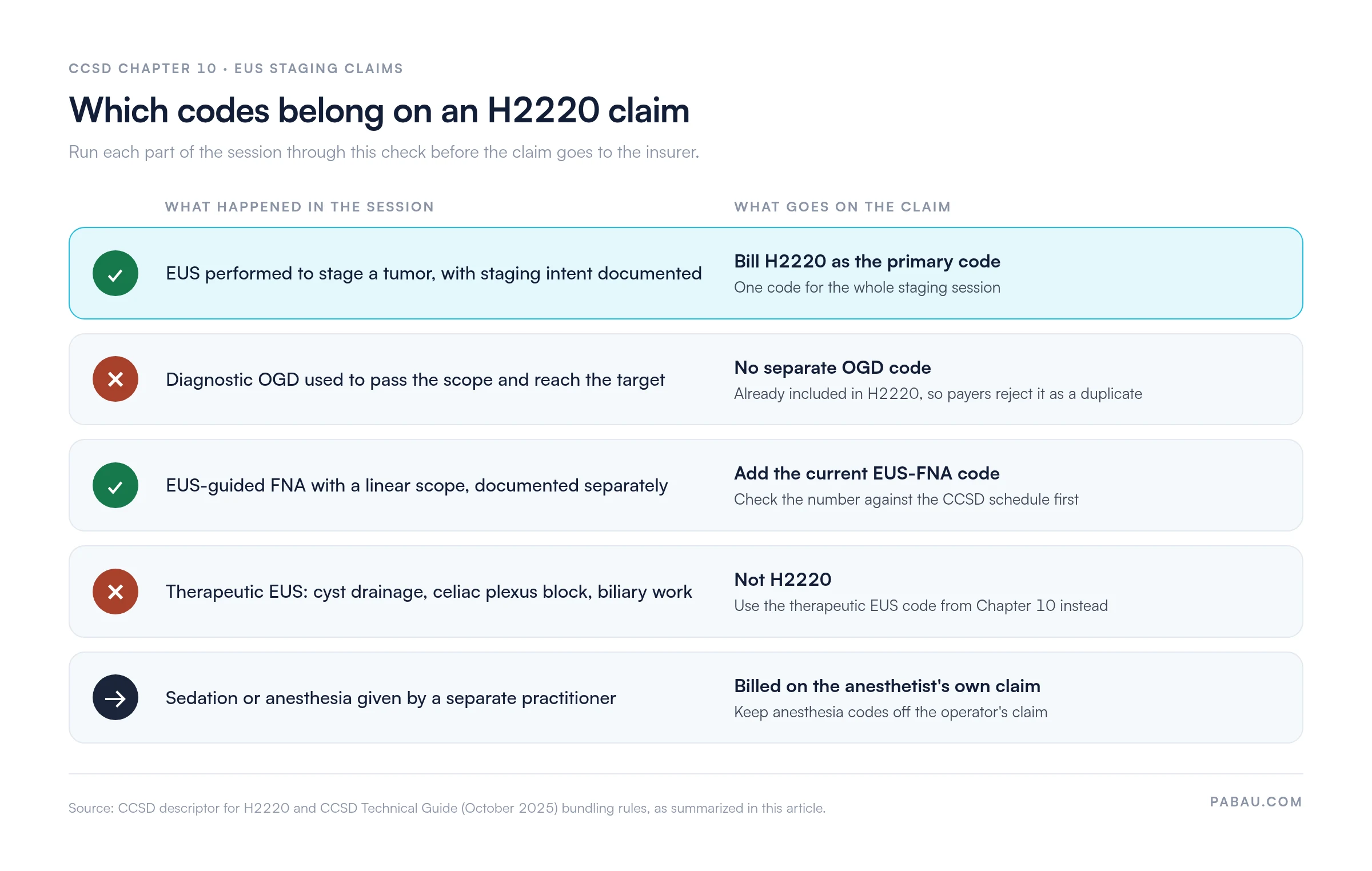
Gastroenterology coders regularly meet the codes below alongside or instead of H2220. Five questions about the session settle which of them go on the claim, and the chart below runs through them in order.
Decision chart for an H2220 claim
Only the staging session and a separately documented FNA belong on the operator’s claim. Rules summarized from the CCSD descriptor and the CCSD Technical Guide.

The bundling rule is easiest to see beside a code that bills the endoscopy itself. G8082 covers a diagnostic OGD with colonoscopy, and the rest of the schedule sits in our CCSD procedure codes library.

The table below shows whether each adjacent code can go on the same claim or is excluded by the bundling rules. For Bupa-specific guidance on adjacent codes, see the Bupa CCSD codes reference.

CCSD codeProcedureConcurrent with H2220?Note
H2220EUS for tumor staging, including diagnostic endoscopyPrimary codeThe code being billed
EUS-FNA codeEUS-guided fine needle aspirationYes, when separately documentedDistinct FNA documentation required. Verify the current CCSD code against the Technical Guide.
Diagnostic OGD codeStandard oesophagogastroduodenoscopyNo, bundled into H2220Most common duplication error. Payers reject the OGD code as a component already included.
Therapeutic EUS codesCyst drainage, celiac plexus block, biliary interventionNo, H2220 is staging onlyUse the appropriate therapeutic EUS code from CCSD Chapter 10 instead
Anesthesia codesConscious sedation or general anesthesiaYes, when provided by a separate practitionerSeparate anesthetist fee. The operator and anesthetist submit individually.

EUS-guided fine needle aspiration: Can it be coded with H2220?

Yes, EUS-FNA performed in the same session as H2220 can be coded separately when it is distinctly documented. The sampling is a separate clinical act on top of the staging imaging that H2220 already covers.

CCSD business rules allow concurrent coding of diagnostic and sampling procedures where each is adequately recorded.

The operative note must contain distinct entries for both the staging assessment and the FNA procedure. At minimum, the FNA documentation should include:

  • Confirmation that a linear echoendoscope was used, since a radial scope can’t guide the needle
  • Number of FNA passes performed
  • Target lesion or lymph node sampled
  • Specimen handling and cytology or histology request confirmation
  • Any on-site rapid adequacy assessment (ROSE) if performed

Always verify the current EUS-FNA code against the CCSD schedule before submission, because code numbers for add-on sampling procedures have changed in past annual updates. A superseded code gets rejected however good the documentation is.

Common billing errors and denial reasons for H2220

H2220 claims get rejected for a predictable set of reasons. Consistent pre-submission checks prevent most of them.

ErrorWhy it causes rejectionCorrective action
Separate OGD code billed alongside H2220Payer identifies a duplicate component. The diagnostic endoscopy is included in H2220 by definition.Remove the OGD code from the claim. H2220 alone covers the full session.
Staging intent absent from documentationPayer can’t verify the procedure matches the H2220 descriptor and may downcode to standard endoscopyEnsure the operative note and referral letter both state staging as the primary purpose
No pre-authorization obtainedMost private medical insurance (PMI) payers require pre-auth for EUS staging. Without a valid reference, the claim is rejected.Obtain pre-auth before the procedure date; record the reference in the patient file
H2220 used for therapeutic EUSThe descriptor specifies tumor staging. Therapeutic procedures have distinct Chapter 10 codes.Identify the correct therapeutic EUS code from the current CCSD Chapter 10 schedule
Insufficient operative note detailPayer review can’t confirm staging findings were documented, so the claim is suspended pending more informationStandardize the endoscopy unit’s EUS report template to include every required staging element
Wrong Chapter 10 code submittedStandard OGD or other non-EUS code used in error. The payer pays a lower rate or rejects it.Build H2220 into the practice coding list as the default for EUS staging sessions

Pro Tip

Build a two-part pre-submission check for every H2220 claim. First, confirm the pre-authorization reference is recorded against the appointment. Second, check that the operative note shows staging intent, echoendoscope type and TNM findings. It takes minutes at claim preparation and saves weeks of resubmission after a rejection.

Payer-specific rules: AXA, Bupa, and other UK insurers

UK private medical insurers each maintain their own Chapter 10 schedule aligned to CCSD coding. The rules below reflect publicly available payer guidance. Check each insurer’s current published schedule before submission, because requirements can change every year.

Billing teams moving from the NHS into private practice often underestimate how many insurer rules sit on top of the base CCSD framework. Our Bupa fee schedule guide shows how one insurer lays out its codes and fees.

InsurerPre-auth required?Code recognised?Key submission notes
AXA HealthYes (staging procedures typically require pre-auth)YesVerify via the AXA Health procedure code portal. Clinical justification is required at the pre-auth stage.
BupaYes for most elective proceduresYesUse the Bupa code search portal to confirm the current fee and any bundling restrictions. The consultant must be Bupa-recognized.
Freedom Health InsuranceTypically required for endoscopic staging proceduresYes (Chapter 10 published schedule)Confirm the current fee against Freedom Health’s published Chapter 10 schedule. Contact provider services for pre-auth.
HealixVerify current requirementsYesHealix applies unbundling guidelines. Check the Healix fee schedule before submission.
Other PMI payersVaries by insurerVerify against each scheduleAviva, Vitality, WPA, Allianz Care and Cigna all use CCSD Chapter 10. Check each fee schedule for H2220 recognition and current rates.

How to submit an H2220 claim: Step-by-step

A structured submission workflow cuts rejections and gives billing teams one process for every insurer. Medical billing software that builds documentation checks into the appointment-to-invoice cycle makes it easier to sustain at volume.

  1. Confirm pre-authorization: Get the pre-auth reference from the insurer before the procedure date. Record it in the patient record and attach it to the claim. Without a valid pre-auth number, most PMI payers reject the claim whatever the documentation says.
  2. Review the operative note before submitting: Check that staging intent, echoendoscope type, region of interest and staging findings (TNM or equivalent) are all documented. If an element is missing, ask the clinician before submission rather than after rejection.
  3. Select H2220 as the primary code: Confirm no separate OGD code has been inadvertently added. H2220 alone covers the diagnostic endoscopy component.
  4. Add EUS-FNA code if applicable: If FNA was performed and distinctly documented, add the current CCSD EUS-FNA code. Verify the code number against the current CCSD Technical Guide. Don’t rely on codes saved from previous years.
  5. Keep anesthesia codes off the operator’s claim: A separate anesthetist submits anesthesia on their own claim. If the operator’s claim includes another provider’s anesthesia codes, it may be partially rejected.
  6. Submit via the appropriate channel: Most UK private healthcare claims go electronically through Healthcode or through the insurer’s own portal. Healthcode is the main electronic data interchange (EDI) network for CCSD claims. Attach supporting documents to each insurer’s requirements.
  7. Track and respond to queries promptly: Payers may request more documentation within a set timeframe. Software that tracks claim status keeps queries from expiring unanswered.

How Pabau prevents H2220 claim rejections

In many endoscopy practices, the EUS report lives in one system and the pre-auth reference sits in an email. Then someone keys the claim in by hand. Each handover is a chance to drop the staging intent or the authorization number.

Pabau, the practice management platform we build, keeps those steps on one patient record. The pre-authorization code is stored as a case and attached to the appointment. The operative note template prompts for staging intent, scope type and TNM findings. The claim is raised from the same invoice.

Before submission, Pabau checks each claim for missing or invalid details and sends it through Healthcode to insurers such as Bupa and AXA Health. A rejected claim is flagged as needing action, with a link to the field that caused it. Your billing team fixes the problem in minutes instead of chasing paperwork.

Get H2220 claims paid the first time

Pabau stores pre-authorization codes against the appointment and checks each claim for missing details before it goes to Healthcode. Fewer EUS staging claims come back rejected.

Pabau practice management platform for UK private healthcare billing

Conclusion

H2220 pays cleanly when the claim matches the descriptor: one code for the staging session, with the endoscopy left inside it. Most rejections trace back to an operative note written without the claim in mind.

So start with the report template. Make staging intent, scope type, region of interest and TNM findings required fields, and record the pre-authorization reference at booking. It adds a few minutes per report, which is far less than a resubmission cycle after a payer query.

Book a demo to see how Pabau links EUS documentation, pre-authorization codes and CCSD claims in one patient record.

Continue your research

Continue your research

Managing Bupa CCSD submissions across your practice? Bupa CCSD codes covers code recognition and submission requirements for Bupa claims.

Billing a diagnostic lower GI endoscopy instead? CCSD code H2002 explains how diagnostic colonoscopy is coded and billed.

Coding a colonoscopy that removed a lesion? CCSD code H2003 covers therapeutic colonoscopy with snare loop biopsy or excision.

Reducing claim rejections across all CCSD procedures? Medical billing software in Pabau tracks claim status, flags missing details and connects to Healthcode.

Frequently asked questions

What does CCSD Code H2220 cover?

CCSD Code H2220 is the UK private healthcare code for endoscopic ultrasound for tumor staging, including diagnostic endoscopy. It covers the whole EUS staging session, from passing the scope to the target through to the staging report. Imaging, tumor and lymph node assessment and image capture are all included. The diagnostic endoscopy is included and can’t be billed separately.

Is diagnostic endoscopy included in H2220 or billed separately?

Diagnostic endoscopy is included in H2220 and must not be billed separately. The official CCSD descriptor says “including diagnostic endoscopy,” which is a bundling instruction. A separate OGD code alongside H2220 is the most common rejection trigger, and payers reject it as a duplicate component.

Can H2220 be billed alongside EUS-guided fine needle aspiration?

Yes. When EUS-FNA is performed in the same session and documented separately, an additional CCSD code for the FNA can be submitted alongside H2220. The operative note needs distinct entries for staging and FNA, including passes, the target sampled and the linear echoendoscope. Check the current FNA code number against the CCSD Technical Guide first.

Which private health insurers in the UK accept H2220?

AXA Health, Bupa, Freedom Health Insurance and Healix all recognize CCSD Code H2220 in their published Chapter 10 schedules. Aviva, Vitality, WPA, Allianz Care and Cigna also use CCSD Chapter 10, so check each insurer’s current schedule. Most UK PMI payers require pre-authorization before an EUS staging session.

Why would an H2220 claim be denied by AXA or Bupa?

The most common reason is a separate OGD code billed alongside H2220, which duplicates the included endoscopy. Others are missing staging intent in the operative note, no valid pre-authorization reference, and using H2220 for a therapeutic session. Notes that lack TNM findings or the echoendoscope type often get the claim suspended pending more information.

Which CCSD codes are adjacent to H2220 in Chapter 10?

Chapter 10 of the CCSD schedule groups endoscopic gastrointestinal tract procedures. Adjacent codes include diagnostic OGD codes, which are bundled into H2220, and EUS-FNA codes, which are separately codeable when documented. Therapeutic EUS codes cover procedures such as cyst drainage or celiac plexus block. Confirm exact numbers in the current CCSD schedule, as Chapter 10 is revised annually.


Avatar photo
Anja Dodevska
Content Writer

Anja Dodevska writes about healthcare, dermatology, and the day-to-day realities of running a medical practice for Pabau. She enjoys breaking down complex topics into clear, accessible content and has a soft spot for the often-overlooked aspects of clinic life. When she's not writing, she's exploring cafes, walking her dog, or spending time with friends and family.
×

