

HCPCS Code G0163: Skilled nursing observation and assessment
What is HCPCS Code G0163? HCPCS Code G0163 is a deleted Level II code for skille...

Last Updated: Oct 15, 2026
G6080 is the CCSD code for laparoscopic small bowel resection +/– stoma. It covers removing a diseased segment of jejunum or ileum through keyhole ports, then joining the bowel or forming a stoma in the same operation.
The code sits in the CCSD Abdomen chapter, in the small intestine section (11.4.0). Robotic assisted resection takes G6083 instead, and colonic resections use H-series codes. Most UK insurers require pre-authorization and an operative note confirming the laparoscopic approach.
Let Pabau's smart automation suggest the right codes, reduce claim denials, and keep your practice compliant—effortlessly.
Automate repetitive tasks and focus on what matters most—your patients.
Reduce coding errors and ensure compliance with the latest regulations.
Clean claims, fewer denials, and faster reimbursements.
Powerful insights and reporting to help your practice thrive.
HIPAA compliant SOC 2 certified GDPR-compliant Trusted by 4,000+ clinics worldwide

CCSD Code G6080 covers laparoscopic small bowel resection with or without stoma, per the official CCSD Schedule descriptor.
A stoma formed at the same laparoscopic sitting falls within G6080’s descriptor, so check current bundling rules before coding it separately.
The operative note must state the laparoscopic approach explicitly, because a missing confirmation is a common denial trigger.
Robotic resections take G6083 and colonic resections take H-series codes, while the schedule has no open twin of G6080.
Pabau, the practice management platform we build, links CCSD and diagnosis codes on the invoice and sends the claim to Healthcode.
CCSD Code G6080 is the procedure code for laparoscopic small bowel resection with or without stoma, as defined in the CCSD Schedule of Procedures.
The “+/- stoma” element means a stoma formed at the same operative sitting falls within the code’s scope. Surgeons typically form one to defunction an anastomosis, or where a primary anastomosis isn’t safe.
CCSD codes are used only for UK private medical insurance (PMI) billing. The NHS classifies procedures with OPCS-4 and sets tariffs with Healthcare Resource Group (HRG) codes.
The two systems use different descriptors, so a coder moving into private billing can’t substitute one for the other. Our CCSD billing guides explain how the private schedule is structured.
G6080 sits in chapter 11 (Abdomen), section 11.4.0 (Small intestine). Its neighbors there include G6000 for open formation of jejunostomy and G6083 for robotic assisted small bowel resection.
The G6080 descriptor covers the whole laparoscopic resection episode: port placement, bowel mobilization, resection of the affected segment, and either an anastomosis or a stoma.
It doesn’t cover laparoscopic colonic resection or standalone stoma formation, which have their own CCSD codes. The schedule also has no single open equivalent of G6080.
Laparoscopic small bowel resection is performed when a segment of small intestine is non-viable, obstructed, diseased, or otherwise needs removing. The surgeon takes the laparoscopic route when patient anatomy, adhesion burden, and surgical expertise allow it.
Common clinical indications that drive a G6080 claim include:
The diagnosis code linked to the claim must match one of these clinical scenarios. PMI payers may apply benefit limits or ask for more clinical evidence for some diagnoses. Crohn’s disease draws the most scrutiny, because staged procedures are common.
Knowing the operative steps helps billing staff check that the procedure note supports a valid CCSD Code G6080 claim. The standard laparoscopic sequence runs as follows:
Each of these steps should appear in the operative note. The note must confirm the laparoscopic approach, name the bowel segment resected, describe the anastomosis technique or stoma type, and record intraoperative findings.
Reading the bundling correctly prevents both under-coding and over-coding. Under-coding bills components of G6080 separately, while over-coding uses G6080 for procedures outside its scope. The table below summarizes what the code does and doesn’t include.
Several CCSD codes describe bowel resection or related procedures, and submitting a neighboring code is a common reason for denial. The table below sets G6080 against its nearest neighbors, and the decision chart after it maps each operative finding to its code.
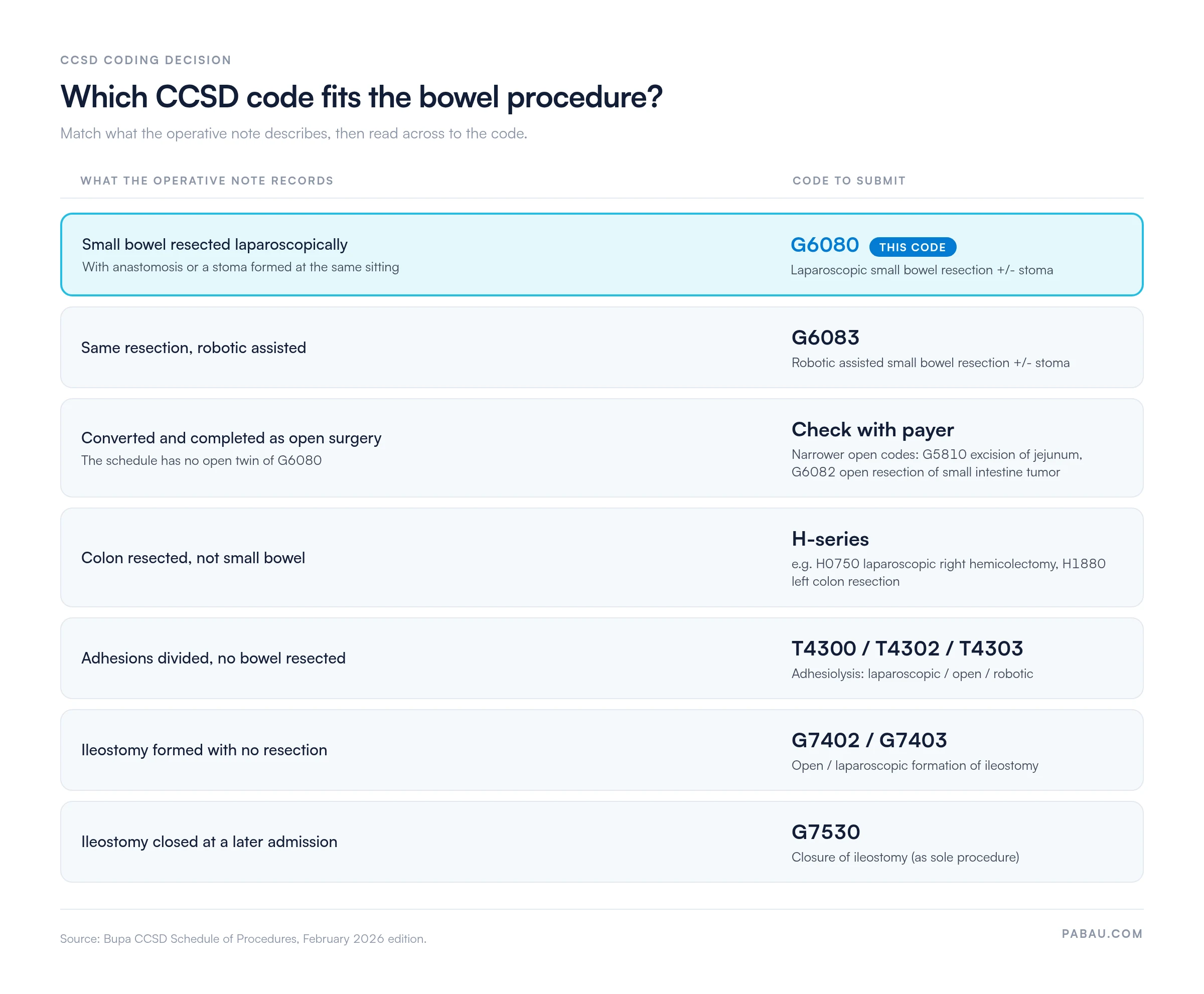
No single code applies, because the CCSD schedule has no open counterpart of G6080. The standard convention is to code the procedure as completed, not as started. A converted case therefore no longer fits G6080’s laparoscopic descriptor.
The nearest open codes are narrower. G5810 covers excision of jejunum, and G6082 covers open resection of a small intestine tumor. Confirm with the payer which code, if any, fits the resected segment and indication before you submit.
The operative note must record the reason for conversion, the point the laparoscopic approach was abandoned, and how the resection was completed. Without this, payers can’t tell which code applies and will query or deny the claim.
The operative note is the primary supporting document for a CCSD Code G6080 claim, and a complete one heads off most payer queries. The billing team can’t submit a clean claim until the surgeon has finished it.
The operative note must include all of the following to support a valid claim:
Structured digital operative forms help surgical teams capture each required element, so incomplete notes don’t reach the billing team. Any AI-assisted note must be reviewed and signed by the operating consultant before submission. An automated draft doesn’t meet PMI documentation requirements until the clinician signs it.
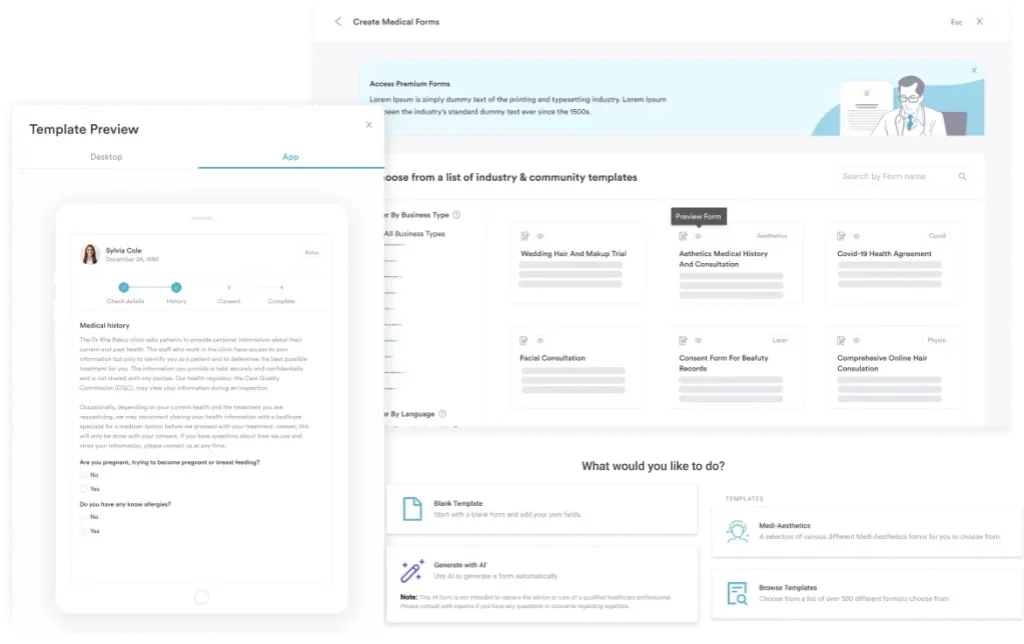
Build a G6080 operative note checklist into your surgical documentation workflow. Confirm the laparoscopic approach, segment resected, specimen length, anastomosis or stoma type, and GMC number before the note is finalized. A prompt submission with a complete note leaves payers fewer reasons to query the claim.
UK PMI payers treat elective laparoscopic bowel resection as major inpatient surgery, so pre-authorization is required before the procedure. Operating without pre-auth, or on an expired authorization, is a common and avoidable denial reason.
The table below summarizes typical prior authorization requirements for CCSD Code G6080. Requirements vary by policy year and plan, so verify current obligations with each payer before scheduling the procedure.
Bupa’s own rules on surgical fee categories and specialist recognition are covered in our guide to Bupa CCSD procedure codes.
Set up a recurring pre-auth audit in your billing workflow. Before each elective G6080 surgery date, check that the authorization reference number is active and covers the procedure. An expired or missing reference is one of the most preventable denial causes for laparoscopic bowel resection claims.
Most CCSD Code G6080 denials trace back to one of six causes, and each has a specific fix.
Every CCSD Code G6080 claim must include a principal ICD-10 diagnosis code that clinically justifies the small bowel resection. The codes below are among those most often submitted with G6080.
Benefit limits and prior authorization rules can vary by diagnosis, so check payer policy, especially for Crohn’s disease, where multiple admissions are common.
Pick the most specific C17 subcode the pathology report supports. Where the tumor site within the small intestine isn’t documented, C17.9 is the fallback.
Healthcode is the main electronic submission route for CCSD-coded claims to UK PMI payers. Most UK private hospitals and independent surgical practices follow the steps below to submit a CCSD Code G6080 claim. Check the Healix fee schedule and individual payer portals for any insurer-specific requirements.
In many surgical practices, the operative note lives in one system, the pre-auth reference in an email, and the claim in the Healthcode portal. Every field re-keyed between them is another chance for a missing GMC number or a mismatched diagnosis code.
Pabau’s private practice claims management keeps the insurer and policy on the patient record and links the CCSD and ICD-10 codes on the invoice. When the invoice is ready, the claim goes to Healthcode without leaving Pabau.
Each claim then moves through clear stages, from submitted to paid or error, so your billing team spots a G6080 query the day it lands. The operative note sits on the same patient record, ready to send when a payer asks for it.
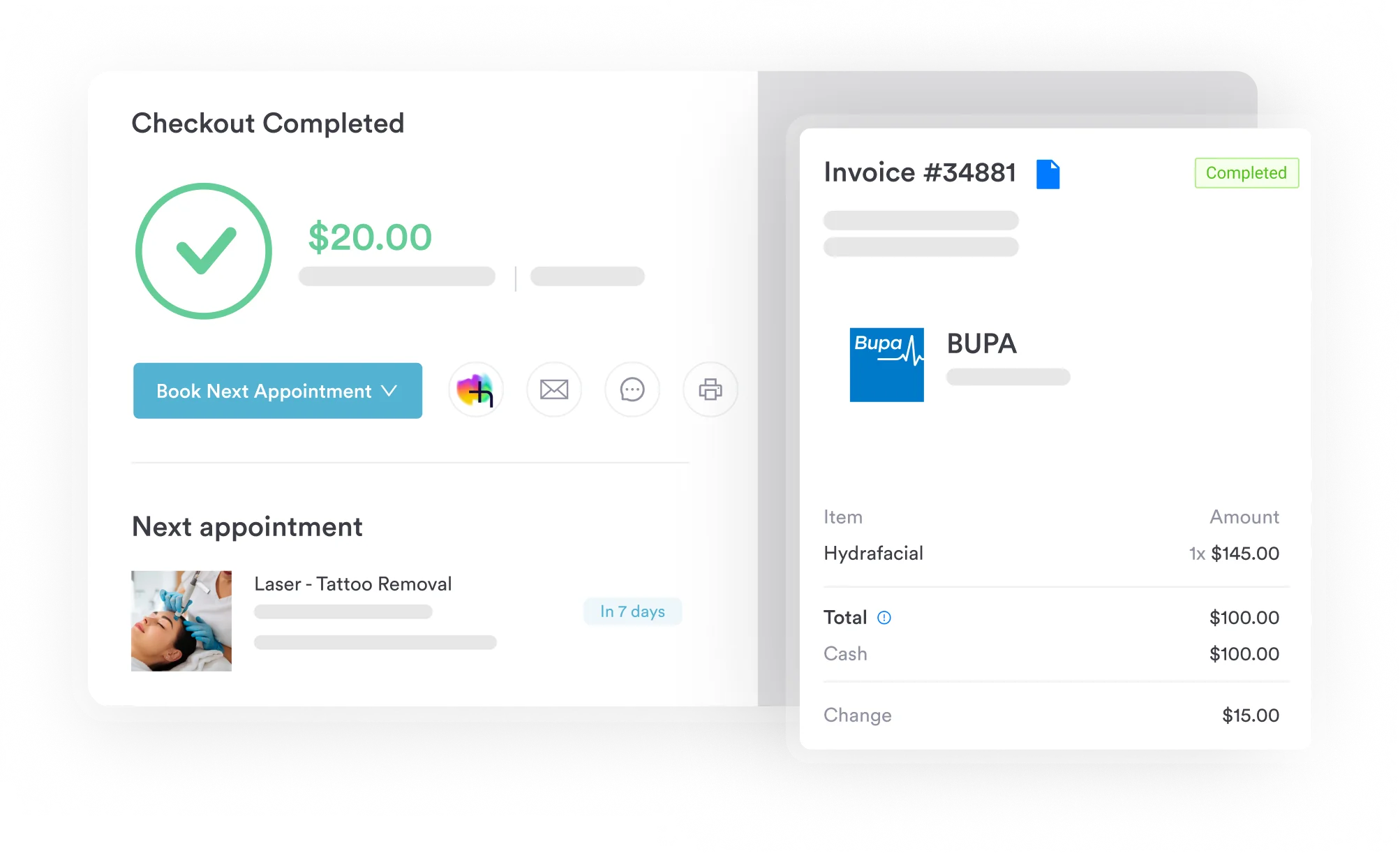

Pabau helps UK private practice teams capture operative documentation, enter CCSD codes, and send claims to Healthcode from one place. See how it supports your claim submission process.

Get the approach and the bowel segment right in the operative note, and G6080 is one of the simpler surgical codes to bill. The work happens before billing starts, with the surgeon who writes the note and the coordinator who books pre-auth.
Stop before you submit G6080 if the case converted to open, used robotic assistance, or resected only colon. Each of those needs a different code or a payer conversation, and catching it at coding costs far less than a resubmission.
Book a demo to see how Pabau links the operative record, the codes and the Healthcode claim for your surgical billing team.

Coding an open duodenal procedure? CCSD code G5000 covers open excision of a duodenal lesion and when endoscopic codes apply instead.
CCSD Code G6080 covers laparoscopic small bowel resection with or without stoma formation, as defined in the CCSD Schedule of Procedures. It applies when the surgeon completes the resection laparoscopically, including any stoma formed at the same sitting. Robotic resection (G6083) and laparoscopic colonic resection (H-series codes) are coded separately.
Per the official CCSD descriptor, a stoma formed at the same laparoscopic sitting as the resection falls within G6080. Payers can read the “+/- stoma” element differently, so verify current bundling rules in the CCSD schedule notes. A later stoma reversal is always a separate procedure with its own CCSD code.
No. CCSD convention is to code the procedure as completed, so a case converted to open no longer fits G6080’s laparoscopic descriptor. The schedule has no direct open equivalent, so confirm the right code with the payer. The operative note must record why and when the approach changed.
The most common reasons are a missing prior authorization, an operative note that doesn’t confirm the laparoscopic approach, and an undocumented stoma type. A neighboring code submitted in error, such as a robotic or colonic resection code, and a missing GMC number also trigger denials. The denial reasons table above sets out the fix for each.
When a second consultant surgeon assists, the appropriate CCSD assistant surgeon modifier is added to the claim. The assistant must be a recognized consultant, and their involvement should be noted in the operative record. Most PMI payers require the assistant’s participation to be approved at pre-authorization, so confirm it before the procedure date.
G6080 applies only to the small bowel (jejunum and ileum). Laparoscopic colonic resections sit in the CCSD H-series, such as H0750 for laparoscopic right hemicolectomy and H1880 for laparoscopically assisted left colon resection. When a procedure resects both small and large bowel, check the current CCSD schedule notes for combined resections.




