

HCPCS Code G0163: Skilled nursing observation and assessment
What is HCPCS Code G0163? HCPCS Code G0163 is a deleted Level II code for skille...

Last Updated: Oct 15, 2026
G6000 is the CCSD code for open formation of a jejunostomy, the surgical creation of a feeding opening into the jejunum through an abdominal incision. It covers both open techniques, Witzel and needle catheter jejunostomy, along with tube placement and wound closure.
The code sits in the CCSD's Abdomen chapter, in the jejunum/ileum section (11.4.0). Laparoscopic and endoscopic routes take different codes, and anesthetic and assistant surgeon fees are billed separately.
Let Pabau's smart automation suggest the right codes, reduce claim denials, and keep your practice compliant—effortlessly.
Automate repetitive tasks and focus on what matters most—your patients.
Reduce coding errors and ensure compliance with the latest regulations.
Clean claims, fewer denials, and faster reimbursements.
Powerful insights and reporting to help your practice thrive.
HIPAA compliant SOC 2 certified GDPR-compliant Trusted by 4,000+ clinics worldwide

CCSD code G6000 covers the open surgical formation of a jejunostomy only. Laparoscopic and endoscopic routes take different codes.
The code includes formation of the stoma and tube placement but excludes anesthetic fees, which the anesthetist bills separately.
Most UK private medical insurers require pre-authorization for G6000 as an elective inpatient procedure, so confirm it with each insurer before the operation.
Claims are most commonly denied for missing or inadequate operative notes, absent ICD-10 diagnosis codes, or no pre-authorization reference number.
CCSD code G6000 is the procedure code for open formation of a jejunostomy in the UK private healthcare coding schedule. The CCSD schedule is the shared procedure coding schedule used by UK private medical insurers. The code captures the full open surgical episode of creating jejunal access, from abdominal incision through tube placement and wound closure. Neighboring procedures sit in our index of CCSD codes for consultants.
G6000 sits within the CCSD’s Abdomen chapter, in the jejunum/ileum section (11.4.0). It applies when the surgeon creates a permanent or long-term jejunostomy through a laparotomy or mini-laparotomy incision. The descriptor covers both Witzel jejunostomy and needle catheter jejunostomy (NCJ). Either one codes as G6000, provided laparoscopic or endoscopic instrumentation is not the primary access route.
Open jejunostomy formation begins with a midline or transverse abdominal incision. The surgeon identifies the proximal jejunum, typically 20 to 40 cm distal to the ligament of Treitz. They then use one of two standard techniques to create access.
Witzel jejunostomy: The surgeon lays the tube along the jejunum and buries it in a seromuscular tunnel of interrupted sutures. This anchors the tube and reduces leakage. A short segment of jejunum is sutured to the anterior abdominal wall (jejunopexy) to prevent internal rotation.
Needle catheter jejunostomy (NCJ): A fine-bore catheter is tunneled submucosally into the jejunum using a needle introducer. NCJ is commonly placed during upper GI resection to give immediate postoperative nutritional access. It still codes as G6000 when performed open.
The operative report for a G6000 claim should describe the incision, the technique, the tube type and size, any jejunopexy sutures and any concurrent procedures. Insurers examine each detail during review, and a sparse operative note is the most common trigger for a documentation query.
G6000 is performed when a patient needs long-term enteral nutrition but cannot tolerate oral feeding or gastric tube feeding. Common indications include:
The ICD-10 diagnosis code on the claim must match the documented indication. A G6000 claim without a diagnosis code that establishes medical necessity is one of the most common reasons for insurer queries and denials.
Knowing the scope of G6000 prevents the two costliest coding errors: Unbundling inclusions into separate codes and leaving out billable items insurers expect.
Always check the current edition of the CCSD technical guide for the bundle rules in effect at the time of service. Insurers can read inclusions differently from the schedule, particularly for concurrent procedures performed under a single anesthetic.
For practices handling private practice claims management across several insurer contracts, tracking these inclusion rules by insurer avoids repeated adjuster queries on G6000 submissions.
Check your insurer’s multiple-procedure reduction rules before billing G6000 alongside a major concurrent procedure such as esophagectomy. Most UK private medical insurers (PMIs) cut the fee for the second procedure by a percentage. Some pay as little as 50% of the scheduled rate. Confirm the reduction in the insurer’s fee schedule before you set the patient’s cost expectations.
The approach determines the CCSD code. Open jejunostomy formation codes as G6000, while a laparoscopic approach uses a different G-series code. Coders must confirm the access route from the operative report before assigning any code.
A conversion from laparoscopic to open mid-procedure codes as the open approach, G6000, because the definitive surgical access was open. The operative note must state the conversion and its reason, such as adhesions or bleeding. It must also confirm that the jejunostomy was completed via laparotomy. Insurers occasionally query conversion cases, and a clear note prevents a denial.
G6000 sits alongside several CCSD G-series codes that cover neighboring GI access procedures. Choosing the wrong one, particularly confusing jejunostomy with gastrostomy, is a common error that leads to denials or audit flags.
The most common coding confusion is gastrostomy versus jejunostomy. A gastrostomy (G-tube) accesses the stomach, and a jejunostomy (J-tube) accesses the jejunum. Each targets a different organ, uses a different code and carries a different CCSD tariff. The anatomy and technique documented in the operative report settle any ambiguity, so code from the operative note rather than from the tube’s exit site.
UK private medical insurers require a valid ICD-10 diagnosis code alongside CCSD code G6000 to establish medical necessity. The diagnosis must reflect the clinical reason documented in the patient notes, not a generic or default code.
Code the primary diagnosis first, then any secondary nutritional diagnosis. Use the most specific code the documented clinical picture supports. “Oesophageal obstruction” (K22.2) is stronger than “dysphagia” (R13.1) when the operative note names the obstructing lesion. Check UK ICD-10 code validity against the NHS Classifications Browser, which reflects the fifth edition used in UK private healthcare billing.
Insufficient documentation is the most preventable cause of G6000 claim denial. Each item below must be in the submitted claim or available on request.
Structured operative note templates cut the administrative load of claim queries considerably. Practices that complete them at the time of surgery, rather than afterward, get fewer adjuster requests and faster payment.
All major UK private medical insurers classify open jejunostomy formation as an elective inpatient surgical procedure. Pre-authorization is required before the procedure in virtually all cases. Each insurer has its own submission pathway, but the core information requested is consistent.
Typical pre-authorization requirements include:
Major insurer pathways for G6000 pre-authorization:
Insurer policies change. Confirm current pre-authorization requirements directly with each insurer before the procedure, and record the authorization reference in the patient record and the claim. If you bill several insurers, keeping a current reference sheet for each one reduces authorization-related denials.
When G6000 is placed during an esophagectomy or gastrectomy, the NCJ is often included in the primary procedure’s pre-authorization. Confirm this with the insurer before requesting a separate G6000 authorization. Some PMIs treat a concurrent jejunostomy as bundled, while others authorize it as an additional procedure with its own tariff.
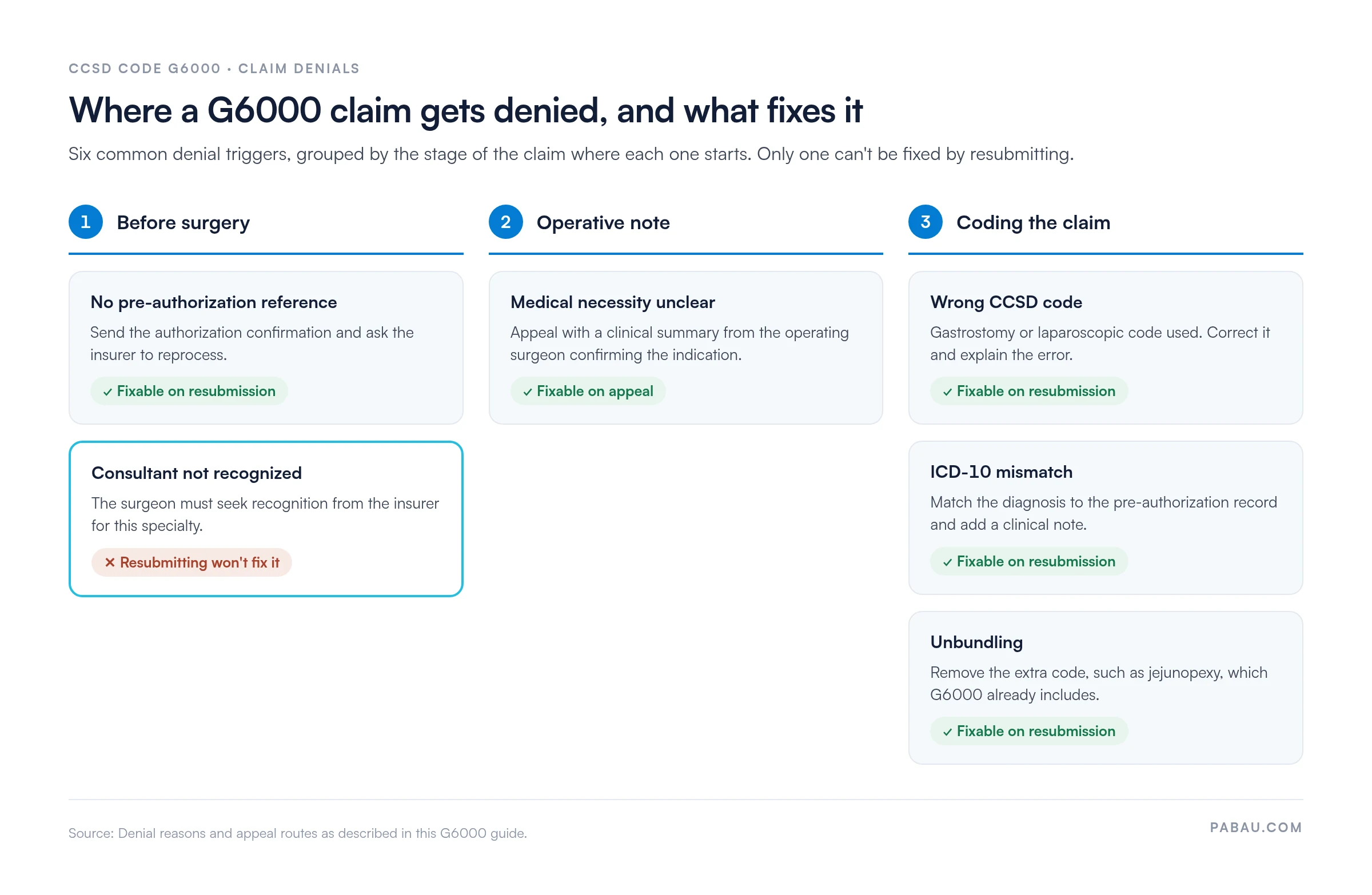
G6000 denial rates are higher than for many elective procedures because the claim combines nutritional support with major surgery. Some policies treat nutritional support as a lower-priority benefit. The most common denial reasons are predictable and preventable, and the diagram below shows where each one starts.
For complex appeals, cite the NICE guidance on nutritional support and the British Society of Gastroenterology (BSG) guidance on enteral access. Insurers are less likely to sustain a denial when professional society guidance backs the clinical rationale. Most PMIs have a formal appeal process, so submit within the timeframe stated in the denial letter (commonly 30 to 90 days).
Open jejunostomy formation requires general anesthesia. G6000 does not include the anesthetist’s fee, which is billed separately using CCSD anesthetic codes. If a first assistant was present, their fee is also billed under a separate CCSD assistant surgeon code.
Key rules for concurrent billing alongside G6000:
Run through this checklist before submitting any G6000 claim. Each item reflects a documented denial trigger or a common insurer query.
Many G6000 queries start with details stored in different places. The authorization reference sits in an email, the operative note in a hospital system, and the invoice gets typed up days later.
Pabau, the practice management platform we build, stores the patient’s insurer and policy number on their record. Every invoice then routes to the right insurer automatically. Before a claim goes out, Pabau checks that details like membership numbers and authorization codes are in place.
Claims go straight to Healthcode, the UK clearing service for private medical bills, or by email to insurers that take them that way. Each one shows a live status in a single dashboard, from pending to paid or error. A rejected G6000 claim surfaces straight away, so you can fix it and resubmit inside the insurer’s window.

Pabau keeps the insurer, policy number and authorization code on the patient record, then checks them before each claim goes out. Your team spends less time answering claim queries.

Assigning G6000 is rarely the hard part. The approach in the operative note settles the code, and the inclusions table settles what you can bill beside it.
The claim is won or lost before the patient reaches the operating room. Confirm the pre-authorization reference and ICD-10 code before surgery, and write the operative note against the checklist. Check consultant recognition well ahead, because no resubmission can fix that denial.
Book a demo to see how Pabau checks authorization codes before each G6000 claim reaches the insurer.

Need a structured overview of Bupa’s CCSD coding framework? Bupa CCSD codes covers how Bupa applies the CCSD schedule, including code submission and recognition requirements.
Checking what Bupa pays for a procedure before you quote? Bupa procedure codes and fee schedule lists Bupa’s procedure codes alongside their scheduled fees.
Coding a procedure performed through an existing stoma? CCSD code G7900 explains how to code and document a therapeutic ileoscopy via stoma.
Billing another open upper GI operation? CCSD code G2330 walks through coding a transabdominal hiatus hernia repair.
CCSD code G6000 covers open formation of a jejunostomy. That is the surgical creation of an opening into the jejunum through an abdominal incision to place a feeding tube. The code includes both open techniques (Witzel jejunostomy and needle catheter jejunostomy), tube placement and wound closure. Anesthetic fees and concurrent procedures are excluded and billed separately.
Open jejunostomy uses a formal abdominal incision and codes as G6000. Laparoscopic jejunostomy uses port-based access and carries a different G-series code. The operative report decides which code applies, so coders must confirm the documented surgical approach before assigning either one. A laparoscopic procedure converted to open mid-operation codes as open (G6000).
You need a complete operative report confirming the open approach, technique, anatomy and tube details. Add a valid pre-authorization reference number, a matching ICD-10 diagnosis code, the consultant’s GMC number, and the date and facility of the procedure. Claims that reach insurers without a pre-authorization reference are rejected at first pass by automated systems.
G6000 targets the jejunum, while gastrostomy codes target the stomach. They are anatomically distinct procedures with separate CCSD codes and different tariffs. The most common error is applying a gastrostomy code when the operative note documents jejunal access. Always code from the anatomy in the operative report, not from the external tube exit site.
The five most common reasons are: No pre-authorization reference, unclear medical necessity, a code mismatch, the wrong CCSD code, and unbundling. A code mismatch means the claim and the pre-authorization record carry different codes. The wrong CCSD code is usually a laparoscopic or gastrostomy code. Unbundling splits components of the formation into separate codes.
Yes. The anesthetist submits their own claim using CCSD anesthetic codes, because the fee is not included in G6000. An assistant surgeon fee may also be billed separately under the appropriate CCSD code, though reimbursement depends on insurer policy. Confirm whether the insurer reimburses first-assistant fees for elective jejunostomy before quoting the patient.




