

CCSD code G5100: Bypass of duodenum billing guide
CCSD code G5100 bills a bypass that leaves the duodenum in place CCSD code G5100...

Last Updated: Oct 16, 2026
F0950 is the CCSD code for surgical removal of complicated buried roots. It covers retained roots or root fragments, with no crown left, that need a mucoperiosteal flap, bone removal or root sectioning to deliver.
UK private insurers use CCSD codes to pay for privately funded care, and Bupa places F0950 in complexity band MINOR 4. A whole impacted or buried tooth is coded F0910 instead. A root that comes out with simple elevation does not qualify.
Let Pabau's smart automation suggest the right codes, reduce claim denials, and keep your practice compliant—effortlessly.
Automate repetitive tasks and focus on what matters most—your patients.
Reduce coding errors and ensure compliance with the latest regulations.
Clean claims, fewer denials, and faster reimbursements.
Powerful insights and reporting to help your practice thrive.
HIPAA compliant SOC 2 certified GDPR-compliant Trusted by 4,000+ clinics worldwide

CCSD code F0950 covers surgical removal of complicated buried roots that need flap elevation, bone removal, or sectioning. Bupa places it in complexity band MINOR 4.
The surgery the root needs decides complexity. Hypercementosis, ankylosis, a fractured root tip, or a root near the nerve or sinus can all qualify, but buried depth alone cannot.
A whole impacted tooth is F0910, and a root displaced into the maxillary sinus falls outside F0950 entirely.
A pre-operative radiograph and a contemporaneous operative note describing each surgical step are the minimum documentation for every F0950 claim.
Pabau, the practice management platform we build, keeps radiographs, consent forms and operative notes in one patient record, so the claim goes out complete.
CCSD code F0950 is the billing code for the surgical removal of complicated buried roots, as defined in the CCSD schedule.
The CCSD Group, whose members include Bupa, AXA Health, Aviva and Vitality, maintains the codes UK private insurers use for procedures and diagnostic tests. The official descriptor is “Surgical removal of complicated buried roots.”
“Complicated” has a precise meaning here. The root can’t be delivered with simple elevation. The code applies when removing the fragment takes a mucoperiosteal flap, removal of alveolar bone, sectioning of the root, or a combination of these steps.
CCSD codes apply to privately funded and insured care in the UK, while NHS dental extractions follow NHS treatment bands. F0950 sits in the Teeth section of chapter 6, alongside the other dental surgery entries in our index of CCSD codes.
When a private patient needs a root removed through open access, F0950 is the candidate code, and the complexity criteria below decide whether it applies.
A root is buried when it lies entirely below the gingival margin with no crown tissue present. Burial alone doesn’t make it complicated for F0950 purposes. What qualifies the case is the surgery needed to get the root out.
The clinical factors that raise a buried root to F0950 complexity include:
If none of these factors applies and the root comes out with simple elevation, the procedure does not meet the F0950 descriptor. The comparison further down shows how the neighboring codes divide the work.
Knowing the procedural steps helps coders and practice managers check that the operative note supports the code before the claim goes out.
Each of these steps should appear, at least in summary, in the operative note. An insurer reviewing an F0950 claim looks for a documented procedure that justifies the complexity designation.
The Teeth section of CCSD chapter 6 holds only a handful of surgical extraction codes. Each one describes a separate procedure, so they don’t form a complexity ladder. Choosing the wrong one is the most common billing error in buried root cases.
Bands and fees above come from Bupa’s February 2026 CCSD schedule. Other insurers set their own fees, so check each payer’s schedule before quoting a patient.
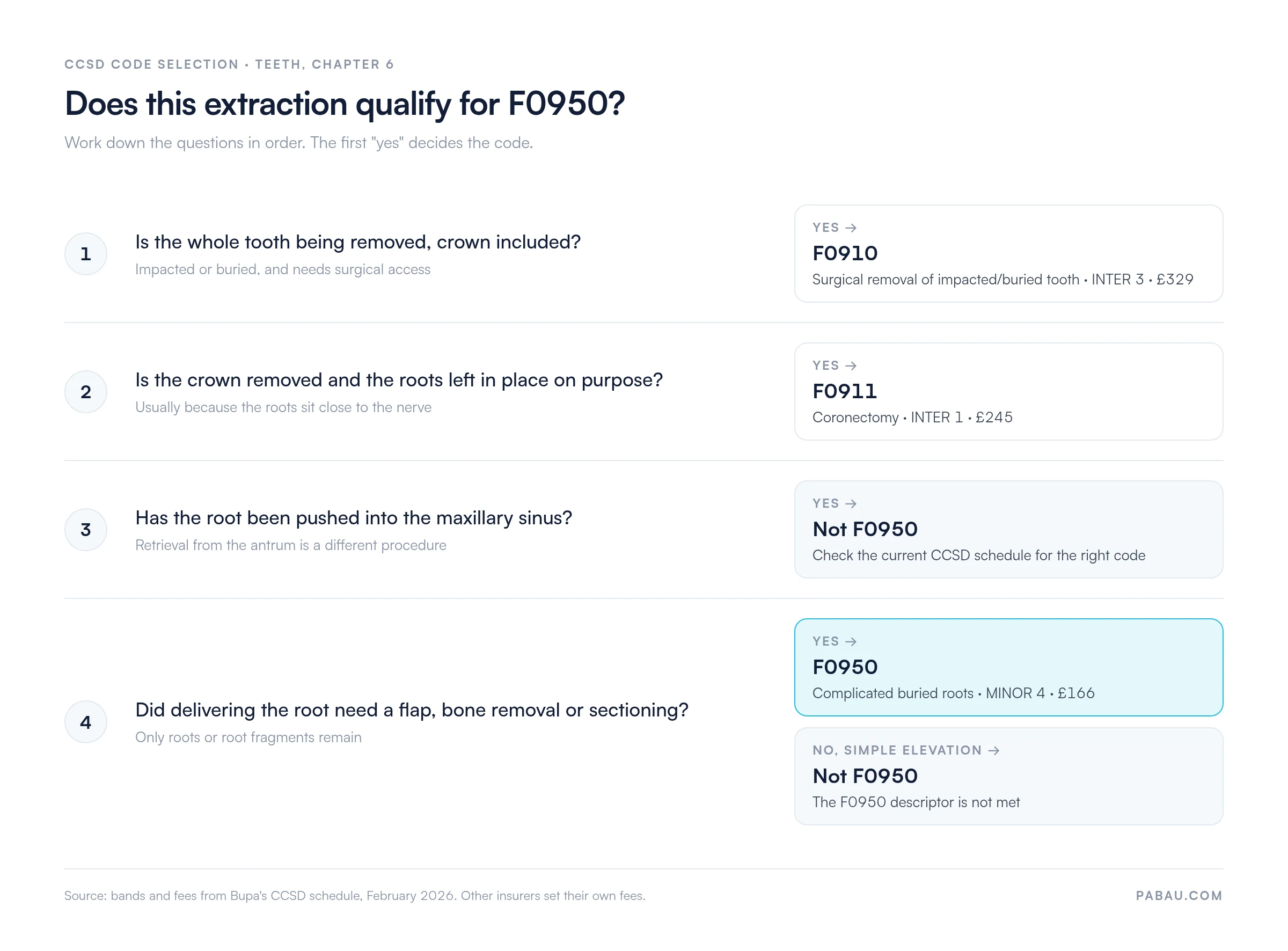
The decision that matters is between F0910 and F0950. F0910 covers the surgical removal of a whole impacted or buried tooth. F0950 covers roots alone, typically left behind after a crown broke away or an earlier extraction fractured.
Bupa bands F0910 at INTER 3 and F0950 at MINOR 4, so F0950 is the lower-banded code of the two. Billing a retained root fragment as F0910 because the surgery was difficult overstates the procedure, and insurers query it. Inside a root removal, that difficulty is exactly what qualifies the case for F0950.
Coronectomy (F0911) is a planned alternative to removing a whole tooth that sits close to the inferior alveolar nerve. The surgeon removes the crown and leaves the roots in place on purpose, so it is never coded as F0950.
A root pushed into the maxillary sinus is a separate case that F0950 does not cover. Retrieving it from the antrum is a different procedure, so check the current CCSD schedule for the code that applies.
The decision path below puts these rules in the order a coder checks them.
These examples help coders and dentists agree on whether F0950 applies before the claim is submitted.
In each scenario, identify the feature that justifies F0950 on the pre-operative radiograph and name it explicitly in the operative note.
Document the reason for complexity in the operative note before coding. Write one sentence naming the complicating factor, for example ‘Root ankylosed to buccal plate, bone removal required along full root length’. That sentence makes the claim far easier to defend if the insurer questions it.
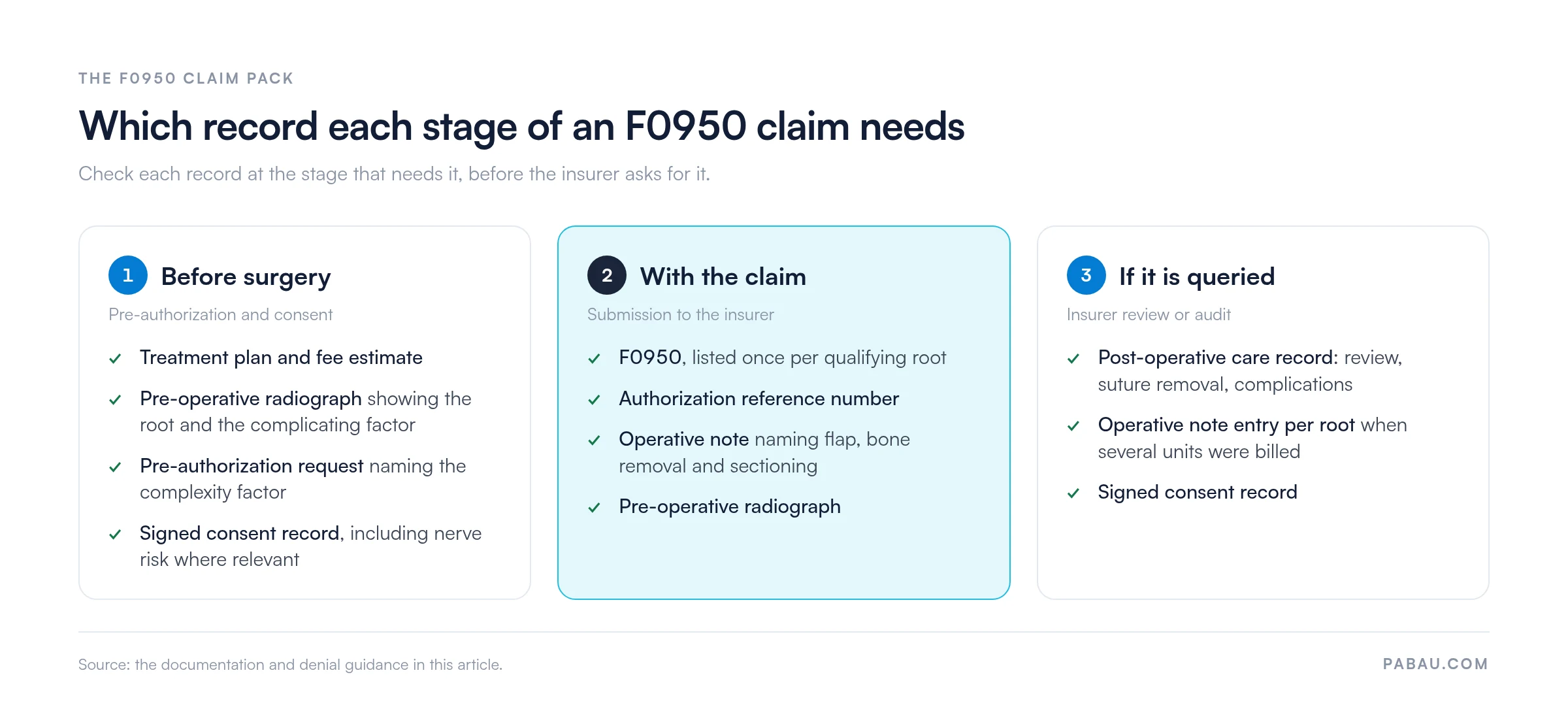
Every F0950 claim needs a minimum set of records in the patient file. A missing one is the fastest route to a denial, or to a request for more information that delays payment.
Send the consent form digitally before the appointment and store it in the patient record. The consent, treatment plan and clinical notes then sit together, so no document goes missing at claim time.
UK private insurers commonly ask for pre-authorization before surgical extractions such as F0910 and F0950. The rules vary by insurer and by policy, so check the current provider guidance before you book the procedure. Use these sources as your starting points:
A typical F0950 pre-authorization request includes the policy number, the proposed CCSD code, and a short clinical justification naming the complexity factor.
It also carries the pre-operative radiograph and the fee estimate. Response times vary by insurer and by how the request is sent, so build that lead time into booking for every surgical extraction.
Confirm the patient’s cover at the booking stage, too. A dental insurance verification form records the insurer, policy number and plan details, so you know whose rules apply before the request goes in.
F0950 denials cluster around a few recurring issues. Each one is preventable with the right process.
A short pre-submission check catches most of these. Before an F0950 claim goes out, confirm the authorization reference, the radiograph, and an operative note that names the complicating factor. The stages below show when each record is needed.
F0950 may be billed alongside several other CCSD codes in the same visit. Some combinations, though, are mutually exclusive or need careful sequencing.
Bundling rules differ between insurers. The CCSD technical guide sets the baseline, but individual provider manuals may add their own unbundling rules. Review the relevant manual before submitting a claim with several codes from one visit.
When billing multiple F0950 units in one visit, list each root separately in the claim notes (e.g. ‘LL6 mesial root’, ‘LL6 distal root’). Attach the matching section of the operative note to each. Insurers that allow multiple units require each to be independently justified.
In many dental practices, the records an F0950 claim needs live in three places. The radiograph sits in the imaging software, the consent form in a paper folder, and the operative note in the clinical chart. Someone then gathers them by hand at submission time, and that is where a document goes missing.
Pabau, the practice management platform we build, keeps them in one patient record. Patients sign consent forms digitally before the appointment, and the radiograph is attached to the same file. The clinician writes the operative note against the visit, and the CCSD code goes straight onto the invoice.
Pabau’s dental claims management software then builds the insurer claim from that record. Your team stops chasing files across folders and systems, and the supporting documents are already together when the insurer asks for them.

Pabau’s dental practice software keeps operative notes, radiographs, consent forms, and CCSD codes in one record. Your team has the full set for a clean F0950 claim without a last-minute file search.

Before you code F0950, find the sentence in the operative note that names the complicating factor. If it’s there and the radiograph shows it, the claim can stand on its own. If it’s missing, fix the note first, because the insurer will ask the same question.
The trade-off is a few extra minutes of writing per case against a queried claim and a late payment. A practice that makes that sentence a habit spends far less time defending its surgical codes.
Book a demo to see how Pabau keeps the radiograph, consent form and operative note together for every surgical extraction claim.

Coding a tooth that was knocked out rather than buried? CCSD code F0830 covers replantation of a tooth after trauma, with its own documentation and billing rules.
Closing a palatal wound after oral surgery? CCSD code F3070 explains how suture of the palate is billed and documented.
Need a consent record that stands up to an insurer audit? This dental treatment consent form shows what a signed dental consent record should capture before treatment.
Want more surgical cases coming through the door? Our guide to growing a dental practice shares eight proven strategies for attracting and keeping patients.
CCSD code F0950 covers the surgical removal of complicated buried roots. These are retained root fragments that need mucoperiosteal flap elevation, alveolar bone removal, or root sectioning to deliver. It is used for privately funded patients in the UK, and Bupa places it in complexity band MINOR 4.
F0910 covers the surgical removal of a whole impacted or buried tooth, crown included. F0950 covers buried roots with no crown left, where a flap, bone removal, or sectioning is needed. Bupa bands F0910 at INTER 3 and F0950 at MINOR 4. Choose the code by what was removed, then document how hard the surgery was.
The minimum is a pre-operative periapical radiograph or OPG showing the root position and shape. Add a contemporaneous operative note describing the flap, bone removal, and any sectioning, plus a signed consent record. Many insurers also ask for the treatment estimate and, where applicable, an authorization reference number obtained before the procedure.
Yes. If more than one root at the same visit qualifies as a complicated buried root, F0950 may be billed per root. Each root needs its own operative note entry naming the complicating factor, and each is listed separately on the claim. Check the insurer’s multiple-procedure policy, as a reduction may apply to the second and later units.
Pre-authorization rules for surgical extractions such as F0950 vary by insurer and by policy. Bupa, AXA Health, Aviva and Vitality each publish provider guidance, so confirm the current rule before treatment. As a precaution, seek authorization for every F0950 case.
The most common triggers are missing pre-authorization, an operative note that doesn’t describe the complicating factor, and a missing pre-operative radiograph. Claims are also denied when the wrong code is chosen, such as F0910 for a root fragment. A pattern of F0950 billing without supporting records can also draw an audit.
Yes. Intravenous sedation given by a qualified sedationist is billed under a separate CCSD sedation code and is not bundled into the F0950 fee. The clinical record should document the sedationist’s name, the sedation technique, and the monitoring used. Confirm the specific sedation codes and any insurer restrictions in the relevant provider manual.



