

CCSD code G5100: Bypass of duodenum billing guide
CCSD code G5100 bills a bypass that leaves the duodenum in place CCSD code G5100...

Last Updated: Oct 16, 2026
CCSD code F0830 is the UK private insurance code for replantation of a natural tooth or teeth following trauma. It applies when an injury knocks a permanent tooth fully out of its socket and the clinician puts it back. Bupa places it in complexity band INTER 2, with a surgeon fee of £286.
Claims turn on the note. Record the injury, the dry time, the storage medium and each tooth's FDI number. Check the patient's policy covers dental injury before treatment, because many UK private medical policies cover it only in limited cases.
Let Pabau's smart automation suggest the right codes, reduce claim denials, and keep your practice compliant—effortlessly.
Automate repetitive tasks and focus on what matters most—your patients.
Reduce coding errors and ensure compliance with the latest regulations.
Clean claims, fewer denials, and faster reimbursements.
Powerful insights and reporting to help your practice thrive.
HIPAA compliant SOC 2 certified GDPR-compliant Trusted by 4,000+ clinics worldwide

CCSD code F0830 covers replantation of a natural tooth or teeth that trauma knocked out of the socket.
Bupa’s February 2026 schedule places F0830 in complexity band INTER 2, with a surgeon fee of £286.
A partly displaced tooth, an implant or a planned intentional replantation each needs a different code.
The note must record the injury, dry time, storage medium, FDI tooth number and splint plan.
Many UK private medical policies cover dental injury only in limited cases, so check cover before you treat.
CCSD code F0830 is the schedule entry for replantation of natural tooth / teeth following trauma. Dentists and oral surgeons use it when an injury has knocked a permanent tooth fully out of its socket and the clinician puts it back.
CCSD stands for the Clinical Coding and Schedule Development Group. It maintains the procedure and diagnostic codes that UK private medical insurers use to process claims. Bupa, AXA Health, Aviva, Vitality, Cigna, WPA, Allianz Care and Healix all work from the schedule.
F0830 sits in chapter 6 of the schedule, Face, mouth, salivary and thyroid, under the Teeth heading. Our CCSD codes by chapter index lists its neighbors. The CCSD Group sets the codes, while each insurer sets its own fee.
The descriptor reads “tooth / teeth”, which points to one code for the episode, however many teeth go back in. Confirm with the insurer before you bill F0830 more than once on a claim.
Replantation returns an avulsed permanent tooth to its socket after an injury. The International Association of Dental Traumatology (IADT) publishes the 2020 guidelines that most UK clinicians follow for this procedure.
Storage medium and dry time shape the outcome. IADT guidance favors milk, Hank’s Balanced Salt Solution (HBSS) or saline, and dry storage harms the cells that reattach the root. Record both details, because insurers and later clinicians read them first.
F0830 fits when trauma has fully displaced a permanent tooth and the clinician replants it. Three conditions decide the code.
F0830 doesn’t cover a planned extraction and replantation for endodontic reasons, a tooth moved to a new site, or an implant. Each of those has its own entry in the schedule. If a broken tooth has to come out surgically instead, the claim moves to F0910.
Run the four checks below in order before you put F0830 on the claim.
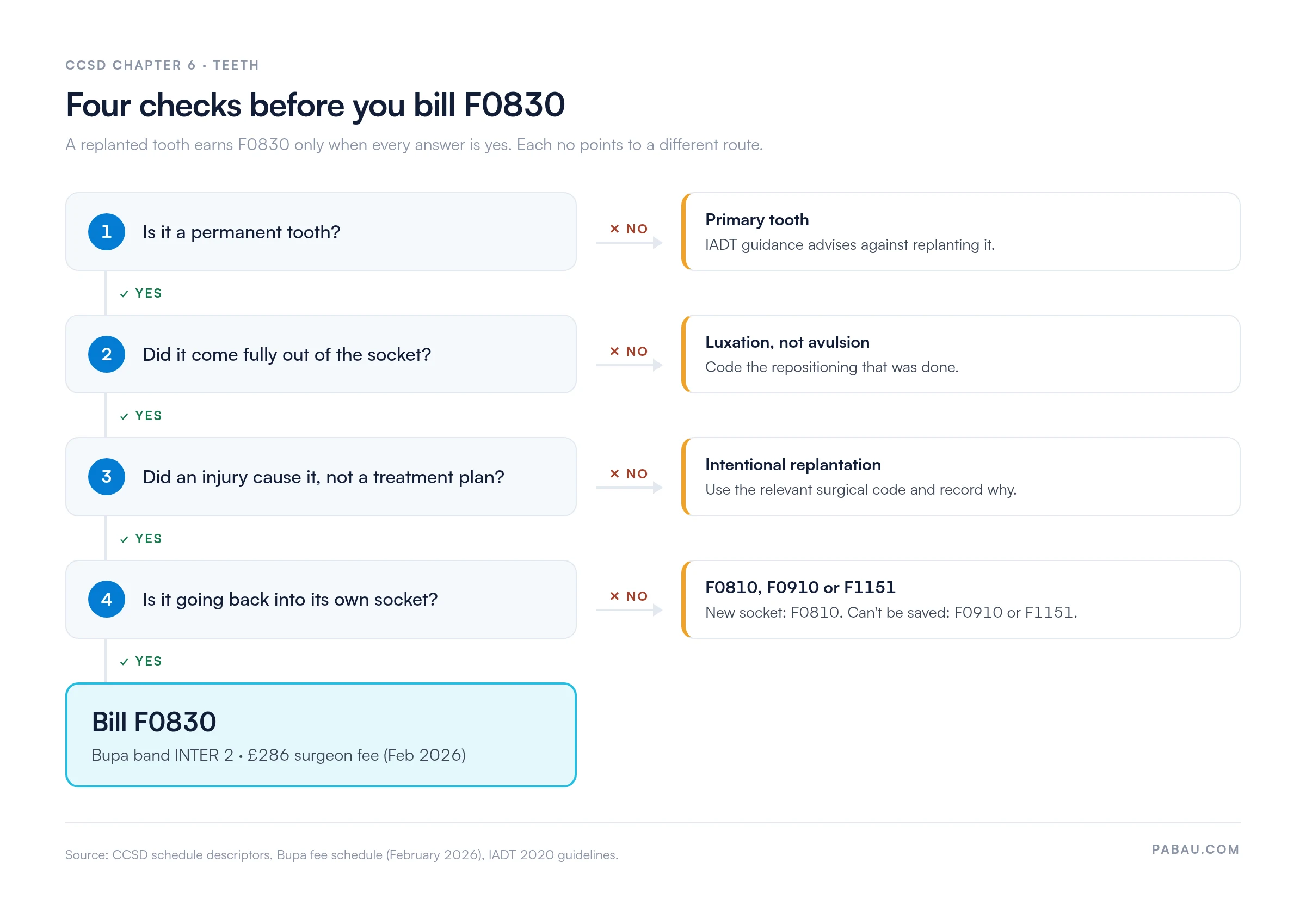
Several chapter 6 codes describe work on the same teeth after an injury. Bupa’s February 2026 schedule rates them differently, and some carry no Bupa fee at all.
Fees come from Bupa’s schedule, collected in our Bupa CCSD codes guide. Other insurers publish their own fees for the same codes, so check the patient’s policy before you quote.
Bupa places F0830 in complexity band INTER 2, with a surgeon fee of £286 in its February 2026 schedule. The band is the insurer’s grading of how complex the procedure is, and it drives the benefit.
Here’s how that plays out. Say the surgeon charges £350 for the replantation. A Bupa patient’s benefit covers £286, which leaves a £64 shortfall. Tell the patient in writing before treatment where you can.
Check the live figure on the Bupa code search before you quote, because fees change between editions. AXA Health, Aviva and the other insurers set their own fees for F0830.
F0830 covers the replantation itself. Other services on the same day are billed by whoever provides them, or not billed to the insurer at all.
The CCSD Group’s full listing of unacceptable combinations sits behind a login. If a combined case looks unusual, confirm the rules with the patient’s insurer before you submit.
Insurers read the note against the descriptor. The General Dental Council (GDC) also expects complete, accurate records, and the British Dental Association (BDA) publishes record-keeping advice. Check the note covers these details.
Patient records also fall under UK GDPR and the Data Protection Act 2018. Store trauma photos and radiographs with the same care as the note itself.
A knocked-out tooth is an emergency, so the claim often starts after the treatment. It follows five steps.
Delays tend to start at step one or step five. Missing cover details or a vague note will hold the claim until someone fixes it.
Emergency appointments leave paperwork behind. A two-minute check catches the loose ends before the insurer does.
Once the insurer accepts the claim, save its reference in the patient record. You’ll need it for any chase or appeal.
Watch for these slips. Each one can turn a clean F0830 case into a queried claim.
Dental trauma appointments are rushed. The tooth has to go back in quickly, and the claim details get pieced together later from memory.
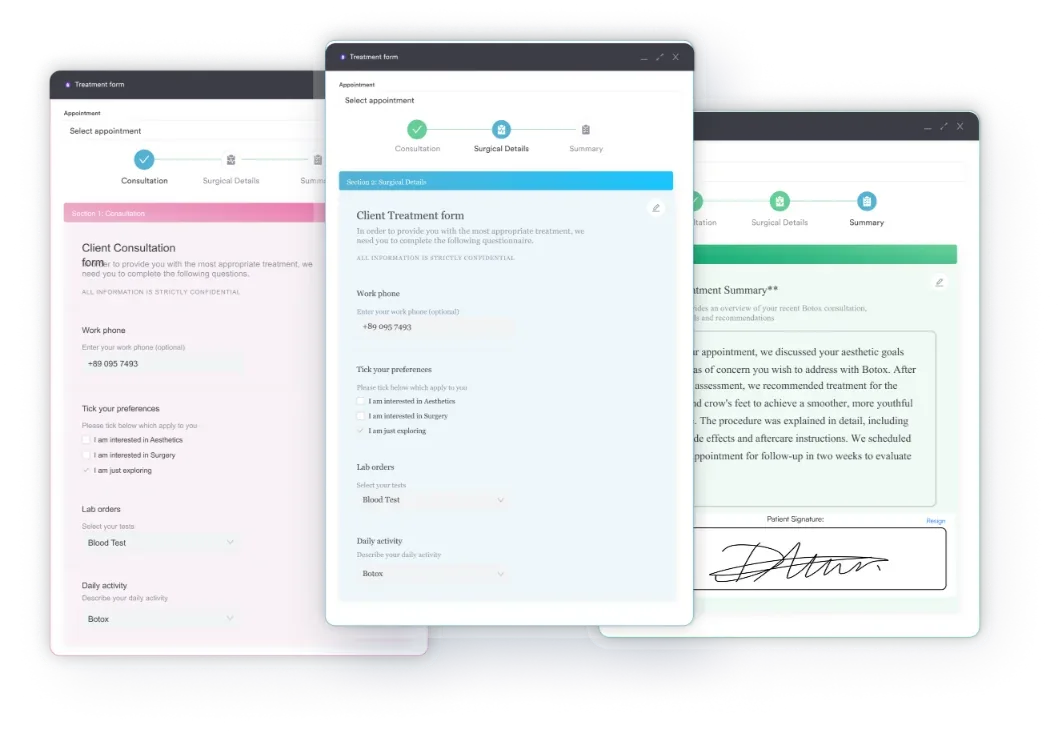
Pabau keeps the trauma note, invoice and insurer details on one patient record. Its digital forms can make dry time, storage medium and FDI tooth number required fields, so the note is complete before it’s signed.
From there, Pabau handles claims management without rekeying. The claim builds from that record and goes to the insurer through Healthcode. The CCSD code, membership number and authorization reference carry across automatically.
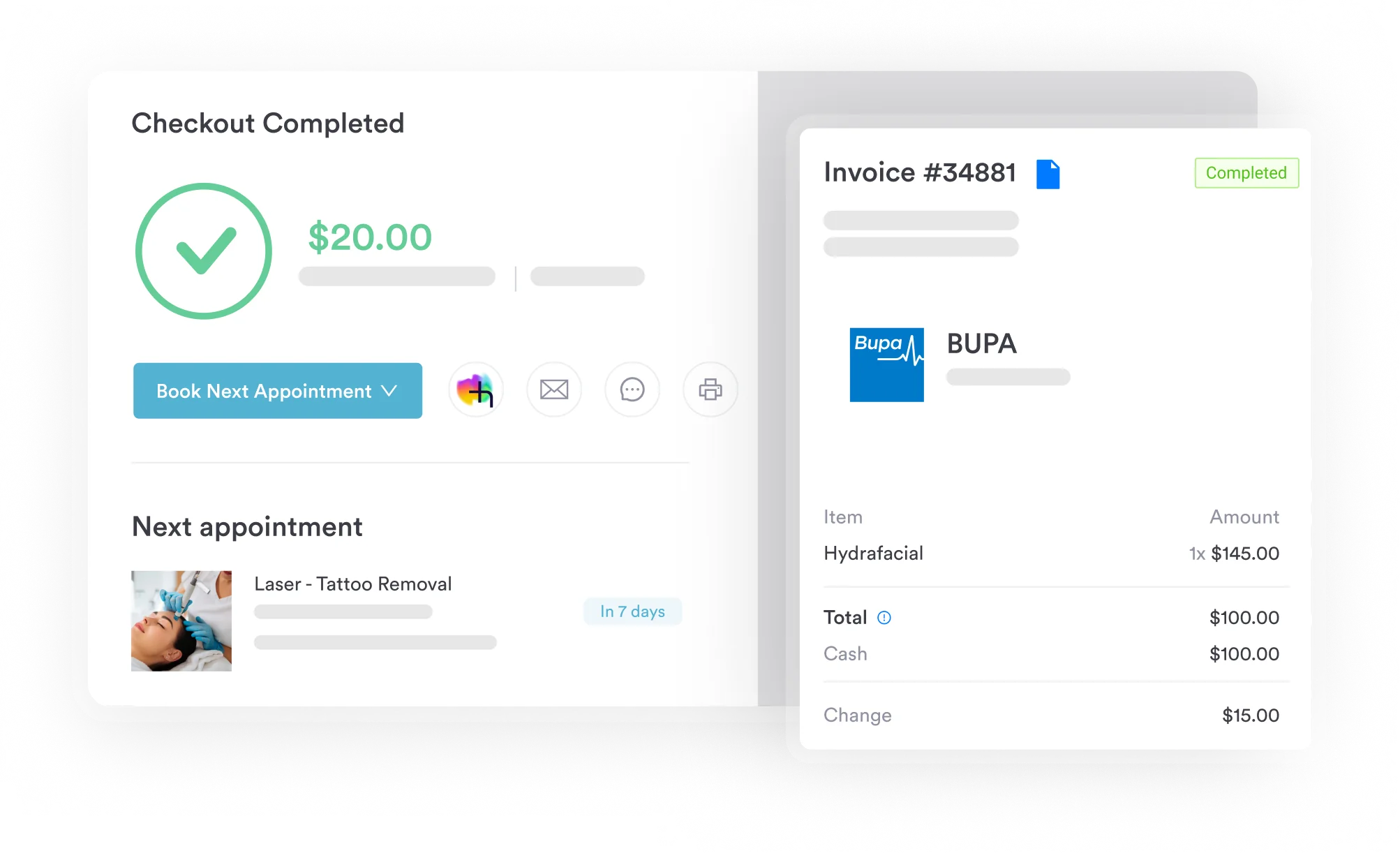
Your team then follows each claim to payment in one view. If the insurer queries it, the note and the authorization reference are already attached to the record.

Pabau keeps the trauma note, invoice and authorization reference on one patient record and submits CCSD-coded claims like F0830 through Healthcode. Your team then tracks each claim to payment.

F0830 pays for an emergency that leaves little time for paperwork. The claim rests on a note showing that trauma fully knocked out a permanent tooth, and that you replanted it.
Write that note before the patient leaves, with the dry time, storage medium and FDI number in it. Check the policy covers dental injury, and the code choice largely takes care of itself.
Book a demo to see how Pabau carries an F0830 claim from the patient record to Healthcode and tracks it to payment.

Browsing codes by chapter? CCSD codes by chapter lists each chapter of the schedule with links to every code guide.
Want to spend less time on claim submissions? Claims management software helps practices submit complete claims and follow each one to payment.
CCSD code F0830 is the UK private insurance code for replanting a natural tooth or teeth after trauma. It applies when an injury knocked a permanent tooth fully out of its socket and the clinician put it back. UK insurers such as Bupa, AXA Health and Aviva use it.
The descriptor reads “tooth / teeth”, which points to one code for the episode, however many teeth are replanted. Insurer rules can differ, so confirm with the insurer before you bill F0830 more than once.
The note should record the cause of injury, the time of avulsion, dry time and storage medium. It should also give each tooth’s FDI number, the treatment and splint, and the clinician’s GDC number.
No. F0830 covers the replantation only. Root canal treatment usually follows within two weeks and is often handled under dental cover rather than private medical insurance.
IADT 2020 guidelines recommend a flexible splint for about two weeks after replanting an avulsed tooth. The splint stays for about four weeks when there is an associated alveolar bone fracture. Bupa’s Teeth section lists no separate splinting code, so record the splint in the F0830 note.
The usual reasons are a note without dry time or storage medium, a luxation coded as an avulsion, or a policy that excludes dental injury. Checking cover before treatment prevents the most avoidable queries.



