CPT code 40819: Labial and buccal frenectomy billing guide
CPT code 40819 covers lip and cheek frenectomies CPT code 40819 is the procedure...

Last Updated: Oct 8, 2026
CCSD code AA489 is the private health insurance billing code for transtympanic chemical labyrinthectomy. In this outpatient procedure, an ototoxic drug is injected through the eardrum to permanently switch off balance function in a diseased inner ear. ENT practices in the UK and Ireland submit it to private medical insurers such as Bupa, AXA Health, Aviva and VitalityHealth.
The procedure is reserved for refractory unilateral Meniere’s disease and can cost the patient hearing in the treated ear. That is why insurers almost always expect pre-authorization and a full documentation trail before they pay an AA489 claim.

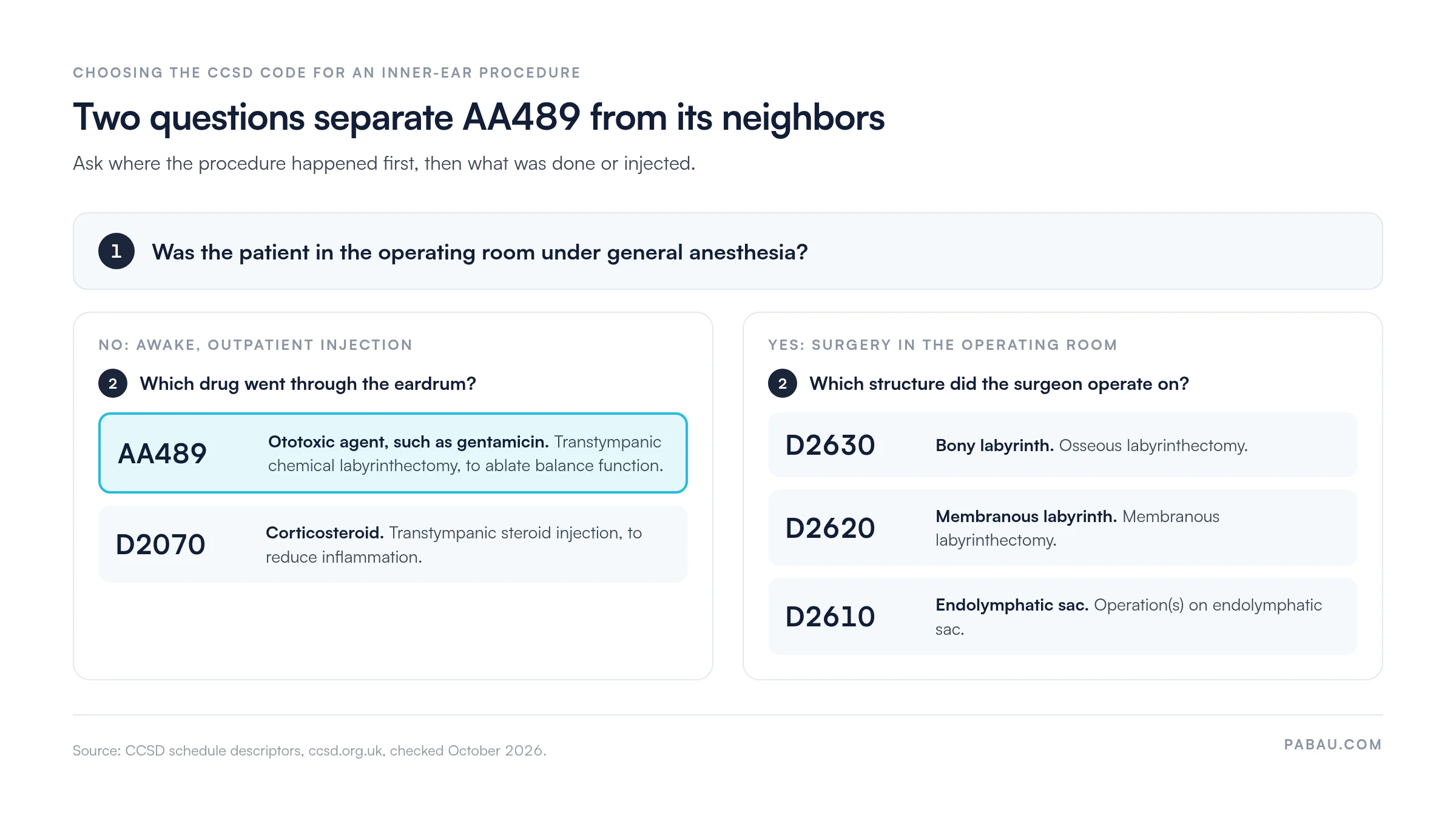
CCSD code AA489 covers transtympanic chemical labyrinthectomy, not surgical labyrinthectomy (D2630 or D2620) or a transtympanic steroid injection (D2070).
The code applies only to private health insurance billing in the UK and Ireland. NHS-funded care is coded and paid through separate systems.
Gentamicin is the agent most commonly used, but the code is not drug-specific, provided the intent is vestibular ablation.
Most major insurers expect pre-authorization before the procedure is performed, and a missing authorization number is the leading cause of claim rejection.
CCSD code AA489 describes transtympanic chemical labyrinthectomy in the schedule maintained by the Clinical Coding & Schedule Development (CCSD) Group. The schedule is the standard procedure reference for claims to UK and Ireland private medical insurers (PMIs). NHS-funded care is coded and paid through separate systems, so an AA489 claim sent through NHS channels will be rejected.
AA489 sits in chapter 5.3.0 Inner Ear, under 5.0.0 Ear, Nose & Throat, with the reference Fe.045. Its official descriptor names both the method and the route. The approach is chemical rather than surgical, and the drug reaches the inner ear through the eardrum.
Don’t choose a code by its number. The neighboring AA4xx codes, such as AA460 and AA461, are trigeminal nerve procedures. The ear codes closest to AA489 are D2070, D2610, D2620 and D2630, and you can compare their descriptors in our CCSD code library.
Transtympanic chemical labyrinthectomy involves injecting an ototoxic agent through the tympanic membrane (eardrum) into the middle ear space. The drug diffuses through the round window membrane into the inner ear. There it destroys vestibular hair cells in the membranous labyrinth, permanently ablating balance function in that ear and removing the source of episodic vertigo.
The procedure takes place in an outpatient setting, not under general anesthesia. The consultant ENT surgeon or neurotologist positions the patient with the treated ear uppermost. They numb the eardrum with a local anesthetic, or use an existing myringotomy, and inject the agent into the middle ear. The patient then holds that position for 20 to 30 minutes so the drug can absorb.
Multiple sessions may be required, depending on the protocol in use:
Where multiple sessions are needed, each injection episode may need its own claim. Check the CCSD technical guidance on whether repeat injections within one clinical episode go under a single AA489 claim or are coded individually.
CCSD code AA489 is used mainly for unilateral Meniere’s disease (endolymphatic hydrops) that has not responded to conservative medical management. Insurers expect documented failure of dietary measures, betahistine and diuretics before they authorize AA489.
The key clinical criteria for appropriate use of AA489 are:
Using AA489 for bilateral Meniere’s disease, or while the affected ear still has useful hearing, will trigger insurer scrutiny. The procedure may also treat other refractory unilateral vestibular disorders, but Meniere’s disease is the primary indication on most AA489 claims.
Knowing the procedural steps helps billing staff check that the procedure note contains what insurers expect. The typical sequence for intratympanic gentamicin treatment is:
Drug concentration, volume and the number of injections vary by surgeon protocol. Coders should never infer a dose for the claim. Record whatever appears in the procedure note, and confirm documentation exists for each billed episode.
The most common coding error with AA489 is selecting a related code that describes a similar but distinct procedure. The table below compares AA489 with the codes most likely to be confused with it.
The critical distinction between AA489 and D2070 is the drug class and intent. Gentamicin is ototoxic and destroys vestibular function, while a transtympanic steroid injection reduces inflammation to rescue hearing in sudden sensorineural hearing loss. Submitting D2070 instead of AA489, or vice versa, is a material error that triggers a clinical query and likely a denial.
Endolymphatic sac surgery is a separate route for refractory Meniere’s disease, billed under D2610 as an operating-room procedure. It aims to relieve pressure rather than ablate balance function.
Surgical labyrinthectomy (D2630, or D2620 for the membranous variant) and chemical labyrinthectomy (AA489) share one goal, permanent vestibular ablation. They reach it by completely different means. Coders must not use the terms interchangeably.
The practical signal for coders is the setting. If the patient went to the operating room under general anesthesia, AA489 is wrong and the claim belongs under D2630 or D2620. If the patient was awake in a consulting or treatment room, a surgical code is wrong. The decision path below combines the setting test with the drug test.
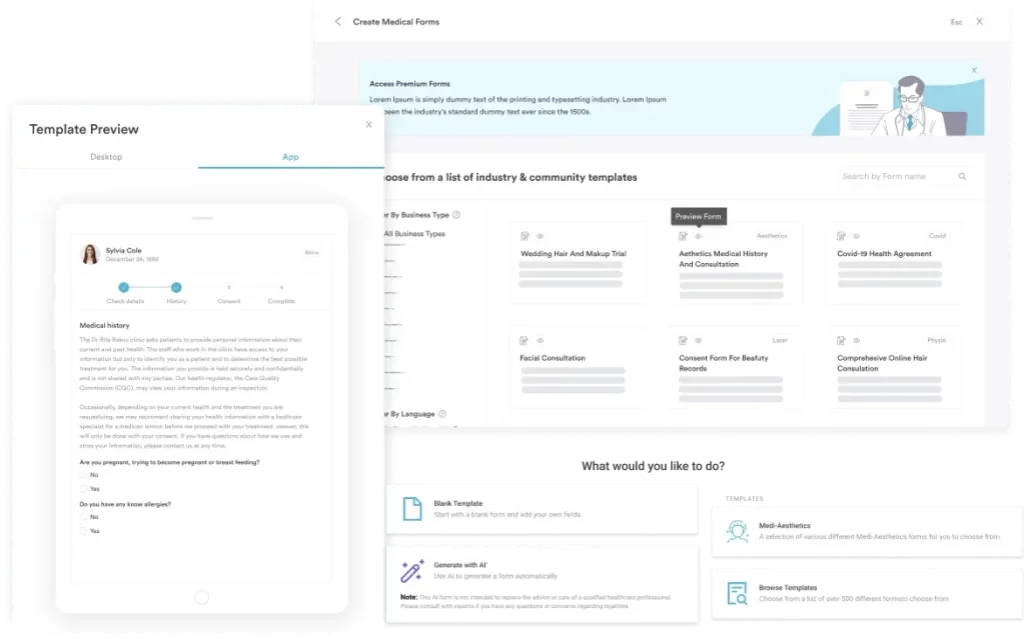
A valid AA489 claim needs documentation that establishes both the clinical justification and the procedural detail. Structured digital forms filled in at the point of care make it harder to miss an element at billing time. Insurers consistently query or deny claims that lack any of the following:
The Royal College of Surgeons of England’s standards require procedural records to be legible, dated and signed. They must also hold enough detail for another clinician to understand what was done. Billing staff should flag incomplete procedure notes before the claim is submitted, not after a rejection.
Most major UK private medical insurers require pre-authorization before AA489 can be performed and claimed. Requirements vary by insurer and change each year, so check each insurer’s current provider portal rather than last year’s guidance. The general pattern across Bupa, AXA Health, Aviva and Cigna is as follows:
Timing matters. Pre-authorization requests submitted after the procedure cannot be backdated, and retrospective authorization is rarely granted for elective vestibular procedures. Start the request as soon as the consultant decides to proceed with AA489.
Build a pre-authorization checklist into your AA489 booking workflow. It should confirm the Meniere’s diagnosis, attached audiometry, documented conservative treatment, the portal submission and the authorization number on the appointment. Catching a missing element before the procedure prevents the most common AA489 denial.
Denials for CCSD code AA489 cluster around five recurring problems. Addressing each one at the point of claim submission reduces rework and speeds up payment.
AA489 rarely appears on its own. The following services may legitimately appear on the same claim, or on related claims within the same episode of care. For Bupa-recognized codes and fee categories, see our guide to Bupa CCSD codes.
Insurer unbundling rules vary. Some insurers will not pay separately for audiometry performed on the same day as AA489 if they consider it integral to the procedure. Check the insurer’s fee schedule and unbundling guidance before listing ancillary codes on the same invoice.
Standard code references rarely list exclusions, but coders need them to avoid incorrect submissions.
When a patient has bilateral Meniere’s disease, the treating consultant may schedule AA489 for each ear separately, weeks or months apart. Code each session independently against the correct ear, with a fresh pre-authorization request for the second side. Never assume that authorization for one side covers the other ear.
In many private ENT practices, the authorization number sits in an insurer portal and the procedure note sits in a consultant letter. Someone then rebuilds the claim from both by hand. A missing hold time or reference number usually surfaces only when the insurer sends a query.
Pabau, the practice management platform we build, keeps the referral, audiometry, consent and procedure note on one patient record. Procedure note templates make the agent, volume and hold time required fields. Its private practice claims software then raises the insurer invoice for AA489 from that same record.
The result is a claim that leaves with the authorization number and the supporting notes already attached. Your billing team spends less time answering queries and more time on claims that are ready to pay.

Pabau helps private ENT practices structure procedure notes, record pre-authorization details, and keep billing records audit-ready. See how it works.

An AA489 claim is won or lost before the patient reaches the treatment room. Get the authorization number, the audiometry and the record of failed conservative treatment on file first. Then the claim carries what every insurer checks.
The trade-off worth remembering is speed against certainty. Booking the injection before the insurer replies may save a week, but retrospective authorization is rarely granted for elective vestibular procedures.
Book a demo to see how Pabau keeps authorization numbers, procedure notes and claims together for private ENT practices.

Need a reference for Bupa’s recognized CCSD codes and fee schedules? Pabau’s Bupa CCSD guide covers procedure codes, insurer-specific fee categories and submission guidance for UK private practice.
Billing a surgical labyrinthectomy instead? CCSD code D2630: Osseous labyrinthectomy explains the operating-room alternative to AA489 and what its claim needs.
Is the consultant planning endolymphatic sac surgery? CCSD code D2610: Endolymphatic sac operation walks through the code for pressure-relief surgery in Meniere’s disease.
Looking up another ENT or inner ear procedure? The CCSD code library lists every CCSD procedure guide we publish for UK and Ireland private billing.
CCSD code AA489 is the billing code for transtympanic chemical labyrinthectomy. In this outpatient procedure, an ototoxic agent (typically gentamicin) is injected through the eardrum to ablate vestibular function. It covers the procedure only, so consultations, audiometry and vestibular function tests are coded separately.
AA489 uses an ototoxic agent to permanently destroy vestibular hair cells. A transtympanic steroid injection, coded D2070, uses corticosteroids to reduce inflammation and typically aims to rescue hearing after sudden sensorineural hearing loss. The drug class and clinical intent decide the code, so submitting D2070 when gentamicin was used is a coding error.
Gentamicin is the agent most commonly used in transtympanic chemical labyrinthectomy because of its selective vestibulotoxic effect. CCSD code AA489 is not drug-specific, provided the agent is ototoxic and the intent is vestibular ablation. Coders should record whichever agent the consultant names in the procedure note rather than assume gentamicin.
Yes, in most cases. Bupa, AXA Health, Aviva and Cigna typically require pre-authorization before AA489 is performed. Requirements and portals differ by insurer and change each year, so check each insurer’s current provider portal rather than prior-year guidance.
Surgical labyrinthectomy is coded D2630 (osseous) or D2620 (membranous) and is performed under general anesthesia in an operating room. Chemical labyrinthectomy (AA489) is an outpatient injection performed with the patient awake under topical anesthesia. The setting, anesthesia, record type and facility costs all differ, so the wrong code on either procedure is a material billing error.
Coverage depends on the individual policy rather than the insurer alone. Bupa, AXA Health and Aviva all recognize CCSD code AA489, but individual policies may exclude vestibular conditions or cap covered intratympanic procedures. Verify member eligibility and the policy schedule before booking to avoid a policy-level denial on a correctly coded claim.