CCSD code F4400: Parotid gland excision billing guide
What CCSD code F4400 covers CCSD code F4400 is the UK private billing code for e...

Last Updated: Oct 9, 2026
CCSD code E0910 is the procedure code for excision of a lesion of the external nose. It sits in Chapter 5 of the CCSD schedule, Ear, nose and throat, under the nose and nasal cavity section. UK private medical insurers use it to bill the removal of a skin or soft-tissue lesion from the outside of the nose.
The code stays the same whether the lesion is benign or malignant, because the diagnosis on the claim carries the pathology. Most queried E0910 claims trace back to a thin operative note or a mix-up with E0820, the internal-nose code.
Let Pabau's smart automation suggest the right codes, reduce claim denials, and keep your practice compliant—effortlessly.
Automate repetitive tasks and focus on what matters most—your patients.
Reduce coding errors and ensure compliance with the latest regulations.
Clean claims, fewer denials, and faster reimbursements.
Powerful insights and reporting to help your practice thrive.
HIPAA compliant SOC 2 certified GDPR-compliant Trusted by 4,000+ clinics worldwide

CCSD code E0910 is the UK private medical insurance code for excising a lesion from the outside of the nose.
Lesions inside the nose take a different code, such as E0820 for excision of lesion of internal nose.
E0910 stays the same for benign and malignant lesions, so the diagnosis on the claim carries the pathology.
Ask the patient’s insurer for an authorization number before the procedure, then record it on the claim.
Most claims reach the insurer through Healthcode, backed by an operative note that names the site, size and margins.
CCSD code E0910 is the procedure code for excision of a lesion of the external nose. The official descriptor reads “Excision of lesion of external nose”. It sits in Chapter 5 of the CCSD schedule, Ear, nose and throat, under nose and nasal cavity.
The schedule is maintained by the Clinical Coding & Schedule Development (CCSD) Group. UK private medical insurers use its codes to identify the procedure on a claim. They include Bupa, AXA Health, Aviva, Vitality, WPA, Freedom and Allianz Care.
The code covers the skin and soft tissue of the external nasal surface. That includes the tip, ala, dorsum, sidewall and columella. Lesions of the nasal cavity, septum or turbinates fall outside it.
E0910 is a minor procedure, and Freedom Health Insurance bands it as Minor. ENT surgeons, plastic surgeons and dermatologists in private practice all bill it.
Surgeons removing a lesion under E0910 follow a set sequence. Knowing the steps helps coders check that the operative note records each one.
Each step has a documentation counterpart. A note that says only “lesion excised from nose” gives the insurer grounds to query the claim.
The same code applies to a cyst on the nasal tip and to a basal cell carcinoma on the ala. The pathology shows up elsewhere: in the diagnosis code on the claim, the margin width and the detail in the note.
Insurers ask for the diagnosis alongside the procedure code. The UK uses the WHO edition of ICD-10, so codes are shorter than their US ICD-10-CM equivalents.
Use the most specific code the record supports. The WHO ICD-10 browser shows the full code hierarchy.
If histology is still pending when you bill, code the clinical diagnosis and note that pathology is awaited. Once the report confirms the diagnosis, ask the insurer how it wants the claim amended. Rules differ between insurers, so check before you resubmit.
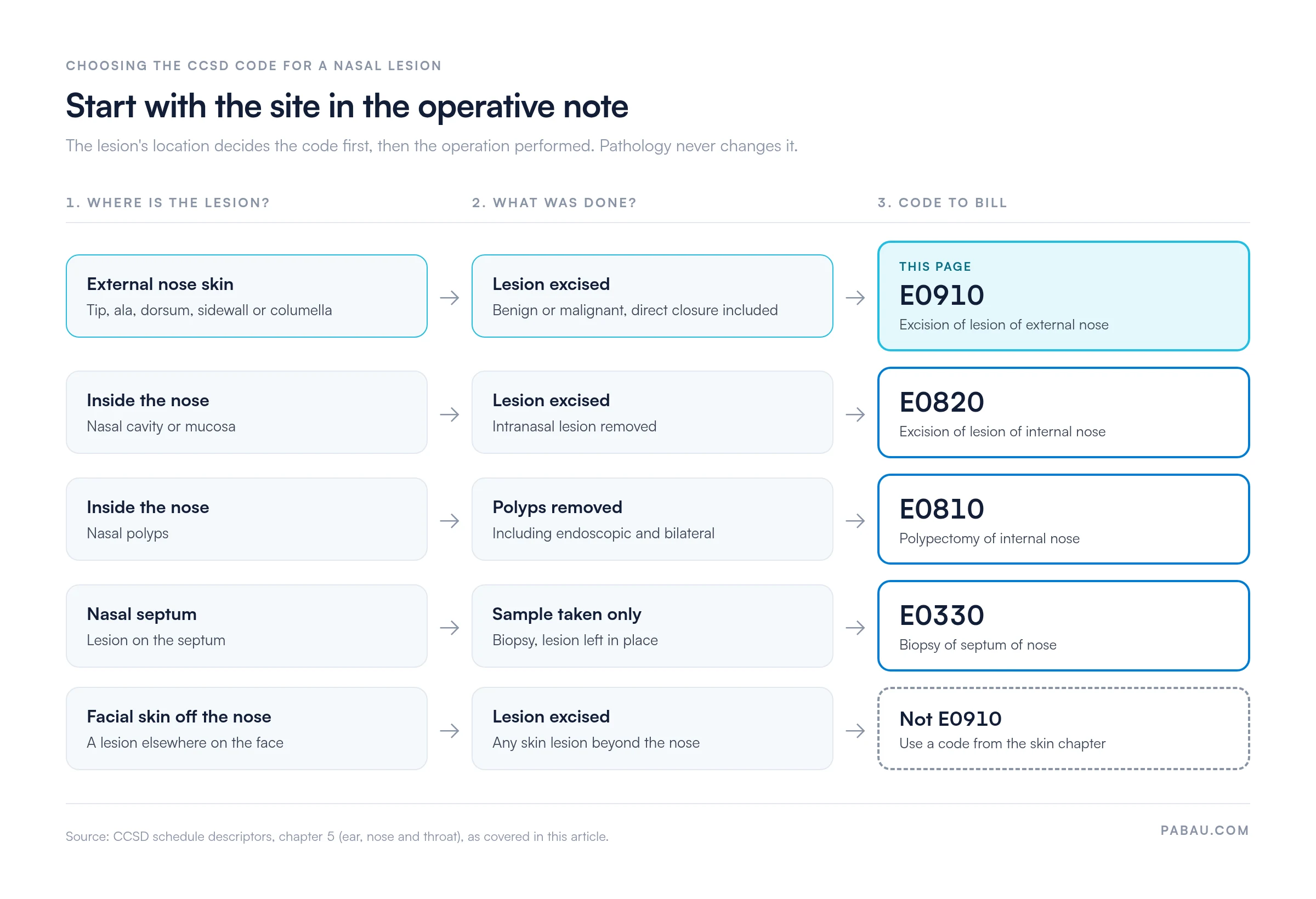
Several nose codes sit near E0910 in Chapter 5. They get mixed up when the site or the operation differs from a simple external excision.
The most common mix-up is E0910 versus E0820. If the note names the nasal mucosa or the septum, E0910 does not apply. Skin lesions elsewhere on the face are coded from the skin chapter of the schedule instead.
A septal lesion that is only sampled takes E0330. Rebuilding the nasal framework after tumor removal takes E0230. Read the site in the operative note first, then the operation, as the path below shows.
For how one major insurer applies the wider schedule, see our guide to Bupa CCSD codes.
The CCSD schedule has no CPT-style modifiers. Instead, each code carries notes and a list of unacceptable combinations. Check the E0910 listing on the CCSD website before you add a second code to the claim.
An operative note for E0910 should hold each item below. Insurers query claims whose note leaves one of them out.
Most UK private medical insurers expect the patient to get authorization before planned treatment. Rules differ between insurers such as Bupa, AXA Health, Aviva and Vitality, so check before the procedure date.
The patient often calls the insurer, but the practice needs these details on file:
Treating without authorization risks a declined claim, leaving the patient to pay. Most policies also exclude cosmetic treatment. Record the clinical reason for removal, such as bleeding, growth or suspected cancer.
Most UK practices send E0910 claims electronically through Healthcode, the UK’s private healthcare clearing house. The steps below follow a typical workflow in private practice claims software.
Returned E0910 claims follow a few predictable patterns. Most are fixed at the coding and documentation stage, long before an appeal.
Review returned E0910 claims once a month and group them by reason. If site and diagnosis mismatches keep appearing, update your team’s ICD-10 crosswalk for external nasal lesions.
The CCSD Group sets codes and descriptors, not fees. Each insurer publishes its own fee or benefit limit for E0910. Freedom Health Insurance, for example, bands E0910 as Minor in its Freedom Elite schedule, effective October 1, 2026. It pays a specialist fee of £100 and an anesthetist fee of £194.
What the consultant receives depends on a few factors:
Check current figures in each insurer’s provider tools, such as the Healix fee schedule and the Vitality fee finder. Then update your practice’s price list whenever an insurer revises its fees.
Nasal lesion claims often fail on admin. The note sits in one system, the invoice in another, and the authorization number in an inbox.
Pabau, the practice management and billing platform we build, holds all three on one patient record. Through its Healthcode integration, your team turns an insured patient’s invoice into an electronic claim. Claims are checked against Healthcode’s validation rules before they are sent.
Claim status is then tracked from the claims dashboard. The team can see which E0910 claims are still outstanding without logging into a separate portal.
For surgical practices, Pabau keeps consent forms and procedure notes with the claim. A nasal excision note template can prompt for site, size, margins and closure at the point of care.
Still comparing options? Our roundup of the best medical billing software in the UK shows how platforms handle private insurance claims.

Pabau keeps the operative note, invoice and authorization number on one patient record and submits CCSD-coded claims through Healthcode. Your team then tracks each claim until it is paid.

E0910 is one of the simpler nose codes to apply, because the site decides it. A lesion on the outside skin takes E0910, and one inside the nose takes another code.
When an E0910 claim comes back, the paperwork is usually to blame. A vague operative note, a missing authorization number or an intranasal diagnosis will send it back. Fix those three before the claim leaves the practice, and E0910 rarely needs a second look.
If your team still chases notes and authorization numbers across systems, start there. Book a demo to see how Pabau keeps ENT claims and records together.

Treating recurrent nosebleeds? CCSD code E0380 explains how to code nasal septum cauterization.
New to CCSD coding? CCSD codes explained covers how the schedule is built and maintained.
E0910 covers excision of a lesion from the skin or soft tissue of the external nose. That includes the tip, ala, dorsum, sidewall and columella. Lesions inside the nasal cavity, on the septum or on the turbinates use other codes.
No. CCSD codes are UK private medical insurance codes, maintained by the Clinical Coding & Schedule Development Group. South African procedure billing uses CCSA and scheme-specific Reference Price List (RPL) codes instead.
No. E0910 applies to benign and malignant lesions alike. The ICD-10 diagnosis on the claim, such as D23.3 or C44.3, tells the insurer what was removed.
Direct closure with sutures is part of the excision. A local flap or skin graft may carry its own CCSD code, subject to the insurer’s rules and the code’s unacceptable combinations.
Usually, yes. Most UK private medical insurers expect the patient to get authorization before planned treatment. Record the authorization number on the claim.
Each insurer sets its own fee, because the CCSD Group maintains codes and descriptors only. Freedom Health Insurance, for example, bands E0910 as Minor, with a specialist fee of £100.