CPT Code 59320: Cervical cerclage billing and coding guide
CPT Code 59320: Official description and procedure overview CPT Code 59320 is de...

Last Updated: Nov 20, 2026
S0642 is the CCSD code for excising four or more skin or subcutaneous lesions from the head and neck, with lipomas excluded. Its official descriptor is "Excision of lesion of skin or subcutaneous tissue - four or more, Head & Neck (excluding lipoma)". It sits in chapter 15 of the schedule, skin and subcutaneous tissue.
Up to three lesions at the same site take S0632 instead, and four or more on the trunk or limbs take S0643. National Friendly's published schedule places S0642 in the Intermediate complexity band.
Let Pabau's smart automation suggest the right codes, reduce claim denials, and keep your practice compliant—effortlessly.
Automate repetitive tasks and focus on what matters most—your patients.
Reduce coding errors and ensure compliance with the latest regulations.
Clean claims, fewer denials, and faster reimbursements.
Powerful insights and reporting to help your practice thrive.
HIPAA compliant SOC 2 certified GDPR-compliant Trusted by 4,000+ clinics worldwide

CCSD code S0642 covers excision of four or more skin or subcutaneous lesions on the head and neck, with lipomas excluded.
Up to three head and neck lesions take S0632, and four or more on the trunk or limbs take S0643.
The CCSD entry for S0602 lists S0642 as an unacceptable combination, so the two shouldn’t share an occasion.
Each UK insurer sets its own fee, so check the current schedule in your provider agreement before you invoice.
Record every lesion and its site in the procedure note, because the count and the site decide the code.
CCSD code S0642 is the procedure code for excising four or more skin or subcutaneous lesions from the head and neck. National Friendly’s schedule of fees places it in the Intermediate complexity band. The descriptor there reads “Excision of lesion of skin or subcutaneous tissue – four or more, Head & Neck (excluding lipoma)”.
It sits in chapter 15 of the schedule, skin and subcutaneous tissue, under Lesions of Skin. Lipomas are excluded by name, and a small lipoma under 10 cm has its own code, S0656.
The descriptor counts lesions and names a site, and those two facts drive the coding. Excision of a malignant lesion has dedicated codes of its own, S0602 to S0605, split by site and by first or repeat excision.
The Clinical Coding and Schedule Development (CCSD) group maintains the schedule that UK private medical insurers such as Bupa, AXA Health and Aviva work from. Its full S0642 entry, with the coding principles, sits behind a login, so check it there before you rely on any summary. For the neighboring codes in plain English, start with our CCSD code guides.
The procedure note decides the code through two facts, how many lesions came off and where they were. Before you count, rule out the cases S0642 never covers. These four checks, in order, settle it.
Put the count and the site together and each combination lands on one code. The grid shows why the fourth head and neck lesion matters most.
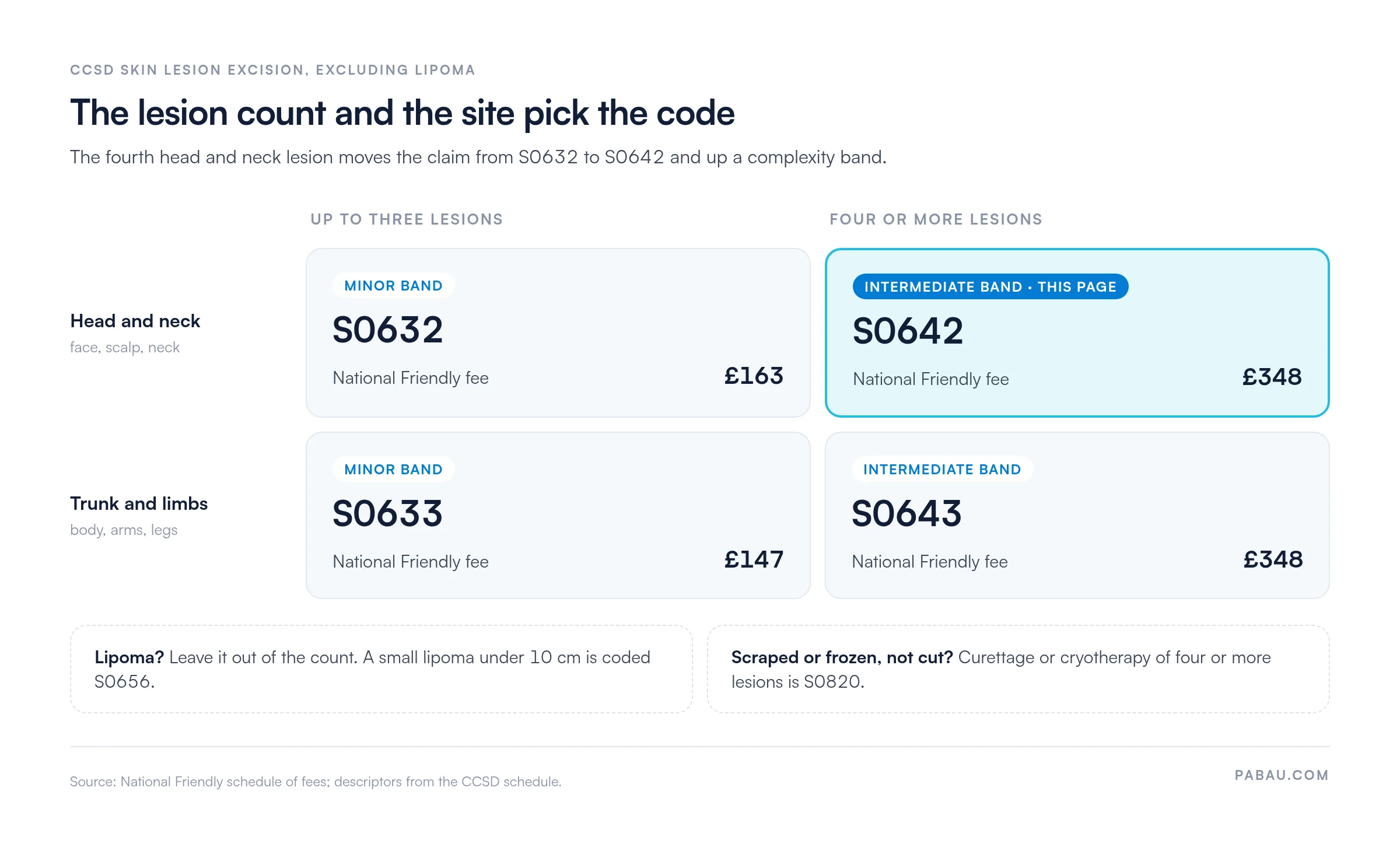
The table adds each code’s full descriptor, including the lipoma and curettage codes, from the same published insurer schedule.
Look at what the fourth lesion does. In that schedule it lifts a head and neck claim from £163 under S0632 to £348 under S0642. An insurer has every reason to check the count against your note, so make sure the note supports it.
The CCSD schedule flags codes that shouldn’t be billed together on the same occasion as “unacceptable combinations”. The entry for CCSD code S0602, primary excision of a malignant head and neck lesion, lists S0642 as one of them. That rule was added on February 7, 2014.
It bites when one of several facial lesions is already known to be malignant. Ask the insurer how it wants that session coded before the procedure, rather than finding out when the remittance comes back short.
The combination lists are guidelines, and each insurer decides what it reimburses. S0642’s own entry may list further combinations, so read it on the CCSD site before you add a second code. Histology on the excised tissue is a separate pathology service and isn’t billed under S0642.
Most practices send CCSD claims electronically through Healthcode, or through an insurer’s own provider portal. Here’s the route an S0642 claim takes.
Fees and authorization rules differ by insurer. These are the places to confirm them before you book.
Our guide to Bupa CCSD codes shows how Bupa’s code search and fee schedule fit together.
Here’s how one illustrative case codes out. A consultant dermatologist sees a patient referred with five symptomatic skin lesions, three on the face and two on the neck.
All five sit on the head and neck, so the count passes four and the code is S0642. The practice requests authorization for S0642 with the planned count. On the day, the note records each lesion’s site, size and closure.
Now change one detail. The consultant decides on the day that two neck lesions can wait. Three lesions is S0632, a Minor-band code, so the practice tells the insurer before invoicing instead of billing the authorized S0642.
Run through this list before the invoice goes out. Each item answers a question an insurer can ask when it queries the claim.
These are the patterns that send a multi-lesion claim back. Each one has a fix you can build into the workflow.
In many practices, the authorization sits in an email and the lesion count sits in the note. The invoice then gets typed up from both, and that’s where a three turns into a four.
Pabau, a practice management platform, keeps the authorization, the procedure note and the invoice on one patient record. With Pabau’s claims management, UK claims go to Healthcode straight from that record.
Consent forms and procedure notes are completed on the same record. When an insurer queries the lesion count, you send the note from the file instead of chasing paper.

Pabau keeps the procedure note, the authorization and the invoice on one record, and sends UK claims through Healthcode. Your S0642 invoices leave the practice complete.

S0642 is a counting code. Four or more lesions on the head and neck earn it, while three or fewer, or a different site, move the claim to a neighbor.
So the work that protects the claim happens in the note. List every lesion with its site, confirm the authorization still matches the count on the day, and keep S0602 off the same occasion. Do that, and the invoice becomes a formality.
Book a demo to see how Pabau keeps the note, the authorization and the S0642 claim on one record.

Excising a malignant lesion in the same session? CCSD code S0602 covers primary excision of a malignant head and neck lesion and lists S0642 as an unacceptable combination.
Going back for clearer margins? CCSD code S0605 covers re-excision of a malignant lesion.
Closing a benign lesion defect with a flap? CCSD code S0655 covers flap closure after a benign lesion is excised.
Treating lesions with a laser instead? CCSD code S0922 covers laser destruction of skin lesions over areas up to 25 cm².
Lasering a larger area of skin? CCSD code S0923 covers laser destruction of skin lesions over areas larger than 25 cm².
No. S0642 describes excision. Laser destruction of skin lesions has its own codes, S0922 for areas up to 25 cm² and S0923 for larger areas.
S0820 covers curettage or cryotherapy of four or more skin lesions, including cauterization. Use it when the lesions are scraped or frozen rather than cut out.
No. Mohs micrographic surgery has its own codes, such as S0520 for Mohs excision with immediate reconstruction. Check the CCSD entry for the right Mohs code before you request authorization.
Usually not, because private medical insurance policies commonly exclude purely cosmetic treatment. Record the clinical reason for each lesion and confirm cover before you book.
Each insurer sets its own fee, because the CCSD schedule doesn’t set fees. National Friendly’s published schedule lists £348 for S0642, so check the current schedule in your provider agreement.