CCSD code E0820 – Excision of internal nasal lesion
Code Definition
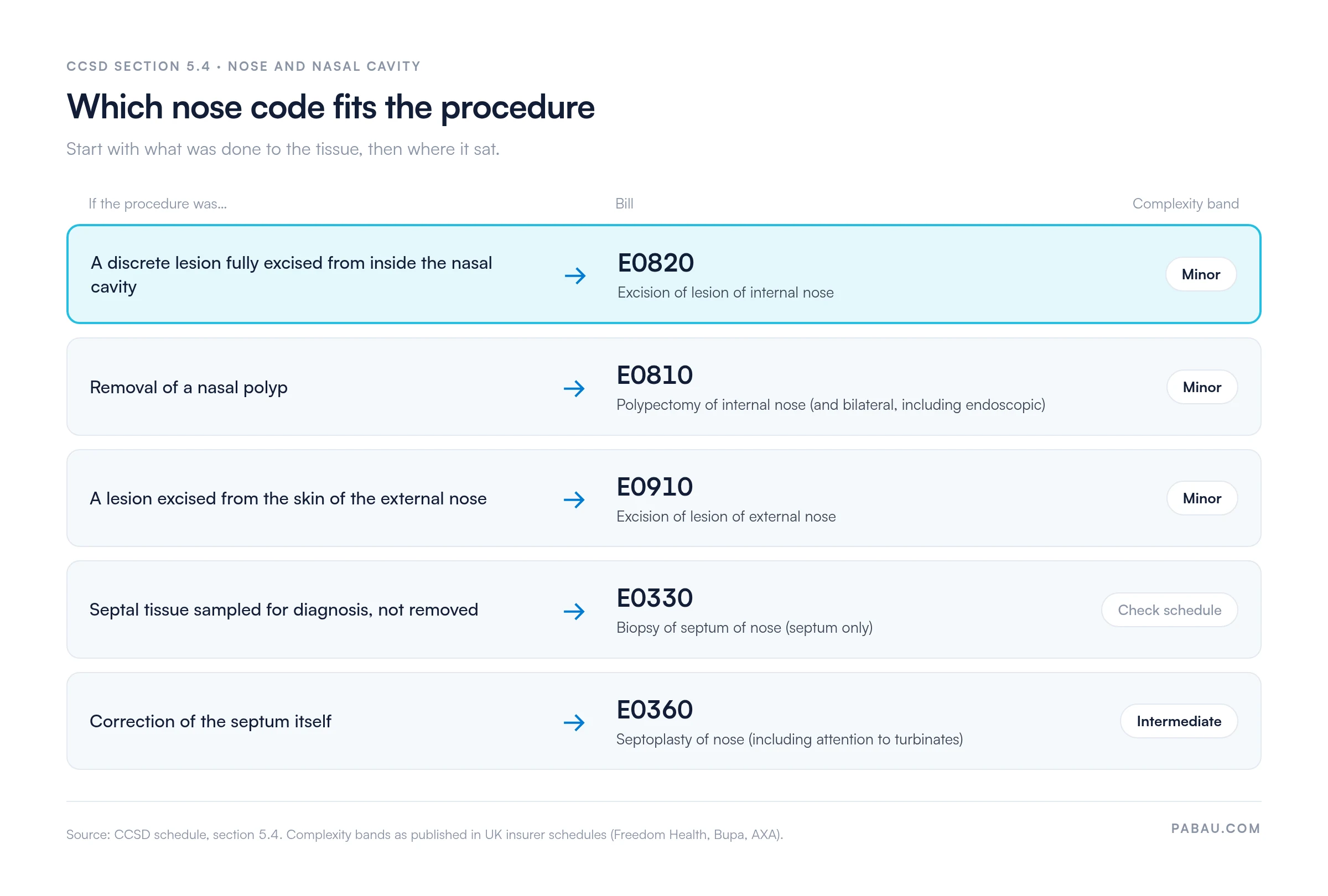
E0820 is the CCSD code for excision of lesion of internal nose. UK private insurers use it when an ENT surgeon removes a discrete lesion, such as a papilloma, granuloma or haemangioma, from the nasal lining.
E0820 sits in Chapter 5 (Ear, nose and throat), section 5.4 Nose and nasal cavity, and insurer schedules band it as Minor. Nasal polyps are billed under E0810, and lesions on the external nose under E0910.
Automate repetitive tasks and focus on what matters most—your patients.
Improve accuracy
Reduce coding errors and ensure compliance with the latest regulations.
Get paid faster
Clean claims, fewer denials, and faster reimbursements.
Grow with confidence
Powerful insights and reporting to help your practice thrive.
HIPAA compliant•SOC 2 certified•GDPR-compliant•Trusted by 4,000+ clinics worldwide
Key takeaways
CCSD Code E0820 covers excision of a discrete lesion from inside the nasal cavity. Nasal polyps take E0810, and lesions on the external nose take E0910.
A detailed operative note naming the lesion type, anatomical site, surgical approach and histology dispatch is the most important claim-support document.
Most major UK private insurers require pre-authorisation before elective intranasal surgery. A claim without a valid pre-auth reference is one of the most common denial triggers.
E0820 sits in the Minor complexity band. Each insurer sets its own fee for it, and the band does not change with the anaesthetic used.
Practice software such as Pabau keeps the operative note, the pre-auth number and the CCSD-coded invoice on one patient record, ready to send through Healthcode.
CCSD Code E0820: definition and clinical scope
CCSD Code E0820 covers excision of a lesion of the internal nose. It falls within Chapter 5 (Ear, nose and throat), section 5.4 Nose and nasal cavity, of the CCSD. The CCSD (Clinical Coding and Schedule Development) schedule is the code set UK private insurers use for billing. Use E0820 when an ENT surgeon excises a discrete lesion from the mucosal lining of the nasal cavity. Typical examples are a granuloma, papilloma, haemangioma or fibroma.
Insurer schedules, including Freedom Health, Bupa and AXA, place E0820 in the Minor complexity band. Pabau’s library of CCSD codes covers the other procedures in the nose and nasal cavity section.
The code applies only to lesions of the internal nose. Bill a lesion on the external nasal skin, nasal tip or alar rim under E0910 (Excision of lesion of external nose). That code is also Minor. Nasal vestibule lesions, at the very entrance of the nostril, may need a separate code depending on the clinical picture and the insurer’s coding policy.
What the procedure involves
Excision of a lesion of the internal nose follows a set surgical workflow. Knowing each step helps with both accurate coding and a robust operative note.
Anaesthesia: Surgeons may use local anaesthesia (LA) or general anaesthesia (GA), depending on lesion size, patient tolerance and surgical access. Record which one you used. Under GA, the anaesthetist bills their own fee separately.
Surgical access: The surgeon approaches the lesion through the nostril, using direct visualisation with a nasal speculum or a rigid nasal endoscope. Endoscopic approaches are now common, so name yours in the operative note.
Excision: The surgeon cuts the lesion from the nasal mucosa with a margin that suits its type. Options include cold-steel scissors, a microdebrider or a diathermy instrument.
Haemostasis: The surgeon controls bleeding with bipolar cautery, packing or absorbable material as appropriate. Record the method.
Specimen handling: The surgeon normally sends the tissue for histology. Insurers differ on whether they require it, but noting the specimen’s dispatch to pathology strongly supports the claim.
What E0820 covers and what it does not
Clear scope prevents the two most common coding errors. One is using E0820 for a procedure it does not cover, and the other is missing it when it applies.
Direct visualisation via nasal speculum (anterior rhinoscopy), rigid nasal endoscope
Procedures extended to sinus surgery (code separately)
Anaesthesia
Local or general anaesthesia
Anaesthetist’s fees (billed separately by the anaesthetist)
Neighbouring codes: E0820 vs related CCSD nasal codes
Choosing between E0820 and its CCSD neighbours is the most common coding decision here. Start from what you did to the tissue, then use the table for each code’s key distinction. Check numbers against the live CCSD schedule, because CCSD revises descriptors.
What happened to the tissue decides the code, and only E0360 moves up to the Intermediate band. Codes from the CCSD schedule, with bands from UK insurer schedules.
Code
Descriptor
Use when
Key distinction from E0820
E0820
Excision of lesion of internal nose
Discrete intranasal mucosal lesion is excised
Primary reference code for this guide
E0810
Polypectomy of internal nose (and bilateral, including endoscopic)
The pathology is a nasal polyp, confirmed clinically or histologically
Polyps and lesions are coded separately. E0810 is also Minor, but E0820 for a polyp is a coding error.
E0330
Biopsy of septum of nose
Septal tissue is sampled for diagnosis only
Covers the septum only. Use E0820 when the lesion is fully removed.
E0360
Septoplasty of nose (including attention to turbinates)
The procedure corrects the septal structure, not a discrete mucosal lesion
Intermediate band. E0820 may be added if a lesion is separately excised, subject to bundling rules.
E0910
Excision of lesion of external nose
The lesion sits on the skin of the external nose
External nose rather than internal nasal cavity. Also Minor.
E0610
Packing of cavity of nose (as sole procedure)
Nasal packing is the only procedure performed
Packing used for haemostasis during an E0820 excision is not billed separately.
Bundling caution: whether E0820 may be billed alongside another nasal or sinus code on the same date depends on each insurer’s schedule. Confirm with the payer before submitting a dual-code claim.
If the surgeon only samples a septal lesion, use E0330 instead.
Documentation requirements for E0820
A well-built operative note is the primary defence against claim denial for CCSD Code E0820. Digital clinical documentation helps capture each mandatory element at the point of care, rather than reconstructing it from memory. The note must include all of the following.
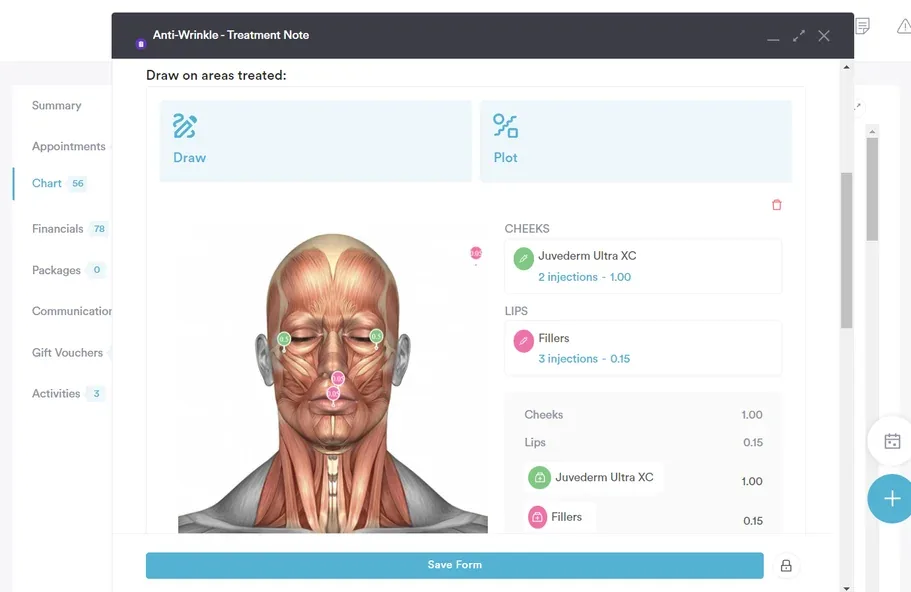
Pabau’s treatment notes let the surgeon draw or plot on an anatomical diagram, so the operative note shows exactly where the lesion sat.
Lesion description: clinical appearance, size (in millimetres where recorded), and suspected or confirmed pathological type (granuloma, papilloma, haemangioma, fibroma).
Anatomical site: precise location within the internal nasal cavity: septum, inferior or middle turbinate, lateral wall, or nasal roof.
Surgical approach: whether the procedure used direct visualisation or rigid nasal endoscopy, and the instruments used for excision.
Anaesthetic method: local or general anaesthesia, with relevant agents noted.
Excision confirmation: statement that the surgeon fully excised the lesion with the intended margin.
Haemostasis: method used to control bleeding post-excision.
Histopathology: confirmation that you sent the specimen to pathology, with the request reference number. Many insurers expect histological confirmation for a lesion claim, so recording the dispatch removes doubt during claims review.
Pre-authorisation reference number: must appear on both the operative note and the invoice.
Storing the operative note in a structured patient record linked to the invoice cuts retrieval time when an insurer asks for supporting documentation.
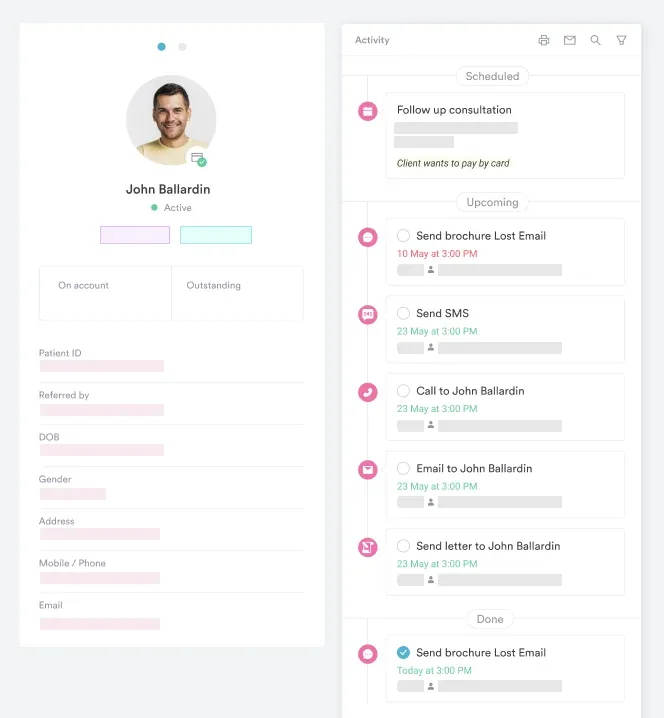
Pabau’s Client records keep patient details and follow-ups in one timeline, so the operative note is to hand when an insurer queries the claim.
Pre-authorisation requirements from UK private insurers
Elective nasal surgery under UK private medical insurance almost always requires pre-authorisation. The table below covers the major insurers that process CCSD claims. Verify current requirements with each payer before booking, as policies change. For Bupa-specific coding and pre-auth guidance, see the Bupa CCSD codes guide.
When requesting pre-authorisation, submit the following:
the patient’s policy number and the proposed CCSD code (E0820)
the clinical indication, meaning the lesion type and symptoms
the planned date and setting (day case or inpatient)
the surgeon’s recognition number
How to bill E0820: step-by-step process
The following workflow applies to claims submitted through Healthcode, the main UK private healthcare billing clearing house, and to direct invoicing. Use Pabau’s private practice billing software to manage the full billing cycle.
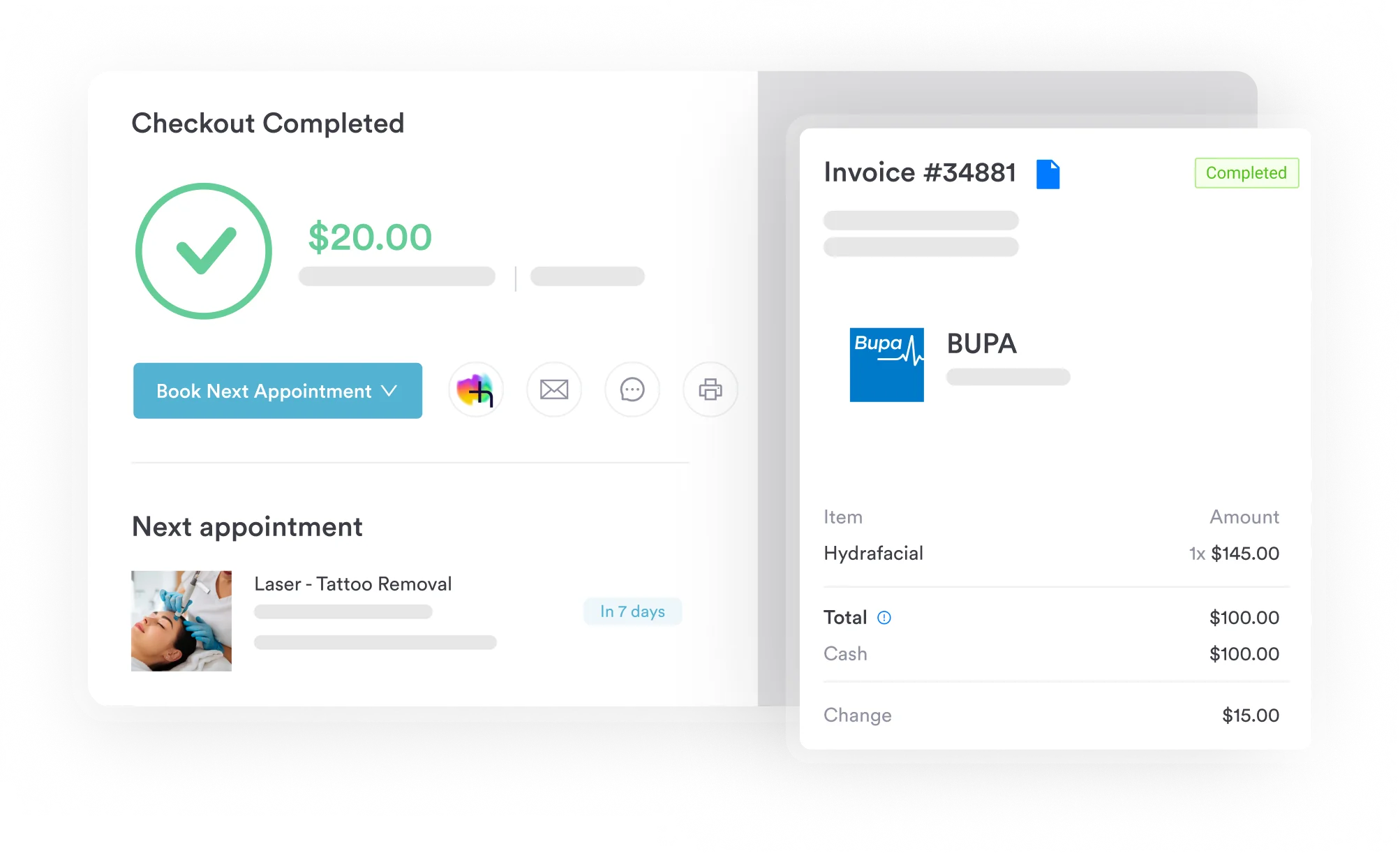
A completed checkout in Pabau raises the invoice against the patient’s insurer, here Bupa, ready to send through Healthcode without re-keying patient details.
Confirm pre-authorisation: obtain a valid pre-auth reference number before the procedure date. Record it in the patient record and on the invoice.
Complete the operative note: document all mandatory elements listed in the documentation section above before signing off. Do not rely on post-procedure reconstruction.
Code the claim: apply CCSD Code E0820 to the procedure line. If the surgeon did a second procedure at the same operation, ask the insurer whether both codes may be billed. Confirm what percentage of the second fee it pays.
Set the fee: use the insurer’s own fee schedule for E0820 or your contracted rate. Include the surgeon’s fee, any assistant surgeon fee, and the day case or inpatient supplement as agreed.
Submit via Healthcode or direct invoice: include the pre-auth reference, the E0820 code, the procedure date and the surgeon’s GMC number. Add the hospital or practice name and the patient’s policy number. Attach the operative note and histology request slip where the insurer requires supporting documents at submission.
Monitor the remittance advice: check the explanation of benefits for any payment shortfall, query or denial reason code, and act within the insurer’s appeal window.
Pro Tip
Check each insurer’s current schedule before setting your fee. Each insurer sets its own fee for E0820, and the anaesthetist’s fee, where one is involved, is billed separately and varies too.
Common reasons E0820 claims are denied
Understanding denial patterns for CCSD Code E0820 helps practices build defences into their submission workflow rather than dealing with rejections after the fact.
Denial reason
What causes it
Preventive action
Missing pre-authorisation
No reference number on invoice; pre-auth obtained after the procedure date
Obtain pre-auth before booking the theatre slot
Wrong code selected
E0820 used for a nasal polyp that should be coded as E0810 polypectomy
Confirm the lesion pathology before selecting the code; use histology to support the choice
Inadequate operative note
Note lacks lesion description, anatomical site, or surgical approach detail
Use a structured template covering all mandatory elements before each submission
Unbundling error
E0820 billed alongside a code the insurer considers included in a primary procedure
Check insurer-specific bundling rules before submitting dual-code claims
No histology reference
Insurer requires pathology confirmation; none documented in the note
Record the pathology request number in the operative note at the time of surgery
Policy exclusion
Patient’s policy excludes the condition being treated (e.g. pre-existing condition clause)
Verify policy coverage at pre-auth stage; obtain written insurer confirmation before proceeding
Appealing a denied E0820 claim
Most UK private insurers publish a formal appeal process. Acting promptly and providing structured clinical evidence gives the strongest chance of reversal.
Obtain the denial rationale: request the insurer’s written explanation of benefit (EOB) or denial letter. The specific reason code determines the appropriate response.
Match your response to the denial reason: missing pre-auth denials need proof the pre-auth was in place, or a retrospective authorisation request. Wrong-code denials need clinical evidence that E0820, not E0810, was the right code.
Gather supporting documentation: compile the operative note, histopathology report, pre-auth correspondence, and any referring clinician letters that support the clinical necessity of the procedure.
Write a covering letter: quote the E0820 descriptor, “excision of lesion of internal nose”, word for word. Then explain why the procedure meets this descriptor rather than any code the insurer substituted.
Submit within the appeal window: most insurers allow 30 to 90 days from the denial date. The EOB will state the specific deadline.
Escalate if needed: if the first-level appeal fails, most insurers offer a second-level clinical review or independent adjudication. For disputes involving significant sums, professional bodies such as ENT UK or the BMA can provide template letters and escalation guidance.
Fee schedule and reimbursement rates for E0820
There is no single rate for CCSD Code E0820. Each insurer publishes its own fee schedule for the code, and many surgeons also hold contracted or recognised rates with individual insurers. The complexity band (Minor) attaches to the code itself, not to the anaesthetic used.
Anaesthetist’s fee: under GA, the anaesthetist bills separately, and that fee varies by insurer too.
Setting: day case procedures are usually reimbursed at a different rate to inpatient admissions.
Assistant surgeon: if a surgical assistant is used, an additional CCSD assistant code may apply. Confirm with the insurer whether this is payable separately.
Annual updates: insurers revise their fee schedules, usually once a year. Check the current schedule before quoting a patient or invoicing, using the fee finders linked in the pre-authorisation section above. Never quote a pound figure without checking it against the insurer’s current published schedule.
Pro Tip
Send patients a written fee estimate before the procedure, including the surgeon’s fee, any assistant fee, the facility charge, and the anaesthetist’s fee if GA. Setting expectations clearly reduces payment disputes and missed billing queries after discharge.
How Pabau keeps E0820 claims complete from pre-auth to payment
Many ENT practices keep the pre-auth email in one inbox, the operative note in a hospital system and the invoice in a spreadsheet. When Bupa or AXA queries an E0820 claim, someone has to pull all three together by hand.
In Pabau, the pre-auth reference, the operative note and the histology request sit on the same patient record as the invoice. Pabau raises the invoice against the patient’s insurer, sends it through Healthcode, and then tracks the remittance against it.
The result is fewer claims bounced for a missing reference number, and faster answers when an insurer asks to see the note.
Send complete CCSD claims through Healthcode
Pabau keeps the operative note, pre-auth reference and CCSD-coded invoice on one patient record. E0820 claims leave complete, and insurer queries get answered fast.
For an internal nasal lesion, you usually settle the coding call before the patient reaches theatre. Confirm the lesion is a discrete mucosal lesion rather than a polyp, and that it sits inside the nasal cavity rather than on the skin. Then get the pre-auth reference in writing.
With those settled, the remaining risk sits in the operative note. A note that names the site, the approach and the histology dispatch turns most insurer queries into a quick reply instead of an appeal.
Book a demo to see how Pabau keeps your ENT operative notes, pre-auth references and Healthcode claims in one place.
Continue your research
Need Bupa-specific coding guidance?Bupa CCSD codes guide covers the Bupa fee schedule, code lookup, and invoicing requirements for UK private practice.
Only sampling a septal lesion?CCSD code E0330 covers billing for biopsy of the septum of the nose.
Removing septal cartilage or bone?CCSD code E0310 covers submucous resection of the nasal septum.
Dividing intranasal adhesions?CCSD code E0440 covers division of adhesions of the turbinate of the nose.
Frequently asked questions
What does CCSD Code E0820 cover?
CCSD Code E0820 is the UK private healthcare procedure code for excision of a lesion of the internal nose. It covers discrete mucosal lesions such as granulomas, papillomas, haemangiomas and fibromas arising within the nasal cavity. Nasal polyps take E0810, and lesions on the external nose take E0910.
What documentation is required to bill E0820?
The operative note must include the lesion description and size, its precise site in the nasal cavity, and the surgical approach. It should also record the anaesthetic type, complete excision, the haemostasis method, the histopathology dispatch reference and the pre-authorisation number. All of these must be in place before the claim is submitted.
What is the difference between E0820 and E0810?
E0820 applies to discrete mucosal lesions such as granulomas, papillomas, fibromas and haemangiomas. E0810, Polypectomy of internal nose, applies when the pathology is a nasal polyp. Using one in place of the other is a coding error that commonly triggers denial. Histopathology is the clinical basis for telling them apart.
What is the typical fee schedule rate for E0820 in UK private practice?
There is no single rate. Each insurer sets its own fee for E0820, which sits in the Minor complexity band whichever anaesthetic is used. The anaesthetist’s fee, where one is involved, is billed separately and also varies. Check the insurer’s current fee schedule or online fee finder before quoting a patient or invoicing.