HCPCS Code G0163: Skilled nursing observation and assessment
What is HCPCS Code G0163? HCPCS Code G0163 is a deleted Level II code for skille...

Last Updated: Oct 15, 2026
C7123 is the CCSD code for phacoemulsification of cataract, without lens implant – unilateral (including topical or local anaesthetic). It covers ultrasonic removal of the crystalline lens from one eye, with no intraocular lens fitted at that sitting.
The code sits in CCSD Chapter 4, Eye and orbital contents, under the lens subsection, and carries an Intermediate complexity classification. Where an intraocular lens is implanted, C7122 is the unilateral code instead.
Let Pabau's smart automation suggest the right codes, reduce claim denials, and keep your practice compliant—effortlessly.
Automate repetitive tasks and focus on what matters most—your patients.
Reduce coding errors and ensure compliance with the latest regulations.
Clean claims, fewer denials, and faster reimbursements.
Powerful insights and reporting to help your practice thrive.
HIPAA compliant SOC 2 certified GDPR-compliant Trusted by 4,000+ clinics worldwide

CCSD Code C7123 covers phacoemulsification of cataract without lens implant, on one eye, under topical or local anaesthetic.
C7123 excludes the intraocular lens, so an implanted IOL moves the claim to C7122.
C7124 is the same procedure on both eyes, and it excludes the implant in the same way.
C7123 bundles topical and local anaesthetic, but general anaesthesia takes a separate code.
Pair C7123 with an H25 or H26 ICD-10 diagnosis and obtain pre-authorisation before the procedure.
CCSD Code C7123 describes phacoemulsification of cataract, without lens implant, performed on one eye, including topical or local anaesthetic. The procedure uses ultrasonic energy to emulsify and aspirate the crystalline lens, as the CCSD official schedule confirms. The code excludes insertion of an intraocular lens. However, where the surgeon implants an IOL, the correct code is C7122 for one eye, or C7125 for both.
Three elements define the scope of C7123, and all three must be present to use the code correctly:
Extracapsular extraction without phacoemulsification is a separate procedure in the schedule. One eye with no implant is billed under CCSD code C7110.
Phacoemulsification without IOL follows the same operative sequence as combined phaco-IOL surgery up to the point of lens insertion. Knowing the steps helps billing staff check that the operative note describes the correct technique before they submit C7123.
The procedure ends at step 6. An operative report that records IOL insertion rules C7123 out. The claim then moves to C7122 for one eye, or C7125 for both.
Several clinical scenarios produce a planned phacoemulsification without an IOL. Billing staff should expect to see one of them named in the operative note whenever a practice submits C7123.
The cataract codes in the CCSD schedule differ on technique, lens-implant status, and laterality. Two questions separate the four phacoemulsification entries. Did the surgeon fit an implant, and did the surgery cover one eye or both?
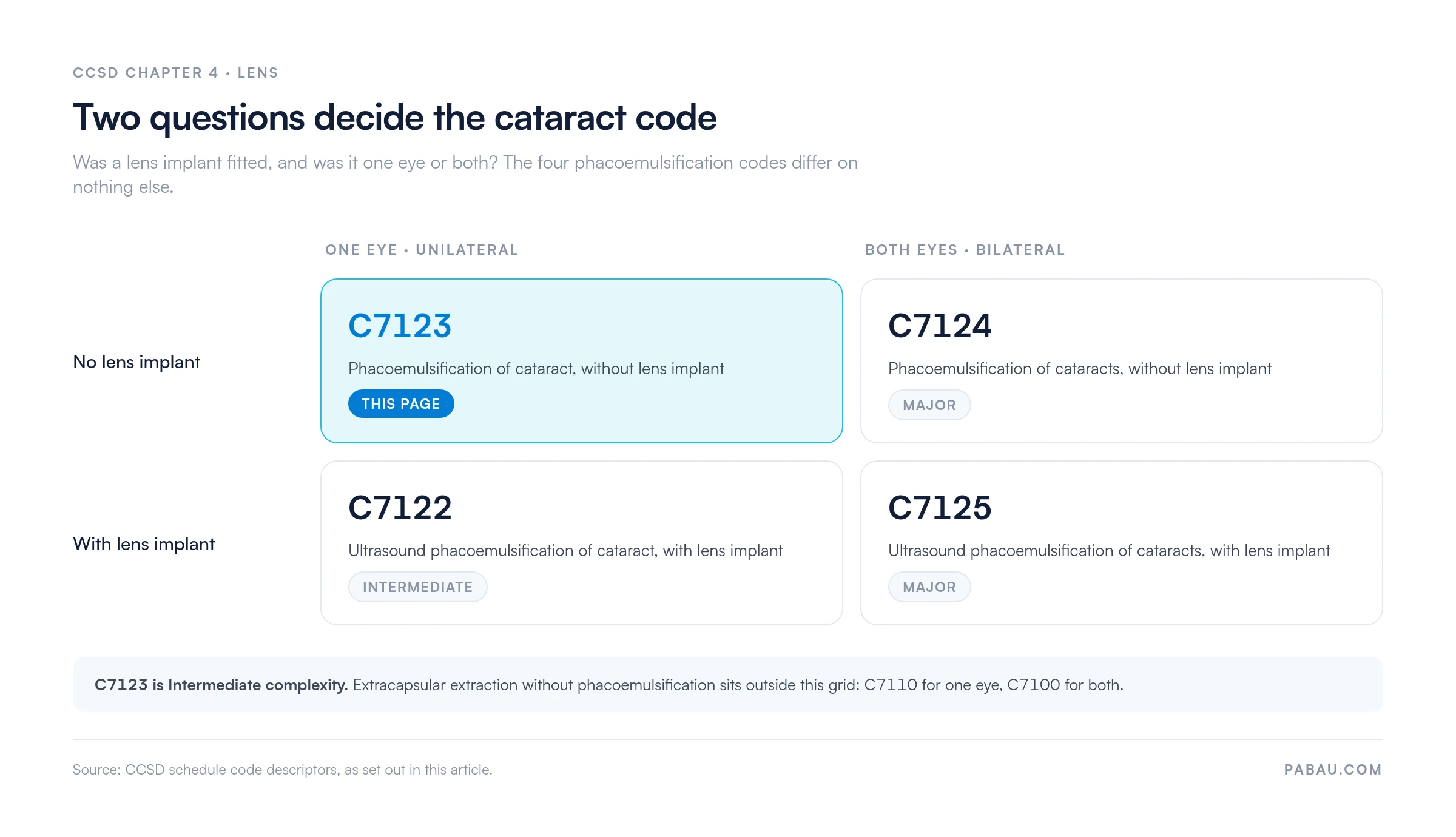
C7122 is the code billers most often confuse with C7123. Both cover one eye, and they differ only on whether the surgeon fitted an intraocular lens. C7124 differs from C7123 on laterality alone, so it also excludes the implant. Confirm the operative note records that the surgeon placed no IOL before billing C7123.
Where a case spans more than one specialty, the CCSD codes index lists the other procedure families in the schedule.
Every C7123 claim requires a supporting ICD-10 diagnosis code. Mismatched or insufficiently specific diagnosis codes are a leading cause of PMI rejection for cataract procedures. Therefore, use the ICD-10 category that matches the documented clinical finding.
The WHO ICD-10 browser gives the authoritative hierarchy for H25 and H26. Always select the most specific sub-code documented in the clinical notes. H25.9 and H26.9 are valid codes. However, PMI reviewers may still ask for clinical evidence of surgical necessity when the diagnosis is unspecified.
An operative note that omits key elements will trigger a request for further information, or an outright denial. For this reason, the note must support every element of the C7123 descriptor. A structured note template that prompts for each required field keeps an omission from reaching the claim.
The operative note must confirm:
Bupa, AXA Health, and Aviva all require pre-authorisation before the procedure. The authorisation number has to appear on the claim form, so record it against the patient as soon as it arrives. Storing operative notes digitally also brings the record under UK GDPR and the Data Protection Act 2018.
All major UK PMI payers typically require pre-authorisation for elective intraocular surgery, C7123 included. Billing without a valid authorisation number is a leading cause of denial on initial submission.
When requesting pre-auth, insurers generally ask for:
Each insurer operates its own portal. The Bupa code search tool lets practices verify that Bupa lists C7123 and check any payer-specific requirements before submission. For AXA Health, use the AXA Health procedure codes portal. Similarly, Aviva’s requirements sit on the Aviva fee schedule for practitioners. Confirm current pre-auth requirements directly with each payer, as payers update their terms periodically.
The Bupa CCSD codes guide covers the wider Bupa billing framework, including how to structure a pre-auth request and format a claim for acceptance.
Submitting C7123 correctly follows a set order. Missing a step usually brings a request for further information, which delays payment by weeks.
Run a pre-submission check on every C7123 claim. Confirm the authorisation number is present and the ICD-10 code matches the operative diagnosis. Then confirm the note states that the surgeon inserted no IOL. Those three points account for most initial denials.
A predictable set of reasons causes most C7123 denials. Most of them are preventable with a pre-submission check before the claim leaves the practice.
Occasionally a surgeon performs an additional procedure at the same sitting as phacoemulsification without IOL. Same-day co-billing follows the standard CCSD multiple-procedure reduction conventions. An anaesthetist who attends on standby without administering an agent submits a separate claim under CCSD code C7181, outside the surgeon’s invoice.
If that glaucoma procedure is a revision of earlier surgery rather than a first trabeculectomy, the revision bills under C6150. Combined cases still follow each payer’s multiple-procedure rules.
Check the current CCSD technical guide for multiple-procedure reduction percentages, as CCSD updates these periodically and they vary by payer contract.
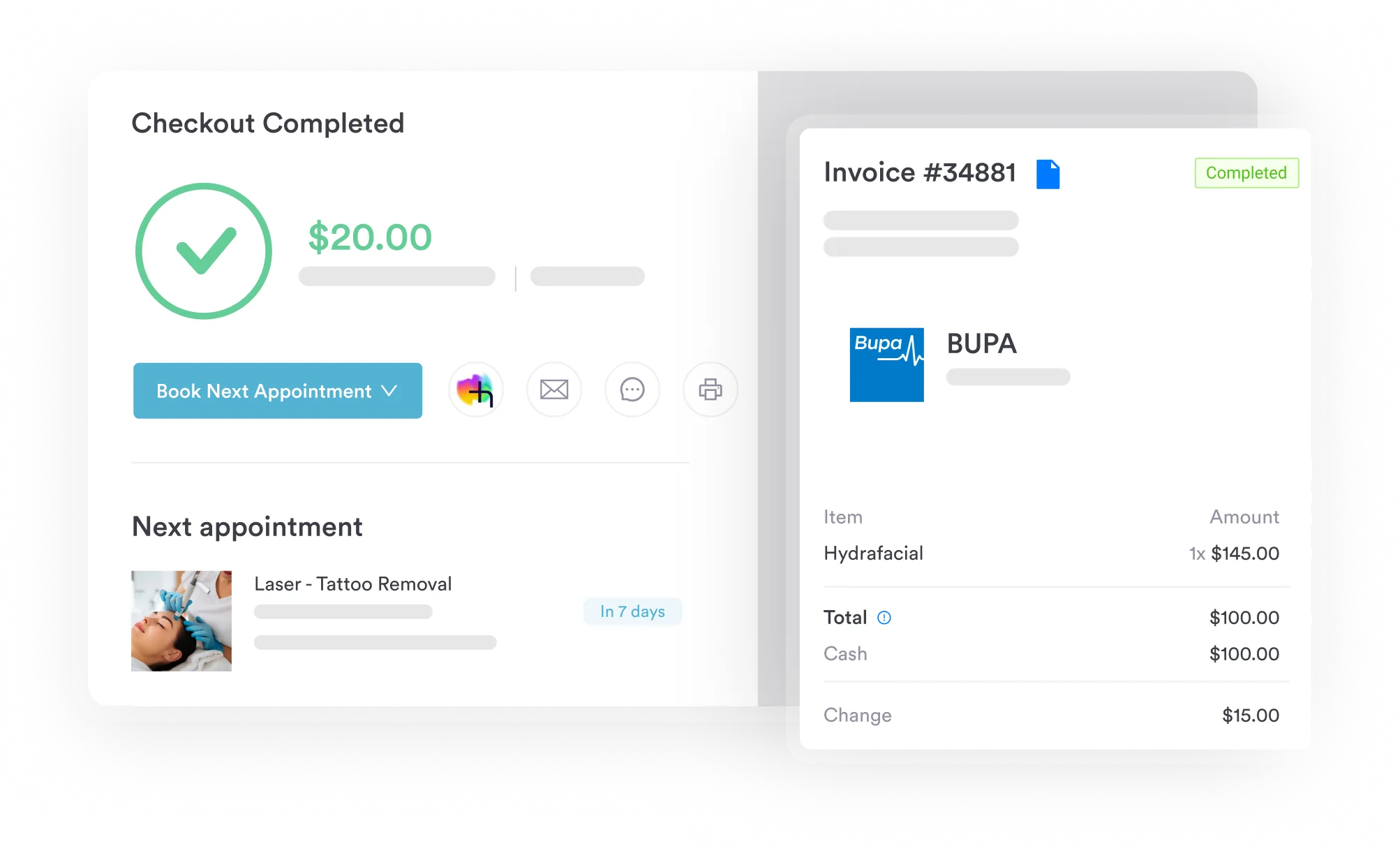
Practice management software like Pabau stores CCSD codes against each service, so billing staff select C7123 from the record instead of retyping it. Its medical claims management tools link the pre-authorisation number to the patient record before the procedure takes place. In addition, the signed operative note attaches to the claim before submission.
For C7123 workflows specifically, the platform covers the three friction points that generate most pre-submission errors:
Pabau also generates referral letters and pre-auth request templates from the same patient record, which cuts the administrative time behind each C7123 claim.

Pabau helps UK private ophthalmology practices track pre-authorisation numbers, attach operative notes to claims, and monitor denial status in one place. Your billing team spends less time chasing paperwork.

C7123 rests on a single fact in the operative note. If the surgeon implanted no lens and treated one eye, C7123 is the code. Any other combination sends the claim to C7122, C7124, or C7125.
Build that check into the workflow rather than leaving it to a coder’s memory. A claim that leaves with its authorisation number, a specific H25 or H26 diagnosis, and an explicit no-IOL statement rarely comes back.
Getting the code wrong seldom loses the claim outright. However, it does cost a resubmission cycle, and weeks of cash flow with it. Book a demo to see how Pabau handles CCSD billing for UK private ophthalmology practices.

Need a complete reference for Bupa CCSD billing? Bupa CCSD codes guide covers how Bupa processes CCSD procedure codes, including fee schedule structure and claim submission requirements.
Coding another anterior segment procedure? CCSD Code C6930 sets out anterior chamber injection billing, from the descriptor to the documentation a PMI payer expects.
Billing an iris procedure? CCSD Code C6450 covers removal of a foreign body from the iris, including pre-authorisation and claim submission.
CCSD Code C7123 covers phacoemulsification of cataract without lens implant, performed on one eye, including topical or local anaesthetic. It does not include intraocular lens insertion, general anaesthesia, or bilateral procedures.
C7123 and C7124 are both without-implant codes. C7123 covers one eye and C7124 covers both eyes on the same day. The unilateral code for phacoemulsification with a lens implant is C7122, not C7124.
No. The official CCSD descriptor states without lens implant. Where the surgeon inserts an IOL, the correct code is C7122 for one eye, or C7125 for both.
Yes, all major UK PMI payers, Bupa and AXA Health included, typically require pre-authorisation before elective intraocular surgery. Confirm current requirements directly with each insurer’s provider portal before the procedure date.
No. C7123 is a unilateral code. Where the surgeon treats both eyes on the same day, C7124 is the bilateral equivalent. Follow each payer’s bilateral billing rules, as two C7123 lines for one date trigger a duplicate-claim flag.
The most common pairings are H25.1 (nuclear senile cataract) and H25.8 (other senile cataract). Traumatic cataract uses H26.1, and paediatric presentations use H26.0. Avoid H25.9 or H26.9 unless the clinical record supports nothing more specific.