

CCSD code G5100: Bypass of duodenum billing guide
CCSD code G5100 bills a bypass that leaves the duodenum in place CCSD code G5100...

Last Updated: Oct 16, 2026
Billable Code
C7110 is the CCSD code for extracapsular cataract extraction without implant on one eye. The surgeon removes the lens nucleus and cortex through a large incision and leaves the posterior capsule in place. No intraocular lens (IOL) is inserted during the operation.
If a lens goes in during the same operation, the code is C7180. Extraction from both eyes without a lens is C7100, and phacoemulsification has its own codes, C7122 to C7125.
Let Pabau's smart automation suggest the right codes, reduce claim denials, and keep your practice compliant—effortlessly.
Automate repetitive tasks and focus on what matters most—your patients.
Reduce coding errors and ensure compliance with the latest regulations.
Clean claims, fewer denials, and faster reimbursements.
Powerful insights and reporting to help your practice thrive.
HIPAA compliant SOC 2 certified GDPR-compliant Trusted by 4,000+ clinics worldwide

CCSD code C7110 covers extracapsular cataract extraction from one eye, with no intraocular lens (IOL) inserted during the same operation.
If a lens goes in during the same operation, bill C7180 instead. Surgery on both eyes without a lens is C7100.
The operative note must state explicitly that no IOL was inserted, and why. It can’t be implied or left out.
Elective cataract surgery needs pre-authorization from the major UK private insurers, and the authorized code must match the code billed.
Bupa places C7110 in fee category INTER 3 and C7180 in INTER 4, so a mix-up changes the fee as well as the code.
CCSD code C7110 covers extracapsular extraction of a cataract from one eye, with no intraocular lens (IOL) inserted during the operation. It sits in section 4.9 (Lens) of the CCSD schedule of procedures, which UK private insurers use much as US payers use CPT. Three facts define the code. The technique is extracapsular, so the posterior capsule stays in place. The claim covers one eye, and no lens implant is included.
The “without implant” wording is part of the code itself, so there’s no modifier to add or drop. When an IOL goes in during the same operation, the claim moves to C7180. Like the other CCSD codes in the lens section, C7110 also has a bilateral twin, C7100, for surgery on both eyes in one session.
The table below sets out the code’s key billing attributes.
Extracapsular cataract extraction (ECCE) removes the cataract nucleus and cortex through a large incision, typically 10–12 mm, while leaving the posterior capsule intact. That capsule can later support a lens implant. In a C7110 case no implant follows, so the patient leaves aphakic (without a lens). The surgical steps run as follows.
Phacoemulsification with a lens implant is now the standard cataract operation in the UK, in NHS and private practice alike. Surgeons still choose ECCE without an implant in a few situations:
The procedure is far less common than it was 20 years ago, but it remains a current and billable procedure under the CCSD schedule. Because coders meet it rarely, the operative record needs to show the IOL decision clearly.
C7110 applies when the surgeon performs an extracapsular extraction and deliberately inserts no intraocular lens during the same operation. These are the scenarios where it’s the right choice.
In each scenario the billing question is the same. Was an IOL inserted during this operation? If yes, bill C7180. If no, bill C7110. Don’t infer the answer from the diagnosis, because the operative note has to state it.
Knowing what C7110 bundles, and what falls outside it, prevents both underbilling and claim inflation. The table below sets out the main inclusions and exclusions under standard CCSD bundling logic.
Insurers spell some of this out. Freedom Health’s fee schedule, for example, includes injections given during cataract removal in the surgery fee. It also bills a phaco case converted to ECCE as a single procedure.
Good claims management software helps by keeping the code, the operative note, and the claim side by side. Practice management software like Pabau holds all three in one patient record. That makes an excluded service easier to spot before the C7110 claim goes out.
Section 4.9 of the schedule codes cataract extraction on three axes: technique, lens, and number of eyes. Picking the wrong neighbor is the most common source of C7110 claim queries, and the C7110/C7180 mix-up leads the list. The table below compares them.
The most billing-critical line in this table is the one between C7110 and C7180. Both are extracapsular, and the only difference is the lens. Extracapsular surgery that implants a lens in both eyes in one session is C7190. The grid below turns the whole section into three questions you can answer from the operative note.
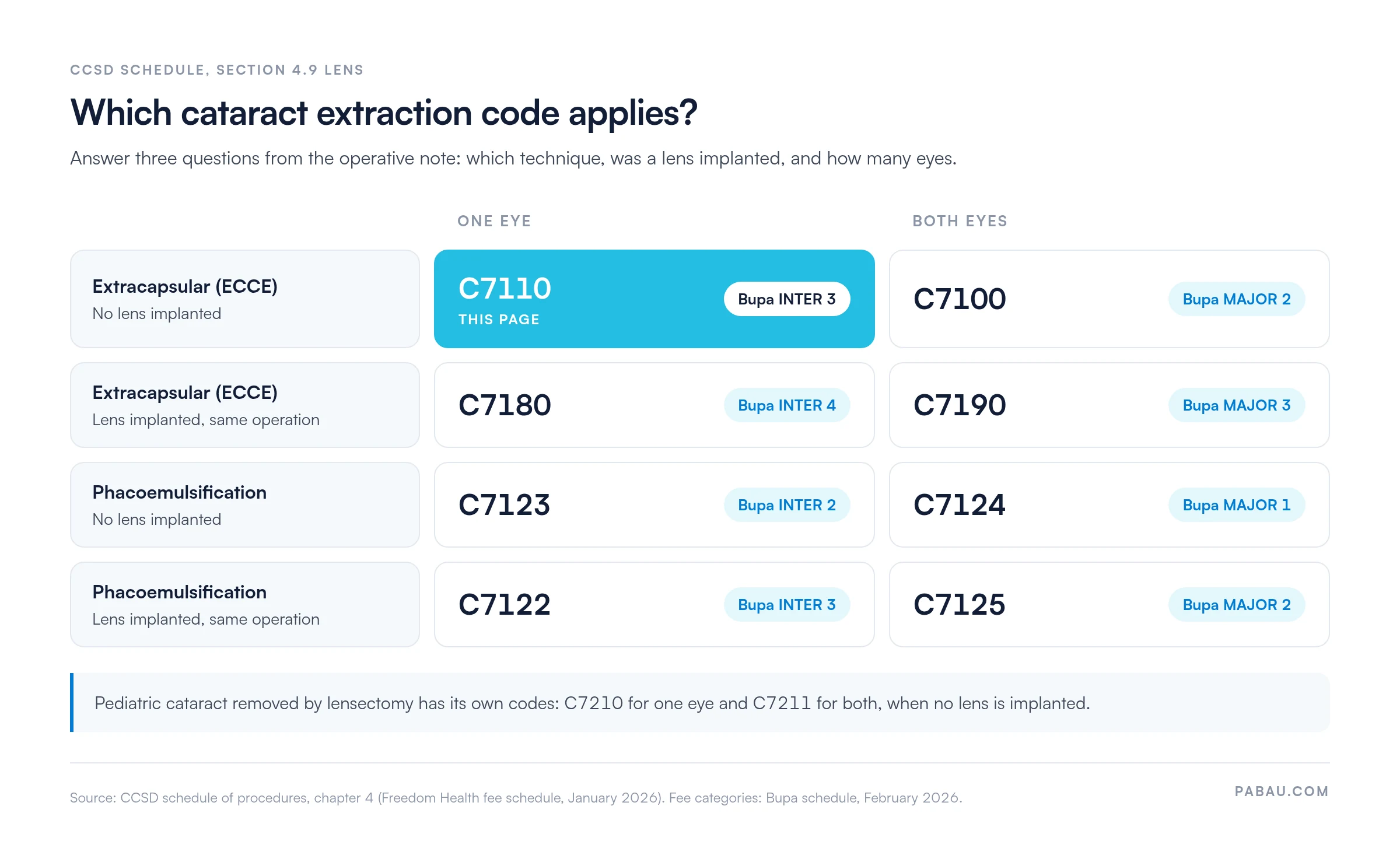
The category gap matters when a claim goes out under the wrong code. Bupa places C7110 in INTER 3 and C7180 in INTER 4, so the mix-up either underclaims or overclaims. Pre-authorization is also tied to a specific code. A practice that obtains authorization for C7180 and then performs C7110, or the reverse, must contact the insurer before submitting the claim.
Technique drives the same choice. When the surgeon uses phacoemulsification on one eye and fits no lens, the claim moves to C7123. With a lens implanted in that same eye, bill C7122 instead.
A valid C7110 claim needs a contemporaneous operative note that clearly supports the code. The code is defined by the absence of an IOL, so that absence has to be stated in writing. This checklist covers the minimum documentation UK private insurers accept.
Keep the operative note, consent form, and pre-authorization reference together in the patient record. The whole file is then ready if an insurer audits the claim. A digital operative note template can make laterality and the IOL decision mandatory fields. That way the documentation doesn’t depend on free-text recall at the end of a long list.
Where the anesthetist attends on standby and gives no agent, that separate claim goes under CCSD code C7181. If sedation or general anesthesia was delivered instead, bill the service the record shows.
UK private insurers cross-check the CCSD procedure code against the ICD-10 diagnosis code on the same claim. A mismatch is one of the most common automatic denial triggers. The table below shows the ICD-10 codes most often paired with C7110.
H27.0 (aphakia) matters most for C7110 claims. Insurers reviewing an extraction without a lens expect to see aphakia recorded as the post-operative condition. A C7110 claim paired only with a cataract diagnosis (H25 or H26) doesn’t confirm the missing lens, so it risks a query. For code lookups, the NHS Classifications Browser covers the UK’s ICD-10 fifth edition.
Elective cataract surgery needs pre-authorization from all the major UK private health insurers. Authorization is issued against a specific CCSD code, not the procedure category. So if C7180 (with implant) was authorized and the surgery ends as C7110 (without implant), re-contact the insurer before you submit. Submitting the non-authorized code usually ends in denial or a query.
For Bupa CCSD codes, authorization is requested through the Bupa Provider Hub. It typically needs a consultant referral letter, a confirmed diagnosis, and the proposed CCSD code. AXA Health runs a similar process through its specialist portal. For Aviva, Vitality, and other insurers, check current requirements with each one directly, because policies and thresholds change.
Key payer resources for authorization and fee lookups:
Reimbursement for the lens codes is negotiated and varies by insurer, region, and facility. Always check the fee against the current payer schedule rather than a historic figure. A pre-authorization tracking step before surgery removes much of the friction from these claims.
C7110 claims are denied for a predictable set of reasons. Each one below comes with a prevention step your billing team can take when the claim is created, not during an appeal.
A structured operative note completed at the point of care cuts laterality and IOL documentation errors. Dictating the note from memory later is where those details slip. A pre-submission check that flags incomplete claims adds a second layer of protection.
Build a C7110 pre-submission checklist into your practice management system. Confirm laterality, the documented IOL decision, the ICD-10 pairing (H25 or H26, plus H27.0 where applicable), and an in-date pre-authorization reference. Running it before any ophthalmic claim leaves the practice catches most denial triggers early.
Posterior capsule rupture with vitreous loss is the most significant intraoperative complication in cataract surgery. When it happens during ECCE, the team performs an anterior vitrectomy to clear vitreous from the anterior segment before closing the wound. That vitrectomy is a separate procedure from the extraction itself.
C7110 doesn’t include vitrectomy. If an anterior vitrectomy is performed during the C7110 operation, add the anterior vitrectomy code, C7910, to the claim. The operative note must record when the capsule ruptured, how the vitreous was managed, and whether a lens was inserted or deferred.
Expect this claim to draw an insurer query, and write the note with that in mind. A thorough note answers the query up front and shortens the turnaround. Unbundling rules vary between payers, so confirm the insurer’s position on the vitrectomy code before you bill.
A conversion follows a different rule. When a planned phaco case is converted to ECCE, insurers such as Freedom Health treat it as a single procedure. Bill the extraction that was completed, C7110 if no lens went in, and don’t add the phaco code on top.
Several post-operative events create their own billable episodes after C7110. They’re separate from the routine follow-up visits that the original claim covers.
Flag patients in their post-operative period on the practice calendar. That keeps a routine follow-up after C7110 from being billed as a standalone consultation.
Most UK private ophthalmology practices submit CCSD claims through Healthcode, the main electronic billing platform for UK private healthcare, or through each insurer’s provider portal. A C7110 claim follows these steps.
Audit every C7110 claim from the previous 90 days once a month. Check each one for a pre-authorization reference, a documented IOL decision, stated laterality, and a matched ICD-10 pairing. Flag any claim missing one of these four before it turns into a payer query or a denial.
In many private ophthalmology practices, the operative note lives in one system and the pre-authorization letter in an inbox. The claim is built in a billing portal. Days after surgery, a coder pieces the episode back together from all three.
Pabau keeps those pieces in one patient record. Custom operative note forms can make laterality and the IOL decision required fields. The pre-authorization reference is recorded next to the note, and the claims dashboard tracks each claim’s status by insurer.
The result is a C7110 claim that goes out with its evidence attached. When a Bupa or AXA claim stalls, it shows up on the dashboard while it’s still easy to chase.

Pabau helps UK private ophthalmology practices enter CCSD procedure codes, track pre-authorization references, and pair ICD-10 diagnoses. Claims go out complete, which cuts C7110 rejections before they happen.

Most cataract lists run on phaco with a lens, so C7110 comes up rarely and gets miscoded when it does. Treat the IOL decision as the billing decision. Write it into the operative note in plain words, and check it against the pre-authorization before anyone opens the claim form.
The cost is a couple of extra fields for the surgeon at the end of the case. Skipping them costs more, because a lensless eye billed as C7180 brings a query, a resubmission, and a delayed payment.
Book a demo to see how Pabau holds the operative note, the pre-authorization reference, and the claim together for private ophthalmology practices.

Need guidance on Bupa’s CCSD code requirements? Bupa CCSD codes covers how Bupa structures its procedure code schedule and what private practices need for submission.
Billing the lens-implant route instead? CCSD code C7125 explains bilateral phacoemulsification with a lens implant, the most common modern cataract claim.
Checking what Bupa pays per fee category? Bupa procedure codes fee schedule sets out how Bupa’s fee categories translate into specialist fees.
CCSD code C7110 covers extracapsular cataract extraction without an intraocular lens implant, on one eye. The posterior capsule stays in place, and no IOL goes in during the operation. Routine post-operative care within the insurer’s bundled period is usually included. Anterior vitrectomy, a secondary IOL, and YAG laser capsulotomy are billed separately.
C7110 covers extracapsular extraction without a lens implant. C7180 covers the same technique with an IOL inserted during the same operation. Pre-authorization is code-specific, so if the plan changes in the operating room, contact the insurer before you submit the claim. Bupa also places the two codes in different fee categories, INTER 3 and INTER 4.
Yes, though phacoemulsification with a lens implant is far more common. Surgeons still use ECCE without implant for very hard cataracts and for planned aphakia in severe corneal endothelial disease. It also applies when a lens is deferred after a complication. For children, check the technique first. Pediatric lensectomy without a lens has its own codes, C7210 and C7211.
Yes. Bupa, AXA Health, and the other major UK private insurers require pre-authorization for elective cataract surgery. Authorization is granted for a specific CCSD code. If the procedure performed differs from the code authorized, contact the insurer before submitting the claim. Policies change, so confirm current rules with each insurer.
Use ICD-10 code H27.0 (aphakia) as the post-operative diagnosis when no IOL is inserted. Insurers cross-check the CCSD procedure code against the diagnosis. A C7110 claim carrying only a cataract code (H25 or H26) doesn’t confirm the missing lens. That claim often draws a query.
Yes. If posterior capsular opacity develops, YAG laser capsulotomy is billed as its own episode under C7340 for one eye or C7341 for both. It isn’t bundled into C7110. Most insurers expect a fresh pre-authorization before the laser procedure.
Posterior capsule rupture with vitreous loss usually needs an anterior vitrectomy, which C7110 doesn’t include. Add the anterior vitrectomy code, C7910, to the claim. The operative note should record when the capsule ruptured, how the vitreous was managed, and whether a lens was inserted or deferred.



