CCSD code F5010: Parotid duct transposition billing guide
CCSD code F5010 covers parotid duct transposition, one side or both CCSD code F5...

Last Updated: Oct 9, 2026
C7180 is the CCSD code for extracapsular cataract extraction with implant – unilateral. It covers manual removal of the cataractous lens through a larger incision, with the posterior capsule left intact. An intraocular lens is placed in the same sitting.
UK private medical insurers use C7180 to process consultant invoices for one eye. Same-sitting surgery on both eyes may use C7190, and phacoemulsification takes its own codes, C7122 to C7125.
Let Pabau's smart automation suggest the right codes, reduce claim denials, and keep your practice compliant—effortlessly.
Automate repetitive tasks and focus on what matters most—your patients.
Reduce coding errors and ensure compliance with the latest regulations.
Clean claims, fewer denials, and faster reimbursements.
Powerful insights and reporting to help your practice thrive.
HIPAA compliant SOC 2 certified GDPR-compliant Trusted by 4,000+ clinics worldwide

CCSD code C7180 covers extracapsular cataract extraction with an IOL implant in one eye. Eyes operated on at separate sittings take two C7180 lines, while same-sitting bilateral surgery may use C7190.
The intraocular lens is bundled into C7180 under standard CCSD rules. Don’t bill it as a separate device unless your insurer agreement allows it.
C7180 describes manual nucleus expression (ECCE), and phacoemulsification uses C7122 to C7125. Submitting the wrong technique code is a common cause of cataract claim rejection.
Most UK private medical insurers require pre-authorization before elective cataract surgery. Operating without it is a primary rejection trigger, however clinically sound the surgery was.
Pabau, the practice management platform we build, holds C7180 in its CCSD code library and sends claims through Healthcode straight from the invoice.
CCSD code C7180 is the Clinical Coding and Schedule Development (CCSD) code for extracapsular cataract extraction with an intraocular lens (IOL) implant in one eye. The descriptor reads: Extracapsular cataract extraction with implant – unilateral. In that episode, the surgeon removes the cataractous lens manually and leaves the posterior capsule intact. An IOL then goes into the capsular bag in the same sitting.
CCSD codes are the standard procedure codes UK private medical insurers use to process consultant invoices. Those insurers include Bupa, AXA Health, Aviva, VitalityHealth and WPA. The CCSD Group maintains the schedule and updates it periodically, so check the current version before coding a procedure you haven’t billed recently. Our index of CCSD codes for consultants lists the other procedures in the schedule.
Extracapsular cataract extraction (ECCE) removes the lens nucleus and cortex through a relatively large limbal or corneal incision. The posterior lens capsule stays intact, and that is the technique C7180 describes. The preserved capsule then acts as a scaffold for the IOL.
The operative sequence you’re billing looks like this:
These steps matter for documentation. The operative note needs to confirm the ECCE technique (not phaco), laterality, posterior capsule status, and the IOL lot number or power. If no lens goes in, the episode moves to C7110 instead.
The most common cataract miscoding error is billing a phacoemulsification code when the surgeon performed ECCE. The two techniques are clinically distinct, and insurers audit the operative note against the code submitted.
If the operative note says “phaco” or “phacoemulsification” and a C7180 claim goes in, the insurer’s clinical audit team will flag the discrepancy. The claim is likely to be rejected and may need a corrected invoice with the right phacoemulsification code. For one eye with a lens implant, that code is usually C7122.
The C71xx range covers cataract and lens surgery, and three facts pick the code within it. The matrix below shows how technique, implant and the number of eyes in the sitting lead to each one.
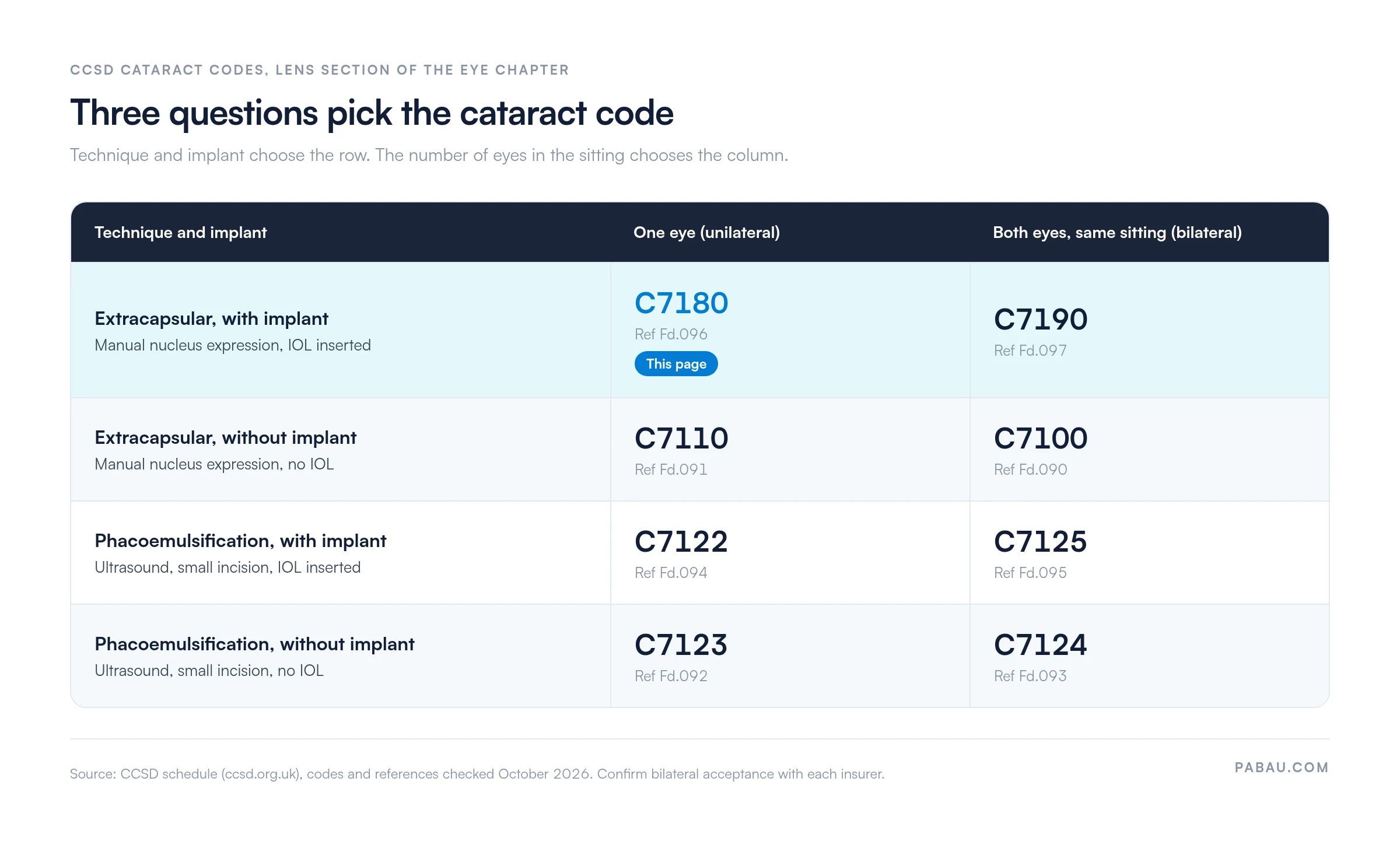
Important: The descriptors above follow the CCSD schedule. Still check them against the current CCSD technical guide before you submit a claim. Insurers adjudicate against the live schedule, and descriptors do change between versions.
Knowing the bundling rules for IOL implant coding prevents double billing and the query letters it generates.
Typically included within C7180 (not separately billable):
Not included, so each needs its own CCSD code on a separate claim line:
Check your insurer’s provider handbook before assuming IOL bundling applies everywhere. Some PMI agreements allow separate device billing under specific policy conditions. Bupa, AXA Health and Aviva all publish provider handbooks. Review the ophthalmology section each year, because bundling rules can change at schedule updates.
UK private medical insurance (PMI) payers generally require pre-authorization before elective cataract surgery. Operating without a valid pre-auth reference is one of the main reasons C7180 claims are rejected in full, however clinically appropriate the surgery was.
Exact thresholds differ by insurer and can change when agreements are renegotiated. The clinical evidence typically requested looks like this:
Always match the pre-auth reference number on the claim to the authorized eye. An authorization granted for the right eye can’t be applied to a left-eye claim without a separate request.
Healthcode is the main electronic claims network UK private practices use to send CCSD-coded invoices to PMI payers. Most major insurers, including Bupa and AXA Health, accept and process claims through it. A C7180 claim follows these steps:
Practices that pre-set CCSD codes per procedure type and use templated operative notes tend to see fewer queries on ophthalmology claims.
Insurers expect a specific evidence set when processing C7180 claims. Missing any of these elements is a common trigger for payment delay or rejection. A digital operative note with standardized fields for cataract surgery captures this data during the clinical workflow rather than after it.
Ophthalmology practice managers know the rejection patterns for cataract claims well. Most come from process failures rather than clinical disagreements, so a short checklist run when the claim is created catches the majority.
Two clinical events most often create extra coding work around a C7180 procedure. One is posterior capsule rupture during surgery, and the other is posterior capsule opacification months later.
Intraoperative: Posterior capsule rupture (PCR). If the posterior capsule tears during the ECCE, the operative plan changes materially. Anterior vitrectomy may be needed, and the IOL may go in the anterior chamber or sulcus rather than the capsular bag. What was performed then differs from what C7180 describes.
Consult the current CCSD schedule for the right additional or alternative code. Don’t absorb a significant extra procedure into C7180 without checking bundling rules with the insurer.
Post-operative: Posterior capsule opacification (PCO) and YAG capsulotomy. PCO is the most common late complication of extracapsular cataract surgery, usually appearing within two to five years. It’s treated with Nd:YAG laser capsulotomy, a separate outpatient procedure with its own CCSD code.
The capsulotomy isn’t bundled into C7180, so it’s coded and billed as a separate encounter on a later date. Its operative report should note that the original surgery was ECCE, which gives the insurer clinical context.
C7180 is a unilateral code by descriptor. When the eyes are operated on at separate sittings, each eye gets its own C7180 claim line with its laterality stated. Two C7180 lines also apply where an insurer requires them for same-day surgery.
Same-sitting bilateral surgery has its own code in the schedule. C7190 covers extracapsular cataract extraction with implant on both eyes, under CCSD reference Fd.097. Check with each payer before you choose between C7190 and two unilateral lines, because insurers don’t all treat bilateral cases the same way.
Most PMI payers also want a pre-authorization that names both eyes, since one naming a single eye won’t cover the second. Some insurers apply a bilateral fee reduction on the second eye, set out in their fee schedule. Confirm the payer’s bilateral policy before listing the case.
Ophthalmology practices billing C7180 through UK private insurers meet the same process risks again and again. Someone picks the wrong code from a dense C71xx list, or laterality isn’t captured at the point of care. Sometimes the IOL lot number is missing at submission. Pabau’s private insurance claims management tools catch these during the workflow, so you aren’t correcting claims after a rejection.
The features that matter most for C7180 billing:
For ophthalmology practices running regular cataract lists, a set coding workflow cuts the time spent on insurer queries and shortens the wait for payment. Book a demo to see how Pabau’s private practice billing tools work for a surgical ophthalmology setup.

Pabau keeps the CCSD code, the operative note and the Healthcode claim in one system, so C7180 invoices go out complete. Fewer insurer queries means faster payment for every cataract list.

C7180 is the right code only when the operative note says extracapsular, one eye, and a lens implant. If any of those three facts changes, the code changes too. The claim should follow the note, not the theater booking.
The practical move is to check technique, implant and laterality against the pre-auth before the invoice leaves the practice. That single check heads off the costliest rejections, from phaco miscoding to a right-eye authorization billed against the left.
The trade-off is a few minutes of review per case against weeks of query letters. Book a demo to see how Pabau ties the operative note, the CCSD code and the Healthcode claim together for your cataract lists.

Operating on both eyes in one sitting? CCSD code C7190 covers the bilateral version of this procedure and when insurers accept it.
Surgeon switched to phaco for both eyes? CCSD code C7125 explains bilateral phacoemulsification with lens implant.
No lens implant placed? CCSD code C7110 covers extracapsular extraction without an implant.
Phaco without an implant? CCSD code C7123 sets out the unilateral code and its documentation.
Need the diagnosis code for the claim? ICD-10 code H26.8 covers other specified cataract and when to use it.
CCSD code C7180 covers extracapsular cataract extraction with an intraocular lens implant in one eye. It includes manual removal of the cataractous lens, preservation of the posterior capsule, and IOL placement in the capsular bag. The IOL is bundled into the procedure fee under standard CCSD rules. It isn’t billed as a separate device unless your insurer agreement allows it.
C7180 describes manual extracapsular extraction (ECCE), where the lens nucleus is delivered by hand through a large incision. Phacoemulsification breaks the nucleus up with ultrasound through a much smaller incision. Phaco has its own CCSD codes, C7122 to C7125, so the two must never be swapped. Insurers check the operative note against the code submitted.
Yes. Under standard CCSD bundling conventions, the IOL is included within C7180 and isn’t separately billable. Individual insurer agreements vary, and some PMI contracts allow separate device billing under specific conditions. Check your provider agreement with each insurer before adding an IOL line to a C7180 invoice.
Most UK private medical insurers require pre-authorization before elective cataract surgery under C7180, including Bupa, AXA Health, Aviva, VitalityHealth and WPA. The evidence each one wants varies, from visual acuity thresholds to referral letter format and ICD-10 codes. It can also change when fee schedules are updated. Confirm current requirements in the insurer’s provider handbook before listing the case.
The most common cause is a phacoemulsification code submitted in place of C7180. Others include a missing pre-authorization reference, laterality that doesn’t match the authorization, and an IOL billed as a separate line. An operative note that doesn’t confirm ECCE, or a missing ICD-10 code, also triggers rejection. Laterality mismatch is especially common in bilateral cases.
Posterior capsule opacification (PCO) after C7180 is treated with Nd:YAG laser capsulotomy. That later outpatient episode takes its own CCSD code on a separate claim, outside the original C7180 claim. Verify the YAG capsulotomy code against the current schedule before billing. The capsulotomy note should also reference the original ECCE, which gives the insurer clinical context.
No. CCSD codes are used by UK private medical insurers, while NHS procedures are coded with OPCS-4. Extracapsular cataract extraction sits in the OPCS-4 C71 category. C7180 applies only to private practice billing submitted to PMI payers.