CPT code 63081: Vertebral corpectomy, cervical spine
CPT code 63081: official descriptor and procedure overview CPT code 63081 descri...

Last Updated: Oct 6, 2026
CCSD code C6910 is the UK private medical insurance code for reformation of the anterior chamber. The surgeon refills a flat or shallow anterior chamber with balanced salt solution, viscoelastic or air. That restores the space between the cornea and the iris, usually after a wound leak or low pressure following eye surgery.
C6910 sits in chapter 4 of the CCSD schedule, Eye and orbital contents. Freedom and National Friendly both rate it Major, with surgeon fees of £450 and £548.
Let Pabau's smart automation suggest the right codes, reduce claim denials, and keep your practice compliant—effortlessly.
Automate repetitive tasks and focus on what matters most—your patients.
Reduce coding errors and ensure compliance with the latest regulations.
Clean claims, fewer denials, and faster reimbursements.
Powerful insights and reporting to help your practice thrive.
HIPAA compliant SOC 2 certified GDPR-compliant Trusted by 4,000+ clinics worldwide

CCSD code C6910 covers reformation of the anterior chamber, and Freedom and National Friendly both rate it Major, at £450 and £548.
Pair it with a WHO ICD-10 code that names the cause, such as H44.4 for hypotony or T81.3 for a leaking surgical wound.
Bill C6910 separately only when the note records a distinct complication, and never on the same claim as C6980.
Pabau’s claims management software sends C6910 claims to Healthcode from the patient record and tracks each one to payment.
CCSD code C6910 is the code for reformation of the anterior chamber. The surgeon refills a flat or shallow anterior chamber with balanced salt solution (BSS), viscoelastic or air. That restores the space between the cornea and the iris before the collapse damages either one.
CCSD stands for the Clinical Coding and Schedule Development Group. Its members include Bupa, AXA Health, Aviva and Vitality, and it maintains the procedure schedule most UK private insurers use. The schedule sets the code, while each insurer sets its own complexity band and fee.
C6910 sits in chapter 4 of the schedule, Eye and orbital contents, in section 4.8, Iris and anterior chamber. You can browse the rest of the schedule in our CCSD codes by chapter guide.
The code records the reformation itself. Why the chamber collapsed goes on the claim as a separate ICD-10 diagnosis code, covered below.
A flat anterior chamber needs prompt treatment. Contact between the iris, lens and cornea can damage the corneal endothelium, so surgeons rarely leave the chamber flat for long.
Urgency matters for billing too. A reformation done in the middle of another operation can’t be pre-authorized in advance, which changes how you approach the insurer.
The surgeon enters the chamber through an existing paracentesis, the main wound or a new side-port incision. BSS, a viscoelastic agent such as sodium hyaluronate, or an air bubble is injected until the chamber deepens.
The surgeon then checks chamber depth at the slit lamp or under the microscope and measures intraocular pressure (IOP). A leaking wound is sutured or hydrated before the patient leaves, or the chamber can collapse again.
Reformation can happen in theater during the original operation or at a separate visit. Record which one it was, because it changes how the claim is built.
The fee depends on whose schedule the patient’s policy follows. Two openly published schedules list C6910, and both rate it Major.
Freedom Health Insurance last updated its chapter 4 fees in January 2026. National Friendly publishes its full schedule as a PDF.
If the consultant charges more than the insurer’s schedule allows, the patient may face a shortfall. Check the current figures before you quote the patient. Our Bupa CCSD codes guide explains how Bupa’s fee categories work.
Ask each insurer to confirm its C6910 fee in writing at the start of the year. Keep the confirmation on file for fee disputes and claim queries.
The iris and anterior chamber section holds several codes for related work. Picking the wrong one, or adding one the schedule won’t accept, leads to a query.
These descriptors follow Freedom’s January 2026 schedule, and wording varies slightly between insurers. National Friendly, for example, words C6920 as “Paracentesis of the eye.” Our guides to CCSD code C6920 and CCSD code C6980 cover both codes in full.
Every C6910 claim needs a primary diagnosis that explains why the chamber collapsed. UK insurers use WHO ICD-10, which stops at four characters and has no laterality codes.
US guidance often quotes ICD-10-CM codes such as H44.41- or T81.89XA. UK insurers don’t use that format, so convert them to the WHO codes above. The note must also name the treated eye, because the code can’t.
The operative note is the first document an insurer asks for when it queries a claim. Make sure it records each of these elements.
A structured operative-note template can require these fields before sign-off. Missing readings then get caught in theater, rather than weeks later in an insurer query.
UK private insurers generally expect the patient to get pre-authorization before planned treatment. The authorization number then goes on the claim.
An urgent reformation in the middle of another operation can’t be authorized in advance. Contact the insurer as soon as you can afterward. Explain the complication and ask how to add C6910 to the existing authorization.
A planned reformation follows the normal route, such as a later visit for a chamber that keeps shallowing. The patient gets authorization for C6910 before the appointment. Each insurer sets its own rules, so check them rather than assuming they match.
CCSD has no laterality or bilateral modifiers, and Freedom’s schedule lists no bilateral version of C6910. If both eyes are reformed on the same day, ask the insurer how it wants the second eye billed.
Whether C6910 goes on the claim at all depends on what the note shows.
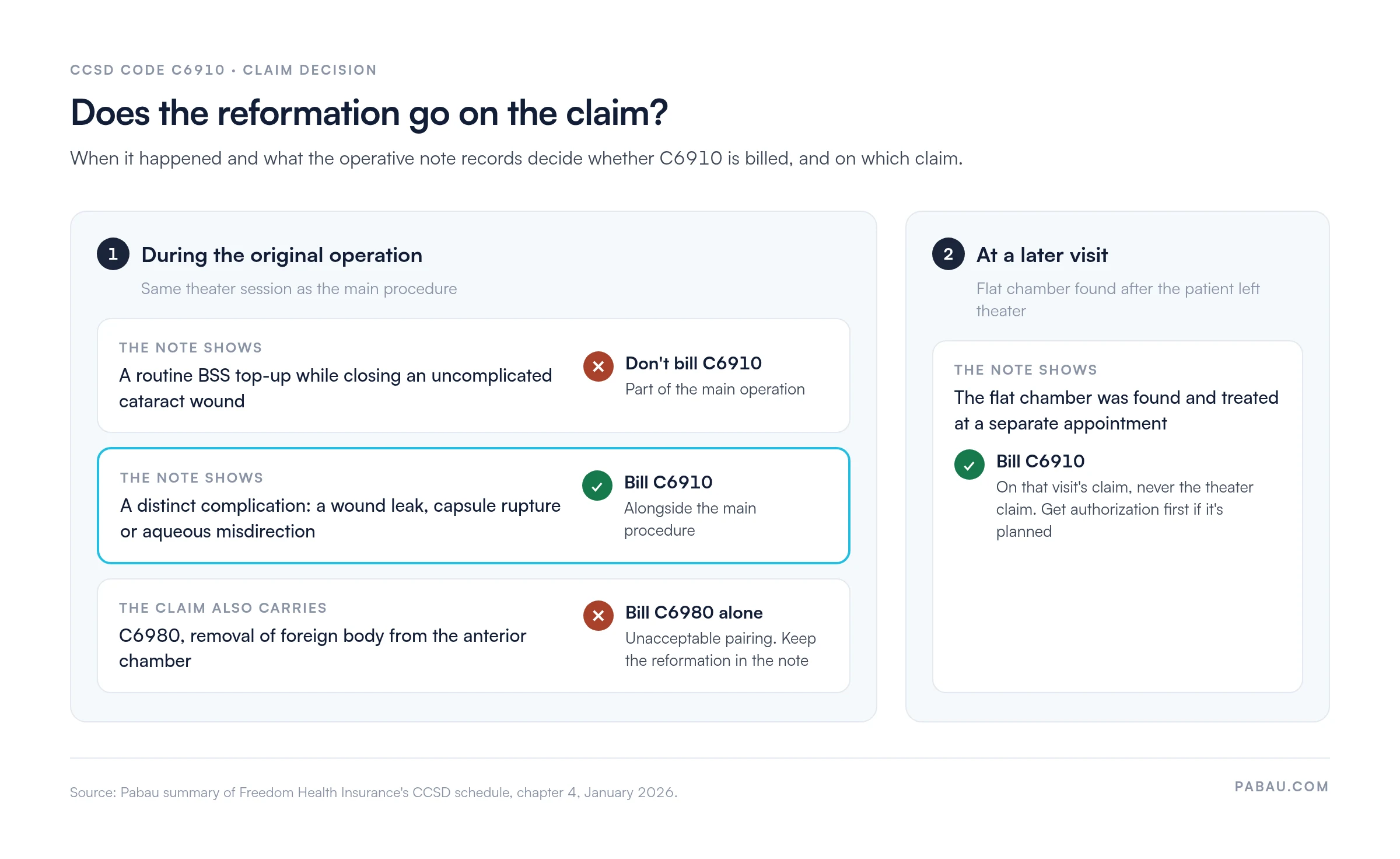
Freedom’s schedule also states that the cataract fee includes any injection into the anterior chamber. If you’re unsure whether a pairing will be accepted, ask the insurer before you submit.
Most C6910 queries trace back to a handful of avoidable problems. Tracking query reasons over time, as our guide to denial management in healthcare describes, shows which one keeps coming back.
Eye practices often book surgery in one system and key claims into Healthcode by hand. Each retyped field is another chance for a wrong code or a missing authorization number.
Pabau’s practice software builds the claim from the patient record and sends it to Healthcode. With its claims management software, the CCSD code, diagnosis, membership number and authorization reference carry across without retyping.
Each claim then moves through clear stages, from submitted to paid, on one screen. When an insurer queries a reformation, your team sees it the same week and answers with the operative note.

Pabau helps UK private eye practices build CCSD claims from the patient record and send them to Healthcode. You can then track every claim to payment.

C6910 is a Major procedure on the schedules that publish it, but the code alone doesn’t get it paid. Insurers pay when the note shows why the chamber collapsed and that the reformation was its own event.
Name the eye, record pressure and depth before and after, and match the diagnosis to the cause. Sort out authorization the same day for urgent cases, and C6910 queries become rare.
Book a demo to see how Pabau takes a C6910 claim from the operative note to Healthcode and tracks it to payment.

Injecting a drug into a chamber that kept its depth? CCSD code C6930 covers anterior chamber injection, with its fees, diagnosis codes and documentation.
Did vitreous come forward after a posterior capsule rupture? CCSD code C7910 explains how to bill an anterior vitrectomy and when it sits alongside the main operation.
Is overfiltration after a trabeculectomy behind the flat chamber? CCSD code C6150 covers revision of previous glaucoma surgery and the insurer rules around it.
Billing the cataract operation where the wound leak started? CCSD code C7122 walks through phacoemulsification with lens implant, from complexity bands to pre-authorization.
CCSD code C6910 covers reformation of the anterior chamber. The surgeon refills a flat or shallow chamber with balanced salt solution, viscoelastic or air. UK private insurers such as Bupa, AXA Health, Aviva and Vitality list the code.
Common pairings are H44.4 (hypotony of eye), H59.8 (other postprocedural disorders of eye and adnexa) and T81.3 (disruption of operation wound). UK insurers use WHO ICD-10, so choose the code that names the documented cause.
Freedom Health Insurance rates C6910 Major, with a £450 specialist fee and a £285 anesthetist fee. National Friendly also rates it Major, at £548. Other insurers set their own fees, so check the current schedule.
A planned reformation needs pre-authorization like any other private procedure. An urgent one done mid-operation can’t be authorized first, so contact the insurer promptly afterward and ask how to add it.
Only when the note describes a distinct complication, such as a wound leak or capsule rupture, that required reformation. A routine top-up of the chamber while closing an uncomplicated cataract wound is part of the main operation.
No. CCSD has no laterality or bilateral modifiers, and Freedom’s schedule lists no bilateral version of C6910. Record the treated eye in the note and ask the insurer how to bill a second eye.